Kameda Jinya (Akita Prefecture) Complete Guide: The History of the Iwaki Clan and the Sanada Family’s Connection to Tenrojo Castle
Located in Iwaki Kameda, Yurihonjo City, Akita Prefecture, the Kameda Jinya was a fortified residence that served as the administrative center of the Iwaki clan’s 20,000-koku Kameda Domain during the Edo period. Also known as Tenrojo Castle, it is a historically significant site, notably as the place where Lady Ota, the fifth daughter of Sanada Yukimura (Sanada Nobushige), married.
Currently, it has been developed into the Kameda Castle Sato Hachijuhachi Art Museum and Tenrojo Village, making it a valuable place to imagine its former glory. This article provides a detailed explanation of the Kameda Jinya’s history, architectural features, highlights, and useful access information for your visit.
The History of Kameda Jinya: The Tumultuous Life of the Iwaki Clan
The Origins and Dispossession of the Iwaki Clan
The Iwaki family, who ruled the Kameda Domain, were originally a prestigious samurai family based in Hitachi Province (present-day Ibaraki Prefecture). During the Sengoku period, they ruled Iwaki-Taira (present-day Iwaki City, Fukushima Prefecture), and the Iwaki family was a powerful daimyo family boasting a maximum of 120,000 koku. However, in the Battle of Sekigahara (1600), the head of the family, Iwaki Sadataka, sided with the Western Army, resulting in their dispossession by Tokugawa Ieyasu.
The Establishment of the Kameda Domain
After Sekigahara, Iwaki Sadataka’s eldest son, Iwaki Nobutaka, worked to repair relations with the Tokugawa family. Nobutaka married the daughter of Satake Yoshinobu, and through this connection, in 1622 (Genna 8), he was granted 20,000 koku in Kameda, Yuri District, Dewa Province, thus establishing the Kameda Domain.
During this period, Yuri County became the territory of Honda Masazumi after the Mogami clan’s downfall. However, Masazumi was also dispossessed the following year, resulting in the division of Yuri County into four domains: the Kameda Domain, the Honjo Domain, the Nikaho Domain, and the Yajima Domain. Iwaki Nobutaka’s appointment was part of this division and rule.
Marriage to the Sanada Family
The relationship between the Kameda Domain and the Sanada family was established during the time of the third lord, Iwaki Shigetaka. Shigetaka married Oden-no-kata, the fifth daughter of Sanada Nobushige (Sanada Yukimura). This marriage was a historical event that ensured the continuation of the Sanada bloodline in the Tohoku region, and it remains a reason why the Kameda Jinya (fortified residence) is still recognized today as a “place associated with the Sanada family.”
Oden-no-kata, as the daughter of Sanada Nobushige, survived the difficult times after the Siege of Osaka and lived in Kameda as the lord’s wife. Her presence adds a special color to the history of the Kameda Domain.
Governance Throughout the Edo Period
The Iwaki clan ruled Kameda throughout the Edo period. Despite being a small domain of 20,000 koku, the Iwaki clan maintained their position as an outside daimyo (feudal lord) and dedicated themselves to the development of their territory and the promotion of industry. They particularly focused on improving agricultural infrastructure and developing new rice fields, strengthening the domain’s financial base.
After the Meiji Restoration, the Kameda Domain was abolished in 1871 (Meiji 4) following the return of land and people to the emperor, and was subsequently incorporated into Akita Prefecture.
Structure and Characteristics of the Kameda Jinya (Fortified Residence)
Scale and Layout of the Jinya
The Kameda Jinya was built in the typical Edo period fortified residence style. Although it was a flatland castle without a keep, it was a magnificent structure with all-stone walls. The Jinya’s area extended to the vicinity of the current former Kameda Elementary School, its grounds, and the Tensagi Shrine.
At the center of the jinya (fortified residence) was the lord’s residence, surrounded by the residences of retainers and government offices. The structure, enclosed by stone walls, was unusual for a jinya and indicated a high level of formality.
Origin of the Alternate Name, Tensagi Castle
The elegant alternative name, Tensagi Castle, is said to originate from the large number of white egrets that flew to this area. There is also a theory that it is related to the Iwaki clan’s family crest, “Sagi no Maru” (Egret Circle). The name Tensagi became a symbolic name expressing the elegance of the castle town and the prestige of the Iwaki clan.
Development of the Castle Town
The castle town of Kameda was systematically developed around the jinya. Samurai residences, merchant districts, and temples and shrines were arranged, and despite being a small domain of 20,000 koku, it had a well-organized urban plan. Even today, remnants of the original town layout can be seen in the Kameda area.
Current Site of Kameda Jinya: Highlights and Facilities
Kameda Castle Sato Yasohachi Museum
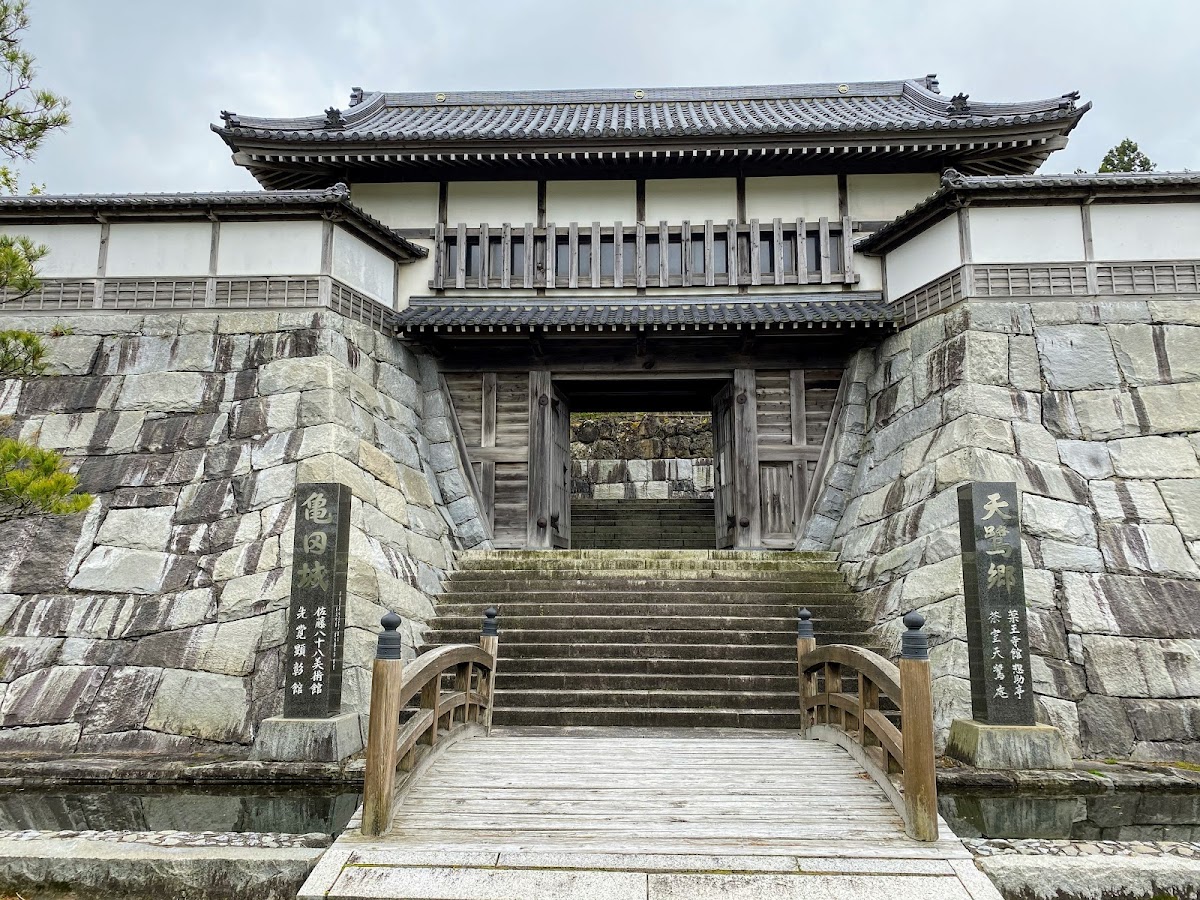
Currently, the Kameda Castle Sato Yasohachi Museum stands on the site of the Kameda Jinya. This building is a castle-like structure that recreates the appearance of the Kameda Jinya in its heyday, and its exterior resembles a full-fledged castle.
Inside the museum, historical materials and works of art related to the Iwaki clan and the Kameda domain are displayed, primarily from the collection of local businessman Sato Yasohachi. The building itself is a highlight, and its stone walls and turret-like exterior are popular photo spots.
Tensagi Village
In a corner of the Kameda Jinya site is a tourist facility called Tensagi Village. Here, buildings that have been restored from Edo-period samurai residences and townhouses line the streets, allowing visitors to experience the lifestyle and culture of that time.
Tensagi Village sometimes holds demonstrations and workshops of traditional crafts, making it a place where you can feel history and culture firsthand. The reconstructed Jinya (fortified residence) architecture is entirely constructed of stone walls, and its magnificent appearance captivates visitors.
Tensagi Shrine
Tensagi Shrine, located within the Jinya site, is a shrine associated with the Iwaki clan. It remains a beloved center of local faith, and the spring festival attracts many worshippers. From the shrine grounds, one can feel the atmosphere of the former Jinya.
Stone Walls and Remains
The stone walls, a characteristic feature of the Kameda Jinya, still remain in part. This highly dignified structure, entirely constructed of stone walls, was exceptionally impressive for a small domain of 20,000 koku (a unit of rice production). This can be seen as a reflection of the Iwaki clan’s pride as a former powerful daimyo and their respect for formality.
Walking through the Jinya site allows one to imagine the layout and scale of the buildings in their heyday, making it an unmissable point for history buffs.
Cultural Value of Kameda Jinya
Historical Connections to the Sanada Family
One reason why Kameda Jinya is particularly noteworthy is that it is the place where the bloodline of Sanada Yukimura was inherited. The 2016 NHK Taiga drama “Sanada Maru” brought it nationwide recognition as a place associated with the Sanada family.
Through Lady Ota, the Sanada family’s genes were passed down to the Iwaki family, and their descendants ruled Kameda until the Meiji era. The history of the daughter of Sanada Yukimura, the last great general of the Sengoku period, marrying into a small domain in Tohoku is dramatic and attracts the interest of many people.
Small Domain Culture of Dewa Province
Kameda Domain was one of the small domains in Dewa Province (present-day Akita and Yamagata prefectures), but it cultivated its own unique culture. Despite its small size of 20,000 koku, the Iwaki clan also focused on cultural promotion, and samurai culture such as tea ceremony and Noh theater took root in the castle town.
Furthermore, they contributed to the development of the regional economy through improvements in agricultural technology and the development of new rice fields. Kameda is known as a rice-producing area and is still highly regarded today as a source of high-quality rice.
Position in the History of Castles in Akita Prefecture
While many castle ruins remain within Akita Prefecture, including Kubota Castle (Akita City), Yokote Castle, and Odate Castle, Kameda Jinya (fortified residence) holds a unique presence as the residence of a small domain.
Despite being a fortified residence without a keep, its high status, including its all-stone construction, speaks to the history and pride of the Iwaki clan. Kameda Jinya is an indispensable part of the history of castles in Akita Prefecture.
Access and Tourist Information
Location
Address: Kameda-machi, Iwaki Kameda, Yurihonjo City, Akita Prefecture
The Kameda Jinya ruins are located in the southern part of Yurihonjo City, in the former Iwaki town area. Situated in a plain near the Sea of Japan, the surrounding area is a quiet environment with sprawling rural landscapes.
Access by Car
- Approximately 5 minutes from Iwaki IC on the Akita Expressway
- Approximately 50 minutes from central Akita City via National Route 7
- Parking: Dedicated parking available at Kameda Castle Sato Yasohachi Museum (free)
Convenient access by car and ample parking make it suitable for family visits.
Access by Public Transportation
- Approximately 15 minutes on foot from JR Uetsu Main Line, Ugo-Kameda Station
- Approximately 40 minutes by local train from Akita Station to Ugo-Kameda Station
Access from Akita City is also possible using the JR Uetsu Main Line. The site is within walking distance from the station, but a taxi will get you there in about 5 minutes.
Estimated Time Required for Sightseeing
Allow 1 to 1.5 hours to visit the Kameda Jinya Ruins. If you plan to thoroughly explore the Kameda Castle Sato Hachijuhachi Art Museum and visit Tensagi Village and surrounding historical sites, about two hours should be sufficient to enjoy your visit comfortably.
Opening Information (Kameda Castle Sato Hachijuhachi Art Museum)
- Opening Hours: 9:00 AM – 4:30 PM (Last entry 4:00 PM)
- Closed: Mondays (or the following day if Monday is a public holiday), New Year holidays
- Admission Fee: Adults 300 yen, High school students and younger free (Fees are subject to change)
We recommend checking the latest information on the Yurihonjo City official website before your visit.
Nearby Tourist Attractions
When visiting Kameda Jinya, exploring the surrounding tourist attractions will make your trip even more fulfilling.
- Iwaki Roadside Station: A popular spot where you can buy fresh local agricultural and marine products.
- Iwaki Onsen: A hot spring facility where you can relax and unwind after a day trip.
- Honjo Castle Ruins: The ruins of the Honjo Domain castle, located within the same city of Yurihonjo.
- Kisakata: A scenic spot visited by Matsuo Basho, about 30 minutes by car.
Points to Note When Visiting Kameda Jinya
Photo Spots
The exterior of the Kameda Castle Sato Yasohachi Museum is a magnificent castle-like building, perfect for photography. The combination of the stone walls and the building, in particular, evokes the atmosphere of the former Jinya.
The reconstructed buildings in Tensagi Village are also excellent photo spots where you can experience the atmosphere of an Edo-period samurai residence. Taking photos with the scenery of each season will result in even more attractive pictures.
Best Season for Visiting
Kameda Jinya can be visited throughout the year, but the following times are especially recommended. – Spring (April-May): The cherry blossoms around the Jinya (fortified residence) site are in full bloom.
- Autumn (October-November): The autumn foliage is beautiful, harmonizing wonderfully with the castle architecture.
- Summer (July-August): Enjoy the lush green environment and the charming atmosphere of the castle town.
Winter (December-March): There is snow cover, and the snow-covered Jinya site has a charming atmosphere, but caution is needed due to icy roads.
Recommended for History Fans
Those interested in castles and history will enjoy their visit more deeply if they research the history of the Iwaki clan and the Kameda domain beforehand. Understanding the relationship with the Sanada family and the changes in daimyo placement after the Battle of Sekigahara will make the historical significance of the Kameda Jinya clearer.
The museum also has exhibits related to the Iwaki clan and the relationship with the Sanada family, so we recommend taking your time to explore it.
Summary: The Charm of Kameda Jinya
Kameda Jinya (Tenro Castle) is a valuable Edo-period fortified residence site remaining in Yurihonjo City, Akita Prefecture. This site, which functioned as the administrative center of the Iwaki clan’s 20,000-koku domain, is also known for the historical episode of Sanada Yukimura’s daughter marrying into the family.
Currently, it has been developed into the Kameda Castle Sato Hachijuhachi Art Museum and Tenro Village, allowing visitors to imagine its former glory. The magnificent stone-walled architecture conveys the pride of the Iwaki clan, who, despite being a small domain, valued formality.
When visiting Akita Prefecture, be sure to visit Kameda Jinya and experience its history as a place associated with the Sanada family and the culture nurtured by this small domain in Dewa Province. The fortified residence site, nestled in a quiet rural landscape, is a place that evokes the profound depths of Japanese history.
With easy access and ample parking, it’s a place where families can enjoy a leisurely visit. Combine it with other nearby tourist attractions for a fulfilling historical exploration.