Kamaba Castle (Shiga Prefecture) Complete Guide: A Thorough Explanation of the Highlights and History of the Continued Top 100 Japanese Castles
Kamaba Castle, located in Maibara City, Shiga Prefecture, is a mountain castle that conveys the turbulent events of the Sengoku period. Designated a national historic site in 2005 and selected as one of the Continued Top 100 Japanese Castles in 2017, it boasts the second largest scale in the Kohoku region after Odani Castle. This article comprehensively covers everything from the historical background of Kamaba Castle to the highlights of its remains and access methods—essential information for castle enthusiasts.
What is Kamaba Castle?: A “Border Castle” of the Sengoku Period
Kamaba Castle is a mountain castle built on a mountaintop approximately 380 meters above sea level, strategically located on the border between northern and southern Omi Province. Due to its location, it was called the “border castle,” and numerous battles were fought over its affiliation between the two major powers: the Kyogoku and Asai clans to the north and the Rokkaku clan to the south.
The Higashiyama Road (later the Nakasendo Road) passed at the foot of the castle, making it a crucial transportation hub. This area, which flourished as Banba-juku, has long been a place that influenced the fate of Omi Province both militarily and economically.
Construction of Kamaba Castle and Changes in its Lords
There are various theories regarding the construction period of Kamaba Castle, but it is believed to have been built by the Hori clan, who ruled this area from the late 15th to the early 16th century during the early Sengoku period. The Hori clan was based in Banba and became the lords of this region, replacing the Doi clan, who had ruled since the Kamakura period.
In the Sengoku period, Kamaba Castle became the front line of the power struggle between the Asai clan of northern Omi and the Rokkaku clan of southern Omi. The castle lord, the Hori clan, was initially a vassal of Asai Nagamasa, but as Oda Nobunaga’s power expanded, their allegiance became a matter of interest.
History of Kamaba Castle: The Conflict Between Oda Nobunaga and Asai Nagamasa
The conflict between Oda Nobunaga and Asai Nagamasa is indispensable when discussing the history of Kamaba Castle. This castle was the stage for their battles and symbolized the tense situation of the Sengoku period.
The Hori Clan’s Defection to Oda Nobunaga
In 1570 (Genki 1), when the conflict between Oda Nobunaga and Asai Nagamasa became apparent, the castle lord, the Hori clan, was forced to make a crucial decision. Initially a vassal of Asai Nagamasa, the Hori clan, seeing Nobunaga’s growing power, decided to defect to the Oda side along with their relative, the Higuchi clan.
However, this defection was discovered by Asai Nagamasa. Enraged, Nagamasa immediately attacked Kamaba Castle and seized it. This incident illustrates the struggles of warlords living in border castles during the Sengoku period and the harsh realities of an era where a single misjudgment could be fatal.
The Battle of Anegawa and the Aftermath of Kamaba Castle
Immediately after the capture of Kamaba Castle, the Battle of Anegawa broke out on June 28, 1570. In this battle, the Asai-Asakura allied forces were defeated by the Oda-Tokugawa allied forces, and the Asai clan’s power suffered a significant setback. As a result, Kamaba Castle once again functioned as an Oda castle.
In 1574 (Tensho 2), the Hori and Higuchi clans were suddenly dispossessed of their domains. The reason is unclear, but it is believed to have been part of Oda Nobunaga’s efforts to strengthen his control over Omi Province. The following year, 1575, Nobunaga gave the rice reserves stored in Kamaba Castle to his ally, Tokugawa Ieyasu, marking the end of its role as a castle.
The Layout and Structure of Kamaba Castle: The Reality of a Pioneering Mountain Castle
For a long time, Kamaba Castle was considered a typical medieval earthen mountain castle. However, archaeological excavations in the Heisei era significantly changed its evaluation. The results revealed that Kamaba Castle was a pioneering mountain castle that made extensive use of stone walls.
Basic Structure of the Castle
Kamaba Castle’s main enclosure is located at the confluence of ridges extending to the north and west. A series of enclosures, including the North, South, and West enclosures, unfold around this central point. Each enclosure is separated by a moat, enhancing its defensive capabilities.
The entire castle area extends approximately 500 meters east-west and 300 meters north-south, making it the second largest mountain castle in the Kohoku region after Odani Castle. This scale indicates that Kamaba Castle functioned not merely as a fort, but as a base for regional control.
Impressive Series of Moats
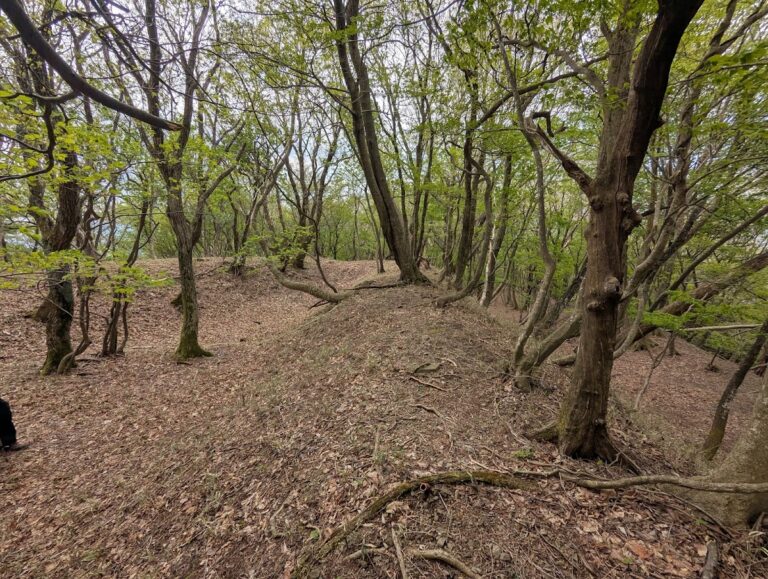
One of the most distinctive features of Kamaba Castle is its series of moats. The approach to the castle features eight trenches, a cleverly designed defensive system designed to exhaust attackers. These trenches were not merely defensive structures, but strategically placed to restrict enemy movement and facilitate counterattacks from within the castle.
Some of the trenches reach depths of over 10 meters, demonstrating the advanced civil engineering techniques of the time. Even today, their impressive presence is palpable, allowing visitors to relive the tension of the Sengoku period.
Main Enclosure: Function as a Living Space
The main enclosure is the central part of Kamaba Castle, where the lord’s residence was located. Archaeological excavations have confirmed the remains of a stone-stone building within the main enclosure, revealing that it functioned not only as a military facility but also as a living space.
Earthworks surround the main enclosure, and some stonework has also been confirmed. Furthermore, a stone-walled gate (castle gate) opens to the north, a design that considered both defense and access. From the main enclosure, one can see a panoramic view of the Kohoku Plain, making it an ideal location for monitoring enemy movements.
The excavated artifacts include high-quality Chinese ceramics such as celadon and white porcelain, suggesting a high standard of living for the castle lord. These discoveries indicate that Kamaba Castle was not merely a military facility, but a place where a cultured life was lived.
North Enclosure: The Impressive Great Turret and Stone Walls
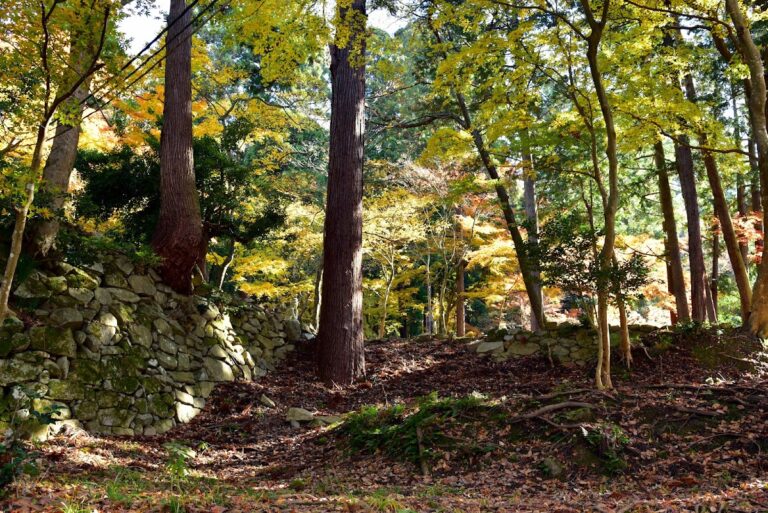
The North Enclosure is located north of the main enclosure and was a crucial defensive point for Kamaba Castle. Here lies the remains of a turret base called the “Great Turret,” with magnificent stone walls remaining at its base.
A Pioneer in the Development of Medieval Castles
The stone walls of the North Enclosure were constructed using highly advanced techniques for a medieval mountain castle. The walls reach heights of over 5 meters in some places, and many large stones were used, indicating the high level of technical skill required.
The existence of these stone walls represents a transitional period in Kamaba Castle’s evolution from a simple earthen castle to a stone castle, making them a valuable historical site for understanding the process of its development into a modern castle. Kamaba Castle holds a significant place in castle history as a pioneer in the development of medieval castles.
The view from the main tower is magnificent, offering panoramic views of Odani Castle to the north and even Lake Biwa. This excellent visibility was extremely important for military surveillance.
South Enclosure: Exquisite Stonework Techniques
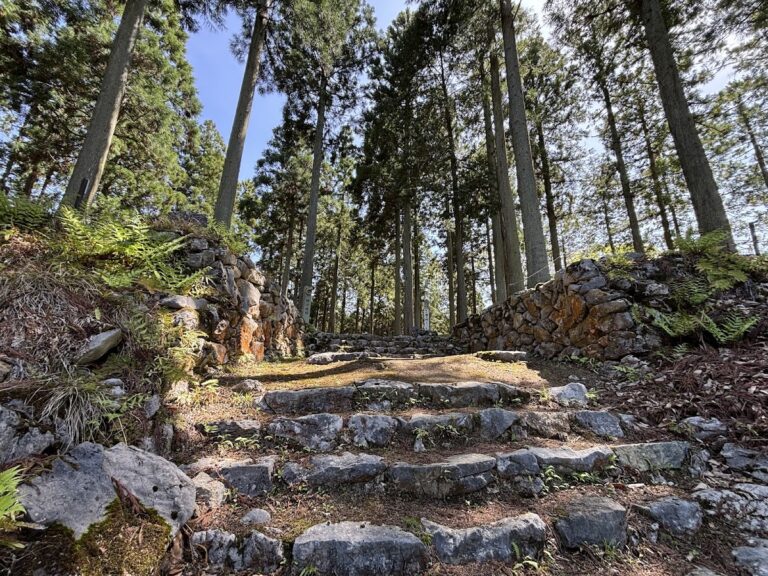
The South Enclosure is adjacent to the south side of the main enclosure, and here too, remarkable stonework has been observed. Unlike the large stone wall of the North Enclosure, the stonework of the South Enclosure employs a more elaborate construction method, demonstrating a diversity of techniques.
The South Enclosure played a role in defending the main enclosure and was in a crucial position to prepare for attacks from the south. The interior of the enclosure is relatively flat and is thought to have been used as a garrison for soldiers and a storage area for supplies.
West Enclosure: An Area for Advanced Exploration
The West Enclosure is a group of enclosures located on the ridge extending west from the main enclosure. Because it’s slightly off the main path to the castle, it’s less visited and is a course suitable for intermediate and advanced hikers.
The West Enclosure area features several small enclosures arranged in a stepped pattern, forming a defensive line to prevent intrusion from the west. This direction has a relatively gentle slope, suggesting that particularly strong defenses were necessary.
Once you feel confident, be sure to venture to the West Enclosure. In the quiet, uncrowded surroundings, you can experience the atmosphere of the Sengoku period more deeply.
The Only Remaining Water Supply Structure in Japan
One of the greatest highlights of Kamaba Castle is its extremely rare “water supply structure.” Securing water was a matter of life and death for mountain castles, and Kamaba Castle had a clever system in place to draw spring water from the mountainside into the castle.
Stone-Structured Waterway
The water supply structure discovered through archaeological excavations is a well-preserved stone-structured waterway. This waterway extends approximately 200 meters from the mountainside water source to the vicinity of the main enclosure, making it a valuable historical structure, rare among medieval castle water management facilities nationwide.
The waterway is skillfully positioned to follow the terrain, designed to transport water while maintaining a consistent gradient. The stonework is highly skilled, resulting in a robust structure capable of withstanding long-term use.
Preparation for Siege
The existence of this water supply structure indicates that Kamaba Castle was built with a long-term siege in mind. Securing a water supply would allow the castle to withstand a siege lasting several months. In fact, during the Sengoku period, cutting off the water supply was one of the most effective tactics in castle sieges.
Currently, this water supply structure is well-preserved, and it is possible to actually walk along the waterway. It is a valuable experience that allows you to feel firsthand the wisdom and efforts of the engineers of that time.
Banba Museum: A Handcrafted Museum Born from Local Pride
When visiting Kamaba Castle, you should definitely stop by the Banba Museum, located in the Banba district at the foot of the mountain. This museum was handcrafted and maintained by local history enthusiasts, and displays the history of Kamaba Castle, excavated artifacts, and cultural properties of the surrounding area.
The museum clearly displays the castle’s layout, photographic panels, and the results of archaeological excavations, deepening your understanding of the castle before climbing it. You may also have the opportunity to hear directly from local residents, gaining valuable information not found in guidebooks.
The Banba Museum is run with the enthusiasm of people who love their local area, and its warm atmosphere is one of its charms. You can also get your stamp for the Continued Top 100 Japanese Castles here.
Access to Kamaba Castle and Important Notes for Visiting
Access Method
By Train:
From JR Tokaido Main Line “Maibara Station” or “Hikone Station,” take the Kokoku Bus and get off at the “Banba” bus stop. The castle entrance is approximately a 20-minute walk from there. Alternatively, a taxi from the station will take you to the entrance in about 15 minutes.
If traveling by car:
Approximately 10 minutes from the Meishin Expressway “Maibara IC”. Parking is available near the castle entrance. Setting your car navigation system to “Banba Museum” will make it easier to find.
Precautions when visiting the castle
Kamaba Castle is a full-fledged mountain castle, and appropriate preparation is necessary for the climb.
Clothing and Equipment:
- Comfortable clothing and hiking boots or trekking shoes are essential.
- Insect repellent is necessary in summer, and warm clothing is necessary in winter.
- Always bring drinking water (there are no vending machines on the mountain).
- Rain gear, a towel, and first-aid supplies are also recommended.
Safety Precautions:
- The climbing path is well-maintained, but there are steep slopes and areas with uneven footing.
- Avoid climbing during or after rain, as the path can be slippery.
- Beware of venomous snakes such as pit vipers (especially in summer).
- Avoid climbing alone; if possible, climb in a group.
- Check the conditions beforehand, as there is a possibility of snow in winter.
Estimated Time Required:
- It takes approximately 40 minutes from the entrance to the main enclosure, and a round trip including sightseeing at the main enclosure takes 2-3 hours. If you plan to thoroughly explore the western enclosure and the water supply remains, it is recommended to allow an additional hour or so.
The Cultural Value of Kamaba Castle
Kamaba Castle was designated a National Historic Site on March 2, 2005, and selected as one of the Continued Top 100 Japanese Castles (No. 151) on April 6, 2017. These designations signify the official recognition of Kamaba Castle’s historical and academic value.
Significance of Historic Site Designation
The designation as a National Historic Site indicates that Kamaba Castle is an important historical site for understanding Japanese history. The following points were particularly praised:
- Historical importance as a border castle: A valuable historical site that tells the story of the power struggle between northern and southern Omi provinces.
- Advanced stonework technology: Demonstrates the development of castle construction technology during the transition from the medieval to the early modern period.
- Rarity of water supply remains: The excellent state of preservation of water supply facilities is rare nationwide.
- Good state of preservation: Remains such as moats, baileys, and stone walls are well-preserved.
Selection as one of the Continued Top 100 Japanese Castles
The selection as one of the Continued Top 100 Japanese Castles is a major motivation for castle enthusiasts to visit Kamaba Castle. The selection by the Japan Castle Association considers not only the historical value of the castle but also its state of preservation and ease of visitation, and Kamaba Castle was recognized as an excellent castle that meets these criteria.
Kamaba Castle and surrounding attractions
When visiting Kamaba Castle, exploring the surrounding historical sites will allow you to gain a deeper understanding of the Sengoku period in Omi.
Odani Castle Ruins
Odani Castle, known as the residence of Asai Nagamasa, is about a 30-minute drive from Kamaba Castle. It is the largest mountain castle in northern Omi Province and is also designated as a national historic site. Visiting both Kamaba Castle and Odani Castle allows you to experience the sphere of influence of the Asai clan.
Hikone Castle
Hikone Castle, a national treasure, is about a 20-minute drive from Kamaba Castle. Built in the early Edo period, it is a flatland castle that showcases the perfected form of a modern castle, in contrast to the medieval mountain castles like Kamaba Castle. Comparing the development of castles over time is also interesting.
Banba-juku, Nakasendo Post Town
Banba-juku, located at the foot of Kamaba Castle, is a historic town that flourished as a post town on the Nakasendo road. The atmosphere of the old highway remains, making it ideal for historical walks.
Points to Enjoy Kamaba Castle
Seasonal Charms
Kamaba Castle shows different faces in each season.
Spring (March-May): The fresh greenery is beautiful, making it the perfect season for hiking. You can also enjoy wildflowers.
Summer (June-August): The greenery is lush, and the shade is cool, but insect repellent is essential. Early morning visits are recommended.
Autumn (September-November): The autumn foliage is beautiful, making it the most popular season. The views are also magnificent.
Winter (December-February): There is a possibility of snow, making it suitable for experienced hikers, but the castle ruins covered in snow are exceptionally beautiful.
Photography Tips
- Large Stone Wall: The stone wall of the northern enclosure is beautifully illuminated by the morning light.
- Moat: A diagonal angle is recommended to emphasize its depth.
- View from the Main Enclosure: On a clear day, you can see all the way to Lake Biwa.
- Water Supply Remains: A valuable spot where you can photograph even the intricate details of the stonework.
Summary: Experience the Charm of Kamaba Castle
Kamaba Castle is a mountain castle that followed a remarkable destiny as a “border castle” during the Sengoku period. Its history, caught between the two great powers of Oda Nobunaga and Asai Nagamasa, its advanced stonework techniques, and the only remaining water supply structure in Japan, offer countless points of interest.
Selected as one of the Continued Top 100 Japanese Castles and protected as a national historical site, Kamaba Castle is an indispensable resource for learning about castles of the Sengoku period. Climbing the castle requires considerable preparation and physical stamina, but the rewards that await you will more than compensate for the effort. When you visit Shiga Prefecture, be sure to stop by Kamaba Castle. The history etched into the stone walls, the memories of battles told by the moats, and the panoramic views of northern Shiga Prefecture from the mountaintop will transport you to the Sengoku period.
Get your stamp for the Continued Top 100 Japanese Castles at the Banba Museum, and enjoy the world of Kamaba Castle, brimming with Sengoku romance, while receiving warm hospitality from the locals.