Itami Castle (Hyogo Prefecture) Complete Guide: A Thorough Explanation of Arioka Castle’s History, Highlights, and Access
Itami Castle (Arioka Castle), formerly located in Itami City, Hyogo Prefecture, is an important historical site that conveys the turbulent events of the Sengoku period. Known as the residence of Araki Murashige and the place where Kuroda Kanbei was imprisoned, this castle occupies a special place in the history of Japanese castles. This article thoroughly explains everything you need to know before visiting Itami Castle, from its history and structure to its highlights and access information.
What is Itami Castle (Arioka Castle)?
Itami Castle was a flatland castle located in Itami, Itami City, Hyogo Prefecture, situated on the Arioka terrace of the Itami district in Kawabe district, Settsu Province. Also known as Arioka Castle, it is designated as a national historical site. Currently, some of the castle ruins remain around Itami Station, and the remains can be seen mainly within Arioka Park.
Located on the eastern side of the Itami Terrace, this castle effectively utilized the natural terrace cliffs to form its castle grounds, creating a magnificent fortress with a large outer enclosure (sōgamae) stretching approximately 0.8 kilometers east-west and 1.7 kilometers north-south. This scale was extremely large for its time, and the structure, which surrounded the entire castle town with moats and earthworks, strongly reflects the characteristics of castle architecture from the late Sengoku period.
History of Itami Castle
From the Nanboku-chō period to the Muromachi period: Construction by the Itami clan
The history of Itami Castle dates back to the Nanboku-chō period. It was built by the Itami clan, who ruled this area, and was initially called “Itami Castle.” The Itami clan was a powerful local lord in Settsu Province, wielding considerable influence in this region.
During the Itami clan’s time, the castle functioned as a relatively small flatland castle, but taking advantage of its geographical location on the west bank of the Inagawa River, it developed into an important base controlling a key transportation hub. Itami Castle during this period is believed to have functioned as the political and economic center of the region.
Tensho 2 (1574): Major Renovation by Araki Murashige
The history of Itami Castle underwent a major change in Tensho 2 (1574). Araki Murashige, a samurai and vassal of Oda Nobunaga, expelled the Itami clan and occupied the castle. Murashige carried out a large-scale renovation of the castle and renamed it “Arioka Castle.”
Araki Murashige’s renovation was thorough, significantly expanding the castle grounds and transforming it into a fortified castle with a moat and earthworks surrounding the entire castle town, including the samurai quarters and merchant houses. This renovation made Arioka Castle known as an impregnable fortress. Murashige, as a daimyo who ruled the entire province of Settsu, made this castle his residence.
It has been suggested that the oldest castle tower in Japan may have existed at Arioka Castle during this period. Archaeological excavations have uncovered the remains of a stone wall believed to be the foundation of a castle tower, which holds significant importance in castle research.
Tensho 6 (1578): Araki Murashige’s Rebellion
In Tensho 6 (1578), Araki Murashige suddenly rebelled against Oda Nobunaga. While there are various theories regarding the reasons for this rebellion, it is believed to have been a complex interplay of dissatisfaction with Nobunaga’s harsh policies and his relationship with the Mori clan.
Upon learning of Murashige’s rebellion, Oda Nobunaga was furious and immediately ordered the siege of Arioka Castle. At this time, Kuroda Kanbei (Takayoshi), who went to Arioka Castle to persuade Murashige, was instead imprisoned in a dungeon within the castle. It is said that Kanbei was confined in the dungeon under terrible conditions for about a year, and was rescued with a limp.
1579 (Tensho 7): The Fall of Arioka Castle
In 1579 (Tensho 7), the siege by the Oda army lasted for nearly a year, and the castle’s food supplies began to run out. Araki Murashige secretly escaped the castle and fled to Amagasaki Castle. His remaining retainers continued to resist, but ultimately the castle surrendered.
After the fall of the castle, Oda Nobunaga severely punished Murashige’s family, retainers, and even the residents of the castle town. This incident is known as the “Battle of Arioka Castle” and is one of the events that symbolizes the cruelty of the Sengoku period.
From the Fall of the Castle to the Present
After the fall of Arioka Castle, it was given to Ikeda Tsuneoki, but it was soon abandoned. During the Edo period, it developed as Itami-gocho and prospered through the sake brewing industry.
After the Meiji era, much of the castle site was urbanized, but in the Showa era, its value as a historical site was re-recognized. In 1979, it was designated a national historic site, and since then, archaeological excavations and restoration of the remains have been carried out.
Structure and Characteristics of the Castle
Outer Enclosure of Arioka Castle
The most distinctive feature of Arioka Castle is its “outer enclosure” structure, which surrounded the entire castle town with moats and earthworks. This structure, which encloses a vast area of approximately 0.8 kilometers east-west and 1.7 kilometers north-south with defensive facilities, was extremely advanced for a Japanese castle of that time.
The outer enclosure of the castle was designed to prepare for a long siege by incorporating not only the main enclosure (honmaru) but also samurai residences, townhouses, and temples and shrines within the defensive line. This is thought to have been constructed by Murashige in anticipation of a confrontation with Oda Nobunaga.
Structure of the Main Enclosure
The main enclosure was located within Arioka Park, west of the current JR Itami Station. Archaeological excavations have uncovered the remains of a stone-walled castle tower base, suggesting a high probability that a castle tower once stood here.
The main enclosure was surrounded by a moat and fortified with earthen ramparts and stone walls. It is also believed that buildings such as palaces and watchtowers were located within the main enclosure.
Ancillary Facilities and Fort Remains
In addition to the main enclosure, Arioka Castle had several forts positioned around it. Some of these fort remains still exist today, providing insight into the castle’s defensive system.
- Kishi Fort: Located northeast of the castle, this facility defended against enemies approaching from the Inagawa River.
- Jōrōzuka Fort: Located southwest of the castle, this fort served to monitor the Osaka area.
- Hiyodorizuka Fort: A defensive stronghold located northwest of the castle.
These forts were designed to function in conjunction with the main enclosure, reflecting a multi-layered defensive strategy.
Stone Walls and Earthworks
Excavation surveys have revealed that Arioka Castle made extensive use of stone walls, which were unusual for the time. In particular, stone walls constructed using techniques such as kirikomi-hagi (cut-stone jointing) and uchikomi-hagi (roasted stone jointing) have been confirmed at the castle tower base and major entrances, indicating that it was a technically advanced castle.
Earthworks were built mainly around the outer perimeter of the castle and reached heights of several meters. Some of these earthworks remain today, allowing us to imagine the scale of the castle at that time.
Current Remains and Highlights
Arioka Castle Ruins (Arioka Park)
The site of Arioka Castle’s main enclosure is now maintained as “Arioka Park.” It is located a short walk from the west exit of JR Itami Station, making it easily accessible.
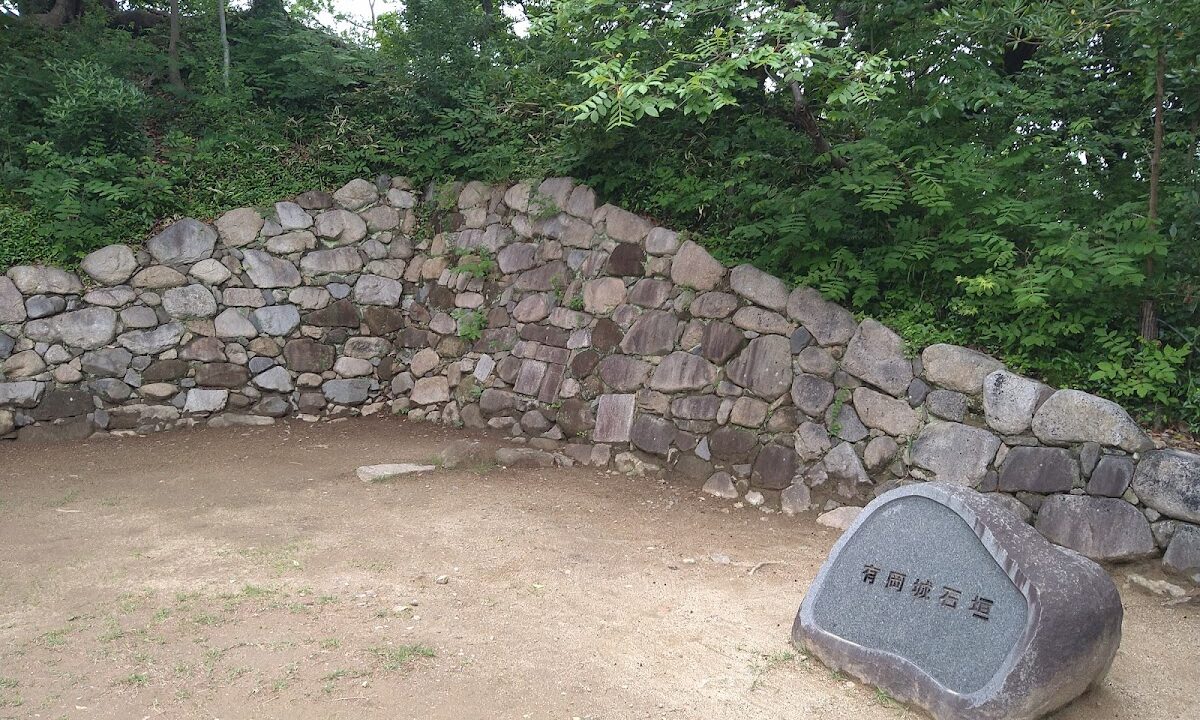
Within the park, remnants of the stone walls are preserved and displayed, allowing visitors to see the stonework unearthed during excavations. Information boards and explanatory signs showing the castle’s layout are also installed, allowing visitors to stroll around and imagine the castle’s former appearance. ### Remains of Earthworks
Parts of the earthworks built around the castle’s perimeter remain in various locations throughout the city. Especially around Itami Station, traces of the earthworks can be found within residential areas, allowing visitors to appreciate the scale of the former outer fortifications.
Remains of Moats
While much of the moats surrounding the outer fortifications have been filled in, some traces remain as topographical features. Furthermore, some moat remains confirmed through archaeological excavations have been preserved for public viewing.
Site of Kuroda Kanbei’s Prison
The site of the earthen prison where Kuroda Kanbei was imprisoned for approximately one year is also preserved as a historical site. Located near JR Itami Station, it is an important spot where one can imagine the harsh life of imprisonment at that time.
The earthen prison was an underground cell, telling the story of Kanbei’s suffering in a narrow, dark space. An explanatory sign is installed at the site, providing a detailed explanation of the historical background.
Itami City Museum
For those who wish to learn more about Arioka Castle, we recommend visiting the Itami City Museum. The museum displays excavated artifacts and materials related to Arioka Castle, allowing visitors to learn in detail about the castle’s history and structure.
Excavated pottery, weapons, and building materials are on display, providing a valuable opportunity to understand the life and culture of the time in concrete terms.
Historical Episodes Related to Itami Castle
The Imprisonment and Rescue of Kuroda Kanbei
One of the most famous episodes in the history of Arioka Castle is the imprisonment of Kuroda Kanbei (Takayoshi). Kanbei visited Arioka Castle on the orders of Oda Nobunaga to persuade Araki Murashige, but Murashige suspected Kanbei of being a traitor and imprisoned him in a dungeon.
His imprisonment lasted for about a year, and Kanbei hovered between life and death in the narrow, dark dungeon. When Kanbei was rescued, he was crippled in the legs, and it is said that he suffered from this disability for the rest of his life.
This experience greatly influenced Kanbei’s worldview and is said to have been the source of his thoughtfulness and caution when he later served as a military strategist for Toyotomi Hideyoshi.
The Mysterious Escape of Araki Murashige
In 1579, the secret escape of Araki Murashige, the lord of Arioka Castle, which was under siege by the Oda army, remains one of the great mysteries of history. Murashige left his wife, children, and retainers behind in the castle and fled alone to Amagasaki Castle.
There are various theories as to the reason for this action, including the theory that it was to forge an alliance with the Mori clan, or to attempt direct negotiations with Oda Nobunaga. However, as a result, the retainers and family he left behind were executed by the Oda army, and Murashige’s reputation was severely damaged.
Murashige later survived as a tea master, active in the world of tea ceremony under the name “Dōkun.” His dramatic life—the glory and fall of a warrior, and his second life as a tea master—has been the subject of many works.
Possibility of Japan’s Oldest Castle Tower
Researchers have suggested that Arioka Castle may have had Japan’s oldest castle tower. The stone wall remains, believed to be the base of a castle tower, discovered during archaeological excavations, may have been built around the same time as, or even earlier than, the castle tower of Azuchi Castle (completed in 1579).
If this is true, Arioka Castle’s tower would occupy an extremely important position in the history of Japanese castle architecture. However, historical records regarding the detailed structure and appearance of the tower are scarce, and further research is anticipated.
Access Information
Access by Train
Access to Arioka Castle Ruins (Arioka Park) is very convenient.
- JR Takarazuka Line (Fukuchiyama Line) “Itami Station”: Approximately 1 minute walk from the West Exit
- Hankyu Itami Line “Itami Station”: Approximately 15 minute walk
JR Itami Station is easily accessible, approximately 20 minutes from Osaka Station and 30 minutes from Sannomiya Station, making it ideal for day trips. You won’t get lost as Arioka Park is immediately visible upon exiting the west exit of the station.
Access by Car
If visiting by car, the following routes are convenient:
- Approximately 10 minutes from Chugoku Expressway “Chugoku Ikeda IC”
- Approximately 15 minutes from Hanshin Expressway Route 11 Ikeda Line “Toyonaka Minami IC”
There is no dedicated parking lot at Arioka Park, but there are several coin-operated parking lots in the surrounding area. Since the area around Itami Station is urban, we recommend using public transportation.
Access from Osaka International Airport (Itami Airport)
Itami City is also known as a gateway to the sky, with Osaka International Airport (Itami Airport) located there. You can access the site from the airport using the following methods:
- Airport Limousine Bus: Approximately 10 minutes to JR Itami Station
- Hankyu Bus: Approximately 15 minutes to Hankyu Itami Station
Visiting Arioka Castle Ruins is a good idea while waiting at the airport.
Nearby Tourist Attractions
When visiting Arioka Castle Ruins, we recommend also visiting nearby tourist attractions.
- Itami City Museum: Exhibits detailed information and excavated artifacts of Arioka Castle
- Itami Gocho: An area where the townscape of Edo-period sake breweries remains
- Itami Sky Park: A park adjacent to Osaka International Airport where you can see planes taking off and landing up close
Points to Note When Visiting Itami Castle
Estimated Time Required for Visiting
While a visit to Arioka Park itself takes about 30 minutes, if you also want to visit the site of the dungeon where Kuroda Kanbei was imprisoned and the surrounding fort ruins, you should allow 2-3 hours. If you also plan to visit the Itami City Museum, please add another 1-2 hours.
Best Time to Visit
Since Arioka Castle Ruins is an outdoor historical site, it is recommended to visit during the pleasant weather of spring (March-May) and autumn (September-November). During cherry blossom season, the cherry blossoms in Arioka Park are beautiful, allowing you to enjoy both a historical walk and cherry blossom viewing.
What to Bring and Wear
- Comfortable Walking Shoes: Comfortable walking shoes such as sneakers are essential for exploring the castle ruins.
- Camera: There are many opportunities to photograph the remains such as stone walls and earthworks.
- Hat and Sunscreen: The sun is strong in summer, so heatstroke prevention is necessary.
- Rain Gear: Since the tour is mainly outdoors, prepare according to the weather.
Things to Know Beforehand
The history of Arioka Castle is complex and filled with many dramas, such as the rebellion of Araki Murashige and the imprisonment of Kuroda Kanbei. Prior to your visit, studying the following points will make your experience more fulfilling:
- The life of Araki Murashige and the circumstances of his rebellion
- The relationship between Kuroda Kanbei and Arioka Castle
- The characteristics and significance of the outer fortifications of a castle
- The development of castle architecture during the Sengoku period
Related Works and Their Influence
The history of Arioka Castle has served as the subject of numerous novels, dramas, and films.
Novels
- Ryotaro Shiba’s *Harimanada Monogatari*: A work depicting the life of Kuroda Kanbei, with his imprisonment at Arioka Castle being a crucial scene.
- Shusaku Endo’s *Hangyaku*: A work based on the rebellion of Araki Murashige.
Dramas
- NHK Taiga Drama *Gunshi Kanbei* (2014): Starring Junichi Okada, this drama depicts the life of Kuroda Kanbei, with the scene of his imprisonment at Arioka Castle being particularly memorable.
Through these works, the history of Arioka Castle has become widely known, and its popularity as a tourist destination has increased.
Summary
Itami Castle (Arioka Castle), located in Itami City, Hyogo Prefecture, is a valuable historical site that conveys the turbulent events of the Sengoku period. With its dramatic history of large-scale renovations by Araki Murashige, the imprisonment of Kuroda Kanbei, and the siege and fall of the Oda army, this castle occupies an important position in the history of Japanese castles.
Although the area is now urbanized, remnants such as stone walls and earthworks are preserved around Arioka Park, allowing visitors to imagine the magnificent castle complex of the time. Its excellent accessibility, just a short walk from JR Itami Station, is also a major draw, making it ideal for day trips from Osaka and Kobe.
For history buffs, those interested in castle architecture, and those interested in Sengoku period warlords like Kuroda Kanbei and Araki Murashige, Arioka Castle ruins are a must-see. Visiting it in conjunction with the Itami City Museum will allow for a deeper understanding of Arioka Castle’s history and culture.
Taking advantage of its proximity to Osaka International Airport (Itami Airport), it’s also a recommended stopover during your travels. Why not stroll through the modern streets of Itami City while feeling the historical romance of the Sengoku period?