
Imabari Castle Complete Guide | History, Highlights, and Access Information for Japan’s Leading Coastal Castle Built by Todo Takatora
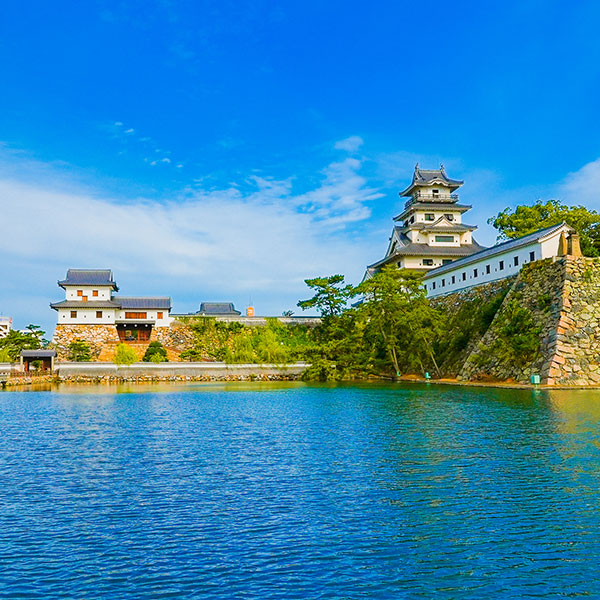
Located in Imabari City, Ehime Prefecture, Imabari Castle is a coastal castle whose construction was begun in 1602 by Todo Takatora, a renowned castle builder. With its unique structure that draws seawater into its moats and one of the largest boat docks in Japan, it is considered one of Japan’s leading coastal castles, alongside Takamatsu Castle and Nakatsu Castle, and is counted as one of the “Three Great Water Castles of Japan.”
This article comprehensively explains everything you need to know before visiting Imabari Castle, from its history and highlights to opening hours, admission fees, and access information.
What is Imabari Castle? | Characteristics of a Flatland Castle that Flourished as a Coastal Castle
Imabari Castle is a flatland castle built on the coast facing the Seto Inland Sea, and was once a vast fortress surrounded by three moats. Its most distinctive feature is its structure as a “coastal castle,” with seawater drawn into its moats. It is said that at high tide, the water level of the moat rose, creating a landscape that made the castle appear to float on the sea.
The castle’s shape is a simple, rectangular design, showcasing advanced early Edo period castle-building techniques that departed from the rugged mountain castles of the Sengoku period. A port connected to the sea was built within the castle grounds, designed to facilitate the transport of goods and enhance military mobility. This port was later inherited by the current Imabari Port, becoming one of the roots of Imabari’s maritime city status.
History and Development of Imabari Castle | From Todo Takatora to the Matsudaira Clan
Construction Period: Construction by Todo Takatora (1602-)
After the Battle of Sekigahara, Todo Takatora was granted a 200,000 koku territory in Iyo Province (present-day Ehime Prefecture) by Tokugawa Ieyasu. In 1602 (Keicho 7), he began construction of Imabari Castle. Takatora was known as a master castle builder, and he utilized his experience in designing numerous castles, including Iga Ueno Castle, Tsu Castle, and Zeze Castle, in the design of Imabari Castle.
It is estimated that the construction, including the buildings, was completed around 1608 (Keicho 13). Takatora completed an innovative castle featuring a moat filled with seawater, one of the largest boat landings in Japan, and what is considered to be Japan’s first multi-story tower-style keep.
From the Todo Clan to the Matsudaira Clan (1608-1635)
In 1608 (Keicho 13), Todo Takatora was transferred to the Tsu Domain in Ise Province (present-day Mie Prefecture), and his adopted son, Todo Takayoshi, took over Imabari Castle. However, Takayoshi died prematurely in 1610 (Keicho 15), and after that, the Imabari Domain was temporarily abolished.
The Matsudaira (Hisamatsu) Era (1635-1869)
In 1635 (Kanei 12), Matsudaira (Hisamatsu) Sadafusa was granted Imabari with a stipend of 35,000 koku, and the Matsudaira clan served as lords of Imabari Castle until the Meiji Restoration. Under the Matsudaira’s rule, Imabari developed as a castle town, with cotton and shipping industries flourishing.
From Abandoned Castle to the Present (1869-)
In 1869 (Meiji 2), Imabari Castle was abandoned, and many of its buildings were demolished. The keep was also dismantled in the early Meiji period, leaving only the stone walls and a portion of the moat.
In 1953 (Showa 28), the castle site was designated a prefectural historical site and developed into Fukiage Park. In 1980 (Showa 55), the five-story, six-tiered keep was rebuilt in reinforced concrete and now functions as the Imabari City History Museum. In 2007, the Tetsugomon Gate was restored, and in 2017, the Yamasato Turret was restored, gradually returning the castle to its former glory.
Todo Takatora | The Life and Achievements of a Master Castle Builder
Todo Takatora (1556-1630) was a Sengoku period warlord from Omi Province (present-day Shiga Prefecture). In his youth, he served Asai Nagamasa, Toyotomi Hidenaga, and Toyotomi Hideyoshi, honing his castle-building skills. He is said to have particularly blossomed his talent for castle architecture during his time serving Hideyoshi’s younger brother, Hidenaga.
In the Battle of Sekigahara, he sided with the Eastern Army (Tokugawa side), and for his achievements, he was granted 200,000 koku in Imabari, Iyo Province. Takatora’s castle-building techniques are characterized by the adoption of high stone walls, practical layouts, and advanced design philosophies adapted to changing times.
At Imabari Castle, he adopted what is considered to be the first multi-story tower-type keep in Japan. Unlike traditional watchtower-style castle keeps, this structure features progressively smaller floor plans on each level, significantly influencing later Edo-period castle architecture. Takatora’s castle-building techniques, known as the “Takatora style,” served as a model for many buildings castle throughout the Edo period.
Imabari Castle Highlights | Exploring the Keep, Turrets, and Stone Walls
Keep (Reconstructed)
Reconstructed in 1980, the five-story, six-level keep is a symbol of Imabari Castle. Its exterior replicates the style of a layered tower keep, with a beautiful contrast between white walls and black roof tiles.
The interior of the keep houses exhibition rooms and observation decks, with approximately 2,500 items of historical artifacts, including weapons, armor, and swords, on permanent display on each floor. From the top-floor observation deck, visitors can enjoy panoramic views of Imabari city and the Seto Inland Sea; on clear days, the Shikoku Mountains can be seen in the distance.
Tetsugomon Gate (Restored)
Restored in 2007, the Tetsugomon Gate is an important defensive structure serving as the main gate of Imabari Castle. The structure of the masugata gate, faithfully reproduced based on historical documents, is a valuable resource for understanding the castle construction techniques of the time.
The name Tetsugomon (Iron Gate) originates from its sturdy construction, with iron plates covering the gate doors. In the restoration, Edo period drawings and archaeological findings were utilized, reproducing not only the exterior but also the internal structure as accurately as possible.
Yamasato Yagura (Restored)
Restored in 2017, the Yamasato Yagura is a two-story turret located in the northwest corner of the castle. Its exterior displays a beautiful white plaster finish, and along with the main keep, it is an important structure that forms part of the Imabari Castle landscape.
The interior is used as an exhibition space, displaying materials related to the history of Imabari Castle and its construction techniques. From the windows, you can see the Seto Inland Sea across the moat, a place where you can truly appreciate Imabari Castle’s location as a coastal castle.
Stone Walls and Moat
The stone walls of Imabari Castle are one of the highlights, showcasing the construction techniques of Todo Takatora. The high-stone wall technique was employed, reaching a maximum height of approximately 12 meters. The slope of the stone walls forms a curve known as the “fan slope,” a design that combines aesthetics with defensive capabilities.
The moat still receives seawater, and you can observe the water level rising at high tide. Saltwater fish inhabit the moat, and you can see sea bream, sea bass, and rays swimming around. This is an extremely rare sight among Japanese castles.
Remains of the Boat Landing
In the southeastern part of the castle grounds, the remains of a boat landing, once considered one of the largest in Japan, can be found. The boat landing served as a port directly connecting the castle to the sea, and was used for transporting goods and for the coming and going of warships. Although the site is now filled in, remnants indicating its large scale can still be seen.
Fukiage Park (Historical Site Park)
The site of Imabari Castle has been developed into Fukiage Park, which is open 24 hours a day. Numerous cherry trees are planted within the park, making it a popular spot for cherry blossom viewing in spring. The promenade along the moat is ideal for a stroll, allowing visitors to enjoy the scenery throughout the seasons.
Visitor Information | Opening Hours, Fees, and Closing Days
Opening Hours
- Castle Tower & Turret Opening Hours: 9:00 AM – 5:00 PM (Last entry at 4:30 PM)
- Historical Site Park (Fukiage Park): Open 24 hours
Admission Fees
- General Admission: 520 yen
- Students: 260 yen
- High School Students and Younger or Under 18: Free
- Seniors (65 years and older): 420 yen
- Group Discount (20 or more people): General Admission 420 yen, Students 210 yen
*These fees are for admission to the Castle Tower, Iron Gate, Yamasato Turret, Armor Turret, and Yamasato Gate Exhibition Room.
Closing Days
- December 29th – December 31st
- There may be other temporary closures. ### Museum Shop
A museum shop is located on the first floor of the castle tower, where you can purchase original Imabari Castle goods, Imabari towels, and local specialty products. Since April 2024, stickers featuring Imabari Castle’s original characters, “Fukiage-hime” and “Takatora Bari-san,” have also been available.
Access | How to Get to Imabari Castle
Access by Public Transportation
By JR
- Approximately 25 minutes on foot from JR Yosan Line “Imabari Station”
- Approximately 9 minutes by Setouchi Bus from Imabari Station (bound for “Imabari Bus Depot” or “via Imabari Castle”), get off at “Imabari Castle” bus stop, and it’s a short walk.
By Highway Bus
- Approximately 1 hour by “Shimanami Liner” from Matsuyama City, get off at “Imabari Station,” and it’s approximately a 25-minute walk or transfer to a bus.
Access by Car
- Approximately 10 minutes from Nishiseto Expressway (Shimanami Kaido) “Imabari IC”
- Approximately 20 minutes from Matsuyama Expressway “Imabari Yunoura IC”
Parking
- Imabari Castle Parking: Free (approximately 50 regular cars, several buses)
- Opening Hours: 9:00 AM – 5:00 PM
- There are also paid parking lots around the historical park.
Address
3-1-3, Torimachi, Imabari City, Ehime Prefecture 794-0036
Event & Exhibition Information | Events Held at Imabari Castle
Imabari Castle hosts various events and exhibitions throughout the year.
Regular Events
- Cherry Blossom Festival (Late March – Early April): Held to coincide with the peak blooming season of the cherry blossoms in the park, with nighttime illuminations.
- Imabari Castle Illumination: The castle tower is illuminated year-round from sunset until 11 PM, offering a magical night view.
Special Exhibitions
Special exhibitions are regularly held inside the castle tower, featuring displays on Imabari’s history and culture, as well as special exhibitions of weapons and armor. The latest event information can be found on the official website of the Imabari City Cultural Promotion Division.
Photo Collection | Imabari Castle’s Seasons and Photo Spots
Photo Spots
The Castle Tower Across the Moat
The view of the castle tower from along the moat on the south side is a representative composition of Imabari Castle. The reflection of the castle tower on the water’s surface is popular as “Inverted Imabari Castle.”
The Iron Gate and the Castle Tower
By framing the restored Iron Gate and the castle tower together, you can express the beauty of the castle architecture.
Night View/Illumination
The illuminated castle tower after sunset creates a different, more fantastical atmosphere than during the day. The reflection of light on the moat’s surface is also a highlight.
Seasonal Highlights
- Spring (March-May): The cherry blossom season is especially beautiful, and you can enjoy the collaboration of the castle tower and cherry blossoms.
- Summer (June-August): The castle tower stands out against the backdrop of fresh greenery and blue sky.
- Autumn (September-November): The combination of autumn leaves and the castle tower creates a picturesque scene.
- Winter (December-February): The air is clear, allowing for panoramic views, and you may even see the castle tower covered in snow.
Tourist Attractions Around Imabari Castle
Imabari Towel Museum ICHIHIRO
A museum dedicated to Imabari towels, a representative local product of Imabari. Located about 15 minutes by car from Imabari Castle. Visitors can enjoy towel art exhibits, tours of the towel manufacturing process, and shopping.
Murakami Pirate Museum
A museum where you can learn about the history of the Murakami pirates (Murakami Suigun), who were active in the Seto Inland Sea. Located on Oshima Island, about 30 minutes by car from Imabari Castle.
Shimanami Kaido
A sea route approximately 60km long connecting the islands of the Seto Inland Sea from Imabari to Onomichi. World-famous as a cycling mecca.
Itoyama Park Observation Deck
This observation deck offers a panoramic view of the Kurushima Kaikyo Bridge and is approximately a 10-minute drive from Imabari Castle. Enjoy the beautiful scenery of the numerous islands in the Seto Inland Sea and the bridge.
What are Japan’s Three Great Water Castles? | Imabari Castle, Takamatsu Castle, and Nakatsu Castle
Imabari Castle is counted among Japan’s “Three Great Water Castles,” along with Takamatsu Castle (Takamatsu City, Kagawa Prefecture) and Nakatsu Castle (Nakatsu City, Oita Prefecture).
Takamatsu Castle was the residence of the Takamatsu Domain in Sanuki Province (present-day Kagawa Prefecture). Facing the Seto Inland Sea, it was a sea castle with seawater drawn into its moat. While the main keep no longer exists, structures such as the Mizute-gomon Gate and Tsukimi-yagura Tower remain.
Nakatsu Castle was the residence of the Nakatsu Domain in Buzen Province (present-day Oita Prefecture). It was built by Kuroda Yoshitaka (Kanbei) and completed by Hosokawa Tadaoki. Facing the Suo Sea, it features a structure that draws seawater into its moat.
What these three castles have in common is their location facing the sea and their unique structure that utilizes seawater in its moat. Built at key points for maritime traffic, their design emphasizes the transport of goods using water and military mobility.
Imabari Castle and Japan’s 100 Famous Castles
Imabari Castle was selected as the 79th of the “Japan’s 100 Famous Castles” by the Japan Castle Association in 2006. The Japan’s 100 Famous Castles is a list of famous castles selected based on a comprehensive evaluation of their historical, architectural, and cultural value.
The 100 Famous Castles stamp can be obtained at the keep castle reception. Bringing a stamp book allows you to enjoy a stamp rally visiting all 100 castles nationwide.
Cultural Property Designation Status of Imabari Castle
- Ehime Prefecture Designated Historic Site: Designated in 1953
- Imabari City Designated Tangible Cultural Property: Part of the collections housed in the reconstructed castle tower
The Imabari Castle site is protected as a prefectural designated historic site, and archaeological excavations and preservation and maintenance projects are continuously being carried out.
Summary | The Charm of Imabari Castle and Points to Note When Visiting
Imabari Castle is one of Japan’s leading seaside castles, showcasing the culmination of Todo Takatora’s castle-building techniques. It is a valuable historical site where you can experience the advanced castle architecture of the early Edo period, including moats filled with seawater and a multi-story tower-type castle tower.
The reconstructed castle tower, the restored Iron Gate and Yamasato Turret, and the existing stone walls and moats evoke the castle’s former glory and convey the history and culture of Imabari to the present day. It is also a place where you can learn about the origins of Imabari’s development as a maritime city, given its location facing the Seto Inland Sea.
With an affordable admission fee of just 520 yen, Imabari Castle offers stunning views from its keep, a wealth of exhibits, and beautiful castle architecture, making it a must-visit tourist spot when you’re in Ehime Prefecture. Combine your visit with sightseeing in the surrounding area, such as the Shimanami Kaido or the Imabari Towel Museum, for a truly fulfilling Imabari experience.