Ida Shumegajo Castle (Toyama City, Toyama Prefecture) Complete Guide: History and Highlights of a Sengoku Period Mountain Castle with Remaining Ridge-Shaped Vertical Moats
Ida Shumegajo Castle is a Sengoku period mountain castle located in Ida, Yao-machi, Toyama City, Toyama Prefecture. Designated as a Toyama City Historic Site and selected as one of “Toyama’s 100 Cultural Properties,” this castle site boasts a rare and well-preserved group of ridge-shaped vertical moats, making it a significant historical site in medieval castle research.
History and Lord of Ida Shumegajo Castle
The Saito Clan and the Origins of Ida Shumegajo Castle
Ida Shumegajo Castle is a mountain castle built by the Saito clan, who ruled this area during the Sengoku period. The lord is believed to have been Saito Shume, and it functioned as a fortified outpost for Ida-kan, located at the foot of the mountain. A “tsume-jiro” refers to a castle where the family lived in a residence at the foot of the mountain during peacetime and took refuge in a fortified position on the mountaintop during wartime.
The Saito clan was a powerful local lord family in Etchu (present-day Toyama Prefecture) and held influence throughout the Nei district. Ida Shumagajō is believed to be a castle used by the Saito clan before they later established Jōnōjō as their main base.
Etchu and Ida Shumagajō in the Sengoku Period
During the Sengoku period, Etchu became the stage for power struggles between powerful daimyo such as the Uesugi, Takeda, and Oda clans. From the Tenbun era (1532-1555) to the Tenshō era (1573-1593), the local lords of Etchu engaged in complex diplomacy in their struggle for survival.
There is a theory that the ridged dry moats of Ida Shumagajō are traces of modifications made by the Uesugi army. It has been suggested that when Uesugi Kenshin repeatedly invaded Etchu Province, he sometimes militarily strengthened existing castles, and Ida Shumagajyo Castle may have been one of them. In this case, it is thought that the castle’s defensive capabilities were significantly improved.
Abandonment and Aftermath
After the Saito clan developed Shiroo Castle as their new base, it is presumed that Ida Shumagajyo Castle ceased to function as a fortified stronghold. Many medieval mountain castles were abandoned due to Oda Nobunaga’s invasion of Etchu Province during the Tensho era and subsequent castle development under the Toyotomi regime. Similarly, Ida Shumagajyo Castle is thought to have been abandoned from the late Sengoku period to the early modern period.
Structure and Layout of Ida Shumagajyo Castle
Location and Topography
Ida Shumagajyo Castle is built on Ida-maeyama, a mountain 175.4 meters above sea level, spanning Ida and Konagaya in Yao-machi, Toyama City. A forest road runs along the eastern slope of the mountain, and the entrance to the castle and an explanatory sign are located along this road. The entrance is located at the northern end of the ridge, making it relatively easy to access.
As a mountain castle, it is of medium size and is characterized by its layout that skillfully utilizes the natural terrain. Steep slopes are used for defense, and the baileys (kuruwa) are arranged along the ridge.
Arrangement and Characteristics of the Baileys
Compared to other completed mountain castles, the baileys of Ida Shumagajō show areas where the leveling is insufficient. This suggests that this castle was not a permanent main castle, but rather functioned as an emergency outpost. Because it was a temporary castle, it is thought that defense was prioritized over habitability.
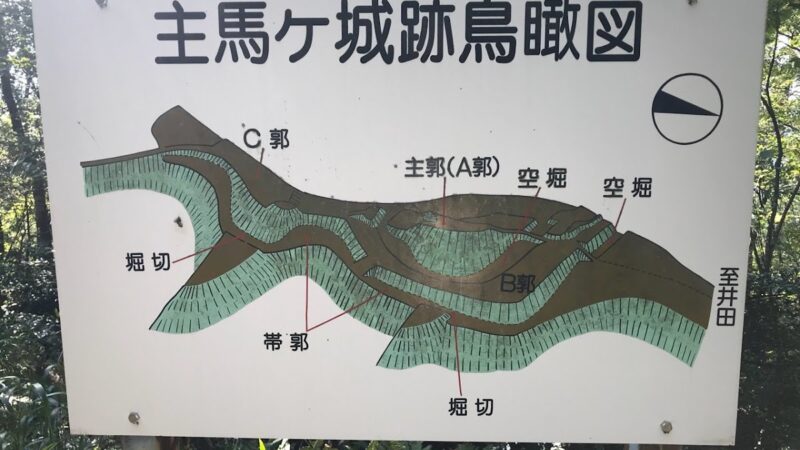
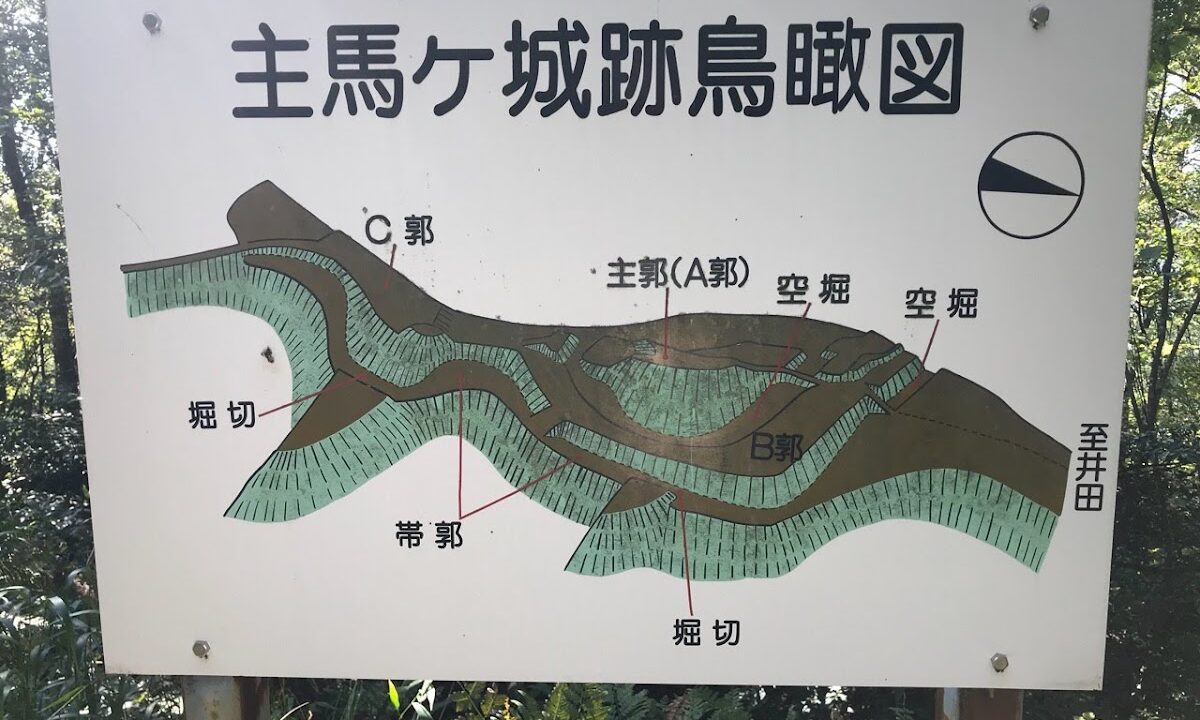
Multiple baileys are arranged around the main enclosure, each demarcated by moats and earthworks. The connecting routes between the baileys are also positioned with defense in mind, and various measures to hinder enemy intrusion can be seen throughout.
Earthworks and Moats
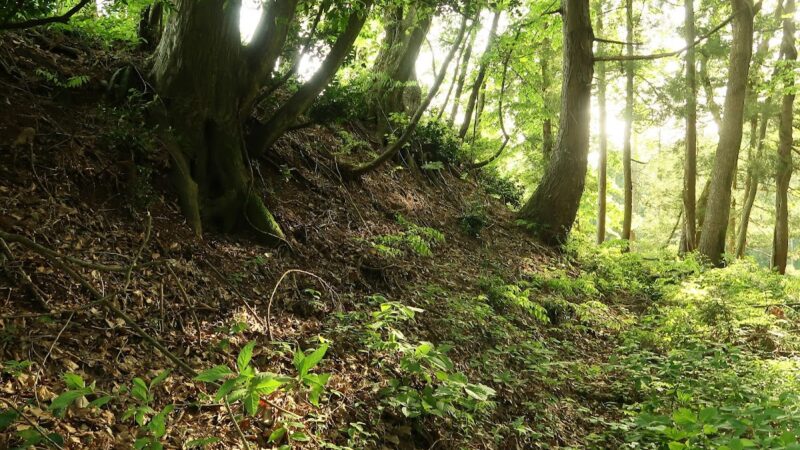
The remains of earthworks are well-preserved within the castle grounds. These earthworks surrounded the baileys and served as defensive walls. Some sections of the earthworks remain over 1 meter high, allowing visitors to appreciate the scale of the defensive structures at the time.
Moats are dry moats dug to block ridges, serving as important defensive structures to prevent enemy intrusion. Multiple moats have been identified at Ida Shumagaga Castle, with a particularly deep one remaining behind the main bailey (southeast side). These moats can be considered a strategically placed feature designed to prevent attacks along the ridges.
The Greatest Highlight of Ida Shumagaga Castle: The Group of Ridge-Shaped Vertical Moats
What are Ridge-Shaped Vertical Moats?
The greatest highlight of Ida Shumagaga Castle is the group of ridge-shaped vertical moats, a rare sight even within Toyama Prefecture. A series of ridged vertical moats refers to a series of vertical moats dug in a ridge-like pattern on a mountain slope. This advanced defensive structure developed during the late Sengoku period (Warring States period).
A vertical moat is a dry moat dug vertically along a slope, serving to prevent enemies from climbing the slope. By arranging multiple such moats in parallel, the entire slope could be transformed into a defensive zone. Ridged vertical moat series are a characteristic feature often found in castles of the Kai Takeda clan and the Echigo Uesugi clan.
Characteristics of the Ridged Dry Moats at Ida Shumagaga Castle
The ridged dry moats at Ida Shumagaga Castle are clearly preserved on the castle slope and are highly valued for their scale and excellent state of preservation. Multiple vertical moats are dug in parallel at equal intervals, suggesting they restricted the lateral movement of enemy soldiers and effectively divided attacks.
The theory that this series of ridged dry moats is the result of modifications by the Uesugi army is based on the observation of traces of castle construction techniques common to Uesugi castles. It is presumed that Uesugi Kenshin added such advanced defensive structures to the existing castles during his invasion of Etchu Province, utilizing them as military bases.
Points to Note When Viewing the Series of Ridged Dry Moats
When viewing the series of ridged dry moats, it is important to carefully observe the topography of the slope. The undulations of the dry moats are clearly visible on-site, allowing you to appreciate the high level of civil engineering technology of the Sengoku period. Especially depending on the angle of the light, the shadows of the dry moats stand out clearly, making it ideal for photography.
By observing the spacing, depth, and length of the ridged dry moats, you can decipher the defensive strategy of the time. Furthermore, walking along the bottom of the moats will allow you to experience how much the attacking forces’ movement was restricted.
Access and Visiting Guide to Ida Shuma Castle
Location and Basic Information
Location: Ida, Yao-machi, Toyama City, Toyama Prefecture
Designation: Toyama City Designated Historic Site
Toyama Castle Card: No. 23
Elevation: 175.4 meters (Ida-maeyama)
Castle Type: Mountain Castle
Construction Period: Sengoku period
Main Lords: Saito Shuma, Saito clan
Access by Car
From central Toyama City, head south on National Route 41 towards Yao. After entering Yao-machi, head towards the Ida area. The entrance to the castle is along a forest road that runs along the eastern slope of the mountain. There is some parking space near the entrance, but be careful of oncoming traffic as the forest road is narrow.
Travel Time: Approximately 40-50 minutes by car from central Toyama City.
Access by Public Transportation
If using public transportation, the nearest station is Etchu-Yatsuo Station on the JR Takayama Line. From the station, you can take a local bus or taxi to the Ida area. However, since the number of services is limited, it is recommended to check the timetable in advance.
If you are accessing the castle entrance on foot, it is a considerable distance, so using a car or taxi is more practical.
Precautions When Visiting the Castle
Ida Shumagagajo Castle is a mountain castle, so the following preparations and precautions are necessary when visiting.
Clothing and Equipment:
- Comfortable clothing (long sleeves and long pants recommended)
- Trekking shoes or hiking boots
- Gloves (for bushwhacking and protection in case of falls)
- Hat, sunscreen
- Insect repellent (especially from spring to autumn)
Items to Bring:
- Drinking water
- Towel
- Map or GPS device
- Camera (for photographing the ruins)
- Flashlight (it can be dark in the forest)
Safety Precautions:
- Avoid climbing alone; visit with others if possible.
- Avoid climbing in rainy weather or after rain, as the ground can be slippery.
- Avoid climbing in winter due to the possibility of snow; only experienced climbers should attempt it.
- Be aware of wild animals such as bears; carry a bell or similar device.
- Be careful not to damage the ruins.
Climbing Route and Estimated Time
The entrance to the castle is at the northern end of the ridge along the forest road, where an explanatory sign is installed. From here to the main enclosure, the route primarily follows the ridge. Estimated Time Required: Approximately 15-20 minutes on foot from the entrance to the main enclosure (excluding sightseeing time).
Estimated Time Required for Sightseeing: Approximately 1 to 1.5 hours if you want to thoroughly examine the remains within the castle.
The path to the castle is not a well-maintained hiking trail, but a natural mountain path. There are steep slopes and areas with dense vegetation, so please proceed with caution. The ridged trenches are located on a slope, so please pay close attention to your footing when observing them.
Related Historical Sites and Tourist Spots in the Surrounding Area
Ida Manor Site
At the foot of Ida Shuma Castle lie the site of Ida Manor, the peacetime residence of Saito Shuma. Although the area is now residential and farmland, some traces of the manor may remain. When visiting Ida Shuma Castle, observing the topography at the foot of the mountain will help you understand the relationship between the castle and the residence.
Jōnō Castle
Jōnō Castle, the base of operations for the Saitō clan after Ida Shumagō Castle, is located in Jōnō, Yao-machi, Toyama City. A larger mountain castle than Ida Shumagō Castle, it is an important historical site that illustrates the expansion of the Saitō clan’s power. Visiting both Ida Shumagō Castle and Jōnō Castle allows you to trace the changes in the Saitō clan’s castles over time.
Yao Townscape
Yao-machi in Toyama City is a charming town known for the “Owara Kaze no Bon” festival. The townscape, with its cobblestone streets and rows of houses with lattice doors, has been designated a National Important Preservation District for Groups of Traditional Buildings. A stroll through the townscape of Yao is also recommended when visiting Ida Shumagō Castle.
Other Surrounding Castles
Many medieval mountain castles remain in Toyama Prefecture. Around Ida Shumagō Castle, there are Shimosasahara Fort, Takamine Castle, Takao Castle, Myōgahara Castle, and others, which can be visited as part of a route exploring the Sengoku period history of Etchū Province.
Cultural Value of Ida Shuma Castle
Significance as a Toyama City Designated Historic Site
Ida Shuma Castle is protected as a Toyama City designated historic site and is recognized as a valuable historical heritage of the region. It is an important archaeological resource that shows the reality of regional control in Etchu during the Sengoku period, and is a valuable example for studying the castle construction techniques and defensive strategies of the time.
Toyama’s Top 100 Cultural Properties
“Toyama’s Top 100 Cultural Properties” is a selection of outstanding cultural properties within Toyama Prefecture, and Ida Shuma Castle is one of them. This means that it is recognized as a cultural property of particularly high value within the prefecture.
Toyama Castle Card
A card of Ida Shuma Castle has been issued as Toyama Castle Card No. 23. Castle cards are popular collectible items among castle enthusiasts and are one of the joys of visiting castles. Please check the information of Toyama City and related facilities for distribution locations and conditions.
Importance in Medieval Castle Research
The ridged vertical moat system at Ida Shumagajō Castle is a rare surviving structure in Toyama Prefecture and holds an important position in medieval castle research. It is particularly valuable as an example for studying the spread of castle-building techniques by the Uesugi clan and the development of military technology in Etchū during the Sengoku period.
Enjoying Your Visit to Ida Shumagajō Castle
Recommended Prior Study
Before visiting Ida Shumagajō Castle, learning about the history of Etchū during the Sengoku period and basic knowledge of mountain castles will make your visit more fulfilling. We especially recommend researching the following topics:
- The situation in Etchū during the Sengoku period (conflicts between the Uesugi, Takeda, and Oda clans)
- The history and genealogy of the Saitō clan
- The structure of mountain castles and types of defensive facilities
- The function of the ridged vertical moat system and castle-building techniques
How to View the Ruins
Without knowledge, the ruins of a mountain castle may appear as nothing more than undulations of the terrain. Observing the following points will help you understand the meaning of the ruins:
Kuruwa: Look for flat, leveled areas. Earthen ramparts may remain along the edges of the kuruwa.
Horikiri: Areas where the ridge is deeply cut. A structure designed to prevent enemy intrusion.
Dorimitsu: Embankments of earth around the kuruwa or along the edges of the horikiri. Served as a defensive wall.
Tatebori: Ditches dug vertically into the slope. Designed to hinder enemy ascent.
Ridge-shaped Tatebori Group: Ruins where multiple vertical moats are arranged parallel to each other. Evidence of advanced defensive techniques.
Photography Tips
When photographing the ruins of a mountain castle, the angle of light is crucial. In the morning and evening, the slanted light emphasizes the topography through shadows, making the ruins clearly visible. Ridge-shaped Tatebori groups, in particular, can be clearly documented under appropriate lighting conditions.
Using a wide-angle lens makes it easier to capture the entire ruins. Also, if using a drone, please comply with the Cultural Properties Protection Act and the Aviation Act, and obtain the necessary permits.
Seasonal Highlights
Spring (April-May): The fresh greenery is beautiful, and the weather is mild, making it ideal for visiting the castle. However, this is also a time when insects are more prevalent.
Summer (June-August): The greenery is dense, and the ruins may be difficult to see. Heat and insect repellent measures are essential.
Autumn (September-November): The autumn foliage is beautiful, and the weather is stable, making it the most suitable season for visiting. The ruins become easier to see after the leaves have fallen.
Winter (December-March): There is a possibility of snowfall, making it difficult to visit the castle. It should be avoided by anyone other than experienced climbers.
Summary: The Charm of Ida Shuma Castle
Ida Shuma Castle is a Sengoku period mountain castle located in Yao-machi, Toyama City, Toyama Prefecture, built as a stronghold for the Saito clan. This castle boasts a rare and well-preserved group of ridged dry moats, making it a significant historical site designated as a Toyama City Historic Site and one of Toyama’s 100 Cultural Properties.
The castle’s structure is a typical example of a mountain castle, utilizing the steep terrain. Earthworks, trenches, and the remarkable group of ridged dry moats remain as the main structures. These remains are valuable evidence of the advanced castle-building techniques of the Sengoku period.
While preparation and equipment are necessary considering it’s a mountain castle, it’s a fascinating spot for history and castle enthusiasts to experience the history of Etchu during the Sengoku period firsthand. Visiting it in conjunction with the nearby Shiroo Castle and the townscape of Yao will allow for a deeper understanding of the region’s history.
Ida Shuma Castle, though not flashy, is a deeply evocative historical site that quietly conveys the traces of the life and battles of local samurai during the Sengoku period. It’s a must-visit for anyone interested in the Sengoku history of Toyama Prefecture or those who enjoy exploring mountain castles.