Shimoyama Castle (Minobu Town, Yamanashi Prefecture): A Complete Guide to its History and Highlights | The Residence Site of the Kai Genji and Anayama Clan
Located in Minobu Town, Minamikoma District, Yamanashi Prefecture, Shimoyama Castle is a historical castle site where a branch of the Kai Genji clan resided from the Kamakura period to the Sengoku period. Currently, it is the grounds of the Nichiren Buddhist temple, Choeizan Honkokuji, and, along with a large ginkgo tree designated as a national natural monument, it still conveys the atmosphere of its former glory. This article comprehensively introduces all the information you need to know before visiting Shimoyama Castle, including its detailed history, highlights, access methods, and surrounding tourist information.
What is Shimoyama Castle? | Basic Information and Overview
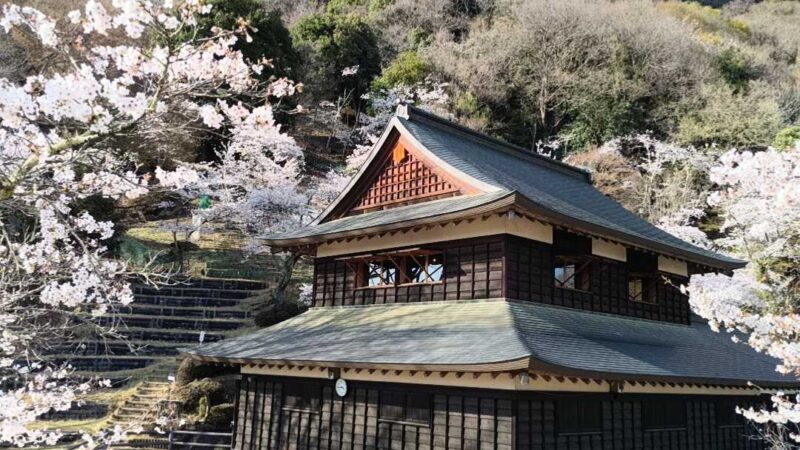
Shimoyama Castle, also known as “Anayama Clan Residence” or “Shimoyama Clan Residence,” is a flatland castle (residence) located in Shimoyama, Minobu Town, Minamikoma District, Yamanashi Prefecture. Built on a plain along the Hakii River, a tributary of the Fuji River, it was an important base controlling a key transportation hub in Kai Province. Currently, the Honkoku-ji Temple of the Nichiren sect stands on the castle site. While much of the original castle structure has been lost, its former size can be inferred from the layout and topography of the temple grounds. Within the temple grounds stands a large ginkgo tree, approximately 750 years old, said to have been planted by Nichiren himself, and designated a national natural monument.
Basic Castle Data
- Location: Shimoyama, Minobu-cho, Minamikoma-gun, Yamanashi Prefecture
- Alternate Names: Anayama Clan Residence, Shimoyama Clan Residence
- Castle Structure: Flatland Castle (Residence)
- Construction Period: Kennin Era (1201-1204)
- Builder: Shimoyama Mitsushige (Grandson of Kagami Tomomitsu)
- Main Lords: Shimoyama Clan, Anayama Clan
- Abandonment Period: Around Tensho 18 (1590)
- Current Status: Within the grounds of Honkoku-ji Temple
- Designated Cultural Property: The large ginkgo tree on the temple grounds is a nationally designated natural monument
History of Shimoyama Castle | From Kai Genji to Anayama Clan
Kamakura Period: Entry of the Shimoyama Clan and Construction of the Castle
The history of Shimoyama Castle dates back to the Kennin Era (1201-1204) in the early Kamakura period. The history of the Shimoyama clan is said to have begun when Mitsushige, the grandson of Kagami Tomomitsu (known as the ancestor of the Kai Genji clan), entered this area and adopted the name Shimoyama Kotaro Mitsushige.
Kagami Tomomitsu was a powerful warrior of the Kai Genji clan who enjoyed the deep trust of Minamoto no Yoritomo, and his family extended their influence widely throughout Kai Province. Mitsushige ruled the Shimoyama area and established his residence there, making it a base for regional control. The Shimoyama clan continued to maintain its power in this area, but historical records regarding their detailed lineage and activities are limited.
Muromachi Period: The Rise of the Anayama Clan
Around 1418 (Oei 25), the Anayama clan, a branch of the Takeda clan, entered the Kawachi region and is believed to have moved their base to the site of the Shimoyama clan’s residence. The Anayama clan originated with Takeda Nobutomo, the second son of Takeda Shinano-no-kami Nobunari, who adopted the name Anayama. As a powerful branch of the Takeda family, they controlled the southern part of Kai Province.
The details of the Anayama clan’s relationship with Shimoyama Castle and the subsequent changes are unclear, but it is believed to have been part of a relocation of positions due to the Takeda clan’s expansion. The Anayama clan controlled the Kawachi region from this base and deepened their relationship with Minobu-san Kuonji Temple.
Sengoku Period: The Anayama Clan’s Golden Age
During the Sengoku period, the Anayama clan played a prominent role as important retainers of Takeda Shingen. In particular, Anayama Nobukimi (Baisetsusai) married Takeda Shingen’s half-sister, holding a special position within the Takeda family. Anayama Nobukimi was counted as one of the Twenty-Four Generals of Takeda and was active in both diplomacy and domestic affairs.
While some theories suggest the Anayama clan’s base was moved to Ejiri Castle (Shimizu Ward, Shizuoka Prefecture), Shimoyama Castle is thought to have continued to function as one of the Anayama clan’s important strongholds. Its location, controlling the pilgrimage route to Minobu-san Kuonji Temple, held significant religious and economic importance.
After the Fall of the Takeda Clan and the Abandonment of the Castle
In 1582, when the Takeda clan was destroyed by the invasion of the Oda-Tokugawa allied forces, Anayama Nobukimi, who had been in league with Tokugawa Ieyasu from an early stage, had his territory secured. However, in the chaos of the Honnoji Incident in June of the same year, Nobukimi lost his life.
Since Nobukimi’s eldest son, Katsuchiyo, was still a child, Tokugawa Ieyasu’s fifth son, Takeda Nobuyoshi (Manchiyo), inherited the Anayama clan. In 1590, after Toyotomi Hideyoshi’s siege of Odawara, Tokugawa Ieyasu was transferred to the Kanto region, and Takeda Nobuyoshi was also transferred to Hitachi Province, forcing the Anayama clan to leave Kai Province. Consequently, it is believed that Shimoyama Castle ceased to function as a political center and was abandoned.
Edo Period and Beyond: Establishment of Honkoku-ji Temple
During the Edo period, Shimoyama lost its status as a political center, but it functioned as a post town on the Minobu Highway (Minobu Road), and records show that it had a main inn, wholesale merchants, and meeting hall.
Honkoku-ji Temple, a Nichiren Buddhist temple, was built on the castle site. As a temple associated with Nichiren Shonin, Honkoku-ji flourished as a stopover for pilgrims visiting Minobu-san Kuon-ji Temple. Within the temple grounds stands a large ginkgo tree said to have been planted by Nichiren Shonin himself, which still thrives today.
Structure and Layout of Shimoyama Castle
Shimoyama Castle was a flatland castle (residence) built on the plains along the Hakii River, part of the Fuji River system. Currently, because the site is the grounds of Honkoku-ji Temple, it is difficult to confirm clear castle remains, but its appearance in the past can be inferred from the topography and the layout of the temple grounds.
Location and Topography
Shimoyama Castle is located on a river terrace formed by the Hakii River, on the eastern side of the mountain range extending from Mount Minobu. It possesses typical residential site conditions, with mountains pressing in from behind and a river flowing in front. Its proximity to the main stream of the Fuji River also provided convenient water transport.
Furthermore, its strategic location controlling the pilgrimage route to Kuonji Temple on Mount Minobu made it a religiously and economically important point. Its location on a transportation route connecting the Kofu Basin and Suruga Province suggests its military importance as well.
Castle Scale and Remains
Shimoyama Castle was not a large mountain castle, but rather a flatland castle centered around the lord’s residence. The current Honkokuji Temple grounds are thought to roughly correspond to the castle area, and the area where the main hall, priest’s quarters, and temple gate are located is considered highly likely to have been the main enclosure.
While no clear remains of moats or earthworks exist today, the subtle topography and elevation changes around the temple grounds suggest that the area was once demarcated by moats and earthworks. Furthermore, there’s a possibility that castle-related names remain in the surrounding place names and hamlet names, making further detailed investigations necessary.
Defensive Structures and Castle Town
Shimoyama Castle, being a flatland castle, is thought to have primarily relied on defenses such as moats, earthworks, and fences. While it’s possible the mountainous area behind it was used as a fortified outpost, no clear remains of a mountain castle have been confirmed.
It’s presumed that the castle town consisted of residences for retainers and a residential area for townspeople, forming the basis of a post town during the Edo period. The townscape that developed along the Minobu Highway may retain remnants of a medieval castle town.
Honkoku-ji Temple and the Great Ginkgo Tree Associated with Nichiren Shonin
Choeizan Honkoku-ji Temple, built on the site of Shimoyama Castle, is a Nichiren Buddhist temple and a center of local faith. The greatest attraction at Honkokuji Temple is the magnificent ginkgo tree, a nationally designated natural monument, that stands tall within the temple grounds.
The Giant Ginkgo Tree Planted by Nichiren
This giant ginkgo tree is said to have been planted by Saint Nichiren himself in 1276 (Kenji 2) on his way to Mount Minobu. It is estimated to be approximately 750 years old, with a trunk circumference of about 12 meters and a height of about 30 meters.
It was designated a national natural monument in 1933 (Showa 8) and is protected as “Honkokuji Temple’s Ginkgo Tree.” In autumn, it displays a magnificent display of yellow foliage, attracting many worshippers and tourists. The tree remains vigorous and is known for bearing abundant fruit every year.
The History and Temple Buildings of Honkokuji Temple
The exact founding date of Honkokuji Temple is unclear, but it is believed that a temple was built on this site after Saint Nichiren entered Mount Minobu (Bun’ei 11, 1274). During the Edo period, it flourished as an important temple along the pilgrimage route to Minobu-san Kuon-ji Temple.
The temple grounds are well-maintained, with a main hall, living quarters, and a main gate, allowing visitors to worship in a tranquil atmosphere. The main hall houses a statue of Nichiren Shonin and memorial tablets of successive abbots.
Relationship with Kagami Tomomitsu
Honkoku-ji Temple is said to have ties to Kagami Tomomitsu, the ancestor of the Kai Genji clan. Since Tomomitsu’s grandson, Shimoyama Mitsushige, founded this area, it is thought that it also served as a memorial for the Kagami clan. There may be memorial towers or stone monuments related to the Kagami clan remaining on the temple grounds.
Highlights and Notes on Shimoyama Castle
Here’s a summary of the main highlights when visiting Shimoyama Castle.
1. Strolling through the Honkoku-ji Temple Grounds
The castle ruins are within the grounds of Honkoku-ji Temple, so you can freely stroll around. Walking around the temple grounds and imagining the layout of the former castle is one of the pleasures of visiting. The path leading from the main gate to the main hall may have been a passageway within the castle in its heyday.
2. The Great Ginkgo Tree, a Nationally Designated Natural Monument
The biggest highlight is undoubtedly the great ginkgo tree, said to have been planted by Nichiren Shonin himself. Its majestic presence, towering directly in front of you after passing through the main gate, is truly awe-inspiring. It is especially magnificent during the autumn foliage season (mid- to late November), when the temple grounds are bathed in golden light, creating a fantastical atmosphere.
3. Observing the Surrounding Topography
Walking around Honkokuji Temple and observing the topography allows you to understand the location conditions of the castle, such as the flat areas on the river terraces and the mountains behind. The scenery along the Hakii River is also beautiful, allowing you to imagine what the transportation routes were like in the past.
4. Stone Monuments and Information Boards
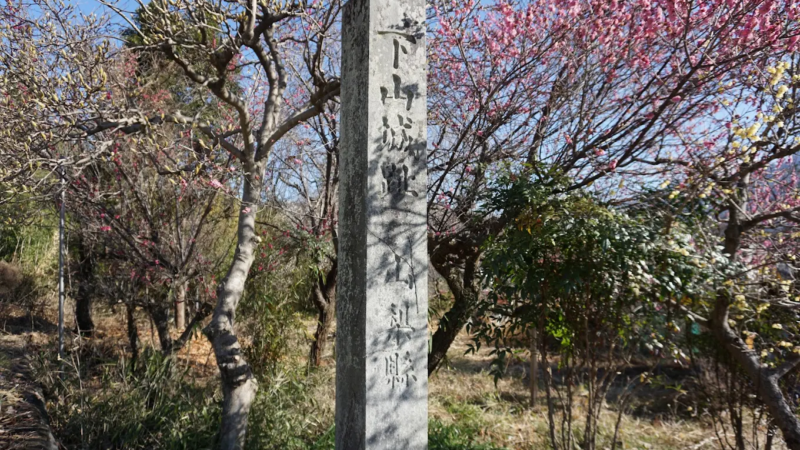
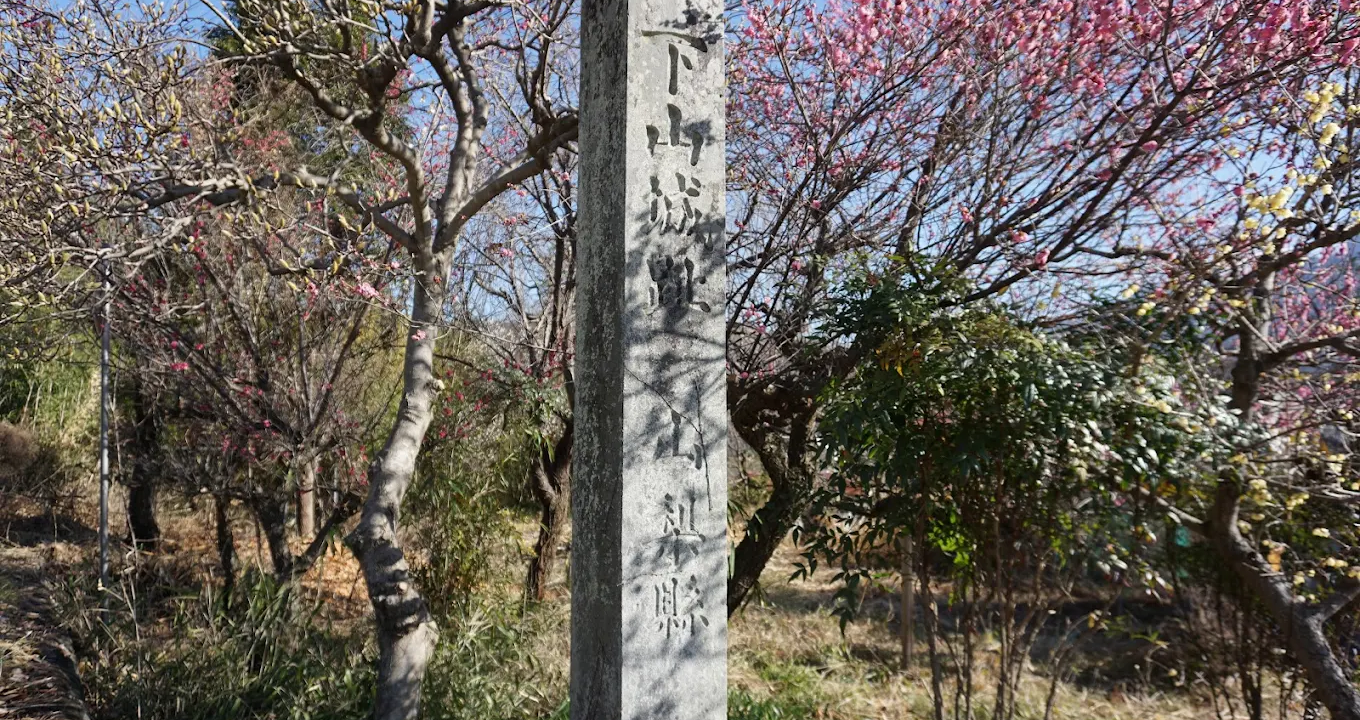
Within the temple grounds and surrounding area, you may find explanatory boards and stone monuments related to Shimoyama Castle, the Kagami clan, and the Anayama clan. You can learn about the historical background by examining these.
5. Traces of the Minobu Highway
The Shimoyama area retains traces of its past as a post town on the Minobu Highway during the Edo period. Walking around and searching for old streets, signposts, and stone lanterns is a fascinating experience.
Access Methods and Visiting Guide
Here are the main access methods to Shimoyama Castle (Honkokuji Temple).
Access by Public Transportation
Using the JR Minobu Line
- Walking from Hakoshima Station: Get off at Hakoshima Station on the JR Minobu Line, then walk for approximately 40 minutes (approx. 3 km).
- Using the Bus from Minobu Station: Get off at Minobu Station on the JR Minobu Line, take the town bus Minobu-Kajikazawa Line, get off at the “Yazawabashi” bus stop, then walk for approximately 3 minutes.
Since the number of town buses is limited, it is recommended to check the timetable in advance. You can check the latest timetable on the Minobu Town website.
Access by Car
- Chubu Trans-Japan Expressway: Approximately 20 minutes from Masuho Interchange via National Route 52.
- Chuo Expressway: Approximately 40 minutes from Kofu-Minami Interchange via National Route 52.
Honkoji Temple has a parking lot for visitors (spaces are limited, so caution is advised during busy times).
Notes for Visitors
- Honkokuji Temple is an active temple, so please observe proper etiquette when visiting.
- Photography is permitted within the temple grounds, but permission may be required for photography inside the main hall, etc.
- The temple may be crowded during the autumn foliage season of the large ginkgo tree (mid- to late November).
- In summer, the sun is strong, so it is recommended to bring a hat and drinks.
- In winter, there is a possibility of snow, so please check the weather beforehand.
Estimated Visit Time
If you only visit the grounds of Honkokuji Temple, it will take about 30 minutes to 1 hour. If you include exploring the surrounding area and the townscape of Minobu-kaido, it is recommended to allow 2 to 3 hours.
Nearby Tourist Spots and Castles
Here are some nearby tourist spots that you might want to visit along with Shimoyama Castle.
Minobu-san Kuonji Temple
Minobu-san Kuonji Temple, known as the head temple of the Nichiren sect, is about a 15-minute drive from Shimoyama Castle. This sacred site, where Nichiren Shonin spent his later years, is a must-see, boasting magnificent temple buildings and a grounds surrounded by abundant nature. The 287 stone steps leading from the main gate to the main hall, known as the “Bodhi Staircase,” are famous, and you can also ascend to the Okunoin Shishinkaku via ropeway.
Shimobe Onsenkyo
Located approximately 10km north of Shimoyama Castle, Shimobe Onsenkyo is a historic hot spring resort known as a secret hot spring used by Takeda Shingen. During the Sengoku period, it was used as a therapeutic bathing spot by the Takeda clan, and it’s possible the Anayama clan also used these hot springs.
Historical Sites Around Kai-Iwama Station
Around JR Minobu Line’s Kai-Iwama Station, there are numerous historical sites associated with the Takeda and Anayama clans. These include Eishoin Temple, the Anayama clan’s family temple, and the tomb of Lady Aburakawa (mother of Anayama Nobukimi), a concubine of Takeda Shingen.
Fujikawa Craft Park
Located in the southern part of Minobu Town, along the Fujikawa River, Fujikawa Craft Park is a comprehensive park with a vast area featuring outdoor facilities, a canoe area, a rose garden, and more. It’s ideal for family visits and offers stunning views of Mount Fuji.
Nearby Castles
Anayama Clan Residence Ruins (Ejiri Castle): The main castle of the Anayama clan, located in Shimizu Ward, Shizuoka City, Shizuoka Prefecture. A strategic point facing Suruga Bay, it was the base of operations for Anayama Nobukimi.
Ichikawa Jinya Ruins: The ruins of an Edo-period jinya (fortified residence) located in the northern part of Minobu Town. This was the site of the Ichikawa magistrate’s office.
Tanimura Castle (Tsuru City): A strategic point in eastern Kai Province, where a senior retainer of the Takeda clan served as castle lord. It’s approximately a 1.5-hour drive from Shimoyama Castle.
The Historical Significance of Shimoyama Castle and the Kai Genji/Anayama Clans
Shimoyama Castle is a valuable historical site that conveys the history of the Shimoyama and Anayama clans, both branches of the Kai Genji clan.
As a Base of the Kai Genji
The fact that Shimoyama Mitsushige, grandson of Kagami Tomomitsu, entered this area is evidence that the Kai Genji clan extended its influence widely throughout Kai Province. While many aspects of the Shimoyama clan’s detailed lineage remain unclear, they were an important local lord who continued to rule this area from the Kamakura period to the Muromachi period.
The Center of the Anayama Clan’s Control of Kawachi
The Anayama clan’s use of Shimoyama Castle as their base strengthened the Takeda clan’s control over the Kawachi region. The Anayama clan held a special position as a branch of the Takeda clan and also had religious authority through their relationship with Minobu-san Kuonji Temple.
Anayama Nobukimi possessed excellent diplomatic skills and was involved in negotiations with the Imagawa and Hojo clans. The decision to ally with Tokugawa Ieyasu at the time of the Takeda clan’s downfall was a desperate measure to ensure the survival of the family, but it ironically ended with their deaths in the chaos of the Honnoji Incident.
Relationship with Minobu-san Faith
Shimoyama Castle was located in a crucial position, controlling the pilgrimage route to Minobu-san Kuonji Temple. The Anayama clan also played a role as protectors of Minobu-san, and are believed to have contributed to the security of the temple’s lands and the development of its buildings. This relationship is an interesting example of territorial control backed by religious authority.
Materials and Research on Shimoyama Castle
While historical materials on Shimoyama Castle are limited, we can learn about its history from the following sources:
Major Historical Materials
- “Kai no Kuni Shi”: A local history of Kai Province compiled in the late Edo period. It includes descriptions of Shimoyama and the Anayama clan.
- “Minobu-cho Shi”: A town history compiled by Minobu Town. This document contains detailed descriptions of Shimoyama Castle, Honkoku-ji Temple, and the Anayama clan.
- “Kai no Kuni Shi”: A geographical record from the Meiji era. It records the history and traditions of the Shimoyama area.
- “Takeda Clan Related Documents”: Ancient documents related to the Takeda and Anayama clans. These are held in various archives and museums.
Related Research Books
- “Takeda Clan Retainer Biographical Dictionary”: A dictionary that provides detailed explanations of the Takeda clan’s retainers. It includes descriptions of the Anayama clan.
- “Castles of Kai” Series: A series of books introducing castles in Yamanashi Prefecture. Shimoyama Castle is also mentioned.
- “Studies on the Anayama Clan”: A research book specifically on the Anayama clan. While the content is specialized, it details their genealogy and activities.
Museums and Archives
Yamanashi Prefectural Museum (Fuefuki City): A museum that deals with the general history of Kai Province. It has exhibits related to the Takeda clan and the Kai Genji clan.
Minobu Town Nakatomi Contemporary Craft Museum: A museum located in Minobu Town. It also houses materials related to the region’s history.
Erinji Temple Treasure Hall (Koshu City): The treasure hall of Erinji Temple, the family temple of Takeda Shingen. Valuable materials related to the Takeda clan are on display.
Summary | The Charm of Visiting Shimoyama Castle
Shimoyama Castle (Minobu Town, Yamanashi Prefecture), although no clear castle remains exist, is a valuable historical site that conveys the history of the Kai Genji and Anayama clans. The current Honkokuji Temple grounds are blessed with a natural monument—a large ginkgo tree planted by Nichiren Shonin—making it a charming place where history and nature harmonize.
Visiting Shimoyama Castle in conjunction with a pilgrimage to Minobu-san Kuonji Temple will allow you to gain a deeper understanding of the history of southern Kai Province from the medieval to the early modern period. Especially during the autumn foliage season, the golden ginkgo tree welcomes visitors, creating an unforgettable experience.
This spot is recommended not only for castle enthusiasts, but also for those interested in Nichiren Buddhism and those who love ancient trees and nature. Why not spend some leisurely time in the tranquil grounds, reflecting on history?
Shimoyama Castle may not be flashy, but it is a deeply meaningful historical site where you can feel the footsteps of the warriors who supported the history of Kai Province. When visiting Yamanashi Prefecture, we highly recommend making a trip there.