A Thorough Explanation of the History and Highlights of Eboshigata Castle Ruins | Visiting the Strategic Site of the Seven Kusunoki Castles
Eboshigata Castle is a mountain castle dating from the medieval to the Sengoku period, located on the summit of Mt. Eboshigata in Kita-machi, Kawachinagano City, Osaka Prefecture. Built on a mountaintop approximately 182 meters above sea level, this castle is known as one of the seven Kusunoki castles built by Kusunoki Masashige and was designated a national historic site in January 2012. As a strategic point overlooking the Koya Kaido road, Eboshigata Castle played an important role from the Nanboku-cho period to the Sengoku period. This article provides a detailed explanation of the castle’s appeal, covering its history, structure, and highlights.
What is Eboshigata Castle? | Overview and Location
Eboshigata Castle Ruins are a medieval castle site located in the southern part of Kawachinagano City, Osaka Prefecture, just south of the confluence of the Ishikawa and Amamigawa rivers. Also known as “Oshigata Castle,” its name comes from the mountain’s shape resembling an eboshi (a type of traditional Japanese hat). The castle’s location is extremely strategic. To the east lies the Amami River, a tributary of the Ishikawa River, and to the west, the Ishikawa River flows northward, with the two rivers merging to the north. This topography means that the castle is surrounded on the east, west, and north by rivers that function as natural moats, leaving only the south open.
The Koya Road, connecting Kyoto/Sakai with Kii Province, runs along the eastern foot of Mount Eboshigata, while the Izumi Road runs to the south, and the Osawa Road branches off from the Koya Road. This strategic location at a crossroads for Izumi, Yamato, and Kii Provinces is the castle’s most distinctive feature.
Currently, the site is maintained as Eboshigata Park, a place of recreation for citizens. However, the remains of the castle are well-preserved, and it is valued as an important historical site for understanding the political and military history from the medieval to the early modern period.
History of Eboshigata Castle | From the Nanboku-cho Period to the Sengoku Period
Construction by Kusunoki Masashige and the Nanboku-cho Period
The history of Eboshigata Castle begins with its construction by Kusunoki Masashige during the Nanboku-cho period. Kusunoki Masashige is known as a warrior who responded to Emperor Go-Daigo’s uprising and contributed to the overthrow of the Kamakura Shogunate.
Kusunoki Masashige built several castles based in Kawachi Province, which were collectively known as the “Seven Castles of Kusunoki.” Eboshigata Castle functioned as a branch castle of Kami-Akasaka Castle and, along with Chihaya Castle and Akasaka Castle, played a part in the Kusunoki clan’s defense network. Its location, allowing for monitoring and control of the important Koya Kaido road, suggests it was a strategically and economically important base.
During the turbulent Nanboku-cho period, it functioned within the Kusunoki clan’s sphere of influence and became one of the Southern Court’s strongholds. Kusunoki Masashige’s strategy involved guerrilla tactics utilizing mountain castles, and it is presumed that Eboshigata Castle played a crucial role in that strategy.
From the Muromachi Period to the Sengoku Period
After the end of the Nanboku-cho period, Eboshigata Castle came under the control of the Hatakeyama clan. After the Ōnin War, it became a castle held by the Hatakeyama clan, the shugo (provincial governor), with vassals such as the Ishikawa and Kai-no-shō clans serving as castle guards.
The Kai-no-shō clan, also known as the Tachibana or Eboshigata clan, was a samurai group rooted in this region. Kai-no-shō Masaharu, in particular, is known as a Christian daimyo, illustrating a part of the religious history of Kawachi during the late Sengoku period.
During the Sengoku period, the influence of Oda Nobunaga and Hashiba (Toyotomi) Hideyoshi extended to Kawachi, and Eboshigata Castle also came under their control. During Toyotomi Hideyoshi’s time, it became a branch castle of Nakamura Kazushi, the lord of Kishiwada Castle, and is believed to have undergone renovations. However, it seems that it was rarely used in actual combat during this period.
Early Modern Period and Designation as a Historic Site
With the arrival of the Edo period, Eboshigata Castle was abandoned and lost its military function. Over the long term, the castle ruins came to be recognized as a regional historical heritage site.
In January 2012, Eboshigata Castle ruins were designated as a national historic site—the first such designation in Osaka Prefecture in 70 years—recognizing its importance in understanding the political and military history from the medieval to the early modern period. This designation officially acknowledged the historical value of Eboshigata Castle ruins, and efforts for preservation and utilization are underway.
Furthermore, it is positioned as a component cultural property of a Japan Heritage site, making it an important asset for conveying the region’s history and culture.
Eboshigata Castle’s Layout and Structure | Characteristics of a Mountain Castle
Defensive Structure Utilizing the Topography
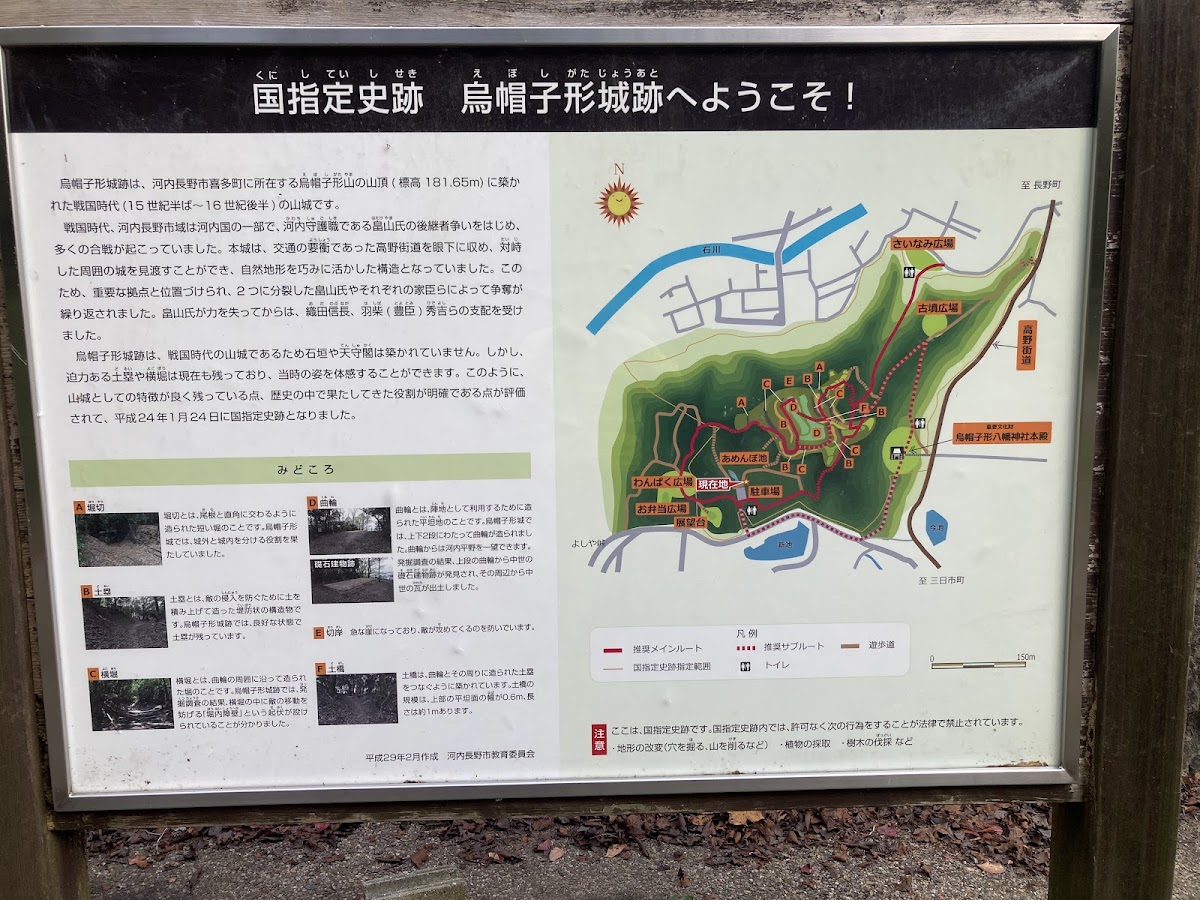
The most distinctive feature of Eboshigata Castle lies in its layout, which skillfully utilizes the natural terrain. Located on the summit of Eboshigatayama Mountain, approximately 180 meters above sea level, the castle is bordered by cliffs to the north and west, with the Ishikawa River flowing below. To the east, a river terrace extends, dropping into the Amamigawa River.
This topography allows the river to function as a natural moat on the east, west, and north sides, making enemy approach difficult. Only the south side is open, and the defensive focus was placed on this southern side.
The basic structure of the mountain castle is a central enclosure (honmaru) at the summit, surrounded by multiple smaller enclosures (kuruwa). The honmaru offered excellent views of surrounding castles and roads.
Details of the Remains
The following remains have been identified:
Honmaru (Main Enclosure): Located at the highest point on the mountaintop, this was the central part of the castle. From here, one could see the Ishikawa River basin and the Koya Road, and it functioned as a command post.
Horizontal Moat: A moat dug horizontally has been identified as a defensive feature of the castle. The moat served to prevent enemy intrusion and also functioned as a movement route within the castle.
Enclosures: Multiple enclosures were arranged around the main enclosure, forming a tiered defensive line. Each enclosure is thought to have been used for garrisoning soldiers and storing supplies.
Cliffs: Steep, artificially carved slopes are visible in various places, a design intended to make ascent difficult for the enemy.
It is presumed that renovations during the Sengoku period added more practical combat elements to the basic structure of a medieval mountain castle. However, it retains few elements of early modern castles, such as stone walls, and fundamentally maintains the characteristics of an earthen castle.
Relationship with Surrounding Facilities
The Eboshigata Hachiman Shrine is located on the eastern slope of the castle, indicating a relationship between the castle and the shrine. In medieval castles, shrines generally played an important role as guardian deities of the castle.
Furthermore, the Eboshigata Kofun (ancient burial mound) is located on the northern slope, indicating that this area was an important location since ancient times. The landscape, where Kofun period remains and medieval castles coexist, speaks to the multi-layered nature of Japanese history.
Highlights of Eboshigata Castle | Points to Note When Visiting Castle Ruins
View from the Main Enclosure
The greatest attraction of visiting Eboshigata Castle ruins is the view from the main enclosure. From the mountaintop at an altitude of 182 meters, you can enjoy a panoramic view of the Ishikawa River basin plains, the Koya Kaido road, and the surrounding mountains.
On a clear day, you can even see in the distance the direction of other castles built by Kusunoki Masashige, giving you a real sense of the Kusunoki clan’s castle network. This view is the most compelling evidence in understanding why a castle was built in this location.
Observation of the Remains
Within the castle ruins, remains from the medieval to Sengoku periods are well-preserved. By actually walking around and observing the main enclosure, baileys, moats, and cliffs, you can experience the structure and defensive ingenuity of the castle at that time.
The scale and placement of the moats, in particular, are crucial for understanding the defensive philosophy of this castle. Furthermore, the arrangement of the baileys, utilizing the undulations of the terrain, exhibits typical characteristics of medieval mountain castles.
Eboshigata Hachiman Shrine
Located on the eastern slope of the castle ruins, Eboshigata Hachiman Shrine is closely intertwined with the castle’s history. Climbing the path to the shrine allows you to experience the approach route to the castle.
From the shrine, you can overlook the Koya Kaido road, realizing its importance to the castle. Excellent views can also be enjoyed from the shrine grounds.
Scenery along the Koya Kaido Road
When visiting the Eboshigata Castle ruins, be sure to enjoy the scenery along the Koya Kaido road. The road in front of Eboshigata Hachiman Shrine is the former Koya Kaido road, a historical route traversed by many people from the medieval to early modern periods.
The view of Mount Eboshigata from the road is likely largely unchanged from the landscape seen by travelers of yesteryear. Viewing the castle from this perspective allows us to understand its role in monitoring the roads.
Value as a National Historic Site
Designated a National Historic Site in 2012, the Eboshigata Castle ruins are highly regarded academically as a typical example of a medieval mountain castle. Information boards and guides are provided, allowing visitors to learn in detail about the castle’s history and structure.
The fact that this is the first National Historic Site designation in Osaka Prefecture in 70 years speaks to the historical importance of these castle ruins. Its value as a regional historical heritage site and as a valuable resource for understanding Japanese medieval history will only continue to grow.
What are the Seven Kusunoki Castles? | The Position of Eboshigata Castle
The Seven Kusunoki Castles are a collective term for seven castles built by Kusunoki Masashige in Kawachi Province. Specifically, they are said to include Chihaya Castle, Kami-Akasaka Castle, Shimo-Akasaka Castle, Eboshigata Castle, Kongozan Castle, and Ryusen Castle, but there are various theories regarding the exact composition of the seven castles.
These castles were interconnected, forming a defensive network. Eboshigata Castle was positioned as a subsidiary castle of Kami-Akasaka Castle and played a role in monitoring the important Koya Kaido road.
Kusunoki Masashige’s strategy was to avoid direct confrontation on flat ground and instead confuse the large Kamakura Shogunate army with guerrilla tactics based in mountain castles. The Battle of Chihaya Castle is a prime example of this strategy, and the network of the seven Kusunoki castles supported this strategy.
When visiting Eboshigata Castle, checking the relative locations of the other seven Kusunoki castles on a map and understanding the Kusunoki clan’s defensive plan will allow you to enjoy history more deeply.
Access and Visiting Information for Eboshigata Castle Ruins
Location
Address: Kitamachi, Kawachinagano City, Osaka Prefecture
Access Methods
By Train:
- Approximately 15-20 minutes on foot from Kawachinagano Station on the Nankai Koya Line and Kintetsu Nagano Line
- Head south along the Koya Kaido road from the station towards Eboshigata Hachiman Shrine
By Car:
- Approximately 30 minutes from the Mihara Kita Interchange on the Hanwa Expressway
- There are a few parking spaces at Eboshigata Park, but spaces are limited, so using public transportation is recommended.
Visiting Information
Opening Hours: Eboshigata Park is always open to the public
Admission Fee: Free
Estimated Time Required: Allow 30 minutes to 1 hour to visit the castle ruins. If you want to carefully observe the remains, it will take longer.
Important Notes:
- As this is a mountain castle, we recommend wearing comfortable clothing and shoes.
- In summer, please remember to take precautions against insects, and in winter, please take precautions against the cold.
- Be careful as the ground can be slippery during and after rain.
- While there are explanatory signs and information boards, learning about the history beforehand will deepen your understanding.
Nearby Tourist Attractions
When visiting Eboshigata Castle Ruins, we recommend also visiting other historical sites and tourist attractions in Kawachinagano City.
Kanshinji Temple: A temple associated with Kusunoki Masashige, possessing many cultural assets, including the National Treasure, the main hall.
Kongoji Temple: An ancient Shingon Buddhist temple known as “Amanoyama,” with numerous important cultural properties.
Koya Kaido Road: Along this historic road, old townscapes and historical sites are scattered, making it ideal for a stroll.
Takihata Dam: A dam lake rich in nature, where you can enjoy the scenery of each season.
By combining these spots, you can enjoy a day filled with the history and nature of Kawachinagano.
Research and Preservation Activities of Eboshigata Castle Ruins
Since its designation as a national historic site, Eboshigata Castle Ruins have undergone continuous academic research and preservation activities. The Kawachinagano City Board of Education, in particular, has conducted archaeological excavations and surveys, deepening our understanding of the castle’s structure and history.
Research into medieval mountain castles relies heavily on the analysis of remains, as documentary sources are limited. Because the remains of Eboshigata Castle Ruins are well-preserved, it serves as a valuable case study for researching the history of castles from the medieval to the Sengoku period.
Preservation activities by local residents and volunteers are also active, including cleaning the castle ruins and maintaining the viewing paths. Furthermore, study sessions and tours are regularly held by local history enthusiast groups, making it a cherished local historical heritage site.
It is also positioned as a component cultural property of a Japan Heritage site, and its future use as a tourist resource is anticipated. As a site for history education, it is desirable that local children have more opportunities to learn about their local history.
The Significance of Visiting Eboshigata Castle | Experiencing History
Visiting the Eboshigata Castle ruins has significance beyond mere sightseeing. It is an opportunity to experience an important scene in Japanese medieval history and learn about the wisdom and ingenuity of our ancestors.
Standing in the castle actually built by the historical hero Kusunoki Masashige, and gazing at the scenery he must have seen, the history from textbooks becomes a living reality. The major currents of Japanese history—the turmoil of the Northern and Southern Courts, the conflicts of the Sengoku period, and the transition to the peaceful Edo period—can be deciphered from a single castle site.
Furthermore, the structure of the mountain castle, which skillfully utilizes the natural terrain, offers many insights for us today. The ingenuity in creating maximum defensive effectiveness within limited resources and technology may provide hints for considering a sustainable society.
The Eboshigata Castle ruins are also indispensable for understanding the history and culture of the Kawachinagano region. Located at a crucial transportation hub on the Koya Kaido road, and situated at a point connecting Izumi, Yamato, and Kii provinces, this castle symbolizes the historical importance of the region.
Preserved as a national historical site, the Eboshigata Castle ruins will be passed down to future generations. Understanding its value and actually visiting it to experience its history will be a valuable experience for us modern people.
Summary | Rediscovering the Charm of Eboshigata Castle Ruins
Eboshigata Castle Ruins is a mountain castle that played an important role from the Nanboku-cho period to the Sengoku period, as one of the seven castles built by Kusunoki Masashige. Located on the summit of Mount Eboshigata in Kawachinagano City, Osaka Prefecture, it was built on a natural stronghold nestled between the Ishikawa and Amamigawa rivers.
Its location overlooking the Koya Kaido road, its skillful layout utilizing the natural terrain, and the remains that tell the story of the historical transition from the medieval to the early modern period—all of these factors enhance the value of visiting Eboshigata Castle Ruins.
Designated a National Historic Site in 2012, the Eboshigata Castle Ruins, whose historical value has been officially recognized, will continue to be researched and preserved, and will be passed down to future generations as a valuable historical heritage of the region.
When you visit Kawachinagano, be sure to stop by the Eboshigata Castle Ruins and experience Japanese medieval history while reflecting on the era of Kusunoki Masashige. It will be a precious time to feel the weight of history through the view from the main enclosure, the remaining ruins, and the scenery.