A Complete Guide to the History and Highlights of Ayukai Castle (Shirataka Town, Yamagata Prefecture)
Ayukai Castle, located in Ayukai, Shirataka Town, Nishiokitama District, Yamagata Prefecture, is a flatland castle that skillfully utilizes the river terrace of the Mogami River. Built during the Oei era, it functioned as an important base in the Okitama region from the Sengoku period to the early Edo period. Even today, the remains such as earthworks and dry moats are well-preserved and it is protected as a Shirataka Town designated historical site.
This article comprehensively explains everything you need to know before visiting Ayukai Castle, including its history, highlights of the remains, access methods, and nearby tourist spots.
Overview of Ayukai Castle
Ayukai Castle (Ayukai-jo) was a Japanese castle located in Ayukai, Okitama District, Dewa Province (present-day Ayukai, Shirataka Town, Nishiokitama District, Yamagata Prefecture), and is also known as “Sakurakan.” This flatland castle was built on a tongue-shaped river terrace at an altitude of approximately 190-200 meters, utilizing the Mogami River as a natural moat.
Basic Information
- Location: Ayugai, Shirataka-cho, Nishiokitama-gun, Yamagata Prefecture
- Castle Structure: Flatland castle (multi-enclosure type)
- Year of Construction: Oei 3 (1396)
- Builder: Ayugai Narimune
- Main Lords: Ayugai clan, Nakajo clan (vassals of the Uesugi clan)
- Cultural Property Designation: Shirataka-cho designated historical site (main enclosure site)
- Altitude: Approximately 190-200 meters
- Relative Height: Approximately 20 meters
The castle made maximum use of the river terrace topography, combining natural fortifications with artificial defensive structures. Currently, the site consists of the grounds of Ayugai Hachimangu Shrine and surrounding fields and residential areas, but traces of its former appearance remain in various places.
History of Ayugai Castle
From Construction to the Ayugai Clan Era
Ayugai Castle is said to have been built in 1396 (Oei 3) by Ayugai Narimune. The Ayugai clan is considered to be a branch of the Nagai clan and had established their own independent power in the Okitama region. Initially, it is thought to have been a single-enclosure, square-shaped residence, but in response to the circumstances of the Sengoku period, the second and third enclosures were expanded, developing into a layout closer to a concentric ring.
Although the Ayugai clan were vassals of the Date clan, they maintained a high degree of independence and governed their own territory independently. As a powerful local lord in this region, they played an important role in the politics and military affairs of the Okitama region.
Under the Date Clan
During the Sengoku period, the Ayugai clan maintained their power from Ayugai Castle, while being subordinate to the Date clan. During the time when Date Masamune was based at Yonezawa Castle, the Ayugai clan functioned as important retainers of the Date clan.
In 1591, when Toyotomi Hideyoshi’s pacification of Oshu led to Date Masamune’s transfer from Yonezawa to Iwadeyama Castle (present-day Osaki City, Miyagi Prefecture), the Ayugai clan followed their lord. As a result, Ayugai Castle ceased to be under the control of the Ayugai clan.
Under the Control of Gamo Ujisato
After the Date clan’s transfer, when Gamo Ujisato took control of Aizu Kurokawa Castle (later Aizu-Wakamatsu Castle), Ayugai Castle came under the control of the Gamo clan. The Gamo clan governed a vast territory centered in Aizu, and Ayugai Castle was incorporated as part of their system of control.
However, in 1598, when Gamo Hideyuki (son of Ujisato) was demoted to Utsunomiya Castle, the Aizu domain faced another period of change.
The Uesugi Era
In 1598, when Uesugi Kagekatsu was transferred from Echigo Kasugayama Castle to Aizu with a domain of 1.2 million koku, the Nakajo clan, a senior retainer of the Uesugi clan, took up residence in Ayugai Castle as its castellan. The Nakajo clan were hereditary vassals of the Uesugi clan and were entrusted with governing the Okitama region.
In 1601, as a result of the Battle of Sekigahara, Uesugi Kagekatsu’s domain was reduced to 300,000 koku in Yonezawa, but Ayugai Castle remained under the control of the Uesugi clan. It is believed that the castle gradually lost its military function during the Edo period.
From the Early Modern Period Onward
Throughout the Edo period, the Ayugai area continued to exist as part of the Yonezawa Domain. After the Meiji Restoration, the Ayugai Hachimangu Shrine was built on the site of the abandoned Ayugai Castle, and the surrounding area was developed into farmland and residential land.
In October 1954, the towns of Arato, Ayugai, Higashine, Shirataka, Juo, and Sanso merged to form Shirataka Town, and the Ayugai area became part of it. Currently, the site of the main keep is protected as a Shirataka Town designated historical site and is carefully preserved as a local historical heritage.
The Layout and Structure of Ayugai Castle
A Castle with a Complete Fortification
Ayugai Castle is believed to have been a castle with a complete fortification encompassing not only the castle hill but also the entire town of Ayugai. It was designed to make maximum use of the tongue-shaped river terrace topography, utilizing the Mogami River as a natural moat.
Layout of Major Enclosures
Honmaru (Main Enclosure) Located at the summit of the castle mountain, it is now a designated historical site of Shirataka Town. It is believed that the most important defensive facilities were concentrated here, as it was the main enclosure.
Ninokuruwa (Second Enclosure) The area where the current Ayugai Hachimangu Shrine stands corresponds to the Ninokuruwa. It was an important enclosure protecting the Honmaru, and the water moat, dry moat, and earthworks around the shrine are well-preserved.
Sannomaru (Third Enclosure) Located further out, it is presumed to have covered a wide area including the castle town.
Defensive Facilities
Ayugai Castle featured defensive facilities typical of castles from the medieval to early modern periods.
- Earthworks: Earthen embankments surrounding the enclosure, preventing enemy intrusion and allowing for the construction of fences and walls on top to enhance defense.
- Dry Moats: Moats without water, functioning as obstacles to hinder enemy advances.
- Water Moats: Moats filled with water, offering a higher defensive effect.
- River Terraces: Utilizing natural steep slopes, these created terrain that was difficult for attackers to climb.
Remaining Structures and Points of Interest
Remains Around Ayugai Hachimangu Shrine
Currently, the central remains of Ayugai Castle are concentrated within and around the grounds of Ayugai Hachimangu Shrine. The following remains are well-preserved in this area, which corresponds to the second enclosure:
Earthworks
Clear earthworks still exist around the shrine grounds. While their height varies depending on the location, they are valuable remains that convey the defensive line of the time. Walking along the earthen ramparts allows you to truly appreciate the scale and structure of the castle.
Dry Moats Several traces of dry moats can be found around Ayugai Hachimangu Shrine. While some have been filled in or altered, other sections clearly retain the shape of the moats.
Water Moat Remains Traces of moats that once held water also remain. Although some areas are now dry, the topography allows you to imagine their former appearance.
Main Enclosure Site
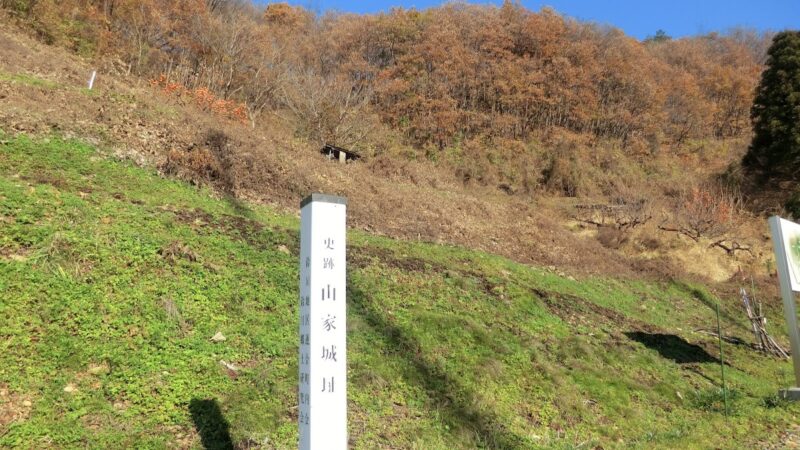
The main enclosure site, designated a historical site by Shirataka Town, is located at the highest point of the castle hill. Currently, it is a flat area, with some parts used for farmland and residential areas, but the shape of the enclosure is relatively well preserved.
From the main enclosure, you can enjoy panoramic views of the surrounding area, including the Mogami River and the Okitama Basin. You can truly appreciate how militarily important this location was.
River Terrace Topography
The most distinctive feature of Ayugai Castle is its layout, which skillfully utilizes the river terrace. The steep slope facing the Mogami River served as a natural fortress. When visiting the castle ruins, paying attention to this topographical feature can help understand the intentions and strategies of the castle’s builders.
About Ayugai Hachimangu Shrine
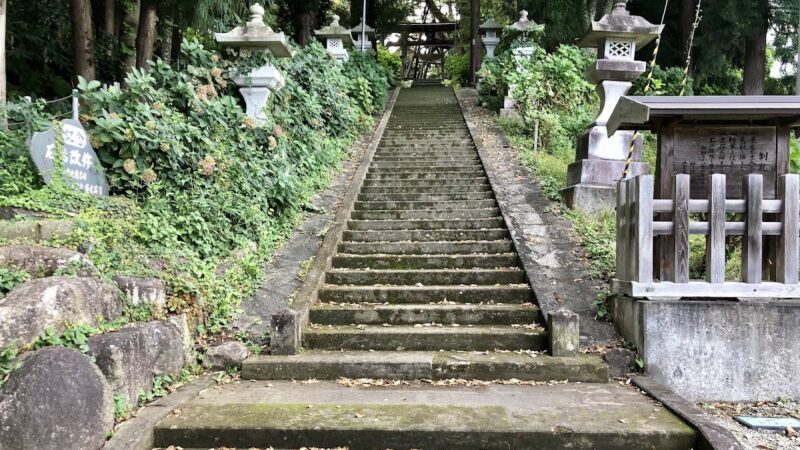
Ayugai Hachimangu Shrine, located on the site of the second bailey of Ayugai Castle, remains a cherished center of local faith. When visiting the castle ruins, you can combine a visit to the shrine with a tour of the remains.
The shrine grounds are well-maintained, and a parking lot for visitors is available. It’s an ideal starting point for exploring the castle ruins.
Access Information
Access by Public Transportation
Using the Yamagata Railway Flower Nagai Line
- Nearest Station: Shiki-no-Sato Station
- Approximately 9 minutes on foot from the station to Ayugai Hachimangu Shrine
- The Yamagata Railway is a local line connecting Akayu Station and Arato Station, offering tranquil rural scenery.
Access by Car
Using the Tohoku Chuo Expressway
- Approximately 38 minutes from Yonezawa Kita IC
- Via National Route 287 and Prefectural Roads towards Shirataka Town
From Yamagata City
- Via National Route 458 and National Route 287
- Travel Time: Approximately 50 minutes
Parking
- Parking is available for visitors to Ayugai Hachimangu Shrine
- Free of charge
Address and Navigation Settings
- Address: Ayugai, Shirataka Town, Nishiokitama District, Yamagata Prefecture
- Car Navigation Settings: Searching for “Ayugai Hachimangu Shrine” is convenient.
Nearby Tourist Attractions
When visiting Ayugai Castle, we recommend also visiting other tourist attractions in Shirataka Town and the Okitama region.
Miyama Kannon-do (National Important Cultural Property)
The Miyama Kannon-do in the Ayugai area is a valuable building designated as a National Important Cultural Property. It is a valuable cultural asset that preserves the architectural style of the Muromachi period, and a historical site worth visiting along with Ayugai Castle.
Sokushinbutsu (Self-Mummified Buddha)
Shirataka Town has a temple that enshrines a Sokushinbutsu, a rare sight in Japan. It is a valuable resource for understanding Japanese religious culture.
Meoto Kannon (Married Couple Kannon)
The Meoto Kannon is also known as a historical site passed down in the region. It is a spot where you can feel the history and culture of the Ayugai area.
Mogami River
The Mogami River, which flows very close to Ayugai Castle, is a major river representing Yamagata Prefecture. You can enjoy the beautiful scenery of each season. ### Shirataka Yana Park Roadside Station
This roadside station offers local specialties and gourmet food from Shirataka Town. Ayu (sweetfish) dishes are a specialty, making it an ideal rest stop for tourists.
Points to Note and Manners When Visiting
Precautions When Visiting
- Consideration for Private Property: Part of the castle ruins is private property. Please do not enter areas marked as “No Entry.”
- Manners at the Shrine: Ayugai Hachimangu Shrine is an active shrine. Please observe proper etiquette when visiting the site.
- Protection of Historical Remains: Please be careful not to damage the remains such as earthworks and moats.
- Take Your Trash Home: Please be sure to take your trash home with you.
Suitable Attire for Visiting
- Comfortable walking shoes (sneakers or hiking boots)
- Seasonal attire (hat and sunscreen in summer, warm clothing in winter)
- Rain gear (weather can change quickly in this area)
Photography
Photography of castle ruins and historical remains is generally permitted, but please avoid photographing inside the main hall of a shrine or on private property, or obtain permission beforehand.
About Shirataka Town
Shirataka Town is located in the southern part of Yamagata Prefecture, at the northern edge of the Okitama region. It was formed in October 1954 through the merger of one town and five villages: Arato Town, Ayugai Village, Higashine Village, Shirataka Village, Juo Village, and Sanso Village.
Geography and Nature
The town is blessed with abundant nature, with the eastern part surrounded by the Shirataka Hills and the western part by the Asahi Mountains, and the Mogami River flowing through its center. Beautiful scenery can be enjoyed throughout the seasons, and many tourists visit, especially during the cherry blossom season in spring and the autumn foliage season.
Culture and History
Numerous historical sites remain, including Ayugai Castle, and it also possesses nationally designated important cultural properties such as the Miyama Kannon-do Temple. It is also known as a safflower producing area, and once prospered from the safflower trade.
The Charm and Historical Value of Ayugai Castle
Ayugai Castle is an important historical site for understanding the history of castles in the Tohoku region from the medieval to the early modern period. Its layout utilizing river terraces, its comprehensive castle structure, and its history of being ruled by powerful Tohoku daimyo such as the Date, Gamo, and Uesugi clans tell the story of the region’s political and military history.
The well-preserved earthworks and dry moats are valuable historical relics that convey the castle-building techniques of that era. Furthermore, the fact that the site is now a place of worship, known as Ayugai Hachimangu Shrine, is evidence that the castle ruins continue to live on within the history and culture of the region.
Model Course for Visiting the Castle Ruins
Standard Course (Estimated Time: Approx. 1 hour)
- Ayugai Hachimangu Shrine Parking Lot (Starting Point)
- Visit Ayugai Hachimangu Shrine (15 minutes) – View the remains of the second bailey
- View the surrounding earthworks and dry moats (20 minutes) – Stroll around the remains of the shrine
- Move to the main bailey (10 minutes)
- Visit the main bailey (15 minutes) – Check the view and the shape of the bailey
- Return to the parking lot (10 minutes)
In-depth Course (Estimated Time: Approx. 2 hours)
In addition to the standard course, the following are added:
- Stroll through the castle town area
- Visit Miyama Kannon-do Temple
- Visit surrounding historical sites
- Enjoy the scenery of the Mogami River
Summary
Ayugai Castle is a valuable medieval castle ruin remaining in Shirataka Town, Yamagata Prefecture. Since its construction in 1396, Ayugai Castle served as the residence of the Ayugai clan and later as an important strategic point in the Okitama region under the rule of powerful daimyo such as the Date, Gamo, and Uesugi clans.
The castle’s layout, skillfully utilizing the river terrace, the remaining earthworks and dry moats, and the history and faith preserved through the Ayugai Hachimangu Shrine offer many attractions to visitors.
Its convenient access, within walking distance of Shiki-no-Sato Station on the Yamagata Railway Flower Nagai Line, is another draw. When visiting Shirataka Town, be sure to visit Ayugai Castle ruins and experience the history of the Okitama region. Combining your visit with a stroll through the surrounding Miyama Kannon-do Temple and the scenery of the Mogami River will make for a more fulfilling historical walk.
The castle ruins are carefully preserved by the local people. When visiting, please observe proper etiquette and help ensure that this valuable historical heritage is passed on to future generations.