Annaka Castle (Gunma Prefecture): A Complete Guide to its History and Highlights | From the Sengoku Period to the Edo Period
What is Annaka Castle?
Annaka Castle (Annaka-jo) is a Japanese castle located in Annaka, Annaka City, Gunma Prefecture, that existed from the Sengoku period to the Edo period. Built in Usui District, Kozuke Province, this castle functioned as the administrative center of the Annaka Domain during the Edo period and has left its mark on history as an important base in western Kanto.
It is also known as Ogi-jo (Fan Castle), a name derived from the fact that the castle grounds spread out like a fan in three directions (east, west, and south) from the main keep (honmaru). Currently, the site of the main keep is occupied by the Annaka City Cultural Center and Annaka Elementary School, making it a historical spot where you can imagine the remnants of the former castle.
History of Annaka Castle
Castle Construction and the Annaka Clan in the Sengoku Period
The construction of Annaka Castle is believed to have begun in Eiroku 2 (1559), by Annaka Shigehisa (Tadamasa). The Annaka clan were local powerful families who settled in the area. A helmet owned by Nukisaki Shrine (Ichinomiya, Tomioka City, Gunma Prefecture) bears the inscription “Annaka Miyauchi Daisuke Akihisa, Eisho 4 (1507),” suggesting that they had established a certain level of power at least by the Muromachi period.
The background to Annaka Tadamasa’s construction of Annaka Castle was preparation against Takeda Shingen, who had been invading western Kozuke Province since around the Koji era. Tadamasa built Annaka Castle, appointed his eldest son Tadanari as its lord, and renovated Matsuida Castle to prepare for a siege. This strategic arrangement was designed with defense against the Takeda clan’s invasion route from the Usui Pass area in mind.
Surrender to the Takeda Clan and the End of the Annaka Clan
However, faced with the formidable military power of Takeda Shingen, the Annaka clan was ultimately forced to surrender. Tadanari surrendered to the Takeda clan, changed his name to Annaka Kageshige, and became a vassal of the Takeda. During this period, Annaka Castle came under the control of the Takeda clan and became one of the Takeda’s strongholds in Kōzuke Province.
The turning point in their fate was the Battle of Nagashino in 1575. Annaka Kageshige fought alongside Takeda Katsuyori but was killed in this battle. No one, including Kageshige, returned to Annaka, and the Annaka clan effectively became extinct. Having lost its lord, Annaka Castle was abandoned and entered a period of decline.
Tokugawa Ieyasu’s Entry into the Kanto Region and the Ii Family’s Entry into the Castle
In 1590, after Toyotomi Hideyoshi’s siege of Odawara, Tokugawa Ieyasu entered the Kanto region. At this point, Annaka Castle was still in ruins, but in 1614, a major turning point occurred.
Ii Naokatsu (Naotsugu), the eldest son of Ii Naomasa, one of the Four Heavenly Kings of Tokugawa, was granted the 30,000 koku domain of Annaka and rebuilt Annaka Castle, making it his residence. This officially established the Annaka Domain, and Annaka Castle began a new chapter in its history as a modern castle.
Along with the castle’s renovation, Ii Naokatsu also developed the castle town, and Annaka flourished as a post town on the Nakasendo road, near the Usui Pass.
Changes in Successive Domain Lords
The Annaka Domain experienced several changes in domain lords throughout the Edo period. Following the Ii family, the Mizuno family took over, and several other fudai daimyo families served as lords of the domain.
Particularly notable lords include Hotta Masatoshi and Itakura Katsukiyo. Both served as Rōjū (senior councilors) in the Edo shogunate, indicating the importance of the Annaka Domain as a territory of a fudai daimyo holding a key position in the shogunate.
Hotta Masatoshi wielded considerable power as a Rōjū of the rank of Tairō (great elder), and under his rule, the Annaka Domain maintained stable administration. Itakura Katsukiyo also participated in shogunate politics as a Rōjū, further enhancing the prestige of the Annaka Domain.
With the abolition of the feudal domains and establishment of prefectures in 1871 (Meiji 4), the Annaka Domain was abolished, and Annaka Castle ceased to serve its purpose.
Structure and Layout of Annaka Castle
Characteristics as a Flatland Castle (Cliffside Castle)
While Annaka Castle is classified as a flatland castle, it is more accurately described as a cliffside castle. This type of castle is built on the edge of a plateau, protected on one side by cliffs or steep slopes, and defended on the other by artificial moats and earthworks.
In the case of Annaka Castle, the Tsukumo River flows to the north, and its river terraces provided a natural stronghold. This topographical advantage allowed for effective defense with relatively few artificial defensive structures.
Structure of Annaka Castle in the Early Modern Period
In the early modern period, Annaka Castle had a three-tiered structure: Honmaru (main enclosure), Ninomaru (second enclosure), and the residences of retainers.
The Honmaru was the central part of the castle where the lord’s residence was located, corresponding to the current Annaka City Cultural Center and Annaka Elementary School buildings. The lord’s residence and administrative functions were concentrated here.
Ninomaru (the second enclosure) is located in the southern part of the elementary school grounds and contained several storehouses. It is believed that important facilities for storing the domain’s supplies, such as rice granaries and armories, were concentrated here.
A notable characteristic of Annaka Castle is the lack of a keep. The palace was thatched, making it a castle built in the style of a jinya (fortified residence). This indicates that the castle was sized appropriately for its 30,000 koku (rice production) yield, and its structure prioritized practicality over the large stone walls and turrets of early modern castles.
Fan-shaped layout
The layout, which gave the castle its nickname “Ogi-jo” (Fan Castle), was such that the main palace was likened to the pivot point of a fan, with the castle grounds spreading out in three directions—east, west, and south—like a fan. This design is thought to have been a clever way to efficiently utilize the limited flat land while balancing defensive capabilities and habitability.
Earthworks and moats surrounded the castle grounds, and these defensive structures formed the castle’s outline. Parts of the earthworks can still be seen as part of the topography today, providing clues to the castle’s structure in its heyday.
Current Highlights of Annaka Castle Ruins
Current State of Remains
The current site of Annaka Castle’s main keep is now occupied by the Annaka City Cultural Center and Annaka Elementary School, and very few remains of the castle as a structure. Many castle facilities were lost due to modernization and urban development after the Meiji Restoration.
However, signboards and stone monuments indicating the castle’s site have been installed, serving as historical markers indicating the former presence of a castle. Furthermore, remnants of the castle town era can be seen in the topography and town layout, offering history enthusiasts the pleasure of imagining what it was like in its heyday.
Traces of Earthworks and Moats
Parts of the earthworks are relatively well-preserved remains of Annaka Castle. Slight traces of the earthworks can be seen as part of the topography around Annaka Elementary School and the Cultural Center.
Regarding the moat, although it has been completely filled in, there are places where the original moat’s location can be estimated using roads and property boundaries. Specialized websites such as “Castle Wanderings” provide detailed information on the locations of these remains.
Yaegafuchi and Karabaiin Temple
As historical sites related to Annaka Castle, there are Yaegafuchi and Karabaiin.
Yaegafuchi was a deep pool located north of Annaka Castle, along the Tsukumo River, and is thought to have functioned as part of the castle’s defensive structure. Although its original form has been lost due to river improvements, the name remains as a place name.
Karabaiin is a temple located in Annaka City, containing the graves of the Annaka domain lords and their retainers. In particular, gravestones related to the Ii family remain, making it an important historical site for commemorating the history of Annaka Castle. The temple also preserves materials related to the history of the Annaka domain, making it worthwhile to visit in conjunction with a visit to the castle ruins.
Annaka City Cultural Center
The Annaka City Cultural Center, built on the site of the castle’s main keep, occasionally holds exhibitions related to Annaka Castle and the Annaka Domain. While not a permanent exhibition, it sometimes features special exhibitions showcasing the history of Annaka Castle and excavated artifacts, so it’s a good idea to check before visiting.
Access and Tourist Information
Access by Train
The nearest station to the Annaka Castle ruins is Annaka Station on the JR Shin’etsu Main Line. It’s about a 15-minute walk from the station to the castle ruins (Annaka City Cultural Center). Head northwest from the station, passing through the center of Annaka City, and you’ll arrive at the cultural center.
Alternatively, it’s about a 20-minute taxi or bus ride from Annaka-Haruna Station on the JR Hokuriku Shinkansen. However, Annaka-Haruna Station is further from the city center, so using Annaka Station is more convenient for visiting the castle ruins.
Access by Car
If you are visiting by car, it is approximately 10 minutes from the Matsuida-Myogi Interchange on the Joshinetsu Expressway, or approximately 15 minutes from the Usui-Karuizawa Interchange. The Annaka City Cultural Center has ample free parking.
For car navigation, it is convenient to set “Annaka City Cultural Center” (3-9-63 Annaka, Annaka City, Gunma Prefecture) as your destination.
Precautions During Visits
Since the Annaka Castle Ruins are located on the grounds of a public facility (Cultural Center) and a school (Annaka Elementary School), please note the following points when visiting:
- Avoid entering the elementary school grounds during class hours.
- Many of the remains are preserved as topographical features, so research their locations beforehand.
- Use signposts and stone monuments as landmarks when exploring.
- Remember to be considerate of your surroundings when taking photographs.
Nearby Tourist Attractions
There are several related historical sites and tourist attractions scattered around the Annaka Castle Ruins.
Matsuida Castle Ruins is a castle that was renovated and defended by Annaka Tadamasa, who built Annaka Castle. It is a historical site worth visiting along with Annaka Castle. It is located in the western part of Annaka City, near Usui Pass.
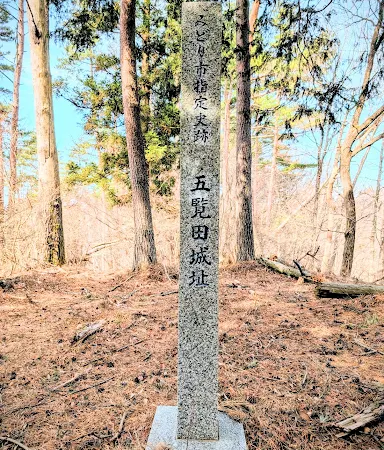
Gokan Castle Ruins is also a medieval castle located within Annaka City. It was the residence of a powerful clan associated with the Annaka clan. It is a historical site that is useful for understanding the history of Annaka Castle.
Usui Checkpoint Ruins is an important checkpoint on the Nakasendo road and a spot where you can learn about the transportation history of the Edo period. It is about a 15-minute drive from Annaka Castle.
Megane Bridge (Usui Third Bridge) is a railway heritage site from the Meiji era and is designated as a National Important Cultural Property. This beautiful brick arch bridge is a representative tourist attraction of Annaka City.
Annaka Castle Notes (Points of Interest)
The points of interest when visiting Annaka Castle are summarized below.
- Topography of the Main Enclosure Site: The layout of the Cultural Center and Elementary School allows us to imagine the scale of the main enclosure in its heyday.
- Traces of Earthworks: The remaining earthworks allow us to understand the castle’s defensive structure.
- Fan-Shaped Castle Town: The fan-shaped layout remains in the current town plan.
- Tombs of Tobai-in Temple: The tombs of the Annaka domain lords and their retainers allow us to reflect on the domain’s history.
- Information Boards and Stone Monuments: Historical explanations are installed throughout the castle ruins.
- Legend of Yaegafuchi: Remnants of a natural terrain used for the castle’s defense.
Although no castle structures remain, by combining these elements, we can imagine what Annaka Castle looked like from the Sengoku period to the Edo period.
The Battle of Annaka Castle with Takeda Shingen
The battle with Takeda Shingen is indispensable when discussing the history of Annaka Castle.
Between the Kōji era (1555-1558) and the Eiroku era (1558-1570), Takeda Shingen intensified his invasion of Kōzuke Province. For the Takeda clan, who had pacified Shinano Province, controlling Kōzuke, a route to the Kantō region, was a crucial strategic objective.
Annaka Tadamasa built Annaka Castle in preparation for this Takeda invasion. Tadamasa’s strategy was a dual defense system: he placed his eldest son, Tadanari, at Annaka Castle while he himself defended Matsuida Castle to the west. Matsuida Castle, located east of the Usui Pass and on the main route from Shinano to Kōzuke, became the front line against the Takeda army’s advance.
However, Takeda Shingen’s military pressure was immense, and the Annaka clan ultimately surrendered to the Takeda. This surrender was not simply a defeat, but rather the establishment of a “subordinate relationship,” a common occurrence among Sengoku daimyo at the time. Tadanari Annaka changed his name to Kageshige Annaka and became a retainer of the Takeda clan, playing a key role in the Takeda army.
During this period, Annaka Castle functioned as one of the Takeda clan’s bases for controlling Kōzuke Province. The Takeda clan established several branch castles in western Kōzuke Province, expanding their influence into the Kanto region.
The Battle of Nagashino in 1575 was a turning point for the Annaka clan. In this battle, where the Oda-Tokugawa allied forces clashed with the Takeda army, Kageshige Annaka fought alongside Katsuyori Takeda and was killed in action. Not only Kageshige, but many of the Annaka family’s key retainers were also killed, effectively ending the Annaka clan’s lineage.
Due to this tragic outcome, Annaka Castle lost its lord and was temporarily abandoned. The Takeda clan’s power also declined after the Battle of Nagashino, and in 1582, the Takeda clan was destroyed in the Oda-Tokugawa allied conquest of Kai Province. ## The Ii Family and the Reconstruction of Annaka Castle
In 1590, after Toyotomi Hideyoshi’s siege of Odawara, Tokugawa Ieyasu was transferred to the Kanto region. Ieyasu ruled over 2.5 million koku in Kanto and established a system of control over the region by placing his senior retainers throughout.
At this time, Ii Naomasa, one of the Four Heavenly Kings of Tokugawa, was granted 120,000 koku in Minowa, Kozuke Province. Naomasa made Minowa Castle his residence, but due to his military achievements in the Battle of Sekigahara in 1600, he was granted an increased stipend and transferred to Sawayama in Omi Province with 180,000 koku.
Ii Naokatsu (Naotsugu), the eldest son of Ii Naomasa, initially resided with his father in Sawayama, but in 1614, he was granted 30,000 koku in Annaka, Kozuke Province, becoming an independent daimyo. Naokatsu rebuilt the dilapidated Annaka Castle and developed it as his residence.
This reconstruction transformed Annaka Castle into a modern castle. Naokatsu not only focused on repairing the castle but also on developing the castle town. He strengthened its function as a post town on the Nakasendo road and promoted commercial development. He also implemented a modern urban plan, systematically arranging the residences of his retainers and clearly separating samurai and merchant districts.
Under Ii Naokatsu’s rule, the Annaka Domain established a foundation for stable administration. Although Naokatsu was transferred to the Takada Domain in Echigo Province with an increased stipend of 150,000 koku in 1632, his short tenure in Annaka Castle, during which he formed the framework of Annaka Castle and its castle town, greatly contributed to the subsequent development of the Annaka Domain.
Successive Lords and Administration of the Annaka Domain
Throughout the Edo period, the Annaka Domain was ruled by several fudai daimyo families. Let’s look at the changes in the main ruling families. ### Ii Family Era (1614-1632)
Ii Naokatsu established the Annaka Domain as its first lord. Born as the eldest son of his father, Naomasa, Naokatsu was initially expected to inherit the Ii family headship. However, due to his frail health, he relinquished the headship to his younger brother, Naotaka, and established himself as the independent lord of the Annaka Domain. Naokatsu’s reign lasted approximately 18 years, during which time he laid the foundation for the castle and its surrounding town.
Mizuno Family Era
After the Ii family, the Mizuno family took over. The Mizuno family was a prestigious hereditary family known as the family of Oda-no-kata, the mother of Tokugawa Ieyasu. During the Mizuno era, the Annaka Domain’s administration became more stable.
Hotta Family Era
The period when Hotta Masatoshi became the lord of the Annaka Domain is a particularly noteworthy era in the domain’s history. Masatoshi Hotta was appointed to the position of Rōjū (senior councilor) in 1680 (Enpō 8), a position equivalent to that of a Grand Elder, and played a central role in the shogunate’s administration. During the reigns of the fourth shogun, Ietsuna, and the fifth shogun, Tsunayoshi, Masatoshi led the shogunate’s administration and promoted political reforms known as the “Tenna Reforms.”
However, in 1684 (Jōkyō 1), he met a tragic end, being assassinated by the Wakadoshiyori (junior councilor) Masayasu Inaba within Edo Castle. This incident is remembered as one of the largest assassinations of a shogunate official throughout the Edo period.
The Itakura Family Era
Katsukiyo Itakura also served as Rōjū, elevating the status of the Annaka Domain. The Itakura family was a lineage that held important positions in the shogunate for generations and is known for hereditary succession as Kyoto Shoshidai (Kyoto Deputy). With Katsukiyo Itakura’s appointment as Rōjū, the Annaka Domain established its position as an important Fudai (hereditary) domain of the shogunate.
Other Lords
In addition to the Naito and Matsudaira families, several other fudai daimyo families also served as lords of the Annaka Domain. Although a relatively small domain with a 30,000 koku (unit of rice production) yield, its strategic location on the Nakasendo road made it strategically important to the shogunate.
With the abolition of the feudal domains and establishment of prefectures in 1871 (Meiji 4), the Annaka Domain was abolished and incorporated into Gunma Prefecture via Annaka Prefecture.
Annaka Castle and the Surrounding Castle Network
Annaka Castle did not exist in isolation, but was part of a defensive network coordinating with surrounding castles.
Relationship with Matsuida Castle
Matsuida Castle is a mountain castle located approximately 8 km west of Annaka Castle and was an important base protecting the eastern side of Usui Pass. The strategic relationship between the two castles can be understood from the fact that when Annaka Tadamasa built Annaka Castle, he himself renovated and defended Matsuida Castle.
Matsuida Castle was a full-fledged mountain castle built on a mountaintop approximately 470 meters above sea level, serving as a frontline base to repel enemies invading over the Usui Pass. Annaka Castle, on the other hand, was a flatland castle that served as a base for rear support and domain administration, suggesting a mutually complementary relationship between the two castles.
During the Edo period, the Matsuida Domain was established on the site of Matsuida Castle, existing as a separate domain from the Annaka Domain. As neighboring domains along the Nakasendo road, the two domains cooperated in areas such as road management.
Relationship with Gokan Castle
Gokan Castle is a medieval castle located in the northern part of Annaka City. It was the residence of the Gokan clan, a local powerful family, and is presumed to have been either allied with or subordinate to the Annaka clan.
Gokan Castle is a relatively small castle, but it may have played a role as a subsidiary castle protecting the northern part of Annaka Castle. In medieval Kōzuke Province, such local powerful families formed a network of castles to resist external enemies.
Relationship with Minowa Castle
Minowa Castle is a large mountain castle located east of Annaka City, in what is now Misato-cho, Takasaki City. During the Sengoku period, it was the central castle of the Nagano clan and a key stronghold in Kōzuke Province.
During Takeda Shingen’s invasion of Kōzuke, Minowa Castle was defended by Nagano Narimasa and his son Narimasa, who repelled numerous attacks from the Takeda army. However, in 1566, Narimasa was killed in battle, and Minowa Castle fell.
While Annaka Castle and Minowa Castle faced the common threat of the Takeda clan’s invasion of Kōzuke, they ultimately met different fates. Minowa Castle became an important base for the Takeda clan, and later, Sanada Masayuki served as its castellan, making it the center of the Takeda clan’s control of Kōzuke.
Legends and Anecdotes about Annaka Castle
The Legend of Yaegafuchi
The Tsukumo River, which flows north of Annaka Castle, had a deep pool called Yaegafuchi. Various legends surround this pool.
According to one theory, it was artificially dug deep as part of the castle’s defensive structure. There is also a sad legend that a woman serving at the castle threw herself into it, and it was known locally as a haunted spot.
Although the river’s original appearance has been lost due to river improvements, the place name “Yaegafuchi” remains, serving as a historical site that tells the history of Annaka Castle.
The Battle of Nagashino and the End of the Annaka Clan
The death of Annaka Kageshige in the Battle of Nagashino in 1575 is the most dramatic event in the history of Annaka Castle.
Kageshige fought alongside Takeda Katsuyori, but the Takeda army suffered a devastating blow at the hands of the Oda-Tokugawa allied forces’ musketeers. It is said that Kageshige fought to the very end for his lord and met a heroic death in battle.
Not only Kageshige, but many of the Annaka family’s senior retainers also perished in battle, and very few returned to Annaka. This tragedy led to the extinction of the Annaka clan, and Annaka Castle became an uninhabited ruin.
This event illustrates the way of life of samurai during the Sengoku period and the harsh reality that a single battle could determine the fate of an entire family.
Preservation and Utilization of Annaka Castle Ruins
Currently, the Annaka Castle ruins are being developed into an urban area, and only a few remains of the castle remain. However, efforts are being made to preserve and utilize it as a local historical heritage site.
Development of Information Boards and Explanations
Annaka City has installed information boards and explanation panels throughout the castle ruins to help visitors understand the history of Annaka Castle. These boards include maps of the castle’s layout and historical explanations, helping visitors imagine its former appearance despite the scarcity of remaining structures.
Exhibitions at the Cultural Center
The Annaka City Cultural Center occasionally holds special exhibitions showcasing the history of Annaka Castle and the Annaka Domain. Excavated artifacts, ancient documents, and maps are displayed, serving as a venue for local history education.
Utilization as a Tourism Resource
Annaka City is promoting initiatives to utilize its historical heritage, including the Annaka Castle ruins, as a tourism resource. This includes developing tourist routes that combine the city’s history as a post town on the Nakasendo road with the railway heritage of the Usui Pass.
For castle enthusiasts and history buffs, detailed information about Annaka Castle is available on websites such as “Castle Tour” and “Castle Attack Group,” attracting visitors from across Japan.
Summary
Annaka Castle (Annaka City, Gunma Prefecture) is a historical castle built to resist the invasions of Takeda Shingen during the Sengoku period and functioned as the administrative center of the Annaka Domain during the Edo period.
Annaka Castle (Annaka City, Gunma Prefecture) is a historic castle built to defend against the invasions of Takeda Shingen during the Sengoku period and functioned as the administrative center of the Annaka Domain during the Edo period. The turbulent history of Annaka Castle, from its construction by the Annaka clan to its surrender to the Takeda clan, the extinction of the Annaka clan at the Battle of Nagashino, and its reconstruction by the Ii family after Tokugawa Ieyasu’s entry into the Kanto region, symbolizes the fate of local lords during the transition from the Sengoku period to the Edo period.
Although very few castle structures remain today, visitors can imagine its former glory by exploring the topography of the main keep site, the remnants of earthworks, and surrounding historical sites. Visiting related facilities such as the Annaka City Cultural Center and Tobai-in Temple will allow for a deeper understanding of Annaka Castle’s history.
Combining a visit to Annaka Castle with exploring the townscape of Annaka, which flourished as a post town on the Nakasendo road, and the historical heritage of Usui Pass, allows you to experience the rich history and culture of western Gunma Prefecture. For history buffs, as well as those interested in Japanese castles and the Sengoku period, Annaka Castle ruins are a historical site well worth visiting.