Hirose Castle (Hida Province) Complete Guide | The History and Highlights of a Magnificent Mountain Castle with Ridge-Shaped Vertical Moats
What is Hirose Castle?
Hirose Castle is a Sengoku period mountain castle located in Nabari and Urisu, Kofu-cho, Takayama City, Gifu Prefecture. Also known as “Tanaka Castle,” it was designated a Gifu Prefecture Historic Site on August 11, 1970.
It boasts a scale second only to Takayama Castle and Matsukura Castle in Hida Province, with an estimated area of approximately 30,000 tsubo (about 100,000 square meters). Built on a mountain 620 meters above sea level, it is considered one of the three great mountain castles of Hida. Currently, the remains, such as the ridge-shaped vertical moats and large trenches, are well-preserved, and it is highly regarded by castle enthusiasts as A masterpiece of earthen castle construction.
Built on the eastern edge of a hill range extending eastward from the western mountain range, Hirose Castle functioned as an important branch castle of the Miki clan in northern Hida and played a significant role in the Sengoku period history of Hida Province.
History of Hirose Castle
Construction and the Hirose Clan
There are various theories regarding the construction period of Hirose Castle, but it is generally believed to have been built during the late Muromachi period, from the Eisho era (1504-1521) to the Tenbun era (1532-1555). According to the “Hishu-shi” (History of Hishu Province), it is recorded as “Tanaka Castle, formerly known as Hirose Castle,” and it is said to have been built during the Tenbun era by Hirose Sakon-no-Shogen Toshiharu.
The Hirose clan were local lords based in the Hida Kokufu region, and they expanded their power using Hirose Castle as their residence. Hirose Toshiharu is known as the castle’s builder, and the Hirose clan continued to serve as castle lords for generations. As the base of the Hirose clan, this castle became the political and military center of northern Hida.
Relationship with the Miki Clan
From the mid-Sengoku period onward, Hirose Castle came under the influence of the Miki clan, a powerful local lord of Hida Province. The Miki clan was a branch of the Anegakoji clan, the provincial governors of Hida Province, and was a Sengoku daimyo who expanded their power mainly in northern Hida.
During the time of Miki Yoritsuna, Hirose Castle was positioned as an important branch castle of the Miki clan and functioned as a military base for the Miki clan in northern Hida. It is believed that members of the Hirose clan, such as Hirose Hyogo-no-kami Munenao, served the Miki clan as castle lords.
Turmoil and Fall of the Castle during the Tensho Era
During the Tensho era (1573-1592), Hida Province was embroiled in fierce warfare. As Oda Nobunaga’s power expanded from the Tokai region, the conflict between the Miki and Anegakoji clans intensified within Hida Province.
After the Honnoji Incident in 1582, Kanamori Nagachika, a vassal of the Oda clan, began his invasion of Hida Province. With the support of Toyotomi Hideyoshi, Kanamori Nagachika proceeded to unify Hida, conquering local forces such as the Miki and Anegakoji clans one after another.
Hirose Castle was also attacked during Kanamori Nagachika’s invasion of Hida and is believed to have eventually fallen. It is estimated that by around 1585, the Kanamori clan had completed their unification of Hida, and Hirose Castle had ceased to serve its purpose and was abandoned.
Layout and Structure of Hirose Castle
Overall Layout
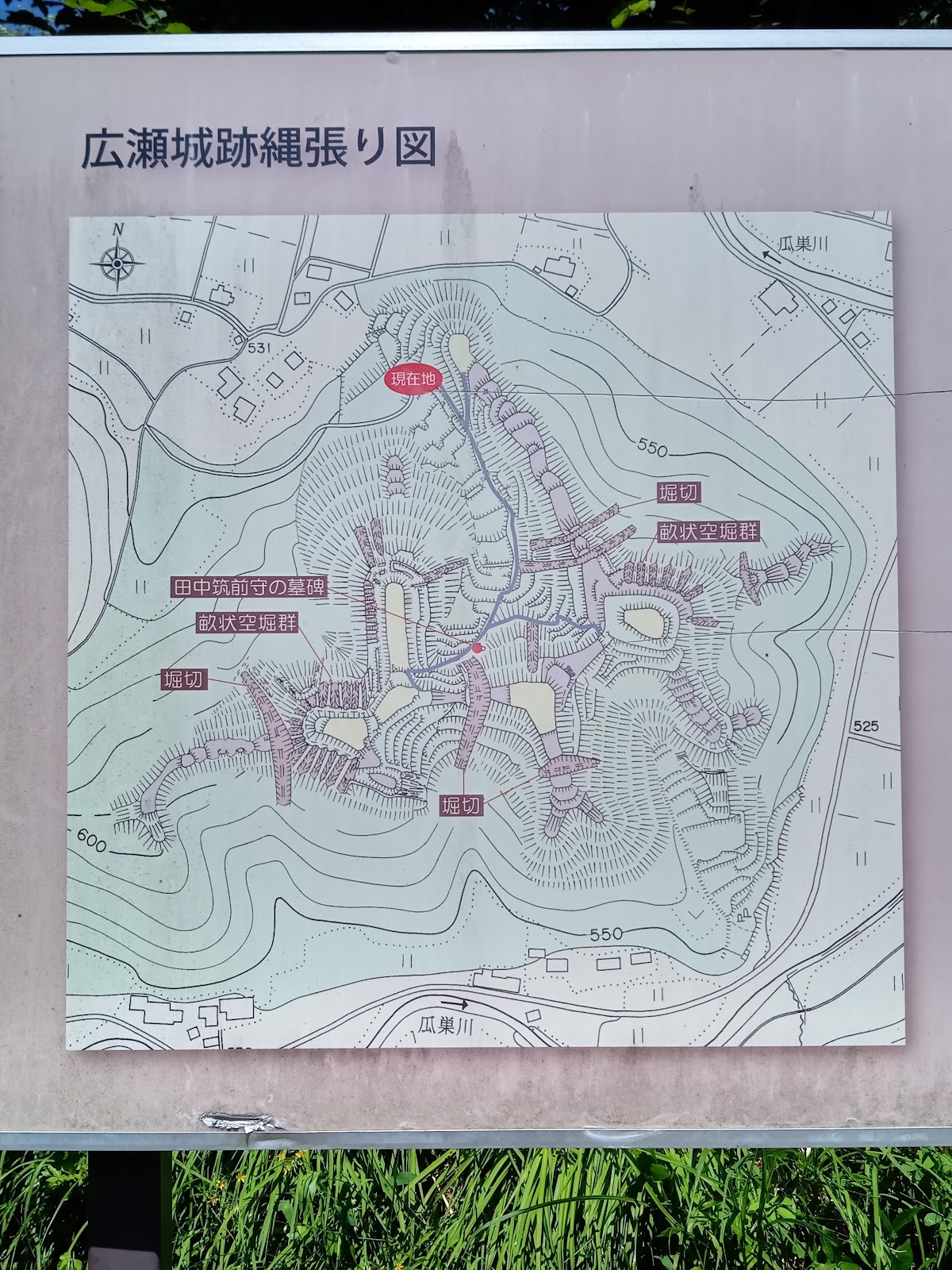
Hirose Castle is a multi-bailey mountain castle built on the eastern end of a hill extending from west to east. The castle grounds extend approximately 400 meters east-west and 200 meters north-south, with multiple baileys arranged along the ridge.
The main bailey (honmaru) is located at the highest point of the castle, with baileys extending east and west from it. The elevation of the main bailey is approximately 620 meters, a difference of about 120 meters from the surrounding plains, indicating its strategic location.
Characteristics of the Main Bailey (Honmaru)
The main bailey is located in the center of the castle and is presumed to be the most important bailey. Excavations have confirmed two foundation stones, revealing the existence of some kind of building.
Fragments of celadon bowls and incense burners have been unearthed around the foundation stones; these are imported items from China dating back to around the 16th century. This suggests that a person of considerable wealth and status resided in this castle. Excavated artifacts such as celadon pottery indicate that Hirose Castle was not merely a military facility, but also functioned as a lord’s residence.
The main enclosure was surrounded by earthen ramparts, enhancing its defensive capabilities. Traces of these ramparts can still be seen today.
The Magnificence of the Ridge-Shaped Vertical Moats
The greatest highlight of Hirose Castle is the ridge-shaped vertical moat system located on the western side of the castle grounds. Ridge-shaped vertical moats are defensive structures where multiple vertical moats are dug parallel to each other on a slope, preventing attacks from the enemy’s flanks and restricting the movement of enemies climbing the slope.
The ridge-shaped vertical moats of Hirose Castle are densely arranged on the slope west of the main enclosure, and their scale and excellent state of preservation have earned them the reputation of being a “masterpiece of earthen castles.” More than ten vertical trenches, each 2-3 meters deep and 20-30 meters long, can be identified, forming a beautiful, wave-like topography.
This group of ridged vertical trenches is a valuable historical site demonstrating late Sengoku period castle construction techniques and is important for understanding the characteristics of mountain castles in the Hida region.
Arrangement of Moats and Enclosures
A large moat is located on the west side of the main enclosure, forming a defensive line by dividing the ridge. This large moat is approximately 5 meters deep and 10 meters wide, and is a clearly visible historical structure.
On the ridge north of the castle grounds, there is a small enclosure thought to be a lookout post, from which the surrounding area was likely monitored. From the parking lot of the Gifu Prefectural Cultural Properties Protection Center, it takes about 5 minutes to reach this lookout post on the northern ridge.
Each enclosure is demarcated by earthworks and steep slopes, utilizing the elevation differences for defensive structures. The communication routes between the baileys are limited, and various measures to restrict enemy intrusion are evident throughout.
Preservation of the Remains
Hirose Castle ruins are protected as a prefectural designated historical site, and the remains are in excellent condition. Earthen ramparts, moats, vertical trenches, and baileys—remains characteristic of earthen castles—are clearly visible, allowing us to imagine the castle’s appearance at the time of its construction.
No stone remains, such as stone walls, have been confirmed; it was constructed purely as an earthen castle. This is a common characteristic of mountain castles in the Hida region and is a valuable example for understanding regional castle-building techniques.
Lords of Hirose Castle
Hirose Toshiharu
Hirose Sakon-no-Shogen Toshiharu, considered the builder of Hirose Castle, was a local lord active during the Tenbun era. The Hirose clan was based in the Kokufu region, and Toshiharu built Hirose Castle, solidifying his power base.
Toshiharu is believed to have contributed to the expansion of the Hirose clan’s power not only through castle construction but also through the administration of the territory. He is regarded as the person who laid the foundation for the subsequent development of the Hirose clan.
Hirose Hyogo-no-kami Munenao
Hirose Hyogo-no-kami Munenao was a member of the Hirose clan who served the Miki clan. He is said to have served as the lord of Hirose Castle during the time of Miki Jitsuna, and played an important role in maintaining the Miki clan’s power in northern Hida.
During Munenao’s time, Hirose Castle played a part in the Miki clan’s network of branch castles, and established a defensive system in cooperation with other Miki clans such as Takado Castle.
Tanaka Chikuzen-no-kami
Hirose Castle is also known as “Tanaka Castle,” which is thought to originate from the fact that the Tanaka clan served as its lords at one time. Tanaka Chikuzen-no-kami is considered a representative figure of this clan, but detailed historical records are scarce, and many aspects of his achievements remain unclear.
Further research is needed to determine the relationship between Mr. Tanaka and Mr. Hirose, or when Mr. Tanaka was the lord of the castle.
Archaeological Excavation Results
The archaeological excavation of Hirose Castle, conducted by the Takayama City Board of Education, has yielded valuable results.
As mentioned earlier, two foundation stones were confirmed in the main enclosure, revealing the existence of a building. The arrangement of the foundation stones suggests that a building of a certain size existed.
Among the excavated artifacts, fragments of a Chinese celadon bowl and incense burner dating from around the 16th century are noteworthy. These were extremely expensive imported goods for the time, indicating that the lord of Hirose Castle possessed considerable wealth and cultural refinement. Celadon is closely related to tea ceremony culture, suggesting it may have been used by a figure of the Sengoku daimyo class.
Other unearthed artifacts include fragments of earthenware and pottery, as well as iron products, providing clues to daily life within the castle.
The results of the archaeological excavation provide important information for clarifying the actual state of Hirose Castle, for which there are few written historical records, and further research is expected in the future.
Access and Visiting Information for Hirose Castle
Access Methods
Access by Car
- Approximately 15 minutes from the Takayama Interchange on the Chubu Trans-Japan Expressway
- From National Route 41, head towards Kofu-cho
- Aim for the Gifu Prefectural Cultural Properties Protection Center
Public Transportation
- Approximately 20 minutes by Nohi Bus bound for Kofu from Takayama Station on the JR Takayama Line
- Approximately 15 minutes on foot from the nearest bus stop
Parking
You can use the parking lot of the Gifu Prefectural Cultural Properties Protection Center. It is advisable to inform the center before visiting. Parking is free.
Ascent Route
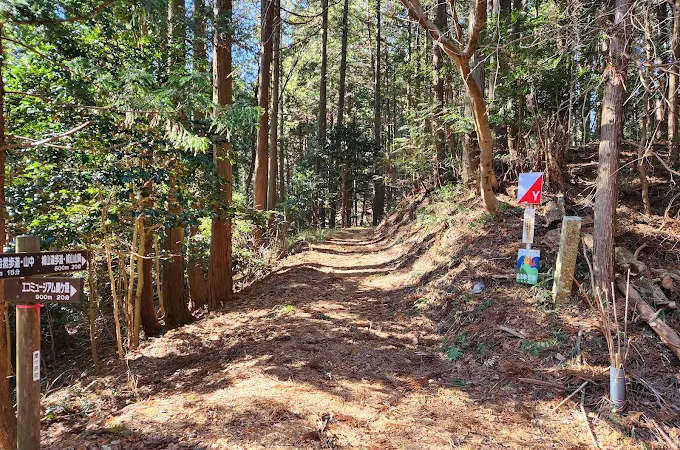
The entrance to the ascent route is next to the Gifu Prefectural Cultural Properties Protection Center, and from there you can ascend the well-maintained mountain trail. It takes about 5 minutes to reach the lookout post on the northern ridge and about 10-15 minutes to reach the main enclosure.
The path to the castle is well-maintained and relatively easy to walk, but since it is a mountain castle, we recommend wearing comfortable clothing and broken-in shoes.
Points of Interest
- Ridge-shaped Vertical Moats: The ridge-shaped vertical moats surrounding the main enclosure on the western side of the castle grounds are a must-see. Observe the magnificent defensive structures carved into the slope.
- Large Moat West of the Main Enclosure: This deeply excavated moat is a legacy to the castle-building techniques of the Sengoku period.
- Main Enclosure: Check the locations of the foundation stones and imagine the former building layout.
- Lookout Post on the Northern Ridge: The view from here is excellent and an important point for understanding the castle’s location.
Points to Note When Visiting
- As it is a mountain castle, the ground can be slippery in rainy weather and during winter.
- Insect repellent is necessary during summer.
- Bring your own drinking water.
- Please be careful not to enter the earthworks or moats to protect the remains.
- Please take all your trash with you.
Related Historical Sites in the Surrounding Area
Takado Castle
Takado Castle was the main castle of the Miki clan and, along with Hirose Castle, was a base for the Miki clan in northern Hida. It is about a 20-minute drive from Hirose Castle, and visiting both will help you understand the Miki clan’s sphere of influence.
Takayama Castle
Takayama Castle, built by Kanamori Nagachika after the unification of Hida, has different characteristics from Hirose Castle as a modern castle. It is located in the city of Takayama and is currently maintained as Shiroyama Park.
Matsukura Castle
Matsukura Castle, one of the three great mountain castles of Hida, is a mountain castle with magnificent remains, similar to Hirose Castle. Known as the main castle of the Anekōji clan, it is an important historical site for understanding the Sengoku period history of Hida Province.
Historical Significance of Hirose Castle
Hirose Castle is an important historical site for understanding the Sengoku period of Hida Province. It has the following historical significance:
Base of a Hida Local Lord
As the base of the Hirose clan, a local lord, it is a valuable example illustrating the reality of regional governance. It allows us to understand the process of forming an independent power in the Hida region, far removed from the central government.
Miki Clan’s Branch Castle Network
After coming under the influence of the Miki clan, it played a part in the branch castle network in northern Hida. It is an important example that concretely demonstrates the role of branch castles in the territorial control of Sengoku daimyo.
Pinnacle of Castle Construction Technology
The defensive remains, including the ridged vertical moats, represent the pinnacle of castle construction technology in the late Sengoku period. In particular, the high level of perfection as an earthen castle is worthy of national recognition.
Evidence of Local Culture
The excavated artifacts, such as celadon pottery, demonstrate the existence of a sophisticated culture even in the mountainous regions of Hida. This is valuable evidence of interaction with central cultures such as Kyoto and Sakai.
Hirose Castle and the Sengoku Period History of Hida
The history of Hirose Castle is closely intertwined with the Sengoku period history of Hida Province.
From the late Muromachi period to the Sengoku period, the authority of the Anegakoji clan, the provincial governor of Hida Province, declined, leading to a situation where local lords such as the Miki, Anegakoji (Mukokoji), and Ema clans vied for power. The Hirose clan was one such local lord, maintaining their influence from their base in the provincial capital area.
As the Miki clan expanded their power in northern Hida, Hirose Castle came under their control and functioned as an important military base. During the time of Miki Jitsuna, it played a role in the defense of northern Hida as part of the Miki clan’s network of branch castles, with Takadō Castle as its main castle.
During the Tensho era, with the expansion of Oda Nobunaga’s power, Hida Province also came under the influence of the central government. After the Honnoji Incident, Kanamori Nagachika, supported by Toyotomi Hideyoshi, launched an invasion of Hida, and local forces, including the Miki clan, were successfully destroyed.
Hirose Castle also fell during Kanamori Nagachika’s unification of Hida, bringing its history to an end. Kanamori clan established their control over early modern Hida from Takayama Castle, and medieval mountain castles like Hirose Castle became obsolete and were abandoned.
The Value of Hirose Castle in the Modern Age
Hirose Castle ruins continue to hold many values even today.
A Place for Historical Education
Protected as a prefectural-designated historical site, Hirose Castle ruins serve as an important teaching material for local history education. Visiting the actual remains allows one to experience the true reality of the Sengoku period, something not learned from textbooks.
Tourism Resources
For tourists visiting Takayama City, Hirose Castle Ruins offer a different kind of charm than the old townscape of Takayama. For castle enthusiasts who enjoy mountain castle walks, it’s a must-see spot with impressive remaining structures.
Subject of Academic Research
It’s the subject of diverse research topics, including castle construction techniques of the Sengoku period, the realities of local feudal lords, and the history of the Hida region. Further excavations and research may lead to new discoveries.
Preservation of the Natural Environment
By being protected as a historical site, the surrounding natural environment is also preserved. The forest surrounding the castle ruins is a habitat for diverse flora and fauna, making it significant from an environmental conservation perspective.
Summary
Hirose Castle, also known as Tanaka Castle, is a Sengoku period mountain castle located in Kofu-cho, Takayama City, Gifu Prefecture. It was built in the late Muromachi period by Hirose Toshiharu and later functioned as an important branch castle of the Miki clan. It fell during Kanamori Nagachika’s invasion of Hida during the Tensho era and was subsequently abandoned.
The castle’s greatest highlight is the magnificent series of parallel trenches stretching out on the west side of the main enclosure. The sight of these deeply dug trenches running parallel to each other is truly spectacular, worthy of being called a masterpiece of earthen castle construction. The remains of large moats, earthworks, and baileys are also well-preserved, allowing visitors to experience the castle-building techniques of the Sengoku period.
Archaeological excavations have unearthed 16th-century Chinese celadon pottery, revealing the high cultural level of the castle’s lord. Designated a Gifu Prefecture historical site in 1970, it is now a mountain castle easily accessible via a well-maintained path, making it popular with many castle enthusiasts.
As an important historical site that tells the story of Hida Province’s Sengoku period history, and as an excellent example of an earthen castle, Hirose Castle continues to hold high historical and academic value. When visiting Takayama, why not extend your trip and experience the spirit of the Sengoku period?