
Complete Guide to Hiketa Castle | A Thorough Explanation of the Highlights and History of the Continued Top 100 Japanese Castles and National Historic Site
What is Hiketa Castle?
Hiketa Castle (Hiketa-jo) is a castle located in Hiketa, Higashikagawa City, Kagawa Prefecture, that existed from the Sengoku period to the early Edo period. Built on a mountain 82 meters above sea level, this castle has the characteristics of a “sea castle,” facing the Harima Sea to the west and surrounded by the sea to the north and south, while also being a “mountain castle” with its main baileys located at the mountaintop.
In 2017, it was selected as one of the “Continued Top 100 Japanese Castles” (No. 177) by the Japan Castle Association, and on March 10, 2020, it was designated a National Historic Site. As the first castle in Sanuki Province to be built entirely of stone walls, it retains valuable remains that convey the castle-building techniques of the Oda-Toyotomi period.
Located on three sides surrounded by the sea, it functioned as an important base for monitoring maritime traffic in the Seto Inland Sea and defending the border with Awa Province (present-day Tokushima Prefecture). The view of Awaji Island was also magnificent, making it a strategically valuable fortress.
History of Hikida Castle
Hikida Castle in the Sengoku Period
There are various theories about the origin of Hikida Castle, but it is believed that some kind of castle facility already existed during the Sengoku period. This region is located at the eastern edge of Sanuki Province and borders Awa Province, so its military importance has been recognized since ancient times.
During the Tensho era (1573-1592), this area was under the control of a Sengoku daimyo of Sanuki, but the situation changed dramatically with Toyotomi Hideyoshi’s conquest of Shikoku.
The Era of Sengoku Hidehisa and Bito Tomonori
In 1585 (Tensho 13), Sengoku Hidehisa was granted Sanuki Province and became the lord of Hikida Castle for his achievements in Toyotomi Hideyoshi’s conquest of Shikoku. Sengoku Hidehisa was a samurai who served under Hashiba Hideyoshi, but he was dismissed from his position due to a blunder at the Battle of Hetsugigawa during the Kyushu campaign in 1586.
Afterward, Bito Tomonobu became the lord of Hikita Castle, but he too met the same fate, being dismissed due to a blunder during the Kyushu campaign. During this period, Hikita Castle was in an unstable situation with frequent changes in its lord.
Full-scale construction by Ikoma Chikamasa
In 1587, Ikoma Chikamasa was transferred from Ako in Harima Province (present-day Ako City, Hyogo Prefecture) to become the lord of Sanuki Province with a domain of 170,000 koku. Ikoma Chikamasa established Takamatsu Castle as his main castle, with Marugame Castle in western Sanuki and Hikita Castle in eastern Sanuki as subsidiary castles, creating a system for governing Sanuki Province.
During the Keicho era (1596-1615), Ikoma Chikamasa strongly carried out large-scale renovations of Hikida Castle in parallel with the renovation of Takamatsu Castle. It is believed that during this period, it was developed as the first castle in Sanuki Province to be entirely constructed of stone walls. The stone wall construction techniques were state-of-the-art at the time, and it reflects the characteristics of castles built during the Oda-Toyotomi period.
The Ikoma clan ruled Sanuki for four generations, and Hikida Castle continued to function as a key stronghold in eastern Sanuki.
Abolition due to the One Castle Per Province Decree
In 1615, when the Edo shoginate issued the One Castle Per Province Decree, Hikida Castle was abolished. Only Takamatsu Castle was allowed to survive in Sanuki Province; subsidiary castles such as Marugame Castle and Hikida Castle were to be demolished.
However, while Marugame Castle was later rebuilt, Hikida Castle was never reconstructed and was simply forgotten. There are no clear records of when the castle was completely demolished, and it remained a forgotten entity for a long time. Recent archaeological excavations and research have led to a reassessment of the historical value of Hikita Castle, and it is now being preserved and maintained as a valuable castle ruin from the Sengoku and Azuchi-Momoyama periods.
Structure and Layout of Hikita Castle
Overall Structure
Hikita Castle has a layout that unfolds in a U-shape along the ridge, centered on the summit of Shiroyama Mountain, which is 82 meters above sea level. The main enclosures are as follows:
- South Enclosure (Main Enclosure)
- North Enclosure (North Second Enclosure/North Enclosure)
- East Enclosure
- West Enclosure
- Tango Enclosure
These enclosures were demarcated by stone walls, and watchtower bases were located at the four corners. The most distinctive feature of Hikita Castle is its all-stone construction, which was a pioneering example of stone wall construction technology in Sanuki Province.
Main Enclosure (Southern Enclosure)
The Southern Enclosure is the central enclosure of Hikita Castle and is considered to correspond to the strong main enclosure (honmaru). In the center is a raised area believed to be the base of the castle tower, where a shrine is currently located. From here, one can enjoy a panoramic view of Harima Nada and Awaji Island, reflecting its character as a coastal castle.
The stone walls around the main enclosure are well-preserved, allowing for close observation of the castle construction techniques of the time.
Northern Enclosure (Northern Second Enclosure)
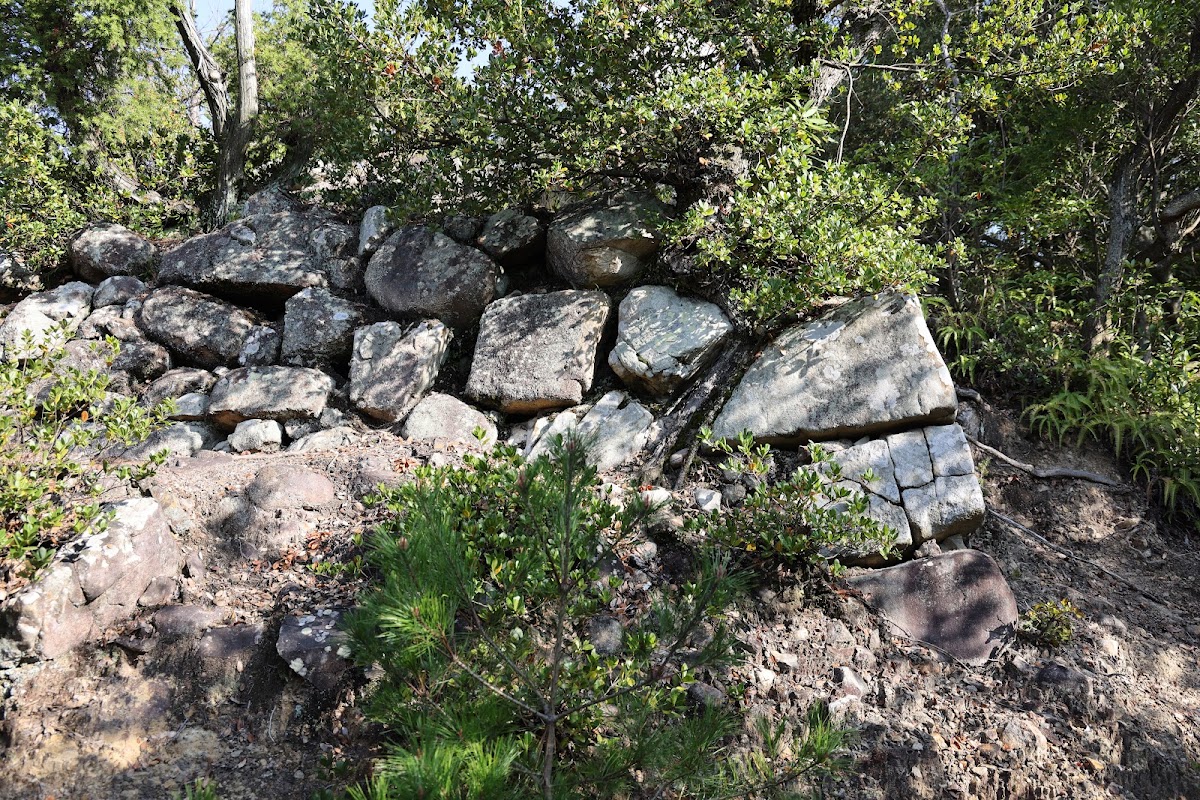
The Northern Enclosure is known for its particularly well-preserved stone walls within Hikita Castle. The continuous, high stone walls demonstrate the high level of stonework technology during the Oda-Toyotomi period.
The stone walls exhibit transitional techniques from rough-hewn stonework to fitted stonework, making them important historical documents for understanding the castle’s construction period and technological advancements.
Makeup Pond (Hikita Well)
One of the distinctive remains of Hikita Castle is a water storage facility called the “makeup pond.” Also known as “Hikida’s Well,” this indicates that the castle, despite being a mountain castle, had an abundant water supply.
This pond, surrounded by stonework, played a crucial role as a source of water for daily life within the castle and as an emergency water source. Given its location as a coastal castle, securing fresh water was a matter of life and death, and the existence of this facility is thought to have greatly enhanced Hikida Castle’s defensive capabilities.
Main Gate and Entrance
The remains of the main gate, the main entrance to the castle, have also been confirmed. The entrance (koguchi) is reinforced with stone walls, and various defensive measures are evident throughout. The structure of a masugata koguchi (square-shaped entrance) has also been confirmed, indicating a complex layout designed to prevent enemy intrusion.
Characteristics of the Stone Walls
The stone walls of Hikida Castle are valuable remains that demonstrate the castle-building techniques of the Oda-Toyotomi period. While primarily using the nozurazumi (rough-stone masonry) technique, some sections also show the uchikomi-tsugi (fitted stone masonry) technique, indicating a transitional period in technology.
The stone materials mainly consist of locally sourced granite, and are characterized by a powerful stacking style using relatively large stones. The corners of the stone walls utilize the sanuki-zumi technique, demonstrating the use of cutting-edge technology at the time.
The height of the stone walls varies depending on the location, but some sections reach over 5 meters, evoking the magnificent appearance of the castle in its heyday.
Highlights of Hikita Castle
Stone Wall Remains
The greatest highlight of Hikita Castle is undoubtedly the well-preserved stone wall remains. The stone walls around the northern enclosure, in particular, are unusually well-preserved, allowing visitors to observe stonework techniques from over 400 years ago up close.
While some sections have collapsed, this actually provides clues to the internal structure of the stone walls, making them a fascinating subject for castle enthusiasts. Viewing the stone walls from various angles and imagining the skills and hard work of the stonemasons of that time is also part of the enjoyment.
Spectacular Views of the Seto Inland Sea
The view from the summit of Shiroyama Mountain is a major attraction of Hikita Castle. To the west lies the Harima Sea, and on clear days, Awaji Island and Shodoshima Island can be seen. The scenery of the Seto Inland Sea, with its numerous islands and blue ocean, continues to captivate visitors.
The view at sunset is particularly exceptional; watching the sun sink into the Seto Inland Sea, one can reflect on the warriors who once defended this land.
Layout of the Enclosures and Utilization of Terrain
The layout of the enclosures, skillfully utilizing the terrain of the castle mountain, is another highlight. The group of enclosures, unfolding along the ridge, maximizes the use of the natural terrain while incorporating features to enhance defensiveness.
Walking through each enclosure allows one to experience the castle-building philosophy and military considerations of the Sengoku period. Understanding the defensive lines elevation utilizing differences and the layout of enclosures that avoid blind spots deepens through actual exploration.
Stone Structure of the Makeup Pond
The stone structure of the Makeup Pond is also a point not to be missed. It is a valuable relic demonstrating the importance of securing a water source in mountain castles and the technical skill that made it Possible.
The meticulously constructed stone walls surrounding the pond possess a beauty that transcends mere practicality, testifying to the high level of stonemasonry skill of the time.
Continued Top 100 Japanese Castles Stamp
For castle enthusiasts, collecting stamps from the Continued Top 100 Japanese Castles is one of the joys. The stamp for Hikita Castle is located at Sanshu Izutsuya-shiki (2163 Hikita, Higashikagawa City).
Sanshu Izutsuya-shiki is a facility utilizing an Edo-period merchant’s house, where you can learn about the history and culture of Hikita. Opening hours are from 9:00 AM to 4:30 PM (closed Mondays, or the following day if Monday is a public holiday), so please check the hours before visiting. Admission is free.
Access to Hikita Castle
Access by Train
The nearest station is JR Kotoku Line “Hikita Station.” It’s about a 20-minute walk from the station to the trailhead on the Hikita Port side. Strolling through the old townscape of Hikita is also a pleasant experience.
Hikida Station is not a limited express train stop, so you will need to take a local train from Takamatsu. Since the number of trains is limited, it is recommended to check the timetable in advance.
Access by Car
From Takamatsu:
- Approximately 5 minutes from the Hikida Interchange on the Takamatsu Expressway
- Head east on National Route 11 towards Hikida town center
From Tokushima:
- Approximately 5 minutes from the Hikida Interchange on the Takamatsu Expressway
- Head west on National Route 11 towards Hikida town center
There is a free parking lot at the Hikida Port side trailhead, with space for about 10 cars. Toilets are also available, making it convenient for preparation before climbing the castle. However, the parking lot may be full on holidays and during tourist season, so early arrival is recommended.
Climbing Routes
There are mainly two routes to climb Hikida Castle.
Hikita Port Side Trailhead Route (Recommended):
- This is the most common route, utilizing a well-maintained hiking trail.
- The climb takes approximately 20-30 minutes.
- Signposts and markers are installed, making it safe even for first-timers.
- Parking and restrooms are available.
Hikita District Side Route:
- Approach from the town side.
- Some sections are somewhat steep, so a certain level of physical fitness is required.
- The climb takes approximately 25-35 minutes.
For both routes, we recommend wearing comfortable shoes and bringing drinking water. Heatstroke prevention is especially important during the summer months.
Notes and Advice for Visitors
Clothing and Equipment
- Shoes: Non-slip trekking shoes or sneakers are essential.
- Clothing: Comfortable clothing; in summer, long sleeves and long pants are recommended for insect protection.
- Items to Bring: Drinking water, towel, hat, insect repellent spray (summer)
- In Rainy Weather: The hiking trail becomes slippery, so avoid attempting to climb the castle if necessary.
Estimated Time Required
- Climbing Time: 20-30 minutes
- Castle Interior Tour: 30-60 minutes
- Descent Time: 15-25 minutes
- Total: Approximately 1.5-2 hours
If you plan to carefully observe the stone walls or enjoy taking photographs, it is recommended to allow extra time.
Best Season
Spring (March-May):
- Mild weather, ideal for visiting the castle
- Beautiful fresh greenery
-However, it may be crowded during Golden Week
Autumn (October-November):
- Cool and comfortable weather
- Enjoy the autumn foliage
- The view of the Seto Inland Sea is clear and beautiful
Summer (June-September):
- Heat and insect repellent are essential
- Early morning or evening visits are recommended
- Stay well-hydrated
Winter (December-February):
- Relatively mild weather, making it possible to visit the castle
- Clear air and excellent views
- Sunset is early, so be mindful of the time
Fees
Visiting the Hikita Castle Ruins is free. Parking is also free.
Stamp collection and brochures at Sanuki Izutsuya are also free, making it an attractive and easy visit.
Nearby Tourist Attractions
Sanuki Izutsuya Residence
When visiting Hikita Castle, be sure to stop by the Sanuki Izutsuya Residence. This facility preserves and utilizes a merchant’s house that operated a soy sauce and sake brewing business from the Edo period to the early Showa period, allowing visitors to learn about the history and culture of Hikita.
It is also a stamp location for the Continued Top 100 Japanese Castles, and you can obtain materials and pamphlets about Hikita Castle.
Basic Information:
- Address: 2163 Hikita, Higashikagawa City, Kagawa Prefecture
- Opening Hours: 9:00-16:30
- Closed: Mondays (or the following day if Monday is a public holiday)
- Admission: Free
Hikita Townscape
The Hikita area retains an old townscape dating back to the Edo period. Soy sauce breweries and merchant houses are scattered throughout, allowing visitors to enjoy a historical atmosphere.
Especially during the Hina Matsuri (Doll Festival) in Hikita (late February to early March), Hina dolls are displayed in old townhouses, attracting many tourists.
Hikita Port and Seascape
The area around Hikita Port offers beautiful views of the calm Seto Inland Sea. There are also shops selling fresh seafood, allowing visitors to experience local food culture.
Konda Hachimangu Shrine
Located at the foot of Hikita Castle, this shrine is a center of local faith. It is a historical shrine with deep ties to Hikita Castle.
Yasuto Pond (Japan Dolphin Center)
Located about 15 minutes by car from Hikita, this facility allows visitors to interact with dolphins. It’s a recommended spot for families and can be enjoyed in conjunction with a visit to Hikita Castle.
Historical Value and Future Prospects of Hikita Castle
Academic Value
Hikita Castle is an extremely important historical site for understanding the history of castles in Sanuki Province during the Oda-Toyotomi period. As the first castle in Sanuki Province to be built entirely of stone walls, it provides valuable resources for studying the dissemination and development of stone wall construction techniques.
Its academic value is highly regarded as a concrete example of castle architecture from the Sengoku period to the early Edo period, illustrating the location of the Ikoma clan’s base of operations in Sanuki and its function as a coastal castle.
Preservation and Development Efforts
Following its designation as a National Historic Site in 2020, Higashikagawa City is focusing on the preservation and development of the Hikita Castle ruins. Efforts are underway to create a safe and comfortable environment for visitors, including the preservation and repair of the stone walls, the development of viewing paths, and the installation of information boards.
Continued archaeological excavations and research are planned, and it is hoped that new discoveries will shed further light on the full scope of Hikita Castle.
Contribution to Regional Revitalization
With its selection as one of the Continued Top 100 Japanese Castles and its designation as a National Historic Site, Hikita Castle is attracting attention as an important tourist resource for Higashikagawa City. The castle has attracted not only castle enthusiasts but also history buffs and general tourists, contributing to regional revival.
Development of tourist routes combining Hikita’s historical townscape and food culture is also underway, aiming to enhance the overall appeal of the region with Hikita Castle at its core.
Summary
Hikita Castle is a valuable ruin castle located in Higashikagawa City, Kagawa Prefecture, designated as one of the Continued Top 100 Japanese Castles and a National Historic Site. Built on a mountain 82 meters above sea level, it is a coastal castle characterized by its unique location surrounded by the sea on three sides.
As the first castle in Sanuki Province to be built entirely of stone walls, the stone wall remains, which convey the castle-building techniques of the Oda-Toyotomi period, are well preserved. The stone walls around the northern enclosure, in particular, are well-preserved, allowing for close observation of the techniques of that time.
During the Sengoku period, Sengoku Hidehisa and Bito Tomonori served as lords of the castle, and later, Ikoma Chikamasa renovated it into a full-fledged modern castle. Although it was abandoned in 1615 due to the “One Castle Per Province” decree, its remains, after more than 400 years, conveying the weight of history to us.
The view of the Seto Inland Sea from the mountaintop is magnificent, offering a panoramic view of Harima Nada and Awaji Island. The remains, such as allowing the Keshōike Pond, are also interesting, visitors to experience the true nature of a castle from the Sengoku period.
Access is convenient, approximately a 20-minute walk from JR Hiketa Station, or about a 5-minute drive from the Hiketa Interchange on the Takamatsu Expressway. Free parking and restrooms are available, making it easy to visit. Admission is free, and the stamp for the Continued Top 100 Japanese Castles can be obtained at the Sanuki Izutsuya Residence.
Expect to spend 1.5-2 hours climbing the castle, and it is recommended to wear comfortable shoes and bring drinking water. Spring and autumn are the best seasons to visit, but it can be enjoyed year-round.
Hiketa Castle is a recommended spot not only for castle enthusiasts, but also for history buffs and nature lovers. Be sure to visit Hikita, enjoying its old townscape and the scenery of the Seto Inland Sea. The history of the Sengoku period and the beautiful landscape will surely create a memorable experience.

