Hamada Castle: A Complete Guide to its History and Highlights | A Thorough Explanation of the Stone Walls and Castle Ruins of the Continued Top 100 Japanese Castles
What is Hamada Castle?
Hamada Castle is a flatland castle built on an isolated hill 67-68 meters above sea level in the heart of Hamada City, Shimane Prefecture. Also known as “Kameyama Castle,” it played an important role as the administrative center of the Hamada Domain for approximately 247 years, from 1619 to 1866. Currently, it is designated as one of the “Continued Top 100 Japanese Castles” and is a popular castle park for citizens and tourists alike, with its well-preserved stone walls.
The most distinctive feature of Hamada Castle is its location as a natural stronghold, surrounded by Matsubara Bay to the north, the Asai River to the east, and the Hamada River to the south and west. The castle’s layout, which skillfully utilizes this terrain, is highly regarded as a culmination of early Edo period castle-building techniques.
History of Hamada Castle
Construction History and Furuta Shigeharu
In 1619 (Genna 5), Furuta Shigeharu, lord of Matsusaka Castle in Ise Province, was appointed as the first lord of the Hamada Domain with a stipend of 54,000 koku (some sources say 55,000 koku) due to his achievements in the Siege of Osaka. Furuta Shigeharu was the nephew of Furuta Shigenari (Oribe), a senior retainer of Oda Nobunaga, and is said to have possessed excellent castle-building skills.
Construction of Hamada Castle began in February of the following year, 1620 (Genna 6), and was completed after approximately five years. For the construction, local stonemasons and carpenters were mobilized, and laborers were gathered from neighboring villages, resulting in large-scale civil engineering work. A three-story keep was built in the main enclosure, and the development of the castle town progressed simultaneously.
Successive Lords and the History of the Hamada Domain
The Hamada Domain, with Hamada Castle as its base, was ruled by several feudal families throughout the Edo period.
The Furuta Family Era (1619-1648)
The rule of the Furuta family, beginning with the first lord Furuta Shigeharu, continued until the time of the third lord Furuta Shigehisa. However, in 1648, Shigehisa committed a crime of madness, killing a retainer, and was subsequently dispossessed of his domain. This incident marked the end of the Furuta family’s rule over the Hamada Domain.
The Matsudaira (Matsui) Family Era (1648-1666)
After the dispossession of the Furuta family, Matsudaira Yasuteru was appointed to the domain with a 30,000 koku stipend, but was transferred to the Izumo-Matsue Domain in 1666.
Matsudaira (Ochi) Family Era (1666-1698)
Matsudaira Chikahide succeeded Matsudaira Yasuteru as lord of the domain with a stipend of 61,000 koku, but the line ended in 1698 (Genroku 11) due to a lack of heirs.
Matsudaira (Honjo) Family Era (1698-1731)
Matsudaira Naonori was appointed as lord of the domain with a stipend of 50,000 koku and ruled until 1731 (Kyoho 16), after which he was transferred to another domain.
Inoue Family Era (1731-1866)
In 1731 (Tenpo 11), Inoue Masatoshi was appointed as lord of the domain with a stipend of 50,000 koku, and the Inoue family ruled the Hamada Domain until the end of the Edo period. In 1769 (Meiwa 6), the domain’s role expanded as they were also entrusted with the management of the Iwami Silver Mine territory. This Inoue family rule was the longest, lasting approximately 135 years.
Second Choshu Expedition and Self-Destructive Retreat
The most dramatic event in Hamada Castle’s history was its fall during the Second Choshu Expedition (Shikyo War) in 1866 (Keio 2).
Hamada Domain, as part of the Shogunate army, faced off against the Choshu Domain. On June 7, 1866, approximately 2,000 Choshu troops led by Omura Masujiro invaded Hamada. Hamada Domain’s forces numbered only about 1,000, putting them at a numerical disadvantage.
After fierce fighting, Hamada Castle was on the brink of collapse. On the night of June 7, Lord Inoue Masanao decided to set fire to the castle and retreat after burning it down himself. All the buildings within the castle were destroyed, and the lord and his entourage fled to Hagi in Yamaguchi Prefecture via Tsuwano Domain.
This battle resulted in the loss of all buildings at Hamada Castle, including the keep, leaving only the stone walls. This self-imposed retreat became a symbolic event marking the end of the 247-year history of the Hamada Domain.
Hamada Castle Ruins After the Meiji Restoration
After the Meiji Restoration, the Hamada Castle ruins were developed into a park. The stone walls were well preserved, and it has become a popular spot for cherry blossom viewing and a place of relaxation for citizens. From the Showa to the Heisei era, restoration work was carried out on the stone walls, and preservation as a historical heritage site progressed.
In 2017, it was selected as one of the “Continued Top 100 Japanese Castles,” attracting attention from castle enthusiasts nationwide as a tourist spot.
Hamada Castle’s Form and Structure
Layout (Basic Arrangement)
Hamada Castle was designed as a terraced hill castle. A terraced layout is a style where the main keep is located at the highest point, and the second and third baileys are arranged in a stepped fashion from there.
The basic structure of the castle is as follows:
- Honmaru: The central area built on a flattened hilltop approximately 68 meters above sea level.
- Ninokuruwa: A narrow enclosure located south of the Honmaru.
- Sannomaru: An enclosure located further south from the Ninokuruwa.
- Demaru: A defensive stronghold independently located west of the Honmaru.
The Hamada River surrounded the castle to the west and south, the Asai River to the east, and Matsubara Bay to the north, all acting as natural moats. The castle’s layout, making maximum use of this terrain, provided extremely strong defenses against attacks.
Structure of the Honmaru
The Honmaru, as the central part of the castle, contained the most important facilities. A three-story keep was built in the Honmaru, surrounded by palaces and turrets.
The keep was a three-story, three-tiered tower, and its exterior is said to have been finished with white plaster. The stone walls of the castle tower base remain in good condition, allowing us to imagine its original scale.
The stone walls of the main enclosure exhibit a mixture of “nozurazumi” (rough-stone masonry) and “uchikomi-tsugi” (fitted stone masonry) techniques, reflecting the technical characteristics of the castle’s construction period. The stone walls on the north side of the main enclosure are particularly tall and make for an impressive historical structure.
Characteristics of the Stone Walls
The stone walls of Hamada Castle are valuable historical remains that demonstrate the castle construction techniques of the early Edo period. The stones used are locally quarried granite and andesite, and the walls exhibit both “nozurazumi” (rough-stone masonry), where natural stones are stacked almost as they are, and “uchikomi-tsugi” (fitted stone masonry), where the surface of the stones was processed before stacking.
The height of the stone walls varies depending on the location, but around the main enclosure they are approximately 5 to 10 meters high. The stone walls on the north side of the main enclosure are particularly well-preserved, retaining much of their original appearance.
The corner sections utilize a technique called “sangi-zumi,” where rectangular stones are interlocked to increase strength. This technique is characteristic of castles from the early Edo period and provides an important clue to the construction date of Hamada Castle.
Remains and Existing Structures
Existing Stone Walls
The greatest highlight of Hamada Castle is its well-preserved stone walls. The stepped stone walls extending from the main keep to the third bailey still exist, allowing us to understand the scale and structure of the castle at that time.
The stone walls of particular note are as follows:
- Main Keep Stone Wall: The stone wall surrounding the main keep, including the keep base, and the highest and most robust structure.
- Second Bailey Stone Wall: The stone wall continuing to the south side of the main keep, where the structure of the entrance (koguchi) can be seen.
- Third Bailey Stone Wall: The stone wall forming the outer perimeter of the castle.
- Outpost Stone Wall: An independent stone wall serving as a defensive base on the west side.
In recent years, preservation and repair work has been carried out on the stone walls, and sections at risk of collapse have been rebuilt. During the restoration, care was taken to preserve the historical value by using the original stone materials as much as possible and employing traditional techniques.
Relocated Gate
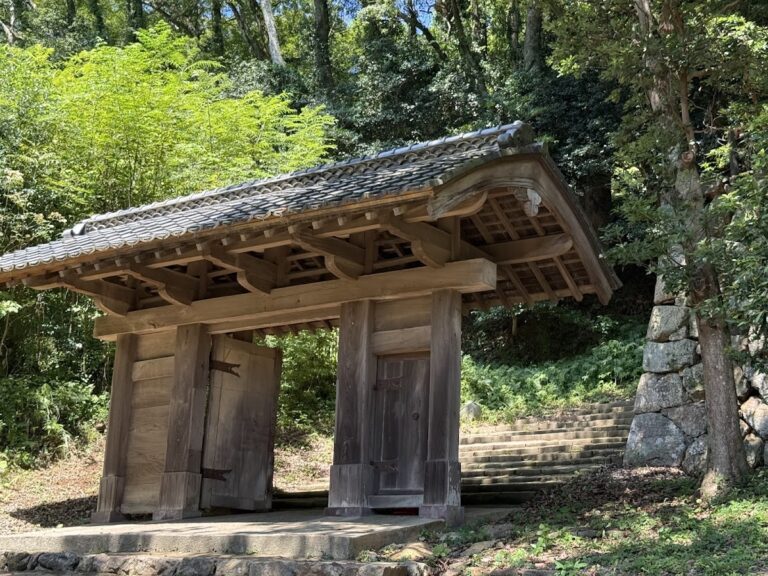
A gate relocated from a samurai residence of the Tsuwano Domain stands on the path leading up to the castle in Shiroyama Park. While not original to Hamada Castle, this gate is an important element that adds a historical atmosphere to the castle ruins.
This gate, which retains the style of a samurai residence gate from the Edo period, is a valuable structure for understanding the architectural techniques of that time.
Gobenden (Imperial Rest House)
Near the Hamada Castle ruins is the “Gobenden,” built during the Meiji era. This was a rest house built during Emperor Meiji’s tour of the San’in region and is now used as the Hamada Castle Museum.
The Gobenden exhibits materials related to the history of Hamada Castle and the Hamada Domain, as well as the history of Sotonoura, a port of call for Kitamae ships, allowing visitors to comprehensively learn about the history of Hamada.
Highlights of Hamada Castle
View from the Castle Tower Base
Climbing to the site of the castle tower base, you’ll be celebrated by a spectacular panoramic view of Hamada city and the Sea of Japan. The view from approximately 68 meters above sea level is the same scenery that the castle’s former lords must have gazed upon.
On a clear day, you can see the horizon of the Sea of Japan to the north, the meandering Hamada River to the west, and the spreading city to the east. The view is particularly beautiful at sunset, offering a stunning vista of the sun setting over the Sea of Japan.
Cherry Blossom Spot
Hamada Castle Ruins are also known as a cherry blossom viewing spot. Approximately 300 Somei Yoshino cherry trees are planted in Shiroyama Park, reaching full bloom from late March to early April each year.
During cherry blossom season, the contrast between the stone walls and the blossoms is beautiful, attracting many visitors. At night, the castle is illuminated, allowing visitors to enjoy the cherry blossoms in a magical atmosphere.
The sight of the cherry blossoms reflected on the stone walls makes this a popular spot not only for castle enthusiasts but also for photography lovers.
Continued Top 100 Japanese Castles Stamp
Hamada Castle was selected as one of the “Continued Top 100 Japanese Castles” (No. 172) in 2017. The stamp for the Continued Top 100 Japanese Castles is located at the Hamada Castle Museum (Goben-den), and is visited by people enjoying castle tours.
The stamp features illustrations of Hamada Castle’s stone walls and keep, making it a popular souvenir.
Stone Monuments and Information Boards
Several information boards and stone monuments explaining the history of Hamada Castle are installed within Shiroyama Park. The main monuments include the following:
- Monument marking the Hamada Castle ruins
- Explanation board about the castle’s self-destruction by burning down
- Information boards indicating the locations of each enclosure
- Explanation boards describing the structure of the stone walls
By strolling around while reading these information boards, you can gain a deeper understanding of the history and structure of Hamada Castle.
Hamada Castle and Related Historical Sites
Remains of the Castle Town
The castle town of Hamada Castle spread out to the south of the castle. The current center of Hamada City retains traces of this, and the grid-like street layout shows evidence of the town’s original layout.
The castle town began of samurai residences and merchant districts, and flourished as a commercial center. Even today, some place names, such as “Tonomachi” (Lord’s Town) and “Konyamachi” (Deep Dyeing Town), retain traces of the castle town era.
Tonoura and Kitamae-bune (Northern Route Ships)
Tonoura, located north of Hamada Castle, prospered as a port of call for Kitamae-bune ships from the Edo period to the Meiji period. As the maritime gateway to the Hamada Domain, it played a vital role, and many shipping agents lined the streets.
Sotoura was designated a Japan Heritage site in 2017 as one of the “Kitamae-bune Port Towns and Shipowner Settlements.” Visiting it along with Hamada Castle allows for a more comprehensive understanding of Hamada’s history.
Hamada Gokoku Shrine
Hamada Gokoku Shrine is located within Shiroyama Park. This shrine enshrines those who died in wars since the Meiji Restoration and is built on the historical site of Hamada Castle.
The view from the shrine is excellent, allowing visitors to enjoy the scenery while praying.
Local Information and Access
Access Method
Access by Train
Approximately 25-30 minutes on foot from JR San’in Main Line “Hamada Station.” A taxi from the station takes about 5 minutes.
The route from Hamada Station to Shiroyama Park passes through the city center, offering pleasant walks through shopping streets and other sights along the way.
Access by Car
It’s approximately 10 minutes from the Hamada Interchange on the San’in Expressway. Shiroyama Park has a free parking lot with space for approximately 30 cars.
Access by Bus
From Hamada Station, take the Iwami Kotsu bus bound for “Ikoji/Mikawa” and get off at the “Tonomachi” bus stop. It’s about a 5-minute walk from there.
Visitor Information
- Visiting Hours: Shiroyama Park is open 24 hours a day for free exploration.
- Admission Fee: Free
- Estimated Time Required: Approximately 30 minutes to 1 hour (1.5 to 2 hours for a thorough visit)
- Restrooms: Public restrooms are available within the park.
- Accessibility: There are stairs and slopes leading to the main keep, making wheelchair access difficult.
Hamada Castle Museum (Goben-den)
- Opening Hours: 9:30 AM to 4:30 PM
- Closed: Mondays (or the following day if Monday is a public holiday), New Year holidays
- Admission Fee: Free
- Address: 123-1 Tonomachi, Hamada City, Shimane Prefecture
- Phone: 0855-24-1402
The museum displays historical materials and models of Hamada Castle, as well as exhibits related to the Hamada Domain. A visit before or after exploring the ruin castles is recommended.
Points to Note When Visiting Hamada Castle Ruins
Here are some points to note when visiting Hamada Castle Ruins:
- Wear comfortable shoes: There are many slopes and stairs in Shiroyama Park, so we recommend wearing comfortable shoes.
- Spring cherry blossom season is recommended: The cherry blossom season is especially beautiful and attracts many tourists.
- Visit the museum first: Learning about the history at the Hamada Castle Museum before exploring the castle ruins will deepen your understanding.
- View from the castle tower base: The view from the castle tower base of the main keep is a must-see.
- Allow plenty of time: If you want to carefully observe the stone walls and enjoy taking photos, it’s a good idea to allocate about 1.5 to 2 hours.
Nearby Tourist Spots
When visiting Hamada Castle Ruins, we recommend also visiting the following nearby spots:
- Sotoura (Japan Heritage Site, Kitamae-bune Port): Approximately 15 minutes on foot
- Hamada City World Children’s Art Museum: Approximately 10 minutes by car
- Iwami Seaside Park: Approximately 15 minutes by car
- Shimane Aquarium Aquas: Approximately 20 minutes by car
- Iwami Tatamigaura: Approximately 20 minutes by car
Cultural Property Designation of Hamada Castle
Hamada Castle Ruins have the following cultural property designations:
- Shimane Prefecture Designated Historic Site: Designated April 13, 1971
- Continued Top 100 Japanese Castles: Selected 2017 (No. 172)
These designations mean that Hamada Castle Ruins are protected as an important cultural heritage site whose historical value has been officially recognized.
Summary
Hamada Castle was built in 1619 by Furuta Shigeharu and played an important role as the center of the Hamada Domain for approximately 247 years. Hamada Castle met a dramatic end in 1866 during the Second Choshu Expedition, when it burned down and abandoned its castle. However, its well-preserved stone walls still convey its original appearance.
Built on a hill approximately 68 meters above sea level, its terraced flatland castle style, its natural fortifications surrounded by the Hamada River and Matsubara Bay, and the stone walls showcasing early Edo period construction techniques, make it a highly valuable historical site from the perspective of castle history.
Currently developed as Shiroyama Park and popular for its cherry blossoms, Hamada Castle ruins have been selected as one of the Continued Top 100 Japanese Castles, making it a popular spot for castle enthusiasts nationwide. When visiting Hamada City, be sure to visit these historic ruin castles and enjoy the history etched into the stone walls and the spectacular views from the castle tower base.
Combining a visit to the Hamada Castle Museum with a stroll through the ruin castles will allow you to gain a deeper understanding of the history of the Hamada Domain and the structure of the castle. Furthermore, by visiting nearby historical sites such as Sotonoura, which has been designated a Japan Heritage site, you can experience Hamada’s history comprehensively.