Furogatani Castle (Sanda City, Hyogo Prefecture) Complete Guide: History, Remains, and Access Information
What is Furogatani Castle?
Furogatani Castle is a Sengoku period mountain castle site located in Keyakidai, Sanda City, Hyogo Prefecture. Currently developed as Keyakidai Park, it is a valuable historical site that preserves the remains of the castle despite being located within a residential area.
It is situated on the tip of a hill ridge at an altitude of approximately 200 meters, offering excellent views to the north and east. This castle, belonging to Arima District in Settsu Province, is believed to have been an important military base related to the siege of Sanda Castle during the Tensho era (1573-1592).
Basic Information
- Location: Keyakidai, Sanda City, Hyogo Prefecture
- Alternate Name: Furogaya Castle
- Castle Structure: Mountain Castle
- Construction Period: Tensho Era (Estimated)
- Builder: Hashiba Hideyoshi (Tradition)
- Remains: Enclosures, Moats
- Designated Cultural Property: None
- Current Status: Keyakidai Park
History of Furogaya Castle
Background of Construction and the Siege of Sanda Castle
Regarding the construction of Furogaya Castle, tradition remains that it is connected to Hashiba Hideyoshi’s siege of Sanda Castle during the Tensho era. Sanda Castle was the residence of the Arima clan, and Hideyoshi, acting on orders from Oda Nobunaga, attempted to capture it as part of his conquest of Harima and Settsu provinces.
Between 1579 and 1580, Hideyoshi is believed to have constructed several outposts (forts) around Sanda Castle in order to besiege it. It is highly probable that Furogaya Castle was built as part of this siege network.
The Situation in Settsu Province during the Sengoku Period
Settsu Province was a strategic point connecting Kyoto and western Japan, and during the Sengoku period, many forces vied for supremacy. The Sanda area was controlled by the Arima clan, but with the expansion of Oda Nobunaga’s power, it came under his control.
Hideyoshi’s attack on Sanda Castle was carried out as part of his campaign to pacify Settsu after Araki Murashige’s rebellion (Battle of Arioka Castle). Arima Noriyori, the lord of Sanda Castle, initially sided with the Oda clan, but later switched allegiance to the Mori clan, making him a target of Hideyoshi’s attack.
The Role and Function of the Castle
It is presumed that Furogaya Castle played a role in monitoring and blockading Sanda Castle from the northeast. Given its location, it is believed to have functioned as a base to cut off supply lines to Sanda Castle and monitor the situation within the castle.
As an auxiliary castle, it is presumed to have been a simple structure focused on military functions, rather than a structure designed for long-term residence. After the fall of Sanda Castle, it was abandoned and is thought to have remained unused to this day.
Castle Structure and Remains
Overall Composition
Furogatani Castle is a typical mountain castle utilizing the tip of a hill ridge. Three baileys (kuruwa) and three trenches (horikiri) have been identified as the main structural elements.
The castle area measures approximately 150 meters east-west and 100 meters north-south, making it a relatively small castle. This is thought to reflect its character as an auxiliary castle.
Arrangement of Baileys
Main Bailey (First Bailey)
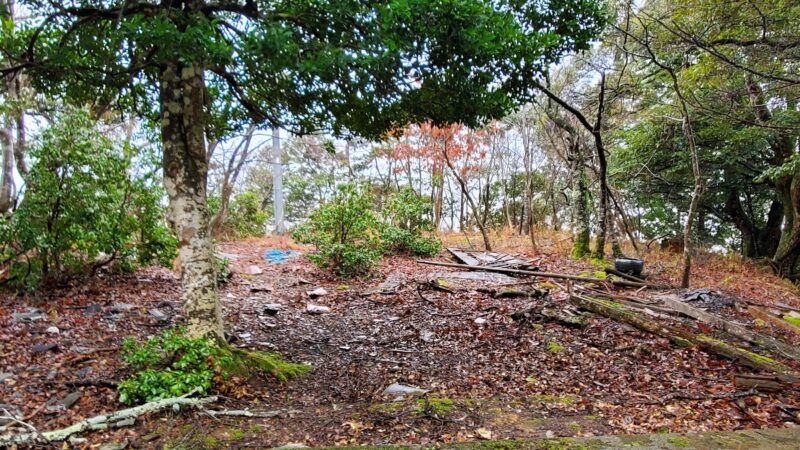
The main bailey, located at the highest point, is the central part of the castle. A flat area approximately 30 meters east-west and 20 meters north-south remains, believed to have been used as a command post or observation post. It is currently maintained as a park with benches and other amenities.
Second Enclosure
Located west of the main enclosure, slightly lower in elevation. It is presumed to have been used as a soldier’s garrison and storage area for supplies.
Third Enclosure
Further west, this enclosure formed the castle’s defensive line.
Moats
Three moats are situated between each enclosure, preventing enemy intrusion and clearly demarcating the areas.
First Moat
Located between the main enclosure and the second enclosure, approximately 3 meters deep and 5 meters wide. It is still clearly visible as a geographical feature.
Second Moat
Located between the second and third enclosures. It is similar in size to the first moat.
Third Moat
Located on the west side of the third enclosure, it serves to separate the castle grounds from the ridge behind it.
These moats are defensive structures unique to mountain castles, designed to make enemy entry difficult by cutting off the ridge. They can still be clearly observed today as changes in the terrain.
Earthworks and Cut Slopes
Partial traces of earthworks remain around each enclosure. Furthermore, artificial steep slopes called cut slopes (kirigishi) are formed along the edges of the enclosures, enhancing their defensive capabilities.
While some of the original form has been lost due to years of weathering and park development, careful observation allows for an understanding of the basic structure of the mountain castle.
Highlights of Furogaya Castle
Development as Keyakidai Park
Currently, the Furogaya Castle ruins are a popular local park known as Keyakidai Park. The park features playground equipment and rest facilities, making it a place for daily relaxation.
Near the park entrance, there is an information board for “Furogatani Castle Ruins,” which provides detailed explanations about the castle’s history and structure. When visiting the castle ruins, it is recommended to first check this information board for basic information.
Viewpoint
From the main enclosure, there are excellent views to the north and east. On clear days, you can see the entire city of Sanda and even Sanda Castle, which was once a strategic point of surveillance.
This view speaks to why Furogatani Castle was chosen as a military base. Visitors will be able to appreciate its strategic importance at the time.
Observation of Remains
Although the area is maintained as a park, careful observation allows you to see the topography of the moats and baileys. The moats, in particular, are relatively clearly preserved, making them valuable learning materials for studying the defensive structure of mountain castles.
While walking along the paths, paying attention to the elevation changes and terrain variations allows you to experience the castle-building techniques of the Sengoku period.
Historical Value
Furogatani Castle is a historical site related to the important historical event of Hashiba Hideyoshi’s siege of Sanda Castle. It possesses historical value as a historical site that shows Hideyoshi’s path to pacifying Settsu Province and ultimately unifying Japan.
It is also a valuable example of a unique castle structure, a “tsuke-jō” (outlying castle), and serves as important material for studying Sengoku period tactics and castle construction techniques.
Access Information
Access by Public Transportation
By Train and Bus
- Get off at JR Takarazuka Line “Sanda Station” or Kobe Electric Railway “Sanda Station”
- Take the Shinki Bus bound for “Woody Town Chuo”
- Get off at the “Keyakidai Center” bus stop and walk for about 5 minutes.
Buses run approximately 2-3 times per hour during the day. It is recommended to check the timetable in advance.
Access by Car
From Major Roads
- Approximately 15 minutes from the Kobe-Sanda Interchange on the Chugoku Expressway
- Take National Route 176 towards Woody Town
Parking
Keyakidai Park does not have its own parking lot. We recommend using nearby coin-operated parking lots or visiting by public transport. Please avoid street parking as it will inconvenience local residents.
Precautions When Visiting
- As it is located within a residential area, consideration for noise and other disturbances to neighbors is necessary.
- As it is a park, please visit during daylight hours.
- There are no prominent signs other than the information board, so please check the location on a map beforehand.
- The ground can be slippery during and after rain, so please be careful.
- In the summer, there are many mosquitoes and other insects, so we recommend taking insect repellent measures.
Nearby Tourist Spots
Sanda Castle Ruins
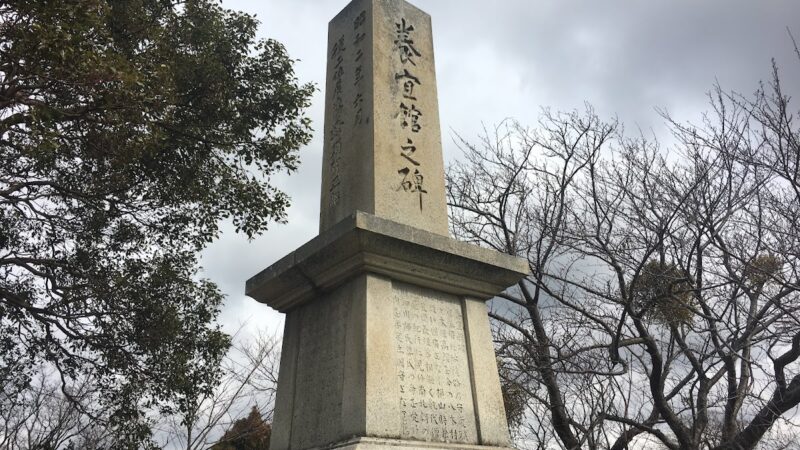
These are the ruins of Sanda Castle, which is closely related to Furogaya Castle. Currently, Sanda Elementary School and Sanda City Hall stand on the site, and very few remains of the original castle exist. However, a stone monument and information boards have been erected. Visiting this site in conjunction with Furogaya Castle will allow you to understand the overall picture of Hideyoshi’s siege of Sanda Castle.
Access: Approximately 10 minutes on foot from JR/Kobe Electric Railway “Sanda Station”
Arima Fuji Park
This is a representative nature park of Sanda City. The vast grounds feature natural landscapes including Mount Arima Fuji, playgrounds, and educational facilities. It is ideal for family visits.
Access: Approximately 15 minutes by bus from Kobe Electric Railway “Okaba Station”
Sanda City General Culture Center (Sato no Oto Hall)
This is a cultural and artistic hub of Sanda City. It has a concert hall and exhibition rooms, and events are held regularly. Exhibitions on Sanda’s history and culture are also sometimes held.
Access: Approximately 15 minutes on foot from JR/Kobe Electric Railway “Sanda Station”
Hanayama-in Temple (Temple associated with Emperor Hanayama)
Located in the northern part of Sanda City, this ancient temple is known as the temple where Emperor Hanayama became a monk. It is also an unofficial pilgrimage site of the Saigoku Thirty-Three Kannon Pilgrimage, making it a must-see spot for history buffs.
Access: Approximately 30 minutes by bus from Kobe Electric Railway “Sanda Station”
Sanda City Historical Materials Collection Center
This facility houses and displays materials related to the history of Sanda City. It also houses materials related to Furogaya Castle and Sanda Castle, allowing visitors to learn more about the local history.
Access: Approximately 10 minutes by bus from JR/Kobe Electric Railway “Sanda Station”
Surrounding Castles
Sanda Castle (Sanda City, Hyogo Prefecture)
As mentioned above, this castle is directly related to Furogaya Castle. It flourished as the residence of the Arima clan, but fell after being attacked by Hideyoshi.
Arioka Castle (Itami City, Hyogo Prefecture)
Known as the residence of Araki Murashige, this castle was the site of a long siege by Hideyoshi. An important battle took place here as a preliminary step to the attack on Sanda Castle. It is currently maintained as a historical park.
Access: Immediately next to JR Itami Station
Hanakuma Castle (Kobe City, Hyogo Prefecture)
One of the important strongholds of Settsu Province, this castle was under the command of Araki Murashige. It is currently maintained as Hanakuma Park, and remnants such as stone walls remain.
Access: Immediately next to Kobe Municipal Subway Hanakuma Station
Takatsuki Castle (Takatsuki City, Osaka Prefecture)
Located in the eastern part of Settsu Province, this castle is known as the residence of the Christian daimyo, Takayama Ukon. It played a role in Hideyoshi’s pacification of Settsu Province.
Access: Approximately 10 minutes on foot from JR Takatsuki Station
Research and Challenges of Furogaya Castle
Limitations of Historical Sources
Currently, no clear documentary sources concerning Furogaya Castle have been discovered. Its existence is mainly estimated based on topography, remains, and local traditions.
While several historical documents exist regarding Hideyoshi’s attack on Sanda Castle, none specifically mention Furogaya Castle. Therefore, information regarding its builder, construction period, and duration of use remains speculative.
Need for Archaeological Investigation
No full-scale excavation has been conducted, and information on the details of the remains and unearthed artifacts is limited. Further academic research could potentially reveal more about the castle’s true nature.
In particular, the discovery of the internal structure of the baileys, traces of buildings used, and artifacts from that period would provide important information about the castle’s character and duration of use.
Challenges of Preservation and Utilization
Currently, the Furogaya Castle site is used as a park by local residents, and a certain degree of preservation is being achieved. However, it has not received formal designation as a cultural property, and no preservation and management plan has been formulated.
Due to its location within a residential area, large-scale development and utilization are difficult, but efforts to enhance its value as a historical heritage site, such as improving the number of information signs and developing walking paths, are expected.
Recommended Visit
Recommended Time to Visit
Spring (March-May)
The fresh greenery is beautiful, and the weather is mild, making it ideal for a stroll. You can also enjoy the cherry blossoms in the park during cherry blossom season.
Autumn (October-November)
The autumn foliage is beautiful, and the views are excellent. The temperature is comfortable, allowing for leisurely observation of the ruins.
Winter (December-February)
The fallen leaves make it easier to observe the topography. Winter is recommended for those who want to carefully study the castle ruins.
Estimated Time Required
A stroll through the park and observation of the ruins takes approximately 30 minutes to 1 hour. If you plan to take photographs or conduct detailed observations, allow about 1.5 hours. If you plan to visit this site along with other nearby historical sites such as the Sanda Castle ruins, we recommend scheduling a half-day visit.
Useful items to bring:
- Camera (for recording ruins and views)
- Binoculars (for enjoying the views)
- Comfortable walking shoes (the park is paved, but suitable shoes are necessary for observing the ruins)
- Drinks (especially in summer)
- Insect repellent (spring to autumn)
- Hat and sunscreen (summer)
- Rain gear (during periods of unpredictable weather)
Summary
Furogatani Castle is an important historical site related to Hashiba Hideyoshi’s attack on Sanda Castle, yet it remains a mysterious castle with many unknown details. Currently, it stands quietly as a park within a residential area, but its topography bears the marks of Sengoku period castle-building techniques and strategies.
Its clear structure of three baileys and three moats succinctly demonstrates its function as an auxiliary castle, making it an excellent teaching tool for learning the basics of mountain castles. Furthermore, the view from the main enclosure eloquently speaks to the reasons why this castle was chosen as a military base.
While there is a challenge in the lack of written historical records, this only increases the value of the information conveyed by the ruins themselves. Visitors can deepen their understanding of history by observing the terrain with their own eyes and imagining the conditions of the time.
When you visit Sanda City, be sure to stop by the Furogaya Castle ruins and feel the spirit of the Sengoku period. This small mountain castle quietly tells a part of Hideyoshi’s path to unifying Japan.