Fukami Castle (Yamato City, Kanagawa Prefecture) Complete Guide: A Thorough Explanation of Sengoku Period Remains and Highlights
What is Fukami Castle?
Fukami Castle is a medieval castle located in Fukami, Yamato City, Kanagawa Prefecture. Also known as “Ichinoseki Castle Mountain” and “Shirogaoka,” it sits on the edge of a plateau on the right bank of the middle reaches of the Sakai River, forming the border with Seya Ward in Yokohama City, in the northeastern part of Yamato City.
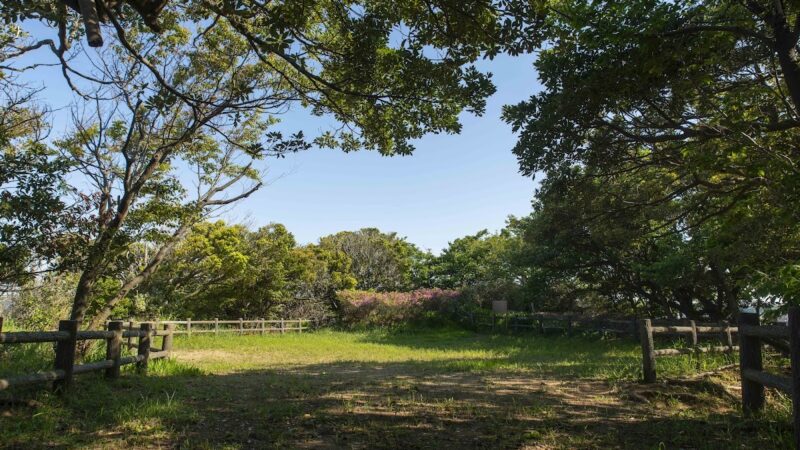
This castle, measuring approximately 100 meters north-south and 150 meters east-west, exhibits a typical medieval castle form, utilizing the steep cliffs of the Sakai River as a natural fortress. Currently, it is preserved and maintained as the “Fukami Historical Forest,” and visitors can actually see the remains such as the main enclosure, earthworks, and dry moats.
Geographical Location of Fukami Castle
Fukami Castle is located in the central part of Sagami Province (present-day Kanagawa Prefecture), built on a strategically important site with the Sakaigawa River, a natural defensive line, at its rear. The Sakaigawa River forms the border between Sagami and Musashi Provinces, indicating the military importance of the castle’s location.
The eastern side of the castle faces a steep cliff overlooking the Sakaigawa River, while a plateau extends from the west to the north. The castle’s layout, skillfully utilizing this terrain, is a valuable example of the advanced castle-building techniques of the Sengoku period.
History of Fukami Castle
Construction Period and Lords
There are various theories regarding the construction period of Fukami Castle, but archaeological excavations conducted over approximately two years starting in 1984 yielded artifacts from the early 13th to 14th centuries. This suggests that some kind of facility existed there from the late Kamakura period to the Nanboku-cho period.
Local tradition has long held that this was the castle of Yamada Iga-no-kami Tsunemitsu. The Yamada clan was known as a local samurai family of Sagami Province and is believed to have ruled this region, but there is currently little reliable historical evidence to support this.
Fukami Castle in the Sengoku Period
Based on the form of the remaining structures, it is believed that Fukami Castle functioned fully during the Sengoku period, from the 15th to the late 16th century. Particularly noteworthy is its complex structure, which makes extensive use of cranks (bends) and allows for flanking fire. These are characteristic castle-building techniques of the Sengoku period and demonstrate the strong influence of the Odawara Hojo clan.
The Odawara Hojo clan was a Sengoku daimyo based in Sagami Province, expanding their power throughout the Kanto region. It is presumed that Fukami Castle was established and improved by the Hojo clan as a temporary military base or a connecting castle for garrisoning. Given its location along the Sakai River, it is thought to have functioned as a base for advancement into Musashi Province and for defense.
Results of the Archaeological Excavation
Five phases of archaeological excavations were conducted at Fukami Castle starting in 1984. These excavations revealed a structure where the main enclosure was surrounded by earthen ramparts and further protected by inner and outer moats.
Excavated artifacts include ceramics from the 13th and 14th centuries, and artifacts from the 16th-century Sengoku period (Warring States period). These findings indicate that Fukami Castle was used for a long period, and that large-scale renovations were carried out, particularly during the Sengoku period.
Detailed results of the excavation are exhibited at the Shimotsuruma Furusato Museum (historical museum) in Yamato City, where visitors can learn about the history of Fukami Castle through castle models and excavated artifacts.
Structure and Layout of Fukami Castle
Main Enclosure (Honmaru)
The main enclosure (Honmaru), the center of Fukami Castle, is a rectangular area surrounded by earthen ramparts. The main enclosure measures approximately 50 meters north-south and 40 meters east-west, making it a medium-sized main enclosure for a medieval castle.
The earthen ramparts surrounding the main enclosure remain clearly visible today, reaching a maximum height of approximately 2 meters. There are sections where it’s possible to walk on top of the ramparts, allowing visitors to experience the actual defensive structures of the time. The interior of the main enclosure is currently flat, and it is presumed that buildings and watchtowers once stood there.
Arrangement of Enclosures
Multiple enclosures (kuruma) are arranged around the main enclosure. According to the layout map, enclosures were located on the front (south side) and port (west side) of the main enclosure, and these were also surrounded by earthen ramparts.
A dry moat was constructed between the enclosures and the main enclosure, forming a double line of defense. This structure is a typical Sengoku period castle-building technique, designed to gradually prevent enemy incursions. Each enclosure functioned as an independent defensive unit, and even if one enclosure was breached, the defense could continue in the other enclosures or the main enclosure.
Dry Moats and Earthen Rampant Works
The dry moats and earthen ramparts are key to the defense of Fukami Castle. A large dry moat is located on the north side of the main enclosure, approximately 3 meters deep and 5 meters wide. This moat is still clearly visible today and is one of Fukami Castle’s greatest attractions.
There are sections where you can walk along the bottom of the moat, allowing you to appreciate its depth and the height of the earthworks. The moat walls are steep, making it difficult for enemy soldiers to climb.
The earthworks surround the main enclosure and each of the baileys, and traces of reinforcement using the rammed earth technique have been confirmed. From the top of the earthworks, one can overlook the surrounding area, making it a suitable structure for observation and defense.
Cranks and Flanking Fire Positions
A distinctive feature of Fukami Castle is the crank (bends in the passageways) and flanking fire positions. The passageways within the castle are intentionally curved, designed to prevent enemies from advancing in a straight line.
Flanking fire positions are structures that allow for attacks from the flanks of approaching enemies by cleverly arranging the earthworks and baileys. At Fukami Castle, the technique of flanking fire has been confirmed in multiple locations, strongly indicating the influence of the castle-building techniques of the Odawara Hojo clan.
These techniques developed during the Sengoku period in the late 16th century, providing evidence that Fukami Castle underwent large-scale renovations during this time.
Highlights of Fukami Castle
Earthworks of the Main Enclosure
The first thing to notice when visiting Fukami Castle is the earthworks surrounding the main enclosure. The rise of the earthworks is clearly preserved at the site, allowing visitors to see firsthand the defensive structures of a medieval castle.
Walking along the top of the earthworks allows you to experience the perspective from which the castle’s soldiers stood guard. By observing the depth of the dry moat and the surrounding terrain from the earthworks, you can understand the ingenuity of this castle’s defensive structure.
Large Dry Moat on the North
The most impressive remains at Fukami Castle are the large dry moat on the north side of the main enclosure. This dry moat, approximately 5 meters wide and 3 meters deep, still retains its size today, making it a valuable historical site for understanding the actual state of moats in medieval castles.
There are sections where you can descend to the bottom of the dry moat and walk along it. Looking up at the earthworks from within the moat is one of the highlights of visiting the castle. The walls of the dry moat are steep, allowing you to truly appreciate the difficulty faced by those attempting to attack the castle.
Arrangement and Layout of the Enclosures
At Fukami Castle, you can observe a layout with multiple enclosures arranged around the main enclosure. Each enclosure is demarcated by earthworks and dry moats, forming a tiered defensive structure.
Walking the site allows you to relive the movement from enclosure to enclosure and then to the main enclosure. The numerous winding passages demonstrate defensive ingenuity even from a modern perspective.
The Steep Cliff of the Sakaigawa River
The eastern side of Fukami Castle faces a steep cliff along the Sakaigawa River, and this natural terrain greatly contributed to the castle’s defense. The cliff is over 10 meters high, making attacks from this direction virtually impossible.
Even today, the cliff along the Sakaigawa River is steep, allowing visitors to appreciate the castle’s strategic location. However, the edge of the cliff is dangerous, so please observe from a safe location.
Development Status of Fukami Historical Forest
The Fukami Castle ruins are preserved and maintained by Yamato City as the “Fukami Historical Forest.” The conservation plan covers an area of 12.2 hectares, protecting not only the castle ruins but also the surrounding natural environment.
Walking Trails and Information Boards
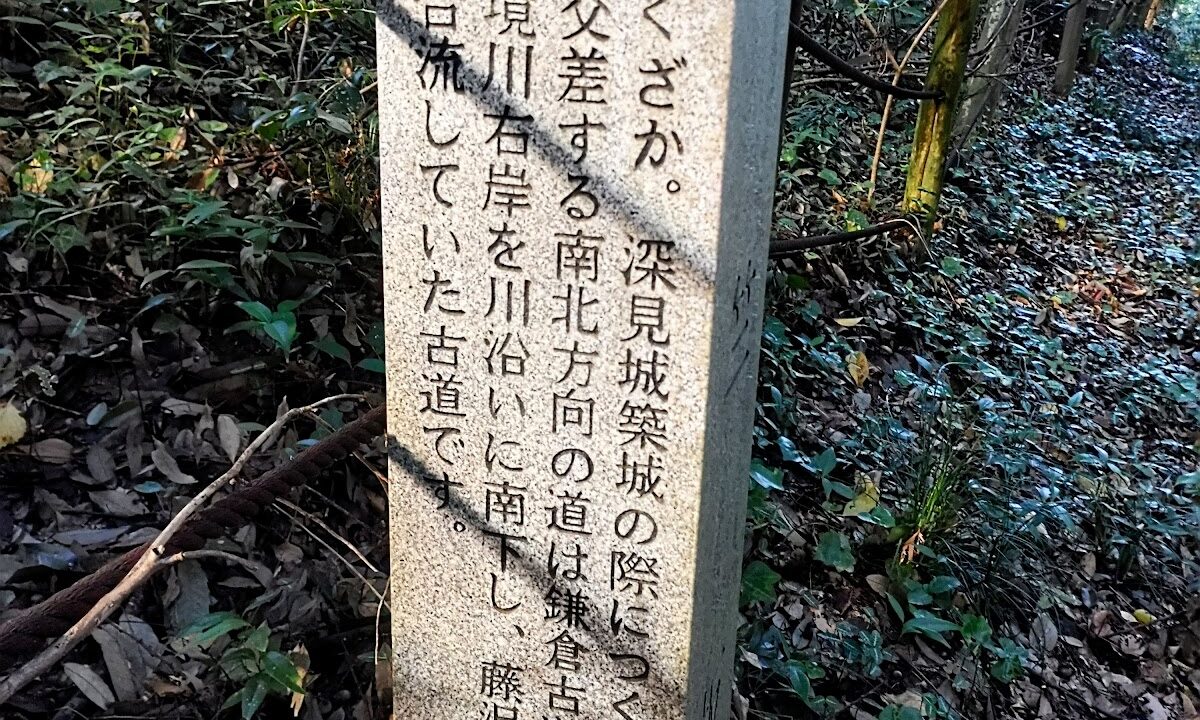
Walking trails are maintained within the forest, allowing visitors to explore the main remains such as the main enclosure and dry moats. Information boards are installed at key points, providing explanations of each remains and the history of the castle.
The information boards include a map of the castle grounds, allowing visitors to check their current location in relation to the ruins. However, some parts of the information boards are difficult to read due to age-related deterioration.
Natural Environment
Fukami Historical Forest is valuable not only as a castle site but also as a precious natural environment. Various trees grow in the forest, allowing visitors to enjoy nature throughout the seasons.
In spring, there is fresh greenery; in summer, deep green; in autumn, vibrant autumn leaves; and in winter, the clear views after the leaves have fallen, each season presenting a different face. The autumn foliage season, in particular, is an ideal time for exploring the castle ruins.
Castle Stamps and PR Activities
Fukami Castle issues castle stamps (Gojoin), which are popular among castle enthusiasts. Castle stamps are collected as mementos of visiting a castle, and their popularity has spread nationwide amidst the recent castle boom.
Fukami Castle’s castle stamps are issued as part of an initiative to promote local history and culture, contributing to increased awareness of the castle ruins. The castle stamp features information about Fukami Castle’s characteristics and history, making it a valuable souvenir of your visit and a valuable resource for historical learning.
Information on how to obtain and purchase the castle stamp can be found at the Yamato City Tourist Information Center and related facilities.
Access and Visiting Information
Location
- Address: 76 Fukami, Yamato City, Kanagawa Prefecture (Fukami Historical Forest)
- Nearest Station: Odakyu Enoshima Line “Yamato Station”
Access by Public Transportation
The most common way to get there is by bus from Odakyu Enoshima Line “Yamato Station”. Take a Kanagawa Chuo Kotsu bus bound for “Fukami,” get off at the nearest bus stop, and walk for approximately 5-10 minutes.
Bus schedules vary depending on the time of day, so it is recommended to check the timetable on the Kanagawa Chuo Kotsu website in advance.
Access by Car
The route from National Route 246 towards Sakaigawa is the easiest to follow. However, since Fukami Historical Forest does not have its own parking lot, we recommend using nearby coin-operated parking lots or public transportation.
Visiting Hours and Required Time
Fukami Historical Forest is generally open to visitors at their own pace. A general tour of the main remains takes approximately 30-40 minutes. If you wish to carefully observe the layout or enjoy taking photographs, allow about an hour.
Precautions During Your Visit
- The ground in the forest can be uneven, so we recommend wearing comfortable shoes.
- In the summer, there are many insects such as mosquitoes, so we recommend taking precautions against insects.
- The ground can be slippery during and after rain, so please be careful.
- The edges of cliffs are dangerous, so please do not approach them.
- Please take all your trash with you.
Nearby Attractions
Shimotsuruma Furusato Museum (Museum)
This museum displays the results of the Fukami Castle excavation and unearthed artifacts. A model of the castle is also on display, and visiting before seeing the actual site will provide a deeper understanding. It’s a must-see facility for learning about the history of Fukami Castle.
Sakaigawa River
The Sakaigawa River, which flows east of Fukami Castle, is a historical river that forms the border between Sagami Province and Musashi Province. While river improvements are currently underway, it remains an important element in understanding the former location of the castle. A promenade has been built along the Sakaigawa River, allowing visitors to enjoy a stroll.
Surrounding Castles
There are several other medieval castle ruins scattered around Fukami Castle.
- Shimotsuruma Castle: A medieval castle located in Shimotsuruma, Yamato City
- Seya Castle: Castle ruins located in Seya Ward, Yokohama City
- Kokubun Castle: Castle ruins related to Sagami Kokubunji Temple, located in Ebina City
Visiting these castles together will provide a deeper understanding of the characteristics of medieval castles in Sagami Province and the Sengoku period history of this region.
Evaluation of Fukami Castle and the Perspective of Castle Enthusiasts
On the castle enthusiast community site “Kojodan,” Fukami Castle has an average rating of ★★★☆☆ (2.83). With 173 visitors (as of 2024), it’s a relatively minor castle site, but this makes it appealing for those who want to quietly observe the remains.
The average visit time is approximately 35 minutes, and it’s praised for its compact size and the good preservation of its main remains. It’s a suitable castle site for learning about the basic structures of medieval castles, such as earthworks and dry moats.
Among castle enthusiasts, it’s noteworthy as a site demonstrating the construction techniques of the Odawara Hojo clan, and the ability to observe technical elements such as flanking fire and cranks on-site is highly valued.
Summary: The Appeal of Fukami Castle
Fukami Castle is a valuable medieval castle site remaining in Yamato City, Kanagawa Prefecture. The castle ruins, including the earthen ramparts surrounding the main enclosure, the large dry moat on the north side, and the layered defensive structure consisting of multiple baileys, are remarkably well-preserved, showcasing the castle-building techniques of the Sengoku period.
Influenced by the Odawara Hojo clan, the castle’s layout features numerous technical innovations such as cranks and flanking fire positions, making it a valuable site for castle research. Its location, backed by the steep cliffs of the Sakaigawa River, is a classic example of a medieval castle that skillfully utilizes the natural terrain.
The castle ruins, now developed as the Fukami Historical Forest, function not only as a place for historical learning but also as a recreational area for citizens. In Kanagawa Prefecture, where urbanization is progressing, the preservation of such historical heritage should be highly valued as a regional cultural asset.
For castle enthusiasts, history buffs, and anyone who enjoys a stroll, Fukami Castle is a worthwhile place to visit. With various ways to enjoy the castle, such as collecting castle stamps and comparing it with surrounding castle ruins, we highly recommend visiting Fukami Castle.
Why not spend some time feeling the romance of history at Fukami Castle, which still conveys the spirit of the Sengoku period?