Fujinami-yakata (Wakayama Prefecture): A Complete Look at a Medieval Castle and Fortress Marking the History of the Yuasa Clan
What is Fujinami-yakata?: A Historic Castle and Fortress in Aritagawa Town, Wakayama Prefecture
Fujinami-yakata is a medieval castle and fortress site located in Shimotsuno, Aritagawa Town, Arida District, Wakayama Prefecture. Also known as “Fujinami Castle,” it served as an important base for the Yuasa clan in Kii Province and was deeply involved in the region’s history for approximately 300 years.
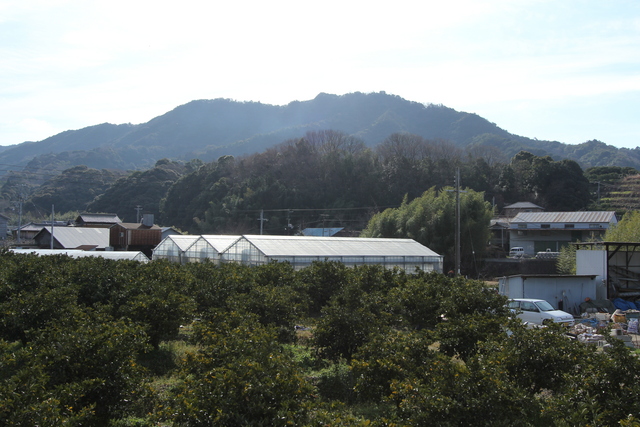
Although much of the site is now used as an orchard, the remains of earthworks and moats remain in good condition, making it a valuable historical site that conveys the characteristics of a medieval castle. It is located about 100 meters east of Amida-ji Temple and is easily accessible from Fujinami Station on the JR Kisei Main Line (Kinokuni Line).
The History of Fujinami Castle: From the Yuasa Clan to the Katada Clan
The Establishment of the Yuasa Clan and the Fujinami Clan
The history of Fujinami Castle is closely intertwined with the history of the Yuasa Clan, a powerful samurai group in Kii Province. The Yuasa Clan expanded its power primarily in Arita County, Kii Province, from the late Heian period to the Kamakura period, and played an active role on the side of the Minamoto clan in the Genpei War.
The Fujinami clan, as a branch of the Yuasa Clan, was entrusted with governing this region. It is believed that the castle originated with Shimotsuno Saburo, who was initially under the control of the Yuasa Clan. The castle’s ownership changed from the Shimotsuno clan to the Fujinami clan, and it was developed as the Fujinami clan’s residence.
The Era of the Katada Clan
Subsequently, Fujinami Castle became the residence of the Katada clan, and their rule continued for approximately 300 years. The Katada clan was a family descended from the Yuasa Clan and played an important role in governing the Arita region.
During the time of the Katada clan, the castle’s functions were strengthened, and defensive structures such as earthworks and moats were constructed. Many of the remains from this period still exist today, providing important clues to understanding the castle’s structure at the time.
The Tensho Invasion of Kishu and the Abandonment of the Castle
The history of Fujinami Castle reached a major turning point in 1585 (Tensho 13). Hashiba Hideyoshi (later Toyotomi Hideyoshi) launched an invasion of Kishu, subduing various forces in Kii Province, including the Yuasa clan. It is believed that the Katada clan was also destroyed in this battle, and Fujinami Castle was abandoned.
The Tensho Invasion of Kishu was one of the important military actions Hideyoshi undertook in his process of unifying Japan. By subduing forces such as the Saika clan and Negoro-ji Temple in Kii Province, Hideyoshi solidified his control over western Japan. The abandonment of Fujinami Castle was an event that occurred within this major historical flow.
Structure and Remains of Fujinami Castle
Basic Structure of the Castle
Fujinami Castle is classified as a flatland castle (hirajiro), possessing a distinctive structure built on flat land. It strongly reflects its character as a medieval residence, and its design is based on a different defensive philosophy than that of mountain castles from the Sengoku period.
The castle’s central area consisted of a main enclosure (kuruma), surrounded by earthworks and moats. It is believed that multiple enclosures existed, each functioning as a living space or defensive stronghold.
Existing Earthworks
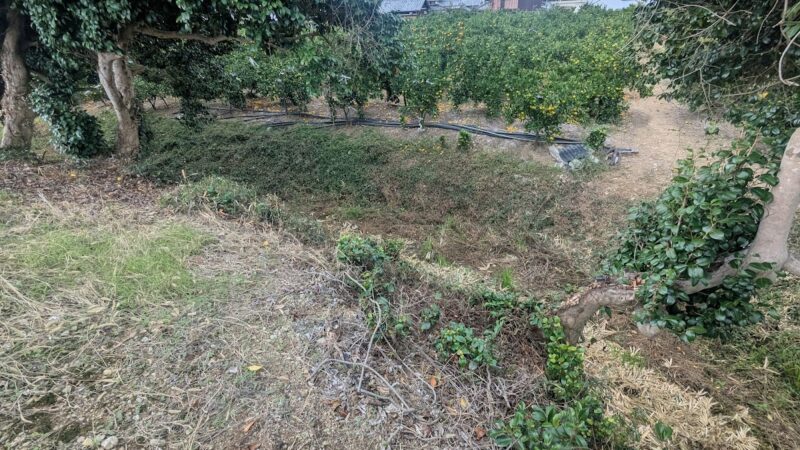
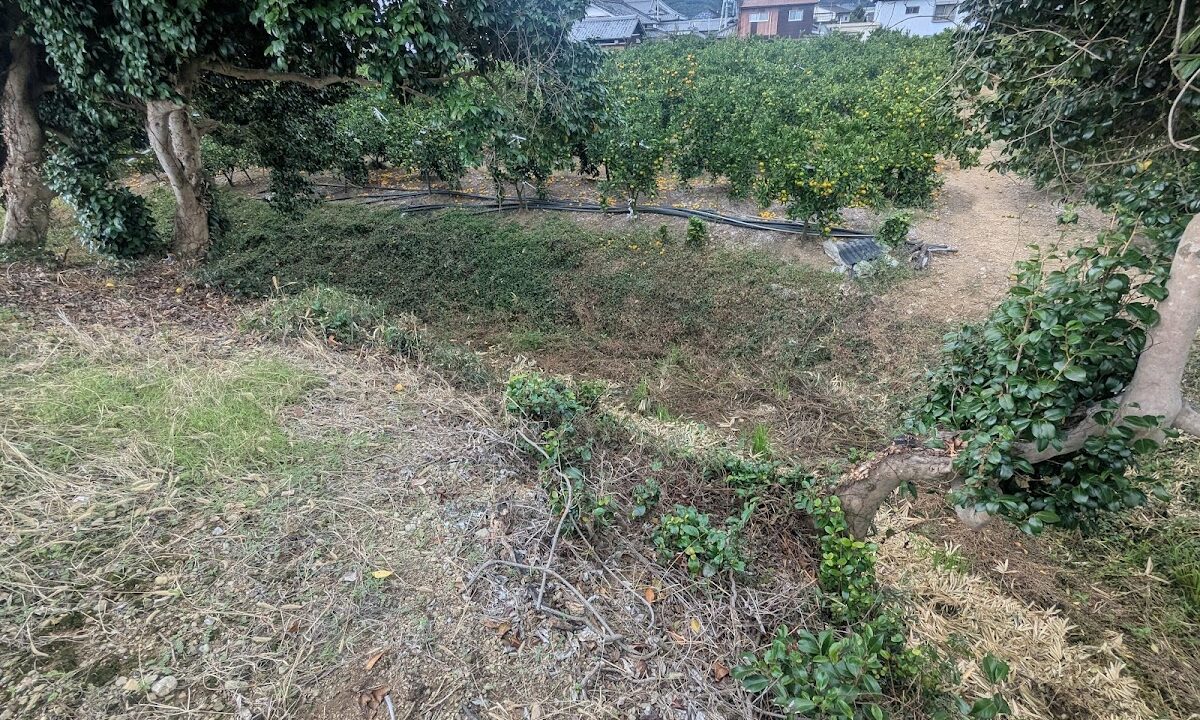
The most prominent remains of Fujinami Castle are the earthworks. The earthworks built around the castle still remain in good condition in some parts. These earthworks served to prevent enemy intrusion and also obscured the view of the castle from the outside.
The height and width of the earthworks provide insights into the castle-building techniques and defensive philosophies of the time. The earthworks exhibit a structure characteristic of medieval castles in Kii Province, making them important resources for studying the history of castles in the region. ### Arrangement of Water and Dry Moats
Fujinami Castle had both water moats and dry moats (horizontal moats). Water moats, filled with water, provided stronger defense. Dry moats, on the other hand, were not filled with water and were used selectively depending on the terrain and location.
Even today, traces of the moats can be seen in the surrounding area, allowing us to infer the defensive system the castle had at the time. The arrangement of the moats played an important role in reinforcing the castle’s weaknesses and restricting the movements of attackers.
Current Situation and Preservation Status
The site of Fujinami Castle is now mostly used as an orchard. It is a cultivation area for citrus fruits, a specialty of Wakayama Prefecture, and modern land use coexists with historical remains.
However, it is possible that some remains have been lost due to the conversion to orchards, making it difficult to grasp the overall structure of the castle. Nevertheless, the earthworks and traces of the moats remaining in the surrounding area are preserved as important evidence of Fujinami Castle’s historical value.
The Position of Fujinami Castle within the Yuasa Clan’s Castle Group
Relationship with Yuasa Castle
Fujinami Castle, as part of the Yuasa Clan’s castle group, had a close relationship with Yuasa Castle (Hirano Castle). Yuasa Castle was located in Aoki, Yuasa-cho, Arida-gun, Wakayama Prefecture, the Yuasa Clan’s base, and functioned as the clan’s central fortress.
Fujinami Castle played a subsidiary role to Yuasa Castle, responsible for the defense and control of the Arida River basin. It is believed that they cooperated with each other within the Yuasa Clan’s sphere of influence to ensure regional security and governance.
Characteristics of Medieval Castles in Kii Province
Wakayama Prefecture has numerous medieval castles, each telling a story of the region’s history. Unlike early modern castles such as Wakayama Castle and Shingu Castle, medieval castles like Fujinami Castle lack stone walls and are characterized by their use of earthworks and moats as primary defensive structures.
Numerous medieval castles and fortifications exist in Kii Province, including Tetori Castle, Ota Castle, and Saikazaki Castle, each playing a significant role in their respective regions. These castles and fortifications reflect the complex political situation in Kii Province during the Sengoku period and the rise and fall of various powers.
Fujinami Castle, as one of these castles and fortifications in Kii Province, occupies an important position in regional history research. It is highly valued academically as a site that concretely demonstrates the history of a specific samurai group, the Yuasa clan.
Access and Visiting Information for Fujinami-kan
Location and Transportation Access
Location: Shimotsuno (Kumai, etc.), Aritagawa-cho, Arida-gun, Wakayama Prefecture
Access by Train:
- Approximately 5-10 minutes on foot or by car from Fujinami Station on the JR Kisei Main Line (Kinokuni Line)
- Some “Kuroshio” limited express trains stop at Fujinami Station
Access by Car:
- Approximately 15 minutes from Arida IC on the Hanwa Expressway
- Advance confirmation of parking is recommended
Precautions During Visits
Since much of the Fujinami-kan site is currently used as a private orchard, please note the following points when visiting:
- Consideration for Private Property: Avoid unauthorized entry into areas used as orchards.
- Protection of Remains: Care must be taken not to damage the earthworks or traces of the moats.
- Confirming Landmarks: Using Amidaji Temple as a landmark will make it easier to find the location.
- Consider the Season: Special consideration is needed during fruit harvest seasons.
Nearby Historical Spots
When visiting Fujinami-kan, visiting nearby historical spots will allow you to understand the local history more deeply:
- Yuasa Castle Ruins: A castle that served as the base of the Yuasa clan and had a close relationship with Fujinami-kan.
- Amidaji Temple: A temple located near Fujinami-kan that tells the history of the region.
- Historical Materials of Aritagawa Town: There are facilities in Aritagawa Town where you can learn about the local history.
Historical Significance and Research Value of Fujinami-kan
Importance in Yuasa Clan Research
Fujinami-kan is an important historical site that concretely demonstrates the history of the Yuasa clan. The Yuasa clan was a powerful samurai group in Kii Province and was active for a long period from the late Heian period to the Sengoku period. The remains of Fujinami Castle are invaluable historical documents illustrating how these samurai groups controlled the region and the types of castles they built.
Fujinami Castle holds high academic value because it allows us to glean insights into the actual castle structure and defensive systems that cannot be understood from written historical sources alone.
Position in Medieval Castle History
In the history of Japanese castles, the transition from the medieval to the early modern period was a crucial turning point. Medieval castles like Fujinami Castle possessed a different defensive philosophy and structure compared to early modern castles with stone walls and keeps.
Fujinami Castle, which well preserves the characteristics of medieval castles with earthworks and moats as its main defensive structures, is a valuable example for studying castle technology and tactics of this era. Comparative research with medieval castles throughout Japan can reveal regional characteristics and commonalities.
Role in Regional History
Fujinami Castle is an indispensable historical site when discussing the regional history of Aritagawa Town and Wakayama Prefecture. As a historical site that concretely illustrates the lives, culture, and political changes of the local people, it contributes to local history education and the formation of regional identity.
Fujinami Castle also holds significant meaning as a concrete example of how the nationwide historical turning point of the Tensho era’s invasion of Kishu had an impact at the regional level.
Fujinami Castle and the Castle Culture of Wakayama Prefecture
Comparison with Major Castles in Wakayama Prefecture
Wakayama Prefecture has castles of various eras and scales. Wakayama Castle, known as a famous castle of the early modern period, is a magnificent castle with stone walls and a keep, serving as the residence of the Kishu Tokugawa family, one of the three main branches of the Tokugawa clan.
Shingu Castle served as an important base in the Kumano region, and Tanabe Castle as a central castle in the Kinan region, both serving as centers of regional control. Compared to these early modern castles, Fujinami Castle, though smaller in scale, is important as a representative example of the castle culture of the medieval period, a different era.
Castles associated with the Saika clan, such as Ota Castle and Saikazaki Castle, also occupy an important position in the history of castles in Wakayama Prefecture. Furthermore, the character of Negoro-ji Temple as a temple-castle also demonstrates the distinctive castle culture of Kii Province.
Political Situation in Medieval Kii Province
Medieval Kii Province, where Fujinami Castle existed, was in a complex political situation with multiple powers vying for power. Besides the Yuasa clan, various forces such as the Saika clan, Negoro clan, and Kumano Betto established their own spheres of influence.
Under these circumstances, each force built castles to protect its territory and kept each other in check. Fujinami Castle also played an important role in maintaining the power of the Yuasa clan within this political context.
Medieval Society as Seen Through Castles
Medieval castles like Fujinami Castle were not merely military facilities, but also functioned as the residence of the feudal lord. They served as the base where the lord and their family lived their daily lives, commanded their retainers, and governed their people.
The structure of the castle, as inferred from the remains, reflects the social strata, lifestyles, and defensive strategies of the time. The arrangement of earthworks and moats, and the configuration of the baileys, allow us to understand how medieval lords demonstrated their authority and protected their territories.
Preservation of Fujinami Castle and Future Challenges
Current Preservation Status
The remains of Fujinami Castle are partially preserved within an area currently used as an orchard. While some earthworks and moats are still visible, it is believed that many parts have been lost due to development and changes in land use.
Some parts are designated as a town historical site, and certain protective measures are taken as a regional historical heritage. However, there are various challenges to preservation, such as the fact that it is privately owned land and the need to balance preservation with modern land use.
Future Preservation and Utilization
The preservation and utilization of medieval castles like Fujinami Castle is a nationwide challenge. The following initiatives are being considered:
- Detailed Survey: Record the precise location and condition of the remains and develop basic academic data.
- Installation of Information Boards: Install information boards in appropriate locations so that visitors can understand the history.
- Collaboration with the Community: Work with local residents and landowners to balance preservation and land use.
- Educational Use: Utilize the site for school education and lifelong learning to deepen understanding of local history.
- Digital Preservation: Preserve the remains as digital data using technologies such as 3D scanning.
Communicating the Value as a Historical Heritage Site
Communicating the historical value of Fujinami Castle is fundamental to supporting preservation activities. Beyond its use as a tourist resource, clearly communicating the results of academic research to the general public can increase interest in local historical heritage.
Collaboration with other castles in Wakayama Prefecture and the establishment of castle-touring routes are also ways to enhance the value of Fujinami Castle. Emphasizing its connection to Yuasa Castle and providing information that allows for a comprehensive understanding of the Yuasa clan’s history would also be effective.
Summary: The History of Kii Province as Told by Fujinami Castle
Fujinami Castle, located in Aritagawa Town, Wakayama Prefecture, is a medieval castle site that conveys the history of the Yuasa clan and the medieval society of Kii Province to the present day. It survived for approximately 300 years, with its lords changing from the Shimotsuno clan to the Fujinami clan and then to the Katada clan, before its history came to an end in 1585 during Hashiba Hideyoshi’s invasion of Kii Province.
The remaining earthworks and moats concretely demonstrate the structure and defensive philosophy of medieval castles, making them valuable resources for castle history research. Medieval history quietly breathes within the modern landscape, now used as an orchard.
Visiting Fujinami Castle is not simply about viewing ruins; it’s also about experiencing the history of the Yuasa clan, the medieval society of Kii Province, and the fate of the region during the great upheaval of the Tensho era. As one of Wakayama Prefecture’s rich historical heritage sites, Fujinami-kan possesses value that should be carefully preserved, researched, and passed down to future generations.
Its convenient location, easily accessible from JR Fujinami Station, is another attractive feature of this historical site. For those interested in the history of Kii Province, those who enjoy castle tours, and those who want to learn about local cultural heritage, Fujinami-kan is an important historical spot well worth visiting.