Complete Guide to Eda-yakata (Ota City, Gunma Prefecture) | A Thorough Explanation of the National Historic Site of the Nitta-sho Ruins
Located in Ota City, Gunma Prefecture, Eda-yakata is the site of a medieval residence built from the Kamakura period to the Nanboku-cho period. Known as the residence of Eda Yukiyoshi, who participated in the overthrow of the Kamakura Shogunate alongside Nitta Yoshisada, it is now registered as a national historic site as part of the Nitta-sho Ruins. The remains, such as earthworks and dry moats, are well-preserved, making it a valuable historical heritage site that conveys the living space of medieval samurai, attracting attention from many history enthusiasts and researchers.
Basic Information on Eda-yakata
Eda-yakata is a flatland castle (residence) located in Nitta-kami-eda-cho, Ota City, Gunma Prefecture. Also known as Eda Castle, it was built in a geographically important location at the western edge of the Kizaki Plateau.
Location: 924-4, Nitta Kamieda-cho, Ota City, Gunma Prefecture, and other locations
Construction Period: Kamakura period to Nanboku-cho period (estimated late 13th to 14th century)
Builder: Eda Yoriyuki
Main Lords: Eda Yukiyoshi, Yanai Shirozaemon
Remains: Enclosures (kuruma), earthworks, dry moats, gate
Designation: National Historic Site (part of the Nitta-sho Ruins)
Year of Cultural Property Designation: Designated as Gunma Prefecture Historic Site No. 1 in 1947, and as a National Historic Site in 2000
History of Eda Castle and its Lords
The Eda Clan and the Nitta Family
The Eda clan, the builders of Eda Castle, are a branch of the Nitta family, descended from Nitta Yoshisue, son of Nitta Yoshishige. Eda Yukiyoshi, the fourth-generation descendant of Nitta Yoshisue, is the most well-known figure. The Eda clan established their power in this region, based in Eda-go within the Nitta Manor.
The Nitta Manor was a vast estate developed from the late Heian period to the Kamakura period, ruled by the Nitta clan. Eda-kan, one of the representative residences of this Nitta Manor, is an important historical site demonstrating the Nitta clan’s power base.
Eda Yukiyoshi and the Overthrow of the Kamakura Shogunate
The most important period in the history of Eda-kan is the overthrow of the Kamakura Shogunate by Nitta Yoshisada in 1333. Eda Yukiyoshi joined Nitta Yoshisada’s uprising and participated in the attack on Kamakura. The Taiheiki chronicles Eda Yukiyoshi’s exploits, stating that he achieved great military success as a key general in the Nitta army in the defeat of the Hojo clan.
Even during the Nanboku-cho period after the fall of the Kamakura Shogunate, the Eda clan continued to act on the side of the Southern Court. Yukiyoshi Eda fought alongside Yoshisada Nitta in various battles, leaving his mark on history as an important member of the Nitta clan.
Eda Castle in the Sengoku Period
Although the power of the Eda clan declined after the Nanboku-cho period, Eda Castle took on a new role during the Sengoku period. During this time, Eda Castle functioned as an outpost of Kanayama Castle (Ota Kanayama Castle).
Kanayama Castle was a mountain castle built on Kanayama in Ota City, and during the Sengoku period, the Yura clan ruled as its lords. Eda Castle became the residence of Shirozaemon Yanai, one of the four chief retainers (or four heavenly kings) of Kanayama Castle, and it is said that the castle was expanded and renovated during this period. It is believed that during this time, its defensive functions were strengthened, and it took on a more castle-like character.
Structure and Highlights of Eda Castle
Size and Layout of the Castle
Eda Castle is a square-shaped castle measuring approximately 100 meters east-west and 80 meters north-south. The site is roughly the same size as the main enclosure of the Sorimachi Manor, another Nitta Manor site, indicating its status as the residence of a powerful warrior of the Nitta clan.
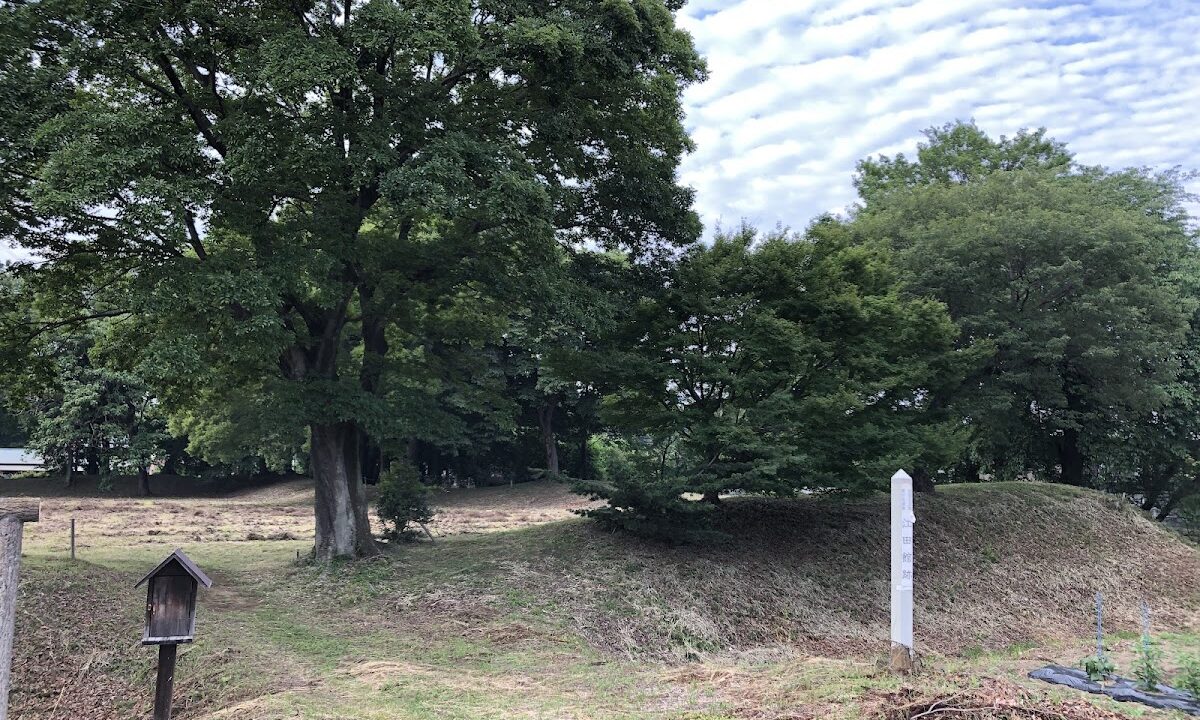
The manor site is located just north of Prefectural Road 292, and clear remains still exist amidst the surrounding farmland and residential areas. While based on a single-enclosure structure centered on the main enclosure, it retains the typical form of a medieval residence, surrounded by a moat and earthen ramparts.
Features of the Earthen Ramparts
One of the greatest highlights of the Eda Manor is its well-preserved earthen ramparts. The ramparts surrounding the manor have largely retained their original form, and while their height varies depending on the location, the highest points reach over 3 meters.
Particularly noteworthy are the flanking bends seen in the east and west ramparts. This defensive technique, which incorporated bends in the ramparts to allow attacks on the enemy’s flanks, is thought to have been added during renovations in the Sengoku period. These flanking bends are important evidence indicating a transformation from a simple residence to a castle emphasizing defensive functions.
The top of the earthen rampart is relatively flat, suggesting the possibility of a fence or wall being erected there in the past. The inside of the rampart has a gentle slope, making it easy to access the top from inside the castle.
Structure of the Dry Moat
The dry moat surrounding the Eda Castle is also an important historical structure. Unlike the wide water moat of the Sorimachi Castle, the moat of the Eda Castle is a typical Yagenbori (V-shaped moat). A Yagenbori is a moat with a V-shaped cross-section, which prevents enemy intrusion and makes movement at the bottom of the moat difficult.
The depth of the moat varies depending on the location, but the deepest part reaches approximately 4-5 meters. The width of the moat is also not uniform, narrower near the entrance (koguchi) and wider in other parts, showing defensive ingenuity.
Currently, some parts of the moat are filled in or shallower, but the overall shape remains clearly visible, allowing us to imagine its appearance in the past. On the outside of the moat, soil excavated from the earthworks was piled up, creating a structure that made attacks from the outside more difficult.
Entrance and Exit
The entrances to the manor house, known as “koguchi,” are believed to have been located on the south and east sides, as far as can be seen today. The southern entrance, in particular, clearly shows the opening in the earthworks and the moat crossing, allowing us to imagine how people entered and exited the manor at the time.
At the entrance, the earthworks curve inward, a design intended to prevent enemy intrusion. This is a technique called “chigai-koguchi,” which enhances defense by preventing a direct advance.
Enclosures within the Manor House
The interior of the manor house is basically composed of a single enclosure (kuruma). The interior is relatively flat, and it is presumed that buildings such as residences and warehouses once stood there. While archaeological excavations have been limited, there is a possibility of discovering building foundations, post holes, and well remains.
Currently, part of the manor’s interior is used as farmland and open space, making it impossible to directly confirm the original building layout. However, by viewing it together with the surrounding earthworks and moats, we can understand the overall structure of the manor as a living space for medieval samurai.
Value as a Nitta-sho Site
Eda Manor was designated a National Historic Site in 2000 as part of the Nitta-sho Site. Prior to that, in 1947, it was designated as Gunma Prefecture’s first Historic Site, indicating its historical value was recognized early on.
The Nitta-sho Site consists of several other sites related to Nitta-sho, including Eda Manor, Sorimachi Manor, Ikushina Shrine, and Yatagami Marsh. These are valuable archaeological sites that illustrate the realities of a medieval manor and occupy an important position in the study of Japanese history.
Among the Nitta-sho Sites, Eda Manor is particularly valuable for its well-preserved remains as a samurai residence, making it an indispensable historical source for studying the changes in samurai life and defensive facilities from the Kamakura period to the Sengoku period.
Preservation and Development of Eda-kan
After being designated a National Historic Site, Eda-kan has been preserved and developed by Ota City. While prioritizing the protection of the remains, efforts are being made to create an environment where visitors can experience history.
Information boards have been installed around the site, providing detailed information about the history and structure of Eda-kan. Regular maintenance, such as mowing the earthworks and moats, is also carried out to maintain the visibility of the remains.
The Cultural Properties Division of the Ota City Board of Education continues to conduct research on the Nitta-sho ruins, including Eda-kan, accumulating new discoveries and knowledge. These results are made public through lectures and materials, and are also used in local history education.
Access Information
Access by Public Transportation
By Train/Bus:
- Get off at Ota Station on the Tobu Railway Isesaki Line
- Take the City Liner Ota from Ota Station and get off at the Kanai Jujiro bus stop, then walk for approximately 19 minutes.
- Alternatively, get off at Kizaki Station on the Tobu Railway Isesaki Line and take a taxi for approximately 15 minutes (approximately 5 km).
Access by Car
Kita-Kanto Expressway:
- Approximately 15 minutes from Ota-Kiryu IC
- Approximately 20 minutes from Ota-Yabuzuka IC
Parking: There is no dedicated parking lot, but there are spaces available for parking on the roadside in the surrounding area. However, consideration must be given to avoiding inconveniencing local residents.
Notes for Visitors
The Eda-kan Ruins are an outdoor historical site and are open for viewing at all times. Admission is free, and no prior reservation is required. However, please note the following points.
- Part of the castle site includes private land, so please do not enter restricted areas.
- Please be careful not to damage the earthworks or moats to protect the remains.
- In summer, the grass grows thick, making the remains difficult to see.
- The ground can be slippery during and after rain, so please be careful.
- There are no toilets or rest facilities, so please prepare in advance.
Nearby Attractions and Tourist Spots
Other Historical Sites of the Nitta-sho Ruins
Sorimachi Castle Site: The site of Nitta Yoshisada’s residence, located approximately 3km from Eda Castle. It is larger in scale than Eda Castle and features a wide moat. It is an important historical site that forms the core of the Nitta-sho Ruins.
Ikushina Shrine: A shrine said to be the place where Nitta Yoshisada raised an army to overthrow the Kamakura Shogunate. The shrine grounds contain a statue of Nitta Yoshisada and a monument commemorating the uprising, making it a historically important sacred site.
Yatagami Marsh: A marsh with a legend that Nitta Yoshisada dedicated his sword here during his attack on Kamakura. It is an important historical site as a place of worship for the Nitta Manor.
Kanayama Castle Ruins
Kanayama Castle, which functioned as an outpost of the Eda Manor during the Sengoku period, is a mountain castle that can be considered a symbol of Ota City. Its stone walls and baileys remain in good condition, and it has been selected as one of Japan’s Top 100 Castles. It is about a 20-minute drive from the Eda Manor, and visiting both together will help you understand the castle network of the Sengoku period.
Ota City Nitta Manor Historical Museum
This museum allows you to learn about the history of the Nitta Manor and the Nitta clan. Artifacts and materials excavated from the Nitta Manor ruins, including the Eda Manor, are on display, and visiting before or after your visit will deepen your understanding.
Location: 3113-9 Serada-cho, Ota City, Gunma Prefecture
Opening Hours: 9:30 AM – 5:00 PM (Last entry at 4:30 PM)
Closed: Mondays (or the following day if Monday is a public holiday), New Year holidays
Admission Fee: 210 yen for adults, 100 yen for elementary and junior high school students
Recommended Route for Visiting Eda-kan
We introduce a model course for efficiently touring the Nitta-sho Ruins.
Half-Day Course (Duration: Approx. 3-4 hours)
- Ikushina Shrine (30-minute visit) – Experience the historical romance at the site of Nitta Yoshisada’s uprising.
- Eda-kan Ruins (40-minute visit) – Observe the earthworks and dry moats in detail.
- Sorimachi-kan Ruins (40-minute visit) – Visit the site of Nitta Yoshisada’s residence.
- Ota City Nitta-sho Historical Museum (60-minute visit) – Learn about the history of Nitta-sho systematically.
Full-Day Course (Duration: Approx. 7-8 hours)
In addition to the above half-day course, the following is added:
- Yatagami Marsh (30-minute visit) – Visit the site of the legend of Nitta Yoshisada
- Kanayama Castle Ruins (90-minute visit) – Enjoy the stone walls and baileys of the mountain castle
- Kanayama Castle Ruins Historic Site Guidance Facility (30-minute visit) – Learn about the history of Kanayama Castle
Seasons and Photo Spots at Edakan
Edakan shows different faces in each of the four seasons.
Spring (March-May): The fresh greenery is beautiful, and the shape of the earthworks and moats is clearly visible. You can also enjoy the cherry blossom trees in the surrounding area during cherry blossom season.
Summer (June-August): The greenery becomes denser, and the remains may be difficult to see, but the castle ruins enveloped in deep green are fantastic. Visiting in the early morning or evening is recommended.
Autumn (September-November): The autumn leaves are beautiful, making it the best season for photography. The view from atop the earthworks is magnificent, offering a harmonious blend of scenery and the surrounding rural landscape.
Winter (December-February): The grass withers, making the remains most easily visible. On snowy days, the contrast of white and black creates beautiful photographs.
Photo Spots
- Near the South Entrance: A classic spot where the relationship between the earthworks and the moat is clearly visible.
- Top of the Earthworks: A viewpoint offering a panoramic view of the castle’s interior.
- Eastern Flanking Section: A technical highlight showcasing the ingenuity of defensive techniques.
- Earthworks Viewed from the Bottom of the Moat: An angle that allows you to appreciate the depth of the moat and the height of the earthworks.
Cutting Edge of Eda Castle Research
Recent excavations and research have accumulated new knowledge about Eda Castle.
Re-examination of the Construction Date
Traditionally, Eda Castle was believed to have been built during the Kamakura period. However, detailed analysis of the remains suggests that many of the existing earthworks and moats may be the result of renovations during the Sengoku period. In particular, technical features such as the bends in the flanking defenses share many similarities with 16th-century castle technology, suggesting that large-scale renovations were carried out during the period when it functioned as an outpost of Kanayama Castle.
Research on the Genealogy of the Eda Clan
Research on the genealogy of the Eda clan is progressing based on historical materials such as the *Taiheiki* and the *Nitta Clan Genealogy*. In particular, the activities of Eda Yukiyoshi are becoming clearer due to the discovery of new historical materials, not only regarding the attack on Kamakura but also his subsequent activities on the Southern Court side.
Positioning within Nitta Manor
Research is also progressing on the positioning of Eda Castle within Nitta Manor. It has been suggested that Eda Castle may have played a role as a defensive base to the east, relative to the Nitta clan’s main base centered around Sorimachi Castle. Furthermore, considering its relationship with surrounding temples, shrines, and roads, it is believed to have also functioned as a transportation hub. ## Summary: The Charm and Historical Significance of Eda Castle
Eda Castle is an important historical site that has watched over the history of this region for approximately 300 years, from the Kamakura period to the Sengoku period. It served different roles in each era: as the residence of Eda Yukiyoshi, who was involved in the crucial turning point in Japanese history—Nitta Yoshisada’s attack on Kamakura—and as a castle that played a part in the defense network of Kanayama Castle during the Sengoku period.
The well-preserved earthworks and dry moats are valuable remains that convey the living space and defensive techniques of medieval samurai. Its designation as a National Historic Site as part of the Nitta-sho Ruins further demonstrates its high historical value.
When visiting Ota City, Gunma Prefecture, be sure to visit the Eda Castle ruins and experience the romance of medieval history. Standing on the earthworks and gazing at the moat, imagining the samurai who once lived here will make history feel much closer.
Inquiries
Ota City Board of Education, Cultural Properties Division
Telephone: 0276-20-7090
For detailed information regarding visits to the Eda-kan Ruins and the Nitta-sho Ruins, please contact the Ota City Cultural Properties Division. The Ota City Tourism and Products Association (Telephone: 0276-47-1833) also provides tourist information.