Hachigata Castle Complete Guide: A Thorough Explanation of the History and Highlights of the Strongest Fortress of the Sengoku Period
What is Hachigata Castle?
Hachigata Castle is a representative castle site from the Sengoku period located in Yorii-machi, Osato-gun, Saitama Prefecture. Built on a river terrace between the Arakawa and Fukasawa rivers, it is known as a flatland castle that functioned as a natural stronghold. It was designated a national historic site on April 19, 1932, and in 2006, it was selected as one of Japan’s Top 100 Castles (No. 18).
The remains are relatively well-preserved for a Sengoku period castle located in the Kanto region, and it is now maintained as Hachigata Castle Park, an important cultural property visited by many history enthusiasts and tourists.
History of Hachigata Castle
From Construction to the Era of Nagao Kageharu
The most widely accepted theory regarding the construction of Hachigata Castle is that it was built in 1476 (Bunmei 8) by Nagao Kageharu, a chief retainer of the Yamanouchi Uesugi clan, who were the Kanto Kanrei (governor of the Kanto region). Nagao Kageharu was a warrior who rebelled against his lord, the Yamanouchi Uesugi clan, and used Hachigata Castle as his base.
Some historical sources also attribute the castle’s construction to Minamoto no Tsunemoto or Hatakeyama Shigetada, but based on the castle’s structure and archaeological excavations, the actual construction period is believed to be during the Bunmei era (1469-1487).
The Era of the Uesugi Clan
After the Nagao Kageharu Rebellion subsided, Hachigata Castle became an important base for the Uesugi clan. During the Eisho era, Uesugi Akizane, son of Uesugi Akisada, served as the castle lord and played a crucial role in maintaining the authority of the Kanto Kanrei. During this period, Hachigata Castle was a strategically important base for controlling northern Kanto, serving as a key transportation hub overlooking Joshu (Gunma Prefecture) and Shinshu (Nagano Prefecture).
Expansion and Improvement by Hojo Ujikuni
In the mid-Sengoku period, the power of the Later Hojo clan, based in Odawara, infiltrated Musashi Province, driving out the Uesugi clan. Fujita Yasukuni (Yasukuni), a local powerful family, became the castle lord, but eventually Hojo Ujikuni, the fourth son of Hojo Ujiyasu of Odawara, married into the Fujita family and became the lord of Hachigata Castle.
Around 1560, Hojo Ujikuni carried out large-scale castle renovations, expanding Hachigata Castle into one of the largests in the Kanto region. Under Ujikuni’s rule, Hachigata Castle functioned as a central base for the Later Hojo clan’s control of northern Kanto, and the castle town flourished greatly.
Hojo Ujikuni was known as a military commander excelling in both military and literary arts, and he governed the surrounding area centered around Hachigata Castle. It is believed that the basic layout (castle design) of Hachigata Castle as seen today was completed during Ujikuni’s time.
The Siege of Odawara and the Fall of Hachigata Castle
In 1590, when Toyotomi Hideyoshi began his siege of Odawara, Hachigata Castle was caught in the crossfire. A large army of 30,000 to 50,000 men from the northern provinces, led by Maeda Toshiie, Uesugi Kagekatsu, and Sanada Masayuki, besieged Hachigata Castle.
The castle lord, Hojo Ujikuni, and approximately 3,000 soldiers holed up in the naturally fortified Hachigata Castle, engaging in fierce battles. As a formidable fortress that had withstood attacks from famous generals such as Takeda Shingen and Uesugi Kenshin, it held out against the northern army’s attack for over a month.
However, when the surrender of Odawara Castle became inevitable, Hojo Ujikuni decided to surrender on the condition that the lives of the soldiers’ soldiers be spared. On June 14, 1590 (Tensho 18), Hachigata Castle surrendered, ending its role as a famous castle of the Sengoku period. After the surrender, Hachigata Castle was abandoned and never used as a fortress again.
Structure and Layout of Hachigata Castle
Design Utilizing Natural Fortifications
The most distinctive feature of Hachigata Castle is its location on a river terrace between two rivers, the Arakawa and the Fukasawa River. The east and north sides faced the Arakawa River, and the south side faced the Fukasawa River, with the cliffs formed by these rivers acting as natural moats.
Only the west side of the castle was adjacent to flat land, so defenses in this direction were heavily reinforced. Advanced castle construction techniques were employed, including deep dry moats, earthworks, and a complex arrangement of entrances.
Vast Castle Grounds
The castle grounds of Hachigata Castle stretched approximately 1.2 kilometers east-west and 0.6 kilometers north-south, covering a total area of about 30 hectares. This scale makes it one of the largest castles of the Sengoku period in the Kanto region.
The castle grounds were divided into several enclosures (kuruwa: sections), the main enclosures being as follows:
- Hon-kuruwa: The central part of the castle, where the lord’s residence was located
- Nin-no-kuruwa: The second most important section after Hon-kuruwa
- San-no-kuruwa: A defensive enclosure that served as a key point
- Soto-kuruwa: The outer fortifications of the castle
- Sasa-kuruwa: An enclosure located north of Hon-kuruwa
- Den-Goten-kuruwa: An enclosure believed to have housed the lord’s residence
These enclosures were separated by earthworks and dry moats, forming a complex defensive system.
Dry Moats and Earthen Embankments
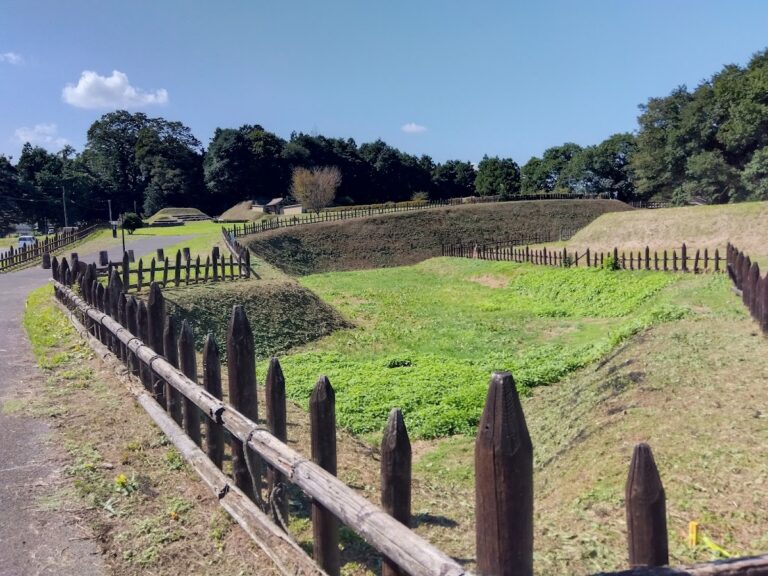
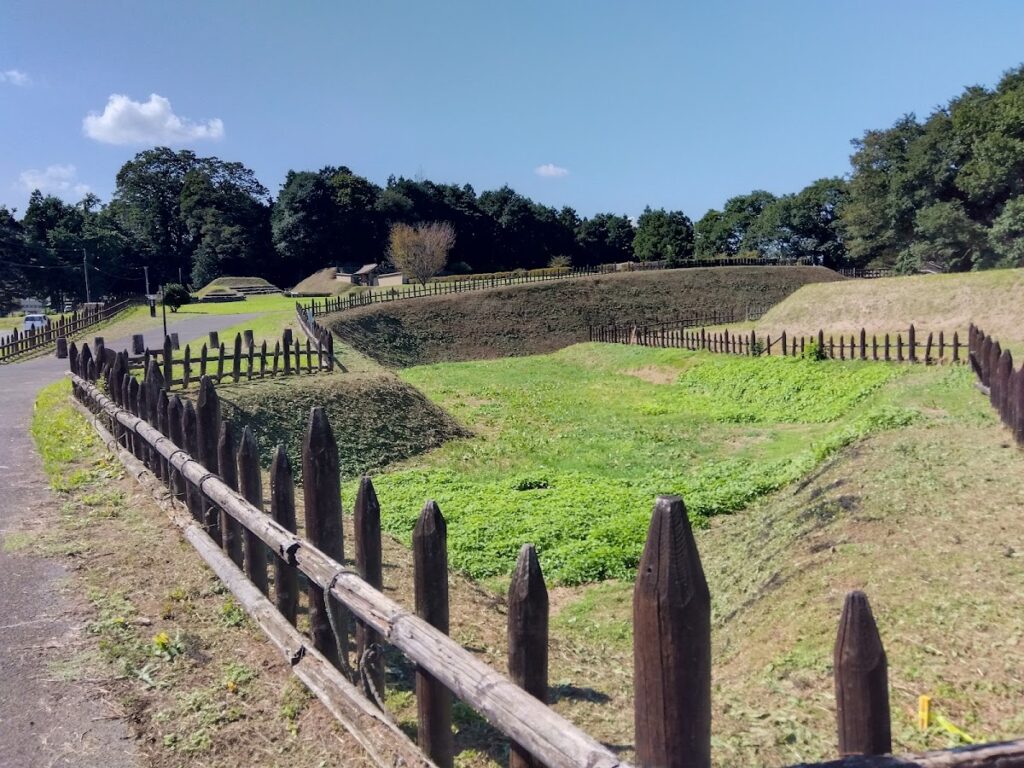
The deep dry moats and high earthen embankments are particularly noteworthy defensive features of Hachigata Castle. Especially along the western defensive line, a large dry moat, over 10 meters deep and over 20 meters wide, was constructed.
Even today, parts of these dry moats and earthen embankments remain in excellent condition, allowing visitors to appreciate the high level of castle-building technology of the Sengoku period. The dry moat between the third and second baileys is particularly well-preserved as a magnificent historical structure.
Structure of the Entrance Gates
Hachigata Castle had multiple entrance gates (koguchi), each incorporating ingenious designs to enhance its defensive capabilities. Structures such as staggered entrance gates and square-shaped entrance gates were employed to make enemy intrusion difficult.
Highlights of Hachigata Castle Park
Hachigata Castle History Museum
Located within Hachigata Castle Park, the Hachigata Castle History Museum is a facility where visitors can learn in detail about the history and structure of Hachigata Castle. The museum houses exhibits of artifacts unearthed during archaeological excavations, a reconstructed model of the castle, and video presentations, making it an ideal place to understand the entirety of Hachigata Castle.
Opening Hours: 9:30 AM to 4:30 PM (Last entry at 4:00 PM)
Closed: Mondays (or the following day if Monday is a public holiday), the day after a public holiday, and during the New Year holidays
Admission Fee: 200 yen for adults, 100 yen for high school and university students, free for junior high school students and younger
The exhibits are regularly updated, and special exhibitions are also held. When visiting Hachigata Castle, it is recommended to first gain some background knowledge at the history museum before exploring the castles for a deeper understanding.
Reconstructed Four-Legged Gate
Within Hachigata Castle Park is a four-legged gate that has been reconstructed based on the results of archaeological excavations. This gate served as the main gate to the main enclosure and faithfully reproduces the architectural style of the time. The area around the reconstructed gate features stone walls and earthworks, allowing visitors to experience the atmosphere of a castle gate from the Sengoku period.
Main Enclosure and Second Enclosure
The main enclosure is the central part of the castle, where the residence of the castle lord, Hojo Ujikuni, was located. Currently, it is a plaza surrounded by earthworks. The view of the Arakawa River from the main enclosure is magnificent, allowing visitors to truly appreciate its strategic location as a natural stronghold.
The second enclosure is an important section adjacent to the main enclosure, also offering a spacious area. A deep dry moat separates the main and second enclosures, its sheer size being astonishing.
Remains of Dry Moats and Earthworks
The most impressive sights within Hachigata Castle Park are the well-preserved remains of dry moats and earthworks. The dry moats around the third enclosure, in particular, are deep and wide, allowing visitors to experience firsthand the reality of Sengoku period defensive structures.
A walking path is maintained, allowing visitors to stroll along the bottom of the dry moat and overlook the castle grounds from atop the earthen ramparts. In spring, the cherry blossoms are beautiful, and in autumn, the autumn leaves are stunning, allowing visitors to enjoy both historical exploration and nature appreciation.
Ujikuni Cherry Tree
Hachigata Castle Park is home to a cherry tree called the “Ujikuni Cherry Tree,” named after the castle lord, Hojo Ujikuni. In spring, it blooms beautifully, attracting many visitors. It’s a popular spot to enjoy the quintessential Japanese scenery of castle ruins and cherry blossoms.
Besides the Ujikuni Cherry Tree, numerous other cherry trees are planted in the park, and during cherry blossom season, the entire castle grounds are bathed in a delicate pink hue.
Views of the Arakawa and Fukasawa Rivers
The views of the Arakawa and Fukasawa Rivers, a characteristic feature of Hachigata Castle’s location, are another highlight. The view of the Arakawa River from the edge of the castle ruins, and the Musashino landscape stretching beyond, is breathtaking. Standing atop the cliff, one can truly appreciate how naturally fortified this castle was.
Access Information
Access by Train
Nearest Station: Yorii Station (Tobu Tojo Line, Chichibu Railway, JR Hachiko Line)
It takes approximately 25 minutes to walk from Yorii Station to Hachigata Castle Park. Walk south from the station, cross the Shoki Bridge over the Arakawa River, and you will immediately arrive at the castle ruins. If walking is difficult, you can also take a taxi (approximately 5 minutes).
Access by Car
- Approximately 15 minutes from the Kan-Etsu Expressway “Hanazono Interchange”
- There are signs along National Route 254
Parking: Hachigata Castle History Museum parking lot (free) and Hachigata Castle Park parking lot (free) are available.
Strategic Importance of Hachigata Castle
Location as a Transportation Hub
The area of Yorii, where Hachigata Castle was built, was a transportation hub connecting Musashi Province, Kozuke Province (Gunma Prefecture), and Shinano Province (Nagano Prefecture). The location was convenient for transporting goods, thanks to access to the Arakawa River. Controlling this area was extremely important for controlling northern Kanto.
Northern Defense Base of the Later Hojo Clan
For the Later Hojo clan, based in Odawara, Hachigata Castle was a frontline defense against threats from the north. When powerful enemies like Uesugi Kenshin and Takeda Shingen invaded Kanto, Hachigata Castle played a crucial role as a bulwark.
In fact, Uesugi Kenshin repeatedly launched castle expeditions to Kanto, but was unable to capture Hachigata Castle. The same was true for Takeda Shingen; the’s strength was widely known even then.
Prosperity of the Castle Town
Under the rule of Hojo Ujikuni, the castle town of Hachigata Castle flourished greatly. Commerce and industry developed, and it became a central hub attracting many people. Ujikuni is said to have focused on protecting his people and implemented good governance.
Archaeological Excavation and Preservation Activities
Continuous Archaeological Excavation
At Hachigata Castle Ruins, continuous archaeological excavations have been conducted since the 1960s. These investigations have revealed the castle’s structure, building layout, and lifestyle. Excavated artifacts include pottery, weapons, and daily life tools, providing valuable information about castle life during the Sengoku period (Warring States period).
Development and Preservation of the Historic Site
As a nationally designated historic site, the preservation and development of Hachigata Castle Ruins are being carried out systematically. While prioritizing the protection of the remains, walking paths and information boards have been installed to ensure the safety of visitors.
Yorii Town recognizes Hachigata Castle Ruins as an important cultural asset of the region and is actively engaged in preservation activities. Regular mowing and cleaning activities are carried out to maintain the site in good condition.
Nearby Tourist Attractions
Tamayodo Lake and Arakawa River Cruise
The Arakawa River, which flows near Hachigata Castle, forms a scenic area called Tamayodo Lake. The area is especially beautiful during the seasons of fresh greenery and autumn leaves, and you can also enjoy a boat trip down the Arakawa River.
Historical Buildings in Yorii Town
Besides Hachigata Castle, Yorii Town has many other historical buildings and sites. There are also Lake Enryoda and Nakamahira Green Park, making it possible to combine historical walks with nature appreciation.
Sightseeing in the Chichibu Area
Yorii Town is also a gateway to the Chichibu region. Using the Chichibu Railway, you can easily access tourist spots such as Chichibu Shrine and the Nagatoro Rock Formations.
Points to Note When Visiting Hachigata Castle
Time Required
We recommend allocating at least 1.5 to 2 hours for a stroll through Hachigata Castle Park. Including a visit to the Hachigata Castle History Museum, about 3 hours will allow for a leisurely visit.
Clothing and Items to Bring
The ruins are hilly, and there are places where you walk along the bottom of the dry moat, so comfortable shoes and clothing are necessary. In the summer, a hat, drinks, and insect repellent are recommended. Don’t forget to take precautions against the cold during the winter months.
Best Season for Visiting
Hachigata Castle can be visited throughout the year, but the following times are especially recommended:
- Spring (Late March to Early April): Cherry blossom season. The cherry trees within the castle grounds, including the Ujikuni cherry tree, bloom beautifully.
- Autumn (Mid-to-Late November): Autumn foliage season. The contrast between the view of the Arakawa River and the autumn leaves is magnificent.
- Early Summer (May): The fresh greenery is beautiful, and the weather is pleasant, making it ideal for a stroll.
Event Information
Yorii Town also holds events related to Hachigata Castle. In particular, the “Hojo Festival” features a reenactment of the Battle of Hachigata Castle and attracts many tourists. Event information can be found on the official Yorii Town website.
Summary
Hachigata Castle is a magnificent castle that embodies the pinnacle of castle-building technology from the Sengoku period, characterized by its design that maximizes the use of its natural fortifications. It has etched its name in history as a formidable fortress that withstood attacks from some of the most powerful warlords of the Sengoku period, such as Takeda Shingen and Uesugi Kenshin.
Currently, it is well-preserved as a nationally designated historical site and is counted among Japan’s 100 Famous Castles. Combining learning at the Hachigata Castle History Museum with exploring the actual castle ruins allows for a deep understanding of the castle culture of the Sengoku period.
Standing atop the cliffs between the Arakawa and Fukasawa rivers, gazing at the view seen by Sengoku warlords, and reflecting on history from over 400 years ago—that is the charm of Hachigata Castle. When visiting Saitama Prefecture, be sure to visit this historic romantic castle.
Beyond its value as a castle ruin, Hachigata Castle Park offers the beauty of nature throughout the seasons, making it a recommended spot not only for history buffs but also for general tourists enjoying hiking and picnics. It’s relatively easy to access from central Tokyo, making it ideal for a day trip.
Hachigata Castle is steeped in history, encompassing the Sengoku period, the reign of Hojo Ujikuni, and the battles surrounding the Siege of Odawara. Using this article as a guide, we encourage you to visit Hachigata Castle and experience its magnificent history and beautiful scenery.