Akita Castle (Akita Prefecture) Complete Guide | History, Highlights, and Access Information for Ancient Fortresses
Akita Castle (Akita-jo/Akita-no-ki) is an ancient fortress located in the Terauchi district of Akita City, Akita Prefecture, dating from the Nara to Heian periods. As a northern base for Dewa Province, it served as a frontline base for the Yamato court’s administration of the Tohoku region. A nationally designated historical site, it is now developed as Takashimizu Park and attracts many history enthusiasts as a valuable historical site that conveys ancient history.
What is Akita Castle? | Japan’s Northernmost Ancient Fortress
Akita Castle is the site of an ancient local government office that functioned from the late 7th century to around the 10th century. Located on a plateau approximately 40 meters above sea level on the Takashimizu Hills near the mouth of the Omono River, it occupied a vast area of approximately 900,000 square meters.
Ancient castles and fortifications were facilities established by the Ritsuryo state (a legal and administrative system) to manage the Tohoku region and serve as a base for negotiations with the Emishi people. Akita Castle was one of the most important, located in the northernmost part of this network. It was not merely a military facility, but a center of politics, administration, diplomacy, and culture, a place where the most advanced technology and culture of the time were concentrated.
Characteristics of Akita Castle
The most distinctive feature of Akita Castle lies in its location and the diversity of its functions. Situated at a crucial transportation hub facing the Sea of Japan, it played an international role, handling the transport of goods by sea and receiving diplomatic envoys from the Bohai Kingdom.
Archaeological excavations have revealed the existence of various facilities, including the government office, the government buildings in the Unoki district, the outer fortifications, and a flush toilet. The flush toilet, in particular, is an extremely rare example of ancient Japanese sanitary facilities and a significant discovery illustrating the advanced nature of Akita Castle.
History of Akita Castle | From Dewa Fort to Akita Castle
Founding Period: The Era of Dewa Fort
The origins of Akita Castle date back to 733 (Tenpyo 5), when Dewa Fort was relocated to the area of present-day Akita City. Prior to this, Dewa Fort was located in the Shonai region (present-day Yamagata Prefecture), but as the border with the Emishi moved northward, a relocation of the base further north became necessary.
Initially called “Dewa Fort,” this facility was an important military and administrative center symbolizing the Yamato court’s control over the Tohoku region. Large-scale construction was undertaken from the outset, and development progressed under the strong will of the central government.
Renaming to Akita Castle and Development
In 760 (Tenpyo Hoji 4), Dewa Fort was renamed “Akita Castle.” This renaming was not merely a change of name, but signified an upgrade in the facility’s status and expansion of its functions. Around this time, Akita Castle came to be positioned as a core facility for the administration of the northern region, independent of the Dewa Provincial Government (present-day Yamagata Prefecture).
From the late 8th to the 9th century, Akita Castle reached its peak. Extensive renovations were carried out on the government buildings, and the outer fortifications were also improved. During this period, Akita Castle is believed to have flourished not merely as a military base, but as the political, economic, and cultural center of northern Dewa Province.
Diplomatic Hub with the Balhae Kingdom
One of Akita Castle’s important roles was as a diplomatic window with the Watari Kingdom (a state that existed from present-day northeastern China to the northern Korean Peninsula). Records of Balhae envoys visiting Akita Castle from 775 (Hōki 6) onward remain in historical documents such as the *Shoku Nihongi*.
Balhae envoys arriving from across the Sea of Japan were first welcomed at Akita Castle before proceeding to the capital. Therefore, it is presumed that Akita Castle was equipped with facilities for receiving international guests and spaces for conducting diplomatic ceremonies.
Changes and End of the Heian Period
From the latter half of the 9th century onward, the importance of Akita Castle gradually declined along with changes in the imperial court’s policy for managing the Tohoku region. In 878 (Genkei 2), the Genkei Rebellion occurred, and Akita Castle was temporarily attacked by the Emishi forces.
In the 10th century, maintaining Akita Castle became difficult, and it is believed to have eventually been abandoned. Afterward, the memory of Akita Castle faded throughout the medieval period, and its exact location remained unknown until modern times.
Structure and Facilities of Akita Castle
Government Office Area
The core of Akita Castle is the government office area. The government office was located slightly southwest of the center of the castle grounds, within a square area approximately 90 meters on each side. It was surrounded by a mud wall, providing strict security.
Inside the government office, buildings such as the main hall, side halls, and rear hall were systematically arranged, and ceremonies and government affairs were conducted there. Archaeological excavations have revealed that these buildings were rebuilt multiple times, indicating that they were maintained over a long period.
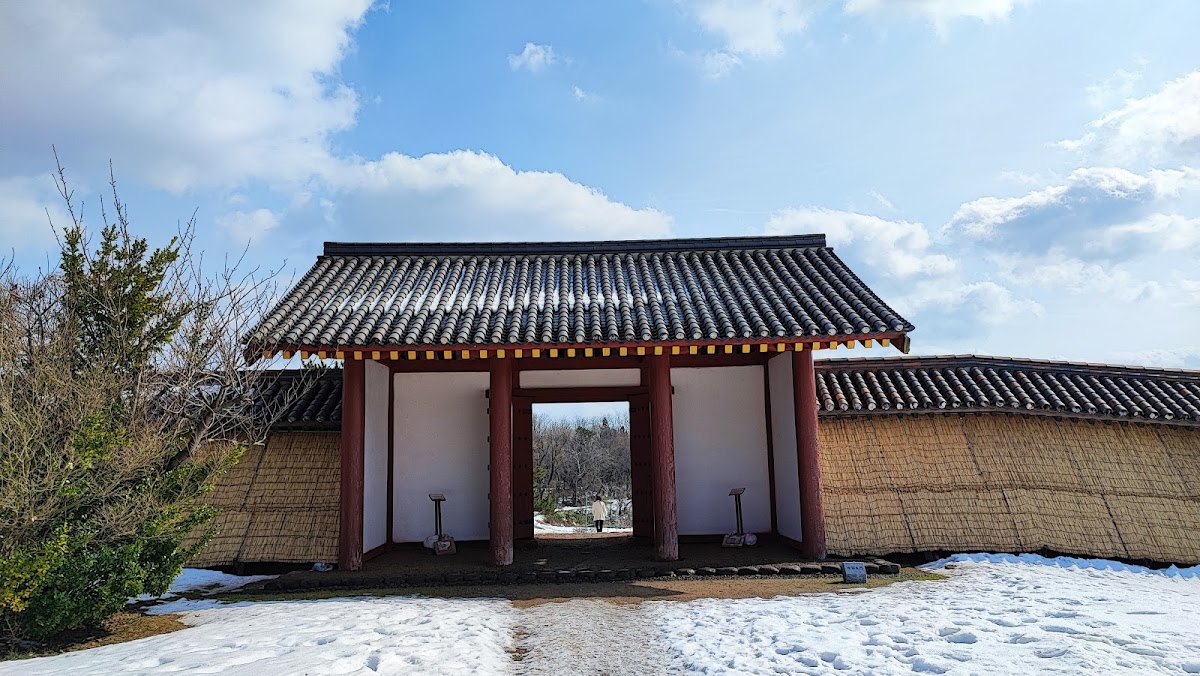
Currently, a portion of the government office site has been restored, with the earthen walls, gates, and building foundations evoking the appearance of the past. A wide avenue, approximately 12 meters wide, extends from the restored east gate of the government office to the outer east gate, allowing visitors to appreciate the grandeur of the ancient city planning.
Government Offices in the Unoki District
In the Unoki district, located northeast of the government office, government facilities such as warehouses and workshops have been discovered. It is believed that these facilities were used for storing goods and various production activities.
Of particular note are the remains related to the production of iron products. Numerous iron slags and iron products have been unearthed from the blacksmith’s workshop site, revealing that iron tools such as weapons and agricultural implements were produced within Akita Castle.
Flush Toilet (Toilet Remains)
One of the greatest discoveries from the excavation of Akita Castle is the remains of a flush toilet. Discovered during excavations between 1981 and 1987, this facility is an extremely valuable example of ancient Japanese sanitation.
The toilet was located east of the government building and featured a flushing system utilizing spring water. Multiple toilet seats were installed inside the building, and waste was discharged outside via a waterway. Such advanced sanitation facilities demonstrate that Akita Castle possessed cutting-edge technology and culture at the time.
Currently, this flush toilet has been restored, and visitors can actually tour its interior. It is a fascinating exhibit for understanding the living environment and sanitary concepts of ancient people.
Outer Fortifications
A defensive structure called the outer fortification surrounded the perimeter of Akita Castle. Composed of wooden fences, railings, and moats, this outer fortification demarcated the entire castle grounds and served a defensive function.
The outer perimeter of the castle extended approximately 3 kilometers, with gates located on the east, west, north, and south sides. The eastern gate, in particular, was a major entrance connecting to the main road leading from the government office, making it a crucial facility. Archaeological excavations have revealed the gate’s structure and scale, and parts of it have been restored.
Archaeological Excavations and Research at Akita Castle Ruins
History of Archaeological Excavations
Full-scale archaeological excavations at Akita Castle Ruins began in 1939 (Showa 14). Initially, the main objective was to understand the extent and structure of the castle grounds, but continuous post-war investigations gradually revealed the overall picture of Akita Castle.
Especially since the 1970s, investigations have uncovered numerous major remains, including the government office, outer perimeter, and government buildings. These findings have led to Akita Castle receiving high academic acclaim as a benchmark site for the study of ancient castles and fortifications.
Currently, ongoing excavations are being conducted, primarily by the Akita City Board of Education, and new discoveries continue to be made. These research findings are on display at the Akita Castle Ruins Historical Museum, allowing the public to access the latest research results.
Ancient Life as Told by Excavated Artifacts
A vast quantity of artifacts have been unearthed from the Akita Castle ruins. These artifacts, including pottery, roof tiles, iron products, wooden objects, and coins, are diverse in nature and provide invaluable information about the life and culture of the time.
Of particular note are the artifacts believed to have been brought from countries such as Balhae and Silla. These are physical evidence supporting the idea that Akita Castle was an international exchange hub and provide important clues for studying ancient Japan’s foreign relations.
Furthermore, numerous wooden tablets inscribed with writing have been unearthed, providing insights into administrative documents and the actual state of material management at the time. These tablets reveal the names of officials who worked at Akita Castle and the contents of the goods that were transported there.
Highlights of Akita Castle Ruins | Historic Site Park
Restored Government Office and Earthen Wall
The current Akita Castle ruins have been developed as a historical park based on the results of archaeological excavations. The biggest highlight is the restored government office area.
The earthen wall surrounding the government office has been faithfully restored based on the structure revealed by the excavations. The approximately 3-meter-high earthen wall recreates ancient architectural techniques, conveying the grandeur of the time to the present day.
The east gate of the government office has also been restored, and together with the 12-meter-wide avenue, you can experience the magnificent landscape of an ancient city. Passing through the gate and walking along the avenue, you can imagine the people who traveled this land more than 1200 years ago.
Restored Flush Toilet
A must-see when visiting Akita Castle Ruins is the restored flush toilet. You can enter the building and see the mechanism of an ancient flush toilet firsthand.
The restoration was based on data obtained from archaeological excavations, and was recreated as faithfully as possible. The advanced sanitary technology of ancient times is astonishing, evident in details such as the water channels utilizing spring water and the placement of toilets.
The explanatory panels are also comprehensive, providing detailed explanations of why such facilities were necessary and who used them.
Natural Environment of Takashimizu Park
The Akita Castle ruins have been developed into Takashimizu Park, allowing visitors to enjoy nature alongside historical site sightseeing. Walking paths are maintained within the park, allowing visitors to stroll while enjoying the scenery of each season.
In spring, cherry blossoms bloom, and in autumn, the autumn leaves are beautiful, making it a popular place for relaxation among locals. This space, where historical sites and nature harmonize, is ideal not only for learning about history but also for refreshing mind and body.
Rest facilities are also provided within the park, allowing visitors to take their time exploring. Sitting on a bench and imagining the ancient landscape, enjoying a quiet moment, is highly recommended.
Akita Castle Ruins Historical Museum | Learning from Excavation Results
Museum Exhibits
The Akita City Akita Castle Ruins Historical Museum, located adjacent to the Akita Castle ruins, is a facility that exhibits artifacts and research results unearthed during archaeological excavations. It’s a must-visit spot when visiting Akita Castle.
The permanent exhibition clearly explains the history of Akita Castle chronologically, using excavated artifacts, reconstructed models, and video materials. Visitors can see actual artifacts such as ancient pottery, roof tiles, iron products, and wooden tablets up close.
Of particular note is the reconstructed model showing the overall layout of Akita Castle. It allows for a three-dimensional understanding of the vast castle grounds and building layout, deepening understanding when viewed before or after visiting the actual site.
Special Exhibitions and Educational Programs
The museum holds special exhibitions and themed exhibitions several times a year. Exhibits showcasing the latest excavation results and in-depth explorations of related themes offer new discoveries with every visit.
Furthermore, the museum offers a wide range of hands-on learning programs for children, allowing them to experience ancient technology and culture firsthand through activities such as fire-making and magatama (comma-shaped bead) making. It is also frequently used for school field trips, playing an important role as a site for history education.
Visitor Information
The Akita City Akita Castle Ruins Historical Museum is open almost year-round, except for the New Year holidays. Admission is very reasonable: 210 yen for adults and free for high school students and younger.
The museum also has a library corner where visitors can browse specialized books on Akita Castle and ancient history. Curator explanations are also provided regularly, making it an ideal environment for those who wish to learn more in depth.
Comparison of Akita Castle with Other Ancient Castles
Differences from Tagajo Castle
Alongside Akita Castle, another famous ancient castle in the Tohoku region is Tagajo Castle, located in Tagajo City, Miyagi Prefecture. Tagajo was the center of administration for the Mutsu Provincial Government in the Tohoku region, while Akita Castle was located further north as a base for northern Dewa Province.
While Tagajo was located inland, Akita Castle was situated on the Sea of Japan coast, playing a crucial role in the transportation of goods by sea and in diplomacy with the Bohai Kingdom. This difference in location is reflected in the differences in the functions and characteristics of the two castles.
Relationship with Hotta-no-saku
Besides Akita Castle, there is another ancient fortified settlement called Hotta-no-saku within Akita Prefecture. Hotta-no-saku is located in present-day Daisen City, Akita Prefecture, further inland than Akita Castle.
There are various theories regarding the construction period and function of Hotta-no-saku, but it has been suggested that it may have functioned as a facility complementing Akita Castle, or as a successor to Akita Castle. The relationship between the two is an important theme in understanding the ancient history of northern Dewa Province.
Relationship with Other Castles in Akita Prefecture
Differences from Kubota Castle
Akita Castle and Kubota Castle are both well-known as representative castles of Akita Prefecture. However, the two castles are completely different in terms of era and character.
Kubota Castle is a modern castle built by the Satake clan during the Edo period and functioned as the administrative center of the 200,000-koku Akita Domain. Akita Castle, on the other hand, is an ancient fortified settlement, representing a difference of approximately 800 years.
Currently, the Kubota Castle ruins are maintained as Senshu Park and are located in the heart of Akita City. Visiting both the Kubota Castle ruins and the Akita Castle ruins allows for a comprehensive overview of Akita’s history from ancient times to the early modern period.
Medieval Castles in Akita Prefecture
Many medieval castles remain in Akita Prefecture. Castles such as Wakimoto Castle, Yokote Castle, and Kakunodate Castle, dating from the Sengoku period to the early Edo period, tell the history of a different era than Akita Castle.
In particular, Wakimoto Castle ruins are a medieval mountain castle built on a hill overlooking the Sea of Japan, and are designated as a National Historic Site. While Akita Castle served as an ancient political and diplomatic center, Wakimoto Castle functioned as a military base for a Sengoku-period daimyo (feudal lord).
Visiting these castles and fortifications in chronological order will allow you to gain a comprehensive understanding of Akita’s history.
Access Information | How to Get to Akita Castle Ruins
Access by Public Transportation
The most convenient way to reach Akita Castle Ruins is by taking a local bus from JR Akita Station. Take the Akita Chuo Kotsu bus bound for “Akita Castle Ruins Historical Museum,” and you will arrive in about 20 minutes. Buses run approximately 1-2 times per hour.
Alternatively, you can get off at the “Gokoku Shrine Entrance” bus stop and walk for about 10 minutes. Since there are more buses that pass through this stop, this may be more convenient depending on the time of day.
Access by Car
By car, it’s approximately 15 minutes from the Akita Chuo Interchange on the Akita Expressway, or about 30 minutes from Akita Airport. The Akita Castle Ruins Historical Museum has a free parking lot with space for approximately 50 regular-sized cars.
If using a car navigation system, setting “Akita City Akita Castle Ruins Historical Museum” (Address: 9-6 Terauchi Yakiyama, Akita City, Akita Prefecture) as your destination is recommended.
Nearby Tourist Attractions
There are several other points of interest around the Akita Castle Ruins. About 10 minutes away by car is the Akita City Folk Performing Arts Museum (Neburi-nagashi Hall), where you can experience Akita’s traditional culture.
Furthermore, it’s about 15 minutes by car to Senshu Park (Kubota Castle Ruins) in central Akita City, and about 10 minutes to the Akita Prefectural Museum, providing excellent access to historical and cultural facilities. Planning a day trip to explore Akita’s history is highly recommended.
Points to Note and Recommended Time to Visit
Clothing and Items to Bring
Akita Castle Ruins is an outdoor historical park, so we recommend wearing comfortable shoes and clothing. Especially when walking from the reconstructed government office area to the outer east gate, there is a considerable distance, so sneakers are suitable.
In summer, the sun is strong, so it’s a good idea to bring a hat, parasol, and drinking water. In winter, there is snow, so warm clothing and non-slip shoes are essential. Insect repellent spray may also be useful depending on the season.
Recommended Time to Visit
Akita Castle Ruins is open year-round, but we especially recommend visiting in spring (late April to May) and autumn (late September to October). The weather is mild during these times, making it ideal for strolling through the historical site.
Spring is a beautiful season with cherry blossoms and fresh greenery. Autumn is the peak season for autumn leaves, allowing you to enjoy the harmony between the ancient historical site and nature. However, please note that during the winter months (December to March), some areas may be difficult to access due to snow.
Estimated Visiting Time
If you plan to visit both Akita Castle Ruins and the Historical Museum, the estimated time required is approximately 2-3 hours. A recommended route is to carefully view the exhibits at the museum before strolling through the historical park.
Those who wish to learn more or enjoy photography should allocate about half a day. If participating in a guided tour, it is recommended to plan with even more time.
Summary | Akita Castle’s Message to Ancient Japan
Akita Castle is an ancient fortress that played a crucial role as the frontline of the Yamato court’s administration of the Tohoku region from the Nara period to the Heian period. As Japan’s northernmost base, it was a center of politics, military affairs, diplomacy, and culture, and also served as a window for international exchange with the Bohai Kingdom.
The remains of government offices, flush toilets, and outer facilities revealed by archaeological excavations attest to the advanced technology and cultural level of the time. At the Akita Castle ruins, now developed as a historical park, you can experience the ancient appearance of the castle from over 1200 years ago through the restored buildings and facilities.
At the Akita Castle Ruins Historical Museum, you can see excavated artifacts and the latest research findings, further deepening your understanding of Akita Castle. It’s a valuable historical site that we highly recommend visiting, not only for those interested in ancient history, but also for anyone visiting Akita Prefecture.
It’s easily accessible from central Akita City, and by visiting it along with other historical spots such as the Kubota Castle ruins, you can gain a comprehensive overview of Akita’s history from ancient times to the early modern period. Be sure to experience Akita Castle, an indispensable site for understanding Japan’s ancient history, firsthand.
Frequently Asked Questions
Q: Are Akita Castle and Kubota Castle the same castle?
A: No, they are completely different castles. Akita Castle is an ancient castle from the Nara to Heian periods, located in the Terauchi district of Akita City. On the other hand, Kubota Castle is a modern castle built by the Satake clan during the Edo period, and is located in the present-day Senshu Park (in the center of Akita City). There is a difference of approximately 800 years between the two castles, and they differ in both character and function.
Q: Do I need a reservation to visit Akita Castle Ruins?
A: You can freely visit the historical park, and no reservation is required. You can also usually enter the Akita Castle Ruins Historical Museum without a reservation. However, if you wish to visit as a group or with a guided tour, we recommend contacting them in advance.
Q: How much is the entrance fee for Akita Castle Ruins?
A: The historical park (outdoors) is free to visit. The entrance fee for the Akita Castle Ruins Historical Museum is 210 yen for adults, and free for high school students and younger (as of 2024). It’s a very reasonable price, and you can enjoy a comprehensive exhibition.
Q: Is it true that a flush toilet was discovered at Akita Castle?
A: Yes, it’s true. Excavations conducted from 1981 to 1987 uncovered the remains of a flush toilet (latrine) utilizing spring water. This is an extremely valuable discovery as an example of sanitation facilities in ancient Japan, and a reconstructed building is now open to visitors. These remains provide important evidence of Akita Castle’s advanced nature.
Q: Until when was Akita Castle in use?
A: Akita Castle was founded in 733 as Dewa-saku, renamed Akita Castle in 760, and is believed to have functioned until around the 10th century. For over 200 years, it played an important role as a base in the northern part of Dewa Province. Afterward, it fell into disuse, and its exact location remained unknown until modern times.
Q: Can I visit in winter?
A: The historical park is open year-round, but during winter (December to March), snow can make some areas difficult to access. The Akita Castle Ruins Historical Museum is open except during the New Year holidays, so it is recommended to focus your visit on the museum during winter. We recommend checking the opening hours before visiting.