History and Remains of Hiki Hachimanyama Castle (Wakayama Prefecture) | A Thorough Explanation of a Sengoku Period Mountain Castle
Hiki Hachimanyama Castle is a Sengoku period mountain castle located in Hidaka-cho, Hidaka-gun, Wakayama Prefecture. Situated at a strategic point in southern Kii Province, it played an important role as a base for regional control. This article provides a detailed explanation of this mountain castle, including its historical background, builder, existing remains, and access methods.
Overview of Hiki Hachimanyama Castle
Hiki Hachimanyama Castle is a medieval mountain castle built in Hidaka-gun, Kii Province (present-day Hidaka-cho, Hidaka-gun, Wakayama Prefecture). Located on a hill approximately 150 meters above sea level, it was built in a strategically important location overlooking the surrounding area.
Basic Information
- Location: Hidaka-cho, Hidaka-gun, Wakayama Prefecture
- Castle Structure: Mountain Castle
- Construction Period: Sengoku period (late 15th to 16th century)
- Builder: Hioki clan (legend)
- Main Lords: Hioki clan, Yukawa clan and related forces
- Year of Abandonment: Unknown (estimated late Sengoku period)
- Remains: Enclosures, earthworks, moats, etc.
- Designated Cultural Property: Not designated
History of Hioki Hachimanyama Castle
Background and Era of Construction
During the Sengoku period when Hioki Hachimanyama Castle was built, Kii Province was in a complex political situation with multiple powers vying for power. The Hidaka region, in particular, was a strategically important area militarily and economically, being a key transportation hub in southern Kii Province and located near the Kumano Kodo road.
Hioki Hachimanyama Castle is believed to be a mountain castle built by a local lord in this region to protect their territory and maintain their power. In Kii Province, religious forces such as Negoro-ji Temple and Mount Koya also possessed considerable military power, and local lords sought survival while maintaining complex relationships with these forces.
Relationship between the Hioki Clan and the Castle
According to tradition, Hioki Hachimanyama Castle was built by the Hioki clan. The Hioki clan was a powerful local lord family in this region. However, reliable historical sources regarding the Hioki clan are limited, and many aspects of their detailed lineage and activities remain unknown.
The place name Hioki is said to originate from the ancient Hiokibe, suggesting the existence of a clan deeply rooted in this region since ancient times.
Connection with the Yukawa Clan
During the Sengoku period, the most powerful force in the Hidaka region of Kii Province was the Yukawa clan. The Yukawa clan expanded their power primarily in Hidaka County, building numerous branch castles to solidify their regional control. Since Hiki Hachimanyama Castle was also within the Yukawa clan’s sphere of influence, it is highly probable that it was under their influence in some way.
The Yukawa clan operated as a powerful local lord in Kii Province throughout the Sengoku period, maintaining their power by sometimes allying with the Hatakeyama clan and sometimes with Negoro-ji Temple. However, they were destroyed during Toyotomi Hideyoshi’s conquest of Kii Province in 1585, and it is presumed that Hiki Hachimanyama Castle was abandoned as a result.
Toyotomi Hideyoshi’s Conquest of Kii Province and the Castle’s Demise
In 1585, Toyotomi Hideyoshi dispatched a large army to pacify Kii Province. This conquest dealt a devastating blow to local forces in Kii Province, including Negoro-ji Temple, the Saika-shu, and the Yukawa clan.
It is believed that Hiki Hachimanyama Castle was either caught up in battles during this period or abandoned due to Hideyoshi’s castle demolition decree. Subsequently, this region came under the control of the Toyotomi regime, and a new system of rule was established centered around Wakayama Castle, a modern castle.
Layout and Remains of Hiki Hachimanyama Castle
Castle Location and Topographical Utilization
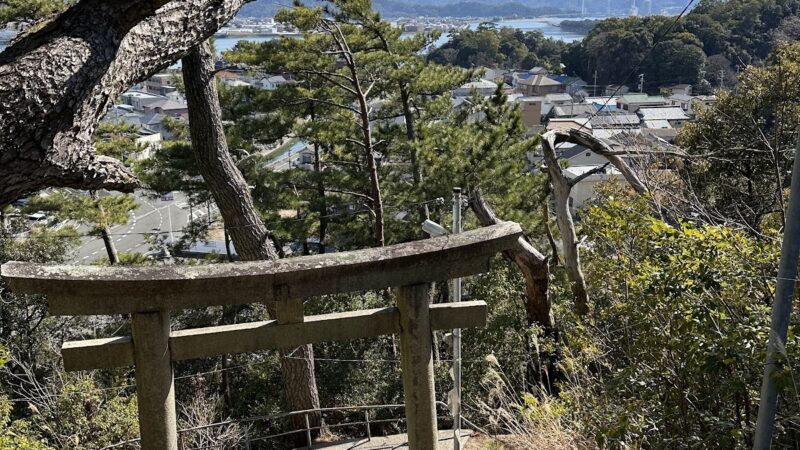
Hiki Hachimanyama Castle was built on a hill approximately 150 meters above sea level. This hill offered a vantage point overlooking the surrounding plains, allowing for early detection of enemy movements. Furthermore, the difference in elevation from the foot of the mountain to the summit provided a favorable defensive position against attackers.
The castle was built skillfully utilizing the natural terrain, making direct use of the steep slopes as defensive lines. This is a common characteristic of medieval mountain castles, demonstrating ingenuity in efficiently enhancing defensive capabilities with limited labor and technology.
Major Remains
Currently, the following remains are found at the Hiki Hachimanyama Castle site:
Main Enclosure (Honmaru)
Located at the mountaintop, the main enclosure was the site of the castle’s central facilities. A relatively flat enclosure has been identified, and it is presumed to have been the location of the lord’s residence and command post. The main enclosure is not particularly large, suggesting it served more as a refuge and defensive base during emergencies rather than a permanent garrison for a large number of soldiers.
Enclosures
Several enclosures (leveled areas) are arranged in a stepped pattern around the main enclosure. These enclosures are thought to have been used as troop garrisons and storage areas for supplies. The size and arrangement of the enclosures provide insights into the castle’s defensive structure.
Moat
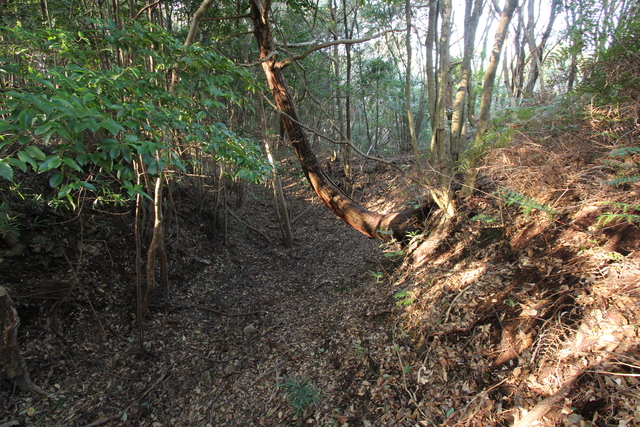
A moat, dug to cut across the ridge, has been identified. Moats are defensive structures designed to prevent enemies from invading along the ridge. The moats at Hiki Hachimanyama Castle are effectively positioned utilizing the natural terrain, offering insights into the castle’s construction techniques.
Earthworks
Traces of earthworks remain in some of the baileys. Earthworks are defensive structures built by piling up earth around baileys, serving to prevent enemy intrusion and protect against arrow and gunfire.
Characteristics of the Castle Layout
The layout (castle design) of Hiki Hachimanyama Castle exhibits typical characteristics of a medieval mountain castle. Permanent structures such as stone walls are absent; the structure primarily consists of baileys, moats, and earthworks constructed through civil engineering.
This type of layout is common to castles built by local lords during the Sengoku period with limited resources and labor, reflecting a practical and functional design philosophy. Unlike early modern castles with large stone walls and keeps, the focus was on regional defense and demonstrating the lord’s authority.
Historical Significance of Hioki Hachimanyama Castle
Position in the Regional History of Southern Kii Province
Hioki Hachimanyama Castle is an important historical site for understanding the region’s history as a castle of a local lord in southern Kii Province. During the Sengoku period (Warring States period), there were no daimyo-level powers in Kii Province; instead, numerous local lords vied for power.
Small mountain castles like Hioki Hachimanyama Castle served as bases for these local lords to protect their territories and govern their communities. The existence of these castles indicates that independent political and military systems functioned in areas where central government control was limited.
Contribution to the Study of Mountain Castles in the Sengoku Period
Hioki Hachimanyama Castle is also valuable for the study of mountain castles in the Sengoku period. Although less attention is paid to them compared to large-scale castles, these small mountain castles convey the typical appearance of castles of that time.
Through investigations of the remains and the creation of layout maps, it is possible to shed light on the castle construction techniques, defensive philosophies, and the realities of local communities during the Sengoku period. Furthermore, comparative studies with surrounding castles can reveal differences in castle construction techniques across regions and shed light on shifts in power spheres.
Access and Visiting Information for Hiki Hachimanyama Castle
Access Methods
Using Public Transportation
- Walking or taxi from JR Kisei Main Line “Kii-Uchihara Station” or “Kii-Yura Station”
- Hidaka Town Community Bus is also available (please check routes and schedules)
Using a Car
- Approximately 30 minutes from Hanwa Expressway “Nanki Tanabe IC” via National Route 42
- Parking: There is no dedicated parking lot for the castle ruins, so please use the parking lots of nearby public facilities or shrines (prior confirmation recommended)
Precautions for Visiting
Hiki Hachimanyama Castle Ruins are not a well-maintained tourist facility. Please note the following points when visiting:
- Clothing and Equipment: Since you will be walking on mountain paths to the castle ruins, comfortable shoes and clothing are essential. Particular caution is needed after rain, as the ground can become slippery.
- Season: In summer, vegetation grows thick, making it difficult to see the remains. Also, precautions against mosquitoes and venomous snakes are necessary. Autumn to spring is the best season for visiting.
- Avoiding Solo Visits: Avoid solo visits in the mountains; it is recommended to visit in groups if possible.
- Consideration for Locals: The area around the castle ruins is a residential area for local residents. Please be considerate and avoid trespassing on private property or making excessive noise.
- Protection of Remains: Damaging the remains or taking soil or stones is strictly prohibited. Please observe proper etiquette when visiting to preserve this valuable cultural asset for future generations.
Nearby Attractions
In addition to visiting Hioki Hachimanyama Castle, why not also visit the following nearby spots?
Dojoji Temple
An ancient temple located in Hidaka Town, known for the legend of Anchin and Kiyohime. It houses numerous cultural properties, including the national treasure, the Thousand-Armed Kannon statue.
Hidaka River
The Hidaka River, known for its clear waters, offers activities such as ayu fishing and canoeing.
Castle Ruins Related to the Yukawa Clan
Numerous castle ruins built by the Yukawa clan remain in the Hidaka region. Visiting the ruins of Kameyama Castle and Hii Castle, among others, will provide a deeper understanding of the Sengoku period history of this region.
Research and Future Challenges of Hiki Hachimanyama Castle
Current Research Status
Regarding Hiki Hachimanyama Castle, a full-scale academic investigation has not yet been sufficiently conducted. The main research results are based on surveys and records by local historians and castle researchers.
It is expected that more will be revealed about the castle’s structure and historical background if a layout map is created, detailed surveys of the remains are conducted, and archaeological excavations are carried out.
Challenges for Preservation and Utilization
The Hiki Hachimanyama Castle ruins are not currently designated as a cultural property. Therefore, no official measures have been taken for preservation, and the remains are at risk of damage due to natural weathering and overgrown vegetation.
On the other hand, there are also movements to utilize it as a local historical heritage site. Local history enthusiasts hold irregular tours and guided excursions, and it holds potential as a resource for local history education and tourism.
In the future, it is desirable to utilize it as a place to learn about local history while implementing appropriate preservation measures.
Hioki Hachimanyama Castle and the Castle Network of Kii Province
Distribution of Castles in Kii Province
Kii Province had numerous mountain castles built during the Sengoku period (Warring States period). These castles were built by local lords to protect their respective territories, and they cooperated with each other to form a regional defense network.
In the Hidaka region alone, many castles were built, centered around Kameyama Castle, the base of the Yukawa clan, including Hii Castle, Shiga Castle, and Ao Castle. Hioki Hachimanyama Castle is also thought to have played a part in this castle network.
Inter-castle coordination and signal fires
During the Sengoku period (Warring States period), castles did not function in isolation; multiple castles worked together for defense. A network of signal fires (noroshi) was established to warn of enemy attacks, and if one castle was attacked, reinforcements would rush from surrounding castles.
It is possible that Hiki Hachimanyama Castle was also connected to surrounding castles via a signal fire communication network. The castle’s location on a hill overlooking the surrounding area also suggests its role in this information transmission.
Summary: The historical value of Hiki Hachimanyama Castle
Hiki Hachimanyama Castle holds an important position in regional history as a castle of a local lord in southern Kii Province during the Sengoku period. While not a large-scale castle, it is a valuable historical site that conveys the typical appearance of a mountain castle of that time.
The existing remains, such as baileys, moats, and earthworks, offer insights into the castle-building techniques and defensive philosophies of the Sengoku period. Furthermore, it holds value as a clue to understanding the activities of local lords such as the Hioki and Yukawa clans.
Further detailed research will likely clarify the historical significance of Hioki Hachimanyama Castle. At the same time, it is hoped that it will be utilized as a regional historical heritage site while appropriate preservation measures are taken.
Those interested in mountain castles of the Sengoku period, or those who wish to learn about the history of Kii Province, should definitely visit the Hioki Hachimanyama Castle ruins. You will surely be able to feel the spirit of the people who lived through the turbulent Sengoku period from the remains that remain in the quiet mountains.