Complete Guide to Komayama Castle (Kanagawa Prefecture) | History, Remains, Access, and Highlights Explained in Detail
What is Komayama Castle?
Komayama Castle is a mountain castle located in Koma, Oiso-machi, Nakagun, Kanagawa Prefecture. Also known as Koma-dera-yama Castle and Sumiyoshi Old Castle, it is built on Mt. Koma, at an altitude of 168 meters (relative height 160 meters), offering a panoramic view of Sagami Bay. It is known as a castle built by Hojo Soun (Ise Sozui) during the Sengoku period in his conflict with the Ogigayatsu Uesugi clan, and was an important base for the Hojo clan’s expansion of power in Sagami Province.
Even today, remnants such as moats, earthworks, and baileys remain well-preserved on the mountain, making it a popular spot for castle enthusiasts and hiking lovers. Mt. Koma itself boasts a rich natural environment, so much so that it has been selected as one of “Japan’s 100 Natural Wonders to Preserve for the 21st Century,” making it a valuable place to enjoy both historical exploration and nature walks.
History of Koma-yama Castle
Koma-yama Before Construction
The name Koma-yama is said to originate from the fact that immigrants from Goguryeo (Goryeo) settled in this area during the Nara period. It has long been an object of worship, and a temple called Koma-ji existed on the mountain until the Edo period. It was also known as a famous spot on the Tokaido road, as depicted in Utagawa Hiroshige’s ukiyo-e print “Hiratsuka Nawate-michi from the Fifty-Three Stations of the Tokaido.”
The Eikyo Rebellion and Uesugi Mochifusa
The first recorded use of Koma-yama as a military base dates back to September of Eikyo 10 (1438). Uesugi Mochifusa, son of the Kanto Kanrei (governor of the Kanto region), is said to have established a camp on Koma-yama. This period was still in the aftermath of the Eikyo Rebellion, and complex power struggles were unfolding in the Kanto region. It is thought that Uesugi Mochifusa chose Koma-yama because it was a strategically important location overlooking Sagami Bay and the plains.
Construction by Hojo Soun (Ise Sozui)
Komayama Castle was fully developed as a mountain castle in Eisho 7 (1510). Ise Sozui (later Hojo Soun), who was aiming to expand his influence into Sagami Province, constructed Komayama Castle along with Sumiyoshi Fortress in preparation for battle against the Ogigayatsu Uesugi clan.
During the Miura Rebellion of Eisho 6 (1509), Ise Sozui was in conflict with Ogigayatsu Uesugi Tomoyoshi. It is believed that after this rebellion, he developed Komayama Castle as a border castle to solidify the boundaries of his sphere of influence in Sagami Province.
The Battle of Gongenyama and the Siege of Komayama Castle
In Eisho 7 (1510), Ise Sozui succeeded in winning over Ueda Masamori of Gongenyama Castle (present-day Hiratsuka City) through stratagem. However, with the assistance of the Yamanouchi Uesugi clan, the Ogigayatsu Uesugi clan launched a counterattack, and Gongenyama Castle fell.
In this battle, it is said that Sumiyoshi Fortress and Komayama Castle were also captured by Miura Yoshitomo (Miura Dosun), a subordinate of the Ogigayatsu Uesugi. Ise Sozui faced difficulties for a time, but ultimately established his power in Sagami Province.
The Subsequent Use of Komayama Castle
There are no clear records of how Komayama Castle was used afterward. After the Hojo clan gained complete control of Sagami Province, it may have ceased to function as a frontline castle and instead served as a base for rear support and surveillance.
In 1569, when Takeda Shingen attacked Odawara Castle, many castles in Sagami Province were caught in the fighting, but there are no records concerning Komayama Castle. Furthermore, there are no records of Koma-yama Castle being a battlefield during Toyotomi Hideyoshi’s siege of Odawara in 1590, suggesting it was likely abandoned by that time.
Structure and Layout of Koma-yama Castle
Main Enclosure (Daido)
The main enclosure is a large, flat area called “Daido” located near the summit of Koma-yama Mountain. This is believed to be the site of the main hall of Koma-ji Temple and played a central role in the castle’s layout. The flat area remains well-preserved, allowing us to imagine its former scale.
From the main enclosure, one can enjoy a panoramic view of Sagami Bay, and it offers excellent views of the Tokaido Road, Hiratsuka, and Odawara. On clear days, it’s even possible to see the Boso Peninsula and the Izu Peninsula, indicating its ideal location as a military surveillance base.
Enclosures
Several enclosures are arranged around the main enclosure. These enclosures, constructed in a stepped manner to conform to the terrain, exhibit the unique layout characteristic of mountain castles. Each enclosure is relatively small, but defensive features are evident throughout.
Areas of enclosures are scattered along the hiking trail, allowing visitors to examine the remains while walking the course. These enclosures are thought to have been used for troop garrisons, storage of supplies, and lookout duties.
Moats
The best-preserved remains at Koma-yama Castle are the moats located on the Hachihyo-yama side. These moats are large in scale and retain sufficient depth, making them valuable historical relics that convey the appearance of the defensive facilities at the time.
Moats are defensive structures that prevent enemy intrusion by cutting off the ridge, and it is estimated that multiple moats were constructed at Koma-yama Castle. The moat on the Hachihyo-yama side, in particular, was an important defensive line to prevent intrusion from the north of the castle.
Vertical Moats and Earthworks
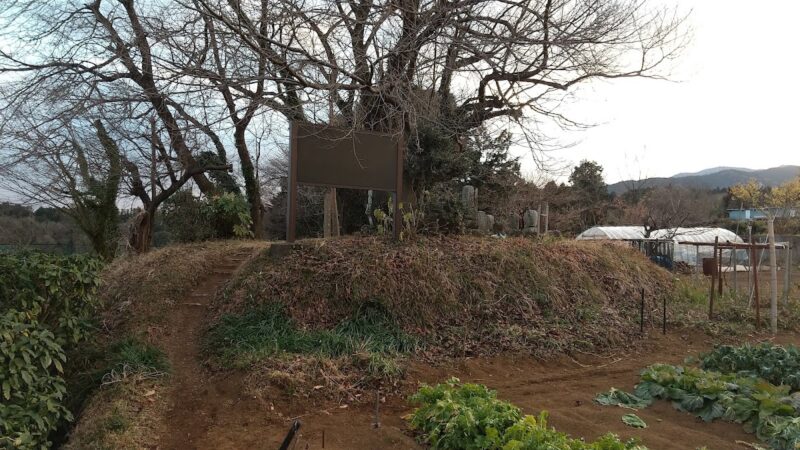
Traces of vertical moats can also be seen on the mountain slopes. Vertical moats are trenches dug vertically into the slope, serving to make it difficult for enemies to climb the slope. The vertical moats of Koma-yama Castle are difficult to discern in some places due to natural erosion, but careful observation reveals traces of artificial construction.
Earthworks also remain in various places. These earthworks, built along the edges of the baileys, not only enhanced defensive capabilities but also obscured the view of the baileys from the outside. Although weathered, they are remnants demonstrating the advanced civil engineering techniques of the time.
Watchtowers
Koma-yama Castle is believed to have had several watchtowers. These facilities were used to monitor Sagami Bay and the plains, playing a crucial role in quickly detecting enemy movements. Several locations with good views still exist today, and it has been suggested that these may be the remains of watchtowers.
Highlights of Koma-yama Castle
Large-Scale Moat on the Hachihyo-yama Side
A must-see when visiting Koma-yama Castle is the moat on the Hachihyo-yama side. This moat is the largest and best-preserved of the remaining structures at Koma-yama Castle. Standing at the bottom of the deeply excavated moat, you can experience the actual defensive capabilities of a castle from the Sengoku period.
Earthworks were built on both sides of the moat, demonstrating its high defensive strength in combination with the depth of the moat. It’s a popular spot for photography and a must-see for castle enthusiasts.
View from the Main Enclosure
The view from the main enclosure (Odo) is one of the greatest attractions of Koma-yama Castle. Despite being a low mountain at an altitude of 168 meters, you can enjoy a grand panorama of Sagami Bay. On clear days, you can sometimes see Enoshima, the Miura Peninsula, the Boso Peninsula, the Izu Peninsula, and even Mount Fuji.
Imagining the castle lord and soldiers monitoring the people traveling along the Tokaido road and ships at sea from this spot during the Sengoku period evokes a sense of historical romance.
Takaku Shrine
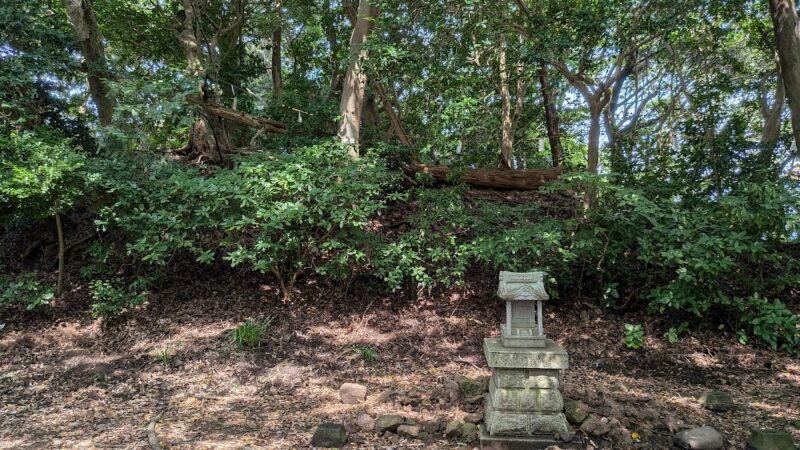
Takaku Shrine is located at the southeastern trailhead of Koma-yama. This shrine is central to the Koma-yama faith and has long been a place of worship for the local people. When visiting Koma-yama Castle, the common route is to first pay respects at Takarai Shrine before beginning the climb.
The shrine grounds are enveloped in a tranquil atmosphere, making it ideal for mental preparation before the climb. There is also parking available near the shrine, making it a convenient starting point for those accessing by car.
Hiking Trails: Men’s and Women’s Routes
The hiking trail starting from behind Takarai Shrine has two routes: the Men’s Route and the Women’s Route. The Men’s Route is shorter but steeper, suitable for those confident in their physical fitness. The Women’s Route, on the other hand, has a gentler slope and is longer, allowing you to enjoy nature at a leisurely pace.
Whichever route you choose, you can observe historical remains such as baileys and earthworks along the way. Choose the route that suits your physical fitness and interests.
Hiking Course Towards Shonan-daira
A hiking course is also maintained, leading from Koma-yama Castle towards Shonan-daira (Awataru-yama). Walking this course allows you to fully enjoy the natural beauty of the hilly area extending from Koma-yama, and you may also discover traces of other castle ruins and defensive structures along the way.
Shonan-daira is also known as a famous cherry blossom viewing spot, and in spring it is bustling with many flower viewers. The opportunity to enjoy the changing seasons along with exploring the history of Koma-yama Castle is a major attraction.
Natural Broadleaf Forest
Koma-yama boasts a rich natural environment, so much so that it has been selected as one of “Japan’s 100 Natural Landscapes to Preserve for the 21st Century.” The entire mountain is covered with a natural broadleaf forest, allowing you to observe the vegetation throughout the seasons.
In spring, there is fresh greenery; in summer, deep green; in autumn, vibrant autumn leaves; and in winter, the clear, unobstructed views after the leaves have fallen—each season offers a different face. Nature observation is another enjoyable aspect of exploring the castle ruins.
Access Information
Access by Public Transportation
Access from JR Tokaido Line Oiso Station
The most common access method is via JR Tokaido Line Oiso Station. It’s approximately a 25-minute walk from Oiso Station to Takarai Shrine (Koma-yama trailhead).
From Oiso Station, head towards Hiratsuka on National Route 1 (Tokaido), then turn north at the Koma intersection to reach Takarai Shrine. The route is flat and easy to walk, passing through a residential area.
Using the Bus
It’s also possible to take a bus from Oiso Station. Take a Kanagawa Chuo Kotsu bus and get off at the “Koma” bus stop. Takarai Shrine is approximately a 5-minute walk from there. However, bus services are limited, so it’s recommended to check the timetable in advance.
Access by Car
Access from Tomei Expressway
From the Atsugi Interchange on the Tomei Expressway, head south on National Route 129. In Hiratsuka city, merge onto National Route 1 and proceed towards Oiso. Turn north at the Koma intersection to arrive at Takarai Shrine. The journey from the interchange takes approximately 30 minutes.
Access from Odawara-Atsugi Road
Takarai Shrine is approximately 10 minutes from the Oiso Interchange on the Odawara-Atsugi Road. Exit the interchange, merge onto National Route 1, and head towards the Koma intersection.
Parking Information
There are a few parking spaces around Takarai Shrine. However, space is limited, and it may be full on weekends and holidays. We recommend visiting early or using public transportation.
There is also parking on the Shonan-daira side, but accessing Koma-yama Castle from here will be a slightly longer distance.
Hiking and Walking Tips
Estimated Time Required
The estimated hiking time from Takarai Shrine to the main enclosure (Odo) is approximately 20 minutes via the men’s path and approximately 30 minutes via the women’s path. If you plan to carefully observe the ruins, allow 1 hour 30 minutes to 2 hours round trip.
If you extend your hike to the Shonan-daira area, you will need an additional hour or so.
Clothing and Equipment
We recommend preparing the following equipment for hiking on mountain trails:
- Comfortable walking shoes (trekking shoes or sneakers)
- Comfortable clothing
- Drinking water (especially essential in summer)
- Hat (for sun protection)
- Towel
- Rain gear (in case of unpredictable weather)
- Camera (for photographing ruins and scenery)
In winter, the sun sets early, so plan your trip with plenty of time to spare.
Important Notes
- The hiking trail is well-maintained, but some sections can be slippery after rain.
- Insect repellent is recommended during the summer months.
- Always take your trash with you.
- Observe the ruins carefully and avoid damaging them.
- Avoid hiking alone; hike in groups whenever possible.
Best Season
Koma-san Castle can be visited year-round, but the following times are particularly recommended:
Spring (March-May): The fresh greenery is beautiful, and the temperature is moderate, making it ideal for hiking. The Shonan-daira area is also bustling during cherry blossom season.
Autumn (October-November): The autumn foliage is beautiful, the air is clear, and the views are excellent. The temperature is also suitable for hiking.
Winter (December-February): The air is clear, and Mount Fuji and distant mountains are clearly visible. However, the sun sets early, so careful time management is necessary.
In summer, be aware of the heat and insects, but early morning visits allow for a comfortable stroll.
Nearby Castles and Tourist Attractions
Koiso Castle
Located approximately 2 kilometers east of Koma-yama Castle, Koiso Castle was a hilltop castle situated near the center of Oiso Town. While its detailed history is unknown, it is believed to have been the residence of a powerful local clan that ruled the Oiso region. Currently, due to urbanization, very few remains are left, but a portion of the castle site has been developed into a park.
Ojo-yama Castle
Ojo-yama Castle, located northwest of Koma-yama Castle near the border with Ninomiya Town, is another medieval castle in this region. While the exact construction date and lord are unknown, it is believed to have been used in power struggles within Sagami Province, similar to Koma-yama Castle.
Sumiyoshi Fortress (Sumiyoshi Castle)
Sumiyoshi Fortress, believed to have been built by Ise Sozui around the same time as Koma-yama Castle, is thought to have been located south of Koma-yama Castle, near Sagami Bay. While no clear remains exist today, it is believed to have formed a defensive line in conjunction with Koma-yama Castle.
Tourist Attractions in Oiso
Oiso Coast: A beautiful coastline facing Sagami Bay, where Japan’s first public beach was established during the Meiji era.
Former Yoshida Shigeru Residence: The former residence of Yoshida Shigeru, who served as Prime Minister of Japan after the war. The garden is beautiful, and it is open to the public as a historical building.
Oiso-juku Honjin Site: A historical site that tells the history of Oiso, which flourished as a post town on the Tokaido highway.
Shimazaki Toson’s Former Residence: The residence where the renowned author Shimazaki Toson spent his later years is preserved.
Evaluation and Reviews of Koma-yama Castle
Among castle enthusiasts, Koma-yama Castle has gained a certain reputation as a “medium-sized mountain castle with well-preserved remains.” In particular, the moat on the Hachihyo-yama side is considered to be in excellent condition and worth seeing among mountain castles in Kanagawa Prefecture.
On the other hand, because it was not the residence of a major Sengoku-period daimyo, its name recognition is not very high. However, because of this, there are few visitors, and some enthusiasts appreciate being able to quietly observe the ruins.
The well-maintained hiking trails make it relatively easy to access, even for beginners, which is highly appreciated. Even those without an interest in history can enjoy it as a hiking course, making it popular with a wide range of people.
Koma-yama Castle and Hojo Soun (Ise Sozui)
When discussing Koma-yama Castle, the existence of its builder, Ise Sozui (Hojo Soun), is indispensable. Sozui was a samurai who was active from the late Muromachi period to the early Sengoku period, and is known as the person who laid the foundation for the Later Hojo clan.
After defeating the Horikoshi Shogunate in Izu Province in 1493 and bringing Izu under his control, Ise Sozui began his expansion into Sagami Province. In 1512, he captured Odawara Castle, securing a base in Sagami Province.
The year 1510, when Koma-yama Castle was built, coincided with the period when Sozui was seriously expanding his influence into Sagami Province. Located on the border with the Ogigayatsu Uesugi clan, Koma-yama was a strategically crucial location.
Sozui’s castle-building strategy was characterized by a network-type defensive system combining major strongholds with smaller subsidiary castles and forts. Koma-yama Castle is thought to have functioned as part of this defensive network centered around Odawara Castle.
Koma-yama Castle and the Sengoku History of Sagami Province
In the early Sengoku period, when Koma-yama Castle was built, Sagami Province was in a chaotic state with multiple powers vying for influence.
As the Kamakura Shogunate, the governing body of the Muromachi Shogunate in the Kanto region, weakened, two Uesugi families, the Yamanouchi Uesugi and the Ogigayatsu Uesugi, competed for power in the Kanto region. Furthermore, the Miura clan, a local powerful family in Sagami Province, also maintained its own independent influence.
In this context, Ise Sozui, who had advanced from Izu Province, expanded his power through skillful diplomacy and military actions. The construction of Koma-yama Castle was a crucial step in this expansion.
The Battle of Gongen-yama in 1510 was a tough fight for Sozui, with Koma-yama Castle temporarily falling, but he ultimately succeeded in bringing most of Sagami Province under his control.
Koma-yama Castle holds historical value as a fortress that marks a crucial turning point in the Sengoku period history of Sagami Province.
Summary
Koma-yama Castle is a mountain castle built by Hojo Soun (Ise Sozui) in the early Sengoku period, and is a historically important fortress that served as a stage for power struggles in Sagami Province. Built on Mount Koma, at an altitude of 168 meters, the castle still retains well-preserved remains such as moats, earthworks, and baileys, conveying the appearance of a Sengoku period mountain castle.
The large moat on the Hachihyoyama side is a must-see historical site when visiting Koma-yama Castle. The view of Sagami Bay from the main enclosure is also magnificent, making it an attractive spot where you can enjoy both historical exploration and nature walks.
It’s accessible on foot from JR Oiso Station, and the hiking trails are well-maintained, making it easy for beginners to visit. It’s a recommended place for a wide range of people, including castle enthusiasts, hiking lovers, history buffs, and nature lovers.
While Kanagawa Prefecture boasts many famous castles such as Odawara Castle and Ishigakiyama Castle, medieval mountain castles like Koma-yama Castle are also important for understanding the history of the Sengoku period. Standing on Koma-yama overlooking Sagami Bay, why not imagine the view seen by the Sengoku warlords and reflect on the romance of history?
Frequently Asked Questions (FAQ)
Q1: Is a reservation required to visit Koma-yama Castle?
A1: Koma-yama Castle is a historical site that can be freely visited, and no reservation is required. However, since you will be using a hiking trail, we recommend visiting in appropriate clothing and equipment.
Q2: How long does it take to visit Koma-yama Castle?
A2: The round trip from Takarai Shrine to the main enclosure takes about 1 to 1.5 hours. If you want to carefully observe the remains, allow about 2 hours. Walking towards Shonan-daira will require even more time.
Q3: Can beginners hike here?
A3: The hiking trail is well-maintained, and the elevation is low at 168 meters, so beginners can easily hike here. However, the “Men’s Slope” is steep, so if you are not confident in your physical fitness, we recommend using the “Women’s Slope.”
Q4: Is there parking at Koma-yama Castle?
A4: There are a few parking spaces around Takarai Shrine, but they are limited and may be full on weekends and holidays. Please consider using public transportation.
Q5: What is the best season to visit Koma-yama Castle?
A5: Spring (March-May) and autumn (October-November) are especially recommended. The temperature is moderate, making it easy to walk, and you can enjoy the fresh greenery and autumn foliage. In winter, the air is clear and the views are excellent, but be aware that the sun sets early.
Q6: Are there any other tourist spots around Koma-yama Castle?
A6: There are many tourist spots in Oiso Town, such as Oiso Beach, the former residence of Shigeru Yoshida, the site of the Oiso-juku Honjin (main inn), and the former residence of Toson Shimazaki. There are also other castle ruins in the surrounding area, such as Koiso Castle and Ojo-yama Castle.
Q7: Can I take pictures at Koma-yama Castle?
A7: You are free to take pictures. The moat on the Hachihyo-yama side and the view from the main enclosure are particularly popular photo spots. If using a tripod, please be considerate of other hikers.
Q8: Can I visit on a rainy day?
A8: It is not recommended to visit on a rainy day, as the hiking trails become slippery. Visiting on a sunny or cloudy day is safest. Please be careful as the ground may be slippery for a few days after it rains.