Complete Guide to Tanesato Castle (Aomori Prefecture): A Thorough Explanation of the History and Highlights of the Birthplace of the Tsugaru Clan
What is Tanesato Castle?
Tanesato Castle is a mountain castle located in Tanesato-cho, Ajigasawa-machi, Nishitsugaru-gun, Aomori Prefecture. It is a historically significant castle site, being the birthplace of the Tsugaru clan. In 2002, it was designated as part of the national historic site “Tsugaru Clan Castle Ruins,” and remains a sacred site visited by many history enthusiasts.
Tanesato Castle is located approximately 500 meters southwest of the Tanesato settlement, upstream of the Akaishi River. Facing the Akaishi River in front and the Oyanagiyama mountain range behind, it is an east-facing mountain castle. Built on a hill approximately 150 meters above sea level, this castle is an important historical site indispensable to understanding the history of the Tsugaru region and has been carefully preserved to this day.
Basic Information
Location: Oyanagi, Taneri-cho, Ajigasawa-machi, Nishitsugaru-gun, Aomori Prefecture
Other Names: Yamagami-kan, Yamagami-jo
Former Province: Mutsu Province
Builder: Oura Mitsunobu (Nanbu Mitsunobu)
Year of Construction: Around Entoku 3 (1491)
Castle Structure: Mountain Castle
Designated Cultural Property: National Historic Site (Part of Tsugaru Clan Castle Ruins)
Main Lords: Oura Mitsunobu, Oura Morinobu
History of Taneri Castle
Oura Mitsunobu’s Advance into Tsugaru
The history of Taneri Castle begins in Entoku 3 (1491) when Nanbu (Oura) Mitsunobu, a member of the Nanbu clan, advanced into the Tsugaru region. Mitsunobu moved from Nanbu Shimokuji (present-day Kuji City, Iwate Prefecture) with his subordinates to the land of Tsugaru Taneri. This relocation was part of the Sannohe Nanbu clan’s expansionist policy.
Mitsunobu established his residence in Taneri and worked to establish a power base in the Tsugaru region from this location. Taneri Castle was an important base that Mitsunobu built as the first step in his rule of Tsugaru, and it became the foundation for the later unification of Tsugaru.
Expansion to Oura Castle
In 1502, Mitsunobu built Oura Castle approximately 15 kilometers northeast of Taneri Castle to fully expand his presence into the Tsugaru Plain. Oura Castle was closer to the plains and strategically located to control key points in the Tsugaru region.
Mitsunobu made Oura Castle the residence of his eldest son, Morinobu, while he himself remained at Taneri Castle. This two-castle system allowed the Oura clan to control a wide area from the mountainous regions to the plains. Taneri Castle continued to function as the headquarters of the Oura clan and as the retirement castle of Mitsunobu.
Mitsunobu’s Later Years and Death
In 1526 (Daiei 6), Oura Mitsunobu ended his life at Taneri Castle. After Mitsunobu’s death, a mausoleum for him was established at Taneri Castle, and it came to be revered as a sacred site of the Tsugaru clan. It is said that some of his retainers committed suicide upon his death, illustrating the strong lord-vassal relationship in the samurai society of that time.
After Mitsunobu’s death, the Oura clan’s headquarters completely moved to Oura Castle, and Taneri Castle took on the role of a subsidiary castle. However, its spiritual importance as the birthplace of the Tsugaru clan was never lost, and it was carefully maintained by successive lords.
The Unification of Tsugaru and Taneri Castle
Five generations after Mitsunobu, Oura Tamenobu (later Tsugaru Tamenobu) achieved the unification of the Tsugaru region during the Tensho era (1573-1592), becoming an independent daimyo and adopting the name Tsugaru. Tamenobu sided with the Tokugawa in the Battle of Sekigahara in 1600, and for his achievements, he was recognized as the first lord of the Tsugaru domain.
Throughout this history of Tsugaru unification, Taneri Castle continued to hold significant importance as the origin of the Tsugaru clan. It is said that Tamenobu also valued Taneri, the land of his ancestors, and strived to maintain Mitsunobu’s mausoleum.
The Abandonment of the Castle and its Aftermath
In 1615, the Edo shogunate issued the “One Castle Per Province” decree, which resulted in the abandonment of all castles in the Tsugaru domain except for Hirosaki Castle. It is believed that Taneri Castle was abandoned around this time, but its character as a sacred site for Lord Mitsunobu was preserved, and the management of his mausoleum continued.
Throughout the Edo period, the Taneri Castle ruins remained a spiritual center for the Tsugaru clan. Records show that successive lords visited Taneri from time to time to commemorate the achievements of their ancestors.
Structure and Remains of Taneri Castle
Castle Layout
Taneri Castle is a typical mountain castle, with a structure that skillfully utilizes the natural terrain. The castle was built on an east-facing slope, using the Akaishi River as a natural moat. The Oyanagi Mountain Range behind it served as a natural stronghold to prevent enemy intrusion, making it an excellent defensive location.
Archaeological excavations have revealed the layout of the baileys centered around the main keep. The site of the main keep can still be seen today as a clear elevation difference on the ground, allowing us to imagine the scale of the castle in its heyday.
Results of Archaeological Excavations
Since the Heisei era, multiple archaeological excavations have been conducted at the Taneri Castle site, yielding many valuable findings. The excavations have confirmed postholes, foundation stones, and traces of earthworks, providing important information for understanding the structure of medieval mountain castles.
Excavated artifacts include pottery fragments, iron objects, and ancient coins, providing insights into life from the late 15th to the 16th centuries. These artifacts are displayed at the “Mitsunobu-ko’s Residence” and are open to the public.
Current Status of the Main Enclosure Site
The main enclosure site is currently being restored, with the locations of the building remains indicated by ground-level displays. Visitors can stand on the actual main enclosure site and enjoy a panoramic view of the Tsugaru Plain, imagining the scenery that Mitsunobu-ko saw.
A bronze statue of Mitsunobu-ko stands in one corner of the main enclosure site, conveying his dignified presence as the ancestor of the Tsugaru clan. Behind the statue, one can see Mitsunobu-ko’s mausoleum, creating a serene atmosphere.
Mausoleum
The most sacred place at the Taneri Castle ruins is the mausoleum of Oura Mitsunobu. Located in a quiet forest behind the main keep, stone pagodas and monuments stand solemnly. Maintained and managed by the Tsugaru clan throughout the Edo period, the mausoleum is still carefully preserved by local people.
The area around the mausoleum is particularly protected as a sacred space, and visitors are expected to pay their respects with reverence.
Mitsunobu-ko’s Residence (Historical Museum)
Facility Overview
At the foot of the Taneri Castle ruins stands the historical museum, “Mitsunobu-ko’s Residence,” where visitors can learn about the history of Taneri Castle and the Tsugaru clan. This facility was developed in the Heisei era and serves as an important base for deepening understanding of the Taneri Castle ruins.
The museum displays exhibits introducing the life of Oura Mitsunobu and the history of the Tsugaru clan, artifacts unearthed during archaeological excavations, and a reconstructed model of Taneri Castle. In particular, the replica of Mitsunobu’s Domaru armor is a popular exhibit, offering a rare opportunity to see the attire of a Sengoku period warlord up close.
Main Exhibits
Genealogy of the Tsugaru Clan: The genealogy of the Tsugaru clan, from Nanbu Mitsunobu to Tsugaru Tamenobu, is explained in detail, allowing visitors to learn about the history of Tsugaru’s unification.
Model of Taneri Castle: Based on the results of archaeological excavations, this reconstructed model of Taneri Castle is an excellent exhibit that allows visitors to understand the castle’s appearance in three dimensions.
Excavated Artifacts: Ceramics, iron products, and ancient coins unearthed during excavations are on display, providing insight into medieval life and culture.
Items Associated with Mitsunobu: Items associated with the Tsugaru family, including a replica of Mitsunobu’s Domaru armor, are on display.
Visitor Information
At the Mitsunobu Hall, visitors can learn about the historical background not only through the exhibits but also before visiting the Taneri Castle ruins. You can also receive advice from the staff inside the building about the highlights of Taneri Castle Ruins and the routes to the castle.
Highlights of Taneri Castle
Statue of Lord Mitsunobu
The bronze statue of Lord Oura Mitsunobu, standing on the site of the main keep, is a symbolic presence at Taneri Castle Ruins. Standing in a position overlooking the Tsugaru Plain, Lord Mitsunobu exudes dignity and spirit as the founder of Tsugaru’s development. Standing before the statue, you can feel as if you are sharing the view of Tsugaru that Mitsunobu saw.
View from the Main Keep Site
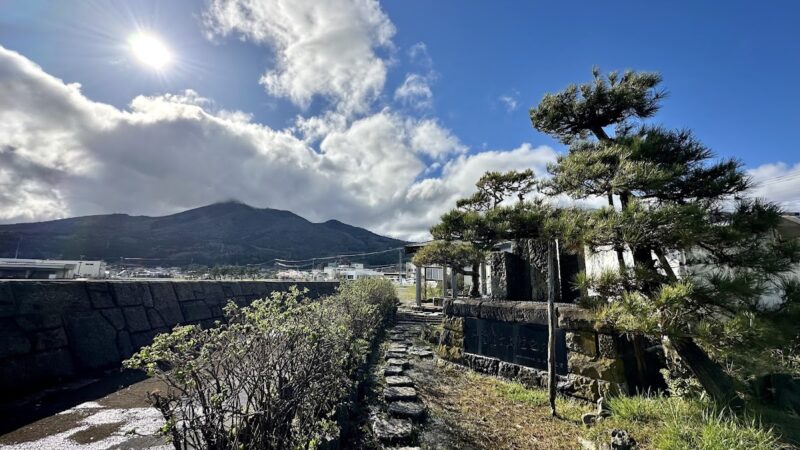
From the main keep site, a magnificent view of the Tsugaru Plain unfolds. On a clear day, you can even see the majestic Mount Iwaki, allowing you to understand why Mitsunobu chose this location as his base for ruling Tsugaru. You can enjoy the beautiful scenery of each season: the fresh green of spring, the deep green of summer, the autumn leaves, and the snowy landscape of winter.
Surface Exhibits of Building Remains
The building remains confirmed through archaeological excavations are indicated by surface exhibits. The locations of postholes are marked with stones and signs, allowing visitors to explore the castle ruins while imagining the original building layout. This exhibit method is designed to allow visitors to experience history while protecting the remains.
Path to the Castle
The path to Taneri Castle has been maintained as a route that evokes the original route. As you ascend the gentle slope, you can imagine the samurai of the Middle Ages traveling along this path. Information boards are installed along the way, allowing you to learn about the castle’s history and structure as you ascend.
Value as a Tsugaru Clan Castle Site
History of National Historic Site Designation
The Tsugaru Clan Castle Site’s designation began with the designation of Hirosaki Castle as a National Historic Site in 1952 (Showa 27). Subsequently, in 2002, the Taneri Castle ruins were added to the designation, and in 2010, the Horikoshi Castle ruins were also added. As a result, three important castle ruins that tell the history of the Tsugaru clan were designated as a single National Historic Site.
The current designated area covers approximately 1,058,000 square meters and is protected as a valuable group of cultural properties that demonstrate the development process of the Tsugaru clan.
Relationship between the Three Castles
The three castles—Taneri Castle, Oura Castle (later Horikoshi Castle), and Hirosaki Castle—are important historical sites that show the stages of the Tsugaru clan’s development. Taneri Castle symbolizes the origin of the Tsugaru clan, Horikoshi Castle the process of unifying Tsugaru, and Hirosaki Castle the establishment of the Tsugaru Domain. Visiting these three castles allows for a three-dimensional understanding of the Tsugaru clan’s history.
Taneri Castle, as the oldest castle, is an indispensable historical site for understanding the roots of the Tsugaru clan.
Access and Surrounding Area Information
Transportation Access
Access by Car: Approximately 50 minutes from Namioka IC on the Tohoku Expressway via National Route 101. Approximately 15 kilometers south of the center of Ajigasawa Town. Parking is available at the Mitsunobu-ko Residence.
Public Transportation: Approximately 30 minutes by bus or taxi from Ajigasawa Station on the JR Gonō Line. Public transportation is limited, so it is recommended to check the timetable in advance.
Precautions for Visiting
Since Taneri Castle Ruins is a mountain castle, appropriate clothing and shoes are necessary for climbing. Particular caution is needed during rainy weather and winter, as the ground can be slippery. Also, don’t forget to bring insect repellent during the summer.
Mitsunobu-ko’s mausoleum is a sacred place, and respectful worship is required. Please refrain from loud conversations and inappropriate behavior.
Nearby Attractions
Around the Taneri Castle ruins, there are numerous historical sites and natural scenic spots associated with the Tsugaru clan. The central area of Ajigasawa Town also boasts tourist facilities serving as a gateway to the Shirakami Mountains, which can be enjoyed in conjunction with a visit to Taneri Castle.
Furthermore, Ajigasawa Town, facing the Sea of Japan, is known for its fresh seafood, and visitors can enjoy dishes made with local ingredients.
Taneri Castle Ruins Development and Utilization Project
Current Initiatives
The Ajigasawa Town Board of Education is promoting the “Taneri Castle Ruins Development and Utilization Project” with the aim of preserving and utilizing the Taneri Castle ruins. This project involves continuous archaeological excavations, preservation and maintenance of the remains, and improvement of information facilities.
A dedicated website has also been launched, regularly publishing the latest information on the Taneri Castle ruins and the results of the excavations. This allows people from distant locations to access information about the Taneri Castle ruins.
Future Prospects
In the future, plans are underway to improve the environment to encourage more people to visit the Taneri Castle ruins. Multilingual signage, barrier-free access, and the introduction of a digital-based explanation system are being considered, and it is expected that the site will develop into a historical site where everyone can learn about history.
Furthermore, its use as a place for local history education is being promoted, providing local elementary and junior high school students with opportunities to learn about their local history.
Summary
Taneri Castle is a mountain castle of extremely important historical significance as the birthplace of the Tsugaru clan. Built in 1491 by Oura Mitsunobu, this castle, which formed the foundation of Tsugaru’s unification, is still carefully preserved as a national historical site.
In addition to points of interest such as the main keep ruins, the bronze statue of Lord Mitsunobu, and the mausoleum, the historical museum “Mitsunobu-ko no Yakata” offers detailed information about the history of the Tsugaru clan. New discoveries from archaeological excavations continue, and further clarification of its historical value is expected in the future.
Standing on the main keep ruins, which offer a panoramic view of the Tsugaru Plain, one can imagine the scenery that Lord Mitsunobu saw and reflect on the history of Tsugaru. Taneri Castle Ruins, where you can have such a valuable experience, is one of the historical sites you should definitely visit when you come to Aomori Prefecture.
Visiting it along with Hirosaki Castle and Horikoshi Castle will allow you to gain a deeper understanding of the history of the Tsugaru clan. For those interested in the history of Tsugaru, those who enjoy visiting castle ruins, and those who want to experience the culture of Aomori Prefecture, Taneri Castle Ruins is a must-see historical site.