Notsukamafu Chashi (Hokkaido) Complete Guide: Highlights and History of the Nemuro Peninsula Chashi Ruins, One of Japan’s 100 Famous Castles
What is Notsukamafu Chashi?
Notsukamafu Chashi is a fort (chashi) built by the Ainu people, located in Makinouchi, Nemuro City, Hokkaido. It is designated as a national historic site as part of the Nemuro Peninsula Chashi Ruins and is an important cultural heritage site, selected as the first of Japan’s 100 Famous Castles.
The place name “Notsukamafu” means “place on the cape” in the Ainu language, and as the name suggests, it is located at the tip of a coastal plateau overlooking Nemuro Bay. It consists of two ruins, Chashi No. 1 and Chashi No. 2, and is believed to have been used from the 16th to the 18th centuries.
What is a Chashi?
“Chashi” is an Ainu word meaning “fence enclosure,” and is a general term for facilities built by the Ainu people for various purposes. Its uses were diverse, and it is believed to have had the following functions:
- Military Defense Facility (Fort): A fortress built to prevent enemy incursions
- Ritual Site: A sacred space for rituals and prayers
- Watchtower: An observation post for monitoring the surroundings
- Meeting Place: A place for important meetings and gatherings of the kotan (settlement)
- Cemetery: A place to honor ancestors
Approximately 500 chashi sites have been identified in Hokkaido, and 32 chashi sites remain in Nemuro City alone. Of these, 24 are designated as a national historic site as the “Nemuro Peninsula Chashi Site Group,” occupying a unique position in the history of Japanese castles.
Historical Background of Notsukamafu Chashi
The Ainu Era
Notsukamafu Chashi was built and used by the Ainu people from the 16th to the 18th centuries. During this period, the Nemuro Peninsula was an important living area for the Ainu people, flourishing as a center for fishing, hunting, and trade.
Chashi were not merely military facilities, but multi-purpose spaces within Ainu society. Locations overlooking the sea, such as Notsukamafu Chashi, were ideal for monitoring fisheries, inspecting trading ships, and even holding ceremonies.
The Encroachment of the Japanese and Rising Tensions
From 1754 (Hōreki 4), officials from the Matsumae Domain and Japanese who managed the area began to reside in the Nemuro region. Initially, relations were centered on trade, but gradually the Japanese’s control over the Ainu people strengthened.
Japanese merchants began to impose harsh labor on the Ainu and exercised violent rule. Forced labor in fishing grounds, unfair trade, and violence against women were rampant acts that trampled on the dignity of the Ainu people.
The Kunashiri-Menashi Rebellion (Kansei Ezo Uprising)
In 1789 (Kansei 1), the anger of the Ainu people finally exploded. A large-scale uprising by the Ainu people occurred, centered on Kunashiri Island and the eastern part of the Nemuro Peninsula (Menashi). This was the “Kunashiri-Menashi War” (Kansei Ezo Uprising).
Notsukamafuchashi was one of the battlefields of this conflict. It is believed that Ainu leaders used the chashi (fortified site) as a base of resistance against the Japanese. 71 people, including Japanese merchants and guards, were killed in the uprising, but it was ultimately suppressed by the military force of the Matsumae Domain.
This battle is recorded as an important event in Japanese history as the last large-scale armed uprising by the Ainu people.
The Birthplace of Russo-Japanese Diplomatic Relations
In 1778 (An’ei 7), a Russian ship arrived in Notsukamafushi Bay. This is considered one of the first official contacts between Japan and Russia, and the area around Notsukamafuchashi holds historical significance as the “birthplace of Russo-Japanese diplomatic negotiations.”
In the late 18th century, Russia pursued its southward expansion policy and showed increasing interest in the Kuril Islands and Hokkaido. Contact during this period was a crucial event that marked the beginning of subsequent Russo-Japanese relations.
Structure and Characteristics of Notsukamafuchashi
A Typical Example of a Cliff-Facing Chashi
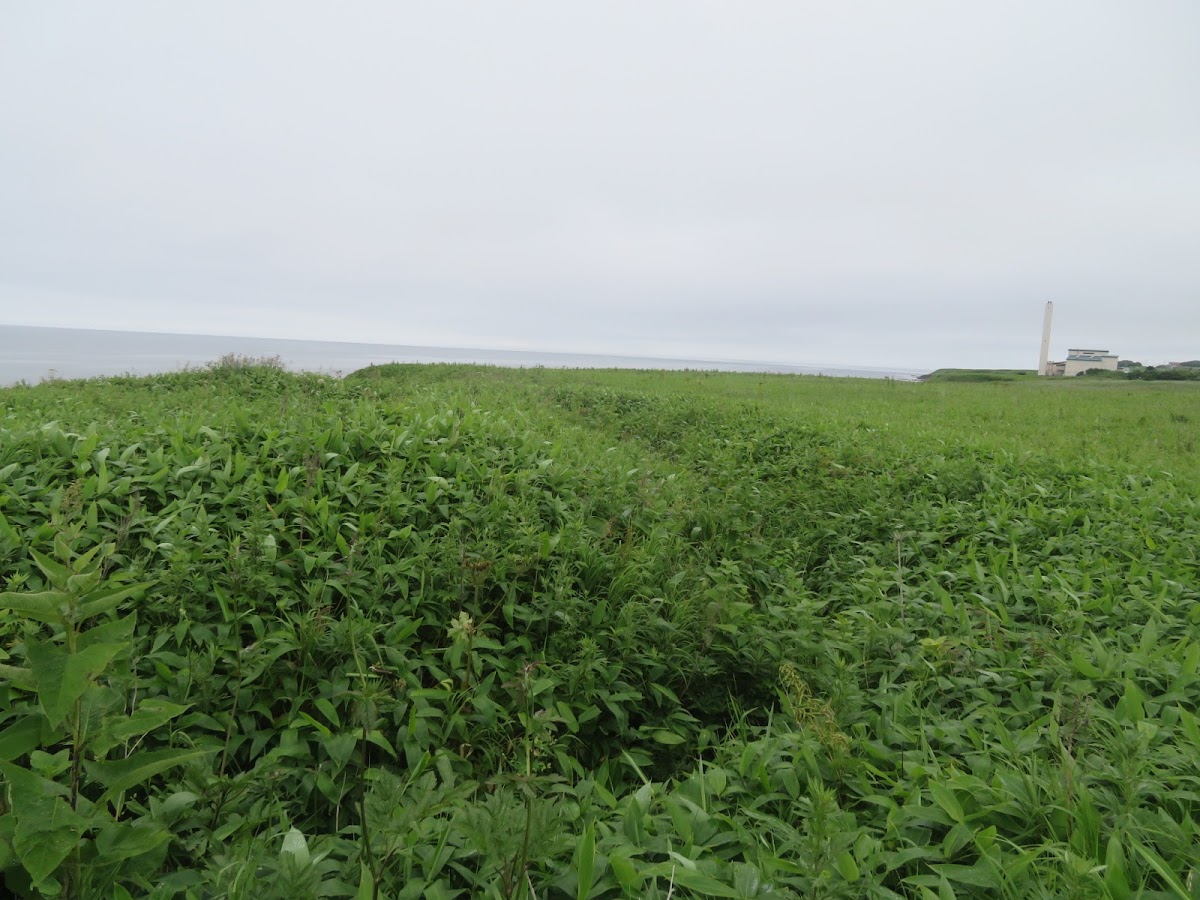
Notsukamafuchashi is a type of chashi known as a “cliff-facing” chashi. A cliff-facing chashi is a structure that utilizes cliffs facing the sea as a natural defensive wall, with earthworks and moats on the landward side for defense.
The advantages of this structure are as follows:
- Natural Defense: The seaward side is a sheer cliff, making enemy intrusion impossible.
- Wide View: Offers a panoramic view of the sea and surrounding area.
- Efficient Defense: Only the landward side needs to be defended, requiring less effort.
- Securing an Escape Route: A retreat route to the sea may be available.
Structure of Chashi No. 1
Chashi No. 1 has a “gourd-shaped” plan, consisting of two connected circular enclosures. This unique structure is distinctive even among the Nemuro Peninsula Chashi ruins.
- Size: Approximately 40 meters north-south, approximately 30 meters east-west.
- Earthwork: A clear earthwork remains on the landward side.
- Internal Space: The two enclosures may have had different functions.
- View: An excellent location overlooking both the Nemuro Strait and Nemuro Bay.
The earthwork remains approximately 1 meter high even today, allowing us to imagine its appearance at the time of construction. The interior is a flat grassy area, suggesting that rituals and meetings were once held here.
Structure of Chashi No. 2
Chashi No. 2 is located adjacent to the south side of Chashi No. 1 and has a smaller, single-circular structure.
- Size: Circular, approximately 20 meters in diameter
- Earthwork: Lower than Chashi No. 1, but clearly visible
- Function: Possibly functioned as an auxiliary facility or lookout post for Chashi No. 1
- Condition: Good, making it easy to understand the basic structure of the chashi
Given the proximity of the two chashi, it is thought that they functioned in conjunction with each other. It is highly probable that Chashi No. 1 played the main facility, while Chashi No. 2 played a supporting role.
Pit Dwelling Sites
Pit dwelling sites have also been confirmed around Notsukamafu Chashi. These are traditional Ainu dwellings called “chise,” indicating that they formed a settlement integrated with the chashi.
The presence of pit dwelling remains indicates that Notsukamafuchashi functioned not merely as a military facility, but also as a place for daily life.
Highlights of Notsukamafuchashi
Well-maintained viewing paths
Notsukamafuchashi is particularly well-maintained among the Nemuro Peninsula Chashi ruins, making it safe for general tourists to visit.
A walking path leads from the parking area through the forest, offering an experience akin to walking through a “forest tunnel.” Upon emerging from this tunnel, the view suddenly opens up, revealing a vast grassland and the blue sea. This dramatic change in scenery leaves a strong impression on visitors.
Spectacular views
The greatest highlight of Notsukamafuchashi is undoubtedly its views.
- Nemuro Strait: To the north lies the Nemuro Strait, offering views of Kunashir Island.
- Nemuro Bay: To the south lies the calm coastline of Nemuro Bay.
- Pacific Ocean: To the east lies the endlessly stretching Pacific Ocean.
- Sunrise: Nemuro is known as “the town closest to the sunrise,” offering beautiful views of the rising sun.
On clear days, Kunashir Island is clearly visible, allowing one to imagine what the Ainu people once saw from this spot.
Clear Remains
At Notsukamafu Chashi, the structure of the chashi (fortified site) is remarkably well-preserved, with the earthworks and enclosure shapes clearly visible. This is particularly noteworthy among the Nemuro Peninsula chashi sites.
The gourd-shaped form of Chashi No. 1 is even more apparent from the air, but its shape can also be experienced by walking along it from the ground. Walking along the earthworks will give you a real sense of the defensive structure of that time.
Information Boards and Explanations
Detailed information boards are installed at the site, providing explanations about the history and structure of the Chashi (fortified settlement), as well as the Battle of Kunashiri-Menashi. Information on the location of stamps for the “100 Famous Castles of Japan” and the entire Nemuro Peninsula Chashi group is also available.
Natural Environment
Notsukamafu Chashi is surrounded by a rich natural environment. Wildflowers bloom profusely from spring to summer, the autumn foliage is beautiful, and in winter, the ruins stand out against the harsh natural landscape.
Many wild birds are also found here, making it a popular birdwatching spot. Listening to the calls of seabirds and imagining the lives of the Ainu people who once lived here is one of the pleasures of visiting.
Access Information
Location
Address: 131 Makinouchi, Nemuro City, Hokkaido
Coordinates: Approximately 43°19′N, 145°36′E
Access by Car
The most convenient way to access Notsukamafuchashi is by car.
- From Nemuro City Center: Approximately 15 minutes (approx. 10 km)
- From Nemuro Nakashibetsu Airport: Approximately 1 hour 30 minutes (approx. 80 km)
- From Kushiro City: Approximately 2 hours 30 minutes (approx. 130 km)
Drive along Hokkaido Prefectural Road 142 (Nemuro Peninsula Line) and follow the signs for “Nokkamappu Cape”. There is a parking space (for about 2-3 cars) a short distance from the road.
Access by Public Transportation
Public transportation access is limited. We recommend taking a taxi from Nemuro city center or renting a car.
The tourist information center in Nemuro City provides model itineraries for visiting the Chashi (ancient tombs) and information on taxi tours.
Parking Information
There is no dedicated parking lot, but there are 2-3 parking spaces available off the main road. It can get crowded during peak tourist season, so visiting earlier in the day is recommended.
Walking
The Chashi are approximately a 5-minute walk from the parking area. The walking paths are well-maintained, but they can become slippery depending on the weather, so comfortable walking shoes are recommended.
Important Notes and Best Season for Visiting
Clothing and Equipment
- Shoes: Comfortable walking shoes such as sneakers or trekking shoes are essential.
- Clothing: Windproof outerwear is recommended as it is often windy.
- Hat: A hat is essential as there is no shade.
- Insect Repellent: Insects are abundant in the summer, so bring insect repellent spray.
- Drinking Water: There are no vending machines nearby, so prepare in advance.
Visitor Etiquette
- Protection of Historical Structures: Do not walk on the earthworks or enclosures.
- No Plant Collection: Do not pick wildflowers or plants.
- Take Your Trash Home: Always take your trash home.
- No Open Flames: Smoking and the use of fire are strictly prohibited.
- Quietness: Respect the historical site and refrain from shouting.
Best Season
Spring (May-June): Wildflowers begin to bloom, and the fresh greenery is beautiful. The temperature is mild, making it ideal for sightseeing.
Summer (July-August): The busiest time for tourists. The grasslands are lush and green, creating a beautiful contrast with the blue sea. However, fog is common.
Autumn (September-October): The autumn foliage is beautiful, and the air is clear, allowing for excellent views. Kunashir Island is often clearly visible.
Winter (November-March): There is snow, which can make access difficult. However, the ruins viewed amidst the harsh winter landscape have a different kind of charm.
Estimated Time Required
Please allow the following time for visiting Notsukamafuchashi.
- Shortest Course: 30 minutes (round trip from the parking lot, brief sightseeing only)
- Standard Course: 1 hour (thorough observation of the ruins, photography)
- In-depth Course: 1 hour 30 minutes to 2 hours (including observation of the surrounding nature, meditation, etc.)
About the Japan’s Top 100 Castles Stamp
Stamp Locations
The Japan’s Top 100 Castles stamps for the Nemuro Peninsula Chashi Ruins, including Notsukamafuchashi, are located at the following locations:
Nemuro City Tourist Information Center
Address: 2-10 Kowa-cho, Nemuro City, Hokkaido
Opening Hours: 9:00 AM – 6:00 PM (may vary depending on the season)
Closed: New Year’s Holidays
Nemuro City Museum of History and Nature
Address: 209 Hanasaki-minato, Nemuro City, Hokkaido
Opening Hours: 9:30 AM – 4:30 PM
Closed: Mondays (or the following day if Monday is a public holiday), New Year’s Holidays
While some stamp locations may offer 24-hour stamping, we recommend visiting during facility opening hours.
Obtaining the 100 Famous Castles Card
Those participating in the Japan’s 100 Famous Castles Stamp Rally can also obtain the “100 Famous Castles Card” along with their stamps. It is distributed at the Nemuro City Tourist Information Center.
Nearby Tourist Attractions
Onnemoto Chashi
Alongside Notsukamafu Chashi, Onnemoto Chashi is the best-preserved of the Nemuro Peninsula Chashi ruins. Located at the northeastern tip of the Nemuro Peninsula, it’s about a 30-minute drive from Notsukamafu Chashi.
Onnemoto Chashi is known for its clearly identifiable pit dwelling remains, and the shape of the chashi (fortified site) is very distinct. Visiting both Notsukamafu Chashi and Onnemoto Chashi will deepen your understanding of the Nemuro Peninsula Chashi ruins.
Cape Nosappu
Cape Nosappu, the easternmost point of mainland Japan, is about a 20-minute drive from Notsukamafu Chashi. You can see the Northern Territories islands up close, and monuments such as the “Bridge to the Four Islands” are installed there.
Visiting early in the morning allows you to witness the earliest sunrise on the mainland.
Nemuro City Museum of History and Nature
This museum offers insights into the history, nature, and Ainu culture of Nemuro City. It also features exhibits on Chashi (fortified settlements), making a visit before or after a visit to Notsukamafu Chashi a valuable experience.
Exhibits include materials related to the Kunashiri-Menashi War and everyday Ainu artifacts.
Shunkunitai
A sandbar jutting out into Nemuro Bay, this is a Ramsar Convention-registered wetland. Known as a haven for wild birds, it’s considered a sacred site for birdwatching.
The Nature Center offers opportunities to learn about the wetland’s natural environment and wild birds.
Nemuro Kurumaishi (Nemuro Wheel Stone)
A massive natural monument featuring beautiful radial jointing. Its distinctive wheel-like shape, with a diameter of 6 meters, gives it globally rare geological value.
About the Nemuro Peninsula Chashi Sites
24 National Historic Sites
Notsukamafu Chashi is one of the 24 chashi sites designated as a National Historic Site as part of the “Nemuro Peninsula Chashi Sites.” These chashi sites are widely distributed from the base to the tip of the Nemuro Peninsula.
The main chashi sites include the following:
- Notsukamafu Chashi (No. 1 & 2)
- Onnemoto Chashi
- Ponmoi Chashi
- Harutoru Charanke Chashi
- Moshiriya Chashi
- Charukorofina Chashi
etc.
Significance of being No. 1 in Japan’s Top 100 Castles
The selection of the Nemuro Peninsula Chashi Sites as No. 1 in Japan’s Top 100 Castles is of great significance.
- Recognition of Diverse Castle Cultures: Recognizing not only castles with stone walls and keeps, but also Ainu forts as “castles.”
- Respect for Indigenous Cultures: Positioning the history and culture of the Ainu people as part of Japanese history.
- Regional Pride: Enhancing pride in and awareness of preserving the region’s historical heritage among Nemuro citizens.
- Tourism Resource: Contributing to attracting tourists as one of Japan’s 100 Famous Castles, located at the easternmost point of the country.
Classification of Chashi
The Chashi on the Nemuro Peninsula are classified as follows based on their structure:
Cliff-faced Type: Utilizing cliffs facing the sea (e.g., Notsukamafu Chashi)
Hilltop Type: Utilizing the tip of a hill
Mountaintop Type: Built on the top of a hill
Island Type: Built on a rocky outcrop jutting out into the sea
This diversity demonstrates flexible castle-building techniques adapted to the terrain and speaks to the advanced civil engineering skills of the Ainu people.
Experiencing Ainu Culture at Notsukamafuchashi
The Ainu Worldview
Understanding the Ainu worldview will deepen your experience when visiting Notsukamafuchashi.
The Ainu believed that “Kamuy” (gods) resided in everything in nature. The sea, mountains, rivers, animals, and plants were all respected as sacred.
The sea, sky, and land viewed from Notsukamafuchashi were not merely scenery to the Ainu, but the world of the gods themselves.
Rituals and Prayer
The chashi (fortified site) was also a place where important rituals were performed. It functioned as the spiritual center of the kotan (village), hosting rituals for bountiful catches and hunts, coming-of-age ceremonies, and ancestral worship.
The spacious interior of Notsukamafuchashi is thought to have been a suitable place for many people to gather and perform rituals.
Challenges Remaining in the Modern Age
The Kunashiri-Menashi War is a symbol of the hardships faced by the Ainu people. Domination, exploitation, and cultural suppression by the Japanese continued for a long time afterward.
In 2019, the “Act on the Promotion of Measures to Realize a Society Where the Pride of the Ainu People is Respected” (Ainu Policy Promotion Act) was enacted, legally stating for the first time that the Ainu people are an indigenous people.
Visiting Notsukamafu Chashi is an opportunity to learn about this history and reflect on multicultural coexistence.
Photography Tips
Recommended Photo Spots
Composition overlooking the sea from inside Chashi No. 1
By capturing the earthworks, sea, and sky in a single photograph, you can express the magnificent location of the Chashi.
The path from the forest tunnel to the Chashi
Capturing the sudden change from the tree-lined promenade to the open grassland creates a dramatic photograph.
Backlit Silhouette at Dusk
The combination of the earthwork silhouette and the sunset creates a fantastical atmosphere.
Sunrise and Kunashir Island
In the early morning, the combination of Kunashir Island and the chashi (fortified site) illuminated by the rising sun is a spectacular sight unique to Nemuro.
Precautions for Photography
- Do not damage the remains: When setting up a tripod, be careful not to damage the earthwork or other remains.
- Consideration for other visitors: Avoid occupying a location for extended periods.
- Drone photography: From the perspective of cultural property protection, prior confirmation with the Nemuro City Board of Education is required.
- Weather changes: The weather in coastal areas is unpredictable, so safety is paramount.
Summary: The Value of Notsukamafuchashi
Notsukamafuchashi is not merely a tourist spot. It possesses multifaceted value, as described below.
Historical Value: The stage for the important historical events of the Kunashiri-Menashi War, showcasing the life and culture of the Ainu people.
Cultural Value: Valuable remains that convey the Ainu people’s castle-building techniques and worldview.
Scenic Value: A spectacular viewpoint offering panoramic views of the Nemuro Strait and the Pacific Ocean.
Educational Value: A place to reflect on multicultural coexistence and the rights of indigenous peoples.
Tourism Value: As the first of Japan’s 100 Famous Castles, it is a sacred site visited by many castle enthusiasts.
Notsukamafuchashi, located at the easternmost tip of Hokkaido, is the region where the sun rises earliest on the Japanese mainland. Visiting this place will be a valuable experience that allows you to connect with Japan’s diverse history and culture.
When you visit Nemuro, be sure to visit Notsukamafuchashi and see for yourself the landscape that the Ainu people saw. Standing on the earthen ramparts and gazing at the sea, the time you spend reflecting on the thoughts of the people who lived here hundreds of years ago will surely be an unforgettable memory.