
.png)
Shimonanma Castle (Kanuma City, Tochigi Prefecture): History and Remains – A Thorough Explanation of a Sengoku Period Mountain Castle
Shimonanma Castle is a medieval mountain castle located in Shimonanma-cho, Kanuma City, Tochigi Prefecture. It functioned as a base for regional control during the Sengoku period, and even today, it remains a valuable historical site with remnants such as earthworks and baileys. This article provides a detailed explanation of Shimonanma Castle’s historical background, castle structure, existing remains, and visiting information.
Overview of Shimonanma Castle
Shimonanma Castle is a mountain castle located in Shimonanma-cho, in the southern part of Kanuma City, Tochigi Prefecture. Built on a hill approximately 250 meters above sea level, it occupies a strategic location overlooking the surrounding area.
Basic Information
- Location: Shimonanma-cho, Kanuma City, Tochigi Prefecture
- Castle Classification: Mountain Castle
- Construction Period: Sengoku period (estimated to be around the 16th century)
- Builder: Believed to be a warlord associated with the Minagawa clan
- Abandonment Period: Unknown (late Sengoku period to early Edo period)
- Remains: Enclosures, earthworks, moats, etc.
- Designation: None (Not designated)
History of Shimonanma Castle
The Nanma Region in the Sengoku Period
During the Sengoku period, when Shimonanma Castle was built, this region was within the sphere of influence of the Minagawa clan, a powerful local lord of Shimotsuke Province. The Minagawa clan was based in present-day Tochigi City and controlled a wide area from southern Kanuma City to northern Tochigi City.
The Nanma region is located in the southern part of Kanuma City and was an important location as a transportation hub. Shimonanma Castle is believed to have been built as a base for controlling this region, or as part of the Minagawa clan’s network of branch castles.
Connection to the Minagawa Clan
The Minagawa clan was a local lord that expanded its power in southern Shimotsuke Province during the Sengoku period. Especially during the time of Minagawa Toshimune and his son Hiroteru, they skillfully conducted diplomacy between powerful forces such as the Hojo and Uesugi clans.
Shimonanma Castle likely functioned as a branch castle of Minagawa Castle (Tochigi City), the main castle of the Minagawa clan, and is presumed to have played a role as a base for governing the Nanma region or as a military frontline base.
About the Castle Lord
Regarding the specific lord of Shimonanma Castle, there is currently a lack of clear historical records, and many details remain unknown. However, based on local traditions and analysis of place names, it is believed that a powerful figure within the Minagawa clan’s retainers served as the castle lord.
It has also been suggested that a local powerful family called the “Nanma clan” existed in the Nanma region, and it is possible that they came under the Minagawa clan’s control and built a castle there. ### History of the Castle’s Abandonment
There are no clear records regarding the exact date of the abandonment of Shimonanma Castle. Generally, it is believed that medieval castles in this region were abandoned at one of the following times:
- After Toyotomi Hideyoshi’s Siege of Odawara (1590): The Minagawa clan was dispossessed, and this region came under the control of Gamo Ujisato.
- Early Edo Period: The One Castle Per Province Decree (1615) led to the abolition of branch castles.
It is presumed that Shimonanma Castle also lost its military function and was abandoned at one of these historical turning points.
Castle Structure and Characteristics
Location and Layout
Shimonanma Castle is a typical mountain castle built utilizing the ridge of a hill. It skillfully utilizes the natural terrain to enhance its defensive capabilities.
The castle area is relatively compact, with multiple baileys arranged around the main enclosure. Moats were constructed on both ends and sides of the ridge to prevent enemy intrusion.
Main Enclosure (Honmaru)
The main enclosure, the heart of the castle, is located at the highest point. It is surrounded by earthen ramparts, enhancing its defensive capabilities. The main enclosure is relatively small, suggesting that the number of troops stationed there was limited.
From the main enclosure, one could overlook the surrounding terrain, indicating that surveillance was also a crucial function.
Enclosure Layout
Several enclosures (flat areas) are arranged in a stepped pattern around the main enclosure. These enclosures are thought to have been used as garrisons for soldiers and storage for supplies.
By utilizing the elevation differences between the enclosures, a layered defense system was implemented, making it difficult for the enemy to easily reach the main enclosure.
Earthen Ramparts and Moats
Earthen ramparts and moats play a vital role as defensive structures at Shimonanma Castle.
Earthen ramparts were built along the edges of the enclosures, serving to prevent enemy intrusion and act as a defensive wall against arrows and gunfire. Traces of these ramparts can still be seen today.
Dry moats are dry moats dug across ridges, effectively blocking enemy routes. At Shimonanma Castle, dry moats were constructed along the main ridges, clearly defining the castle grounds.
Entrance/Exit
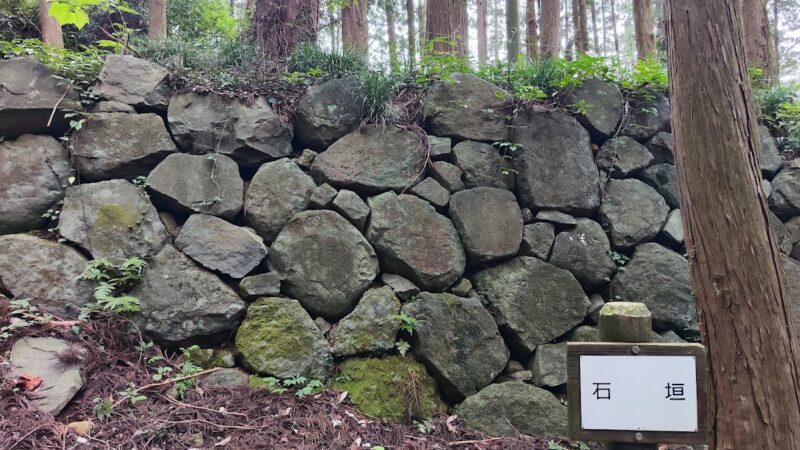
The entrance/exit to the castle, the “koguchi,” was a weak point in defense and therefore heavily fortified. At Shimonanma Castle, traces of earthen ramparts and stonework can be seen near the entrance, indicating a defensive structure.
Current Status of Remains
Remaining Remains
The remains of Shimonanma Castle are still well-preserved within the forest. The main remains that can be identified are as follows:
- Enclosures: Multiple flat areas, including the main enclosure, can be identified.
- Earthworks: Remains of earthworks are visible around some enclosures.
- Moats: Several moats cutting across the ridge can be identified.
- Cliffs: Clearly visible cliffs remain, carved out from the edges of the enclosures.
Preservation Status
Since the Shimonanma Castle ruins are not designated as a cultural property, no special preservation measures have been taken. However, because the area is used as forest land, it has been spared from large-scale development, and the remains are preserved in relatively good condition.
In recent years, investigations have been conducted by castle researchers and history enthusiasts, and the creation of layout maps is also underway.
Points to Note When Visiting
When visiting the Shimonanma Castle ruins, please note the following points:
- Unmaintained: There are almost no walking paths or signposts.
- Potential Private Property: Part of the castle ruins may be private property, so caution is advised when entering.
- Safety Equipment: Appropriate clothing and shoes are necessary as you will be walking through a forest.
- Avoid Solo Visits: It is recommended to visit in a group if possible.
Access Information
Location
322-0346 Shimonanma-cho, Kanuma City, Tochigi Prefecture
Access by Public Transportation
Access by public transportation is inconvenient. Due to the distance from the nearest station, using a private car is recommended.
- Take a taxi from JR Nikko Line Kanuma Station or Tobu Nikko Line Shin-Kanuma Station (approximately 30 minutes).
- Bus service is infrequent, making direct access to the castle ruins difficult.
Access by Car
- From Tohoku Expressway Kanuma IC: Approximately 20 minutes
- From Kita-Kanto Expressway Tsuga IC: Approximately 25 minutes
Take National Route 293 towards Shimonanma-cho. There is no parking near the castle ruins, so if parking on the street, be careful not to obstruct other traffic.
Nearby Historical Sites
When visiting Shimonanma Castle, we recommend also visiting other nearby historical sites.
- Kami-Nanma Castle: A contemporary mountain castle located near Shimo-Nanma Castle.
- Kanuma Castle: A flatland castle in the center of Kanuma City (almost no remains survive).
- Mibu Castle: A castle in Mibu Town closely associated with the Minagawa clan.
- Minagawa Castle: The main castle of the Minagawa clan in Tochigi City.
Historical Significance of Shimo-Nanma Castle
Importance in Local History
Shimo-Nanma Castle is an important historical site that illustrates the reality of regional governance in the Kanuma region during the Sengoku period. While not a large-scale castle, it provides valuable information for understanding how powerful local figures controlled their territories and established defensive systems.
Minagawa Clan’s Branch Castle Network
The Minagawa clan established branch castles throughout their territory, centered around their main castle, Minagawa Castle. Shimo-Nanma Castle played a part in this branch castle network and is important for understanding the reality of the Minagawa clan’s territorial management.
Contribution to Medieval Castle Research
Small mountain castles like Shimonanma Castle rarely appear in historical documents, and much about their actual state remains unknown. However, through the investigation and research of the remains, it is possible to elucidate the realities of regional society and military technology during the Sengoku period.
By analyzing the layout and characteristics of the remains of Shimonanma Castle, we can understand the castle construction techniques and defensive philosophies of this region, contributing to the study of medieval castles.
Current Status of Investigations and Research
Academic Research
Regarding Shimonanma Castle, a full-scale academic investigation has not yet been sufficiently conducted. However, surveys and layout investigations have been carried out by local historians and castle researchers, and the basic structure is gradually becoming clearer.
Future Challenges
To deepen research on Shimonanma Castle, the following challenges exist:
- Excavation of Historical Documents: Research of historical documents to identify the castle lord and construction period
- Detailed Survey: Creation of an accurate castle layout map
- Archaeological Investigation: Collection and dating of artifacts through excavation
- Comparative Study with Surrounding Castles: Clarification of the regional castle network
Advice for Visitors
Preparation for Visiting
When visiting the Shimonanma Castle Ruins, we recommend the following preparations:
- Attire: Long-sleeved shirt and long pants, hiking boots or trekking shoes
- Items to bring: Drinking water, map, compass, insect repellent, work gloves
- Time of year: Avoid visiting during the summer when vegetation is lush; autumn to spring is ideal.
- Time: Allow 1-2 hours for your visit.
Photography Tips
- Earthworks and moats: Photograph from an angle that clearly shows the shape of the remains.
- Flat areas of the enclosures: Use a composition that conveys a sense of spaciousness.
- View: The view from the main enclosure helps to understand its defensive importance.
Manners and Precautions
- Respect for private property: Be careful not to enter private homes or farmland.
- Take your trash home: To protect the natural environment, always take your trash home.
- Protection of remains: Be careful not to damage the earthworks or moats.
- Dangerous areas: Please do not approach steep slopes or areas at risk of landslides.
Summary
Shimonanma Castle is a mountain castle ruin from the Sengoku period located in Kanuma City, Tochigi Prefecture. Although not large in scale, the remains of earthworks and moats are well-preserved, making it a valuable historical site for understanding the realities of regional control during the Sengoku period.
This castle, believed to have functioned as a branch castle of the Minagawa clan, is an important presence that tells the story of the region’s history. While not well-maintained, it is a place worth visiting for those interested in history and castles.
When visiting, please be sure to wear appropriate equipment and prepare in advance, and observe the Sengoku period remains carefully while prioritizing safety. You should be able to sense the lives of the people of that time and their defensive ingenuity from the earthen mounds and the flat areas that remain after excavation.
--765x450.png)
