Complete Guide to Shinonomaru Castle (Hyogo Prefecture): Thorough Explanation of History, Remains, and Access Information
What is Shinonomaru Castle?
Shinonomaru Castle is a medieval mountain castle located in Nogami-no, Kasuga-cho, Tanba City, Hyogo Prefecture. Built on a mountaintop approximately 300 meters above sea level, this castle is known as an important historical site indispensable to understanding the Sengoku period in the Tanba region.
Also known as “Nogami-no Castle” or “Nogami-no Mansion,” it is said to have been the residence of a family of the Akai clan, a Sengoku daimyo of Tanba. Even today, the remains such as earthworks, baileys, and moats are well-preserved, making it a valuable cultural asset that conveys the appearance of a Sengoku period mountain castle.
Location and Geographical Characteristics of Shinonomaru Castle
Shinonomaru Castle is located in the mountainous area of Kasuga-cho, Tanba City, built on a strategic location overlooking the surrounding valleys and roads. The castle’s location exhibits typical characteristics of a medieval mountain castle, featuring a layout that skillfully utilizes the terrain suitable for defense.
The castle grounds extend approximately 200 meters east-west and 150 meters north-south, with multiple baileys arranged around the main enclosure. Its steep terrain creates a natural stronghold, making it a formidable structure that was difficult for attackers to conquer.
History of Shinonomaru Castle
Background and Period of Construction
While there is a lack of clear historical records regarding the exact construction date of Shinonomaru Castle, and many details remain unknown, it is believed to have been built during the Sengoku period, from the late 15th to the early 16th century. This period was a time when local lords in the Tanba region were expanding their power, and it is presumed that Shinonomaru Castle was built during this process.
The purpose of its construction is thought to have been a military base to protect the Akai clan’s sphere of influence in the Tanba region. Its location, controlling surrounding roads and transportation hubs, suggests that it functioned as an important base for governing the territory.
The Akai Clan and Shinonomaru Castle
Shinonomaru Castle is believed to have been ruled by a member of the Akai clan, a well-known Sengoku period daimyo family of Tanba Province. The Akai clan was based in Hikami District of Tanba Province and was a powerful local lord, producing figures like Akai Naomasa, who was feared as the “Red Demon of Tanba” during the Sengoku period.
The Akai clan controlled their territory by establishing multiple branch castles, and Shinonomaru Castle is thought to have functioned as one of these branch castles. While there are various theories regarding the castle’s lord, it is presumed that a member of the Akai clan or a retainer was stationed there.
Oda Nobunaga’s Conquest of Tanba and Shinonomaru Castle
During the Tensho era (1573-1592), Oda Nobunaga began his conquest of Tanba Province as part of his plan to unify Japan. The Oda army, led by Akechi Mitsuhide, waged fierce battles against local lords such as the Akai and Hatano clans of Tanba.
In 1579, during Akechi Mitsuhide’s invasion of Tanba Province, Kuroi Castle, the stronghold of the Akai clan, fell. It is believed that the Akai clan’s subsidiary castles, including Shinonomaru Castle, also fell one after another. Around this time, Shinonomaru Castle disappeared from the historical stage and is presumed to have been abandoned.
Shinonomaru Castle After Abandonment
After its abandonment, Shinonomaru Castle was left as a forest throughout the Edo period, losing its function as a castle. However, fortunately, it avoided large-scale development, and its remains were preserved in relatively good condition.
In recent years, local historians and castle enthusiasts have been conducting investigations, and its historical value is being re-recognized. As an important historical site for understanding the medieval history of the Tanba region, efforts for its preservation and utilization are anticipated.
Layout and Structure of Shinonomaru Castle
Main Enclosure (Honmaru)
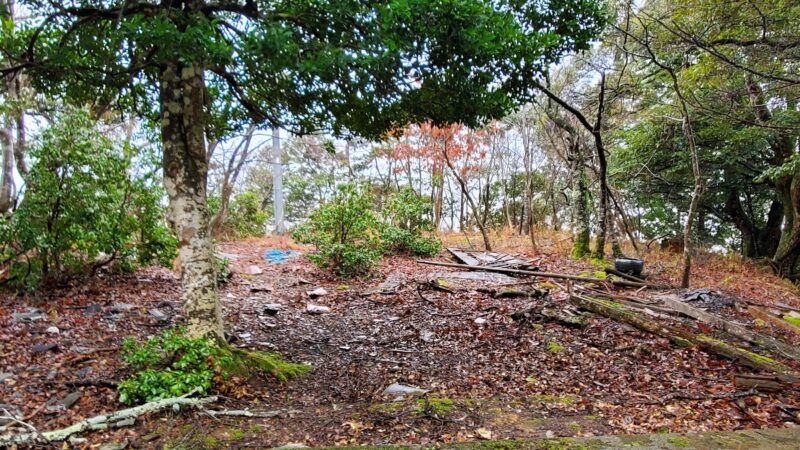
The main enclosure (Honmaru), the center of Shinonomaru Castle, is located at the highest point on the mountaintop. The area measures approximately 30 meters east-west and 20 meters north-south, and traces of earthworks can be seen around it.
From the main enclosure, one can overlook the surrounding valleys and ridges, indicating that it was the core of the castle, serving both as a surveillance and command center. The flat surface remains well-preserved today, allowing us to imagine the castle’s appearance in its heyday.
Arrangement of Enclosures
Several enclosures are arranged in a stepped pattern around the main enclosure. These enclosures are thought to have functioned as defensive fortifications for the main enclosure.
Each enclosure is skillfully positioned to follow the terrain, creating a structure that allows for multiple layers of defense against attackers. The enclosures vary in size, suggesting they were used for different purposes.
Moats and Vertical Moats
A notable feature of Shinonomaru Castle’s defensive structures is the presence of moats and vertical moats. The moats, which cut across the ridges, functioned as an important defensive line to prevent enemy intrusion.
Multiple moats can be found behind the main enclosure (on the north side), some measuring 3 to 5 meters in depth. Several vertical moats descending the slope have also been identified, serving to defend against attacks from the flanks.
Earthworks and Cut Slopes
Traces of earthworks remain throughout the castle grounds. These earthworks served to prevent enemy intrusion and acted as defensive walls against arrows and firearms.
Artificially carved steep slopes, known as cut slopes, are also found around each enclosure, demonstrating the effort to make ascent difficult for enemies. These defensive structures are valuable relics showcasing the advanced mountain castle technology of the Sengoku period.
Highlights of Shinonomaru Castle
Well-Preserved Remains
The greatest highlight of Shinonomaru Castle is the remarkably well-preserved remains of a Sengoku period mountain castle. The main enclosure, enclosures, moats, and earthworks are clearly visible, making it easy to understand the castle’s structure.
The moats, in particular, are deep and clearly preserved, making them a valuable historical site that allows you to experience the defensive techniques of the Sengoku period. For castle enthusiasts, it’s an attractive spot where you can actually walk around and experience the castle’s appearance at that time.
Views and Natural Environment
The views from the main enclosure are also one of the charms of Shinonomaru Castle. On a clear day, you can see the surrounding mountains and valleys, giving you a real sense of why the castle was built in this location.
You can also enjoy the changing seasons, with fresh greenery in spring and vibrant autumn leaves. It’s a place where you can enjoy both mountain castle exploration and nature observation, making it recommended not only for history buffs but also for hiking enthusiasts.
Tanba Mountain Castle Network
Shinonomaru Castle did not exist in isolation; it was part of a mountain castle network that included nearby castles such as Kuroi Castle and Yagami Castle. Visiting these castles together allows for a deeper understanding of the power dynamics and military strategies in the Tanba region during the Sengoku period.
How to Access Shinonomaru Castle
Access by Public Transportation
The nearest stations to Shinonomaru Castle using public transportation are “Kuroi Station” or “Ishio Station” on the JR Fukuchiyama Line (Takarazuka Line). While you can walk or take a taxi from the station, the castle entrance is quite a distance away, so using a private car is recommended.
Distance from Nearest Station
- Approximately 7km from Kuroi Station
- Approximately 6km from Ishio Station
Access by Car
Access by private car is the most convenient. It takes approximately 15 minutes from the Maizuru-Wakasa Expressway “Kasuga IC” to reach the vicinity of the castle entrance.
Main Route
- Approximately 15 minutes from the Maizuru-Wakasa Expressway “Kasuga IC” via the prefectural road
- Turn onto the prefectural road from National Route 175 and follow the signs
There are a few parking spaces near the castle entrance, but it is not a properly maintained parking lot, so parking will be on the roadside. Please be careful not to obstruct the passage of other vehicles.
Ascent Route and Estimated Time
From the entrance to the main enclosure, the climb up the mountain path takes approximately 20-30 minutes. Since some parts of the path are not well-maintained, appropriate clothing and footwear for hiking are necessary.
Precautions When Ascending
- Wear trekking shoes or hiking boots
- Bring drinking water
- Take insect repellent in summer
- Be careful as the ground can be slippery during and after rain
- Avoid climbing alone; travel in groups
Precautions When Visiting Shinonomaru Castle
Safety Precautions
Shinonomaru Castle is not a well-maintained tourist facility; it is a ruin remaining in a mountain forest. Please pay attention to the following points when visiting.
Safety Points
- Prepare appropriate clothing and equipment.
- Be aware of sudden changes in weather.
- Check cell phone signal strength in advance.
- Manage your time to descend before sunset.
- Do not approach dangerous areas.
Manners and Rules
Shinomaru Castle may be located on private or public land. Please observe the following manners when visiting.
Visiting Manners
- Do not damage the ruins.
- Always take your trash with you.
- Use of fire is strictly prohibited.
- Do not collect plants.
- Do not shout.
- Do not enter restricted areas.
Best Time to Visit
The best time to visit Shinonomaru Castle is spring (April-May) and autumn (October-November). During these times, the weather is mild and vegetation is relatively sparse, making it easier to observe the ruins.
Summer is not suitable for visiting due to the overgrown vegetation and numerous insects. During winter, there is a possibility of snow and ice, so adequate equipment and experience are necessary.
Nearby Tourist Attractions
Kuroi Castle Ruins
Located approximately 7km from Shinonomaru Castle, Kuroi Castle Ruins is a nationally designated historical site known as the residence of Akai Naomasa. As a castle associated with Akai Naomasa, known as the “Red Demon of Tanba,” it’s a spot worth visiting along with Shinonomaru Castle.
The view from the main keep at the summit is magnificent, offering a panoramic view of the Tanba region. The path to the castle is well-maintained, making it more accessible than Shinonomaru Castle, which is another attractive feature.
Tanba City Kasuga Historical and Folk Museum
This museum allows you to learn about the history and culture of Kasuga-cho, Tanba City. It features exhibits related to the Akai clan and the medieval history of the Tanba region, which are helpful in understanding the historical background of Shinonomaru Castle.
Kashiwabara Domain Jinya Ruins
These are the ruins of the Kashiwabara Domain’s jinya (fortified residence) from the Edo period, now open to the public as the Kashiwabara Historical and Folk Museum. You can learn about the transition from the Sengoku period to the Edo period, and gain insight into the history of the Tanba region after Shinonomaru Castle was abandoned.
Tanba Dinosaur Fossil Workshop “Chi-tan’s House”
This is an exhibition facility related to the “Tanba Dinosaur,” a dinosaur fossil discovered in Tanba City. Reflecting on ancient Tanba during your historical exploration will be a fascinating experience.
Investigation and Research of Shinonomaru Castle
Current Status of Archaeological Investigations
Although large-scale excavations have not been conducted for Shinonomaru Castle, surveys and measurements have been carried out by local researchers and castle experts. These investigations are gradually revealing details of the castle’s layout and the arrangement of its remains.
Further detailed excavations may yield new insights into the castle’s construction date, lords, and changes over time.
Shinonomaru Castle in Historical Documents
Contemporary historical documents concerning Shinonomaru Castle are extremely scarce, and much of the castle’s history is based on tradition and speculation. It is hoped that the true nature of the castle will be revealed through the discovery of new historical materials and a re-examination of existing ones in the future.
Preservation and Utilization of Shinonomaru Castle
Current Status and Challenges of Preservation
While the remains of Shinonomaru Castle are currently preserved in relatively good condition, maintenance and management are not sufficient. There is a possibility that the remains will gradually disappear due to natural weathering and the proliferation of vegetation.
Future challenges include formal investigation and documentation of the remains, the development of an appropriate preservation and management plan, and ensuring the safety of visitors.
Utilization as a Regional Resource
Shinonomaru Castle is a valuable historical heritage of Tanba City and has the potential to be a regional tourist resource. By developing it as part of a “Tanba Mountain Castle Tour” route in conjunction with surrounding castle ruins such as Kuroi Castle, it is possible to attract history buffs and castle enthusiasts.
It is important for local residents, the government, and researchers to cooperate in balancing preservation and utilization while passing on the value of Shinonomaru Castle to future generations.
Summary
Shinomaru Castle is a mountain castle ruin from the Sengoku period located in Tanba City, Hyogo Prefecture. As a castle associated with the Akai clan, it is an important historical site that tells the story of the Sengoku period in the Tanba region, and the remains of the main enclosure, baileys, moats, and earthworks are well-preserved.
Because it is not a well-maintained tourist spot, appropriate equipment and preparation are necessary when visiting, but it is a valuable place where you can experience the appearance of a mountain castle from the Sengoku period. For those interested in the history of the Tanba region, castle enthusiasts, and mountain castle fans, it is a fascinating spot that you should visit at least once.
Visiting it together with other nearby historical sites such as Kuroi Castle will allow you to gain a deeper understanding of the Sengoku period in Tanba. Why not reflect on the turbulent Sengoku period through Shinonomaru Castle?