Otsuka Castle (Osaka Prefecture, Osaka City) Complete Guide | The Full Picture of a Historic Encampment Utilizing the Chausuyama Kofun
Overview
Otsuka Castle was a Japanese castle located in Chausuyama-cho, Tennoji-ku, Osaka City, Osaka Prefecture. Currently located within Tennoji Park, it is known as an encampment built using the Chausuyama Kofun, a keyhole-shaped burial mound. The castle’s most notable feature is its historically significant role: it served as Tokugawa Ieyasu’s headquarters during the Winter Siege of Osaka (1614) and as Sanada Nobushige’s (Yukimura’s) encampment during the Summer Siege of Osaka (1615).
Chausuyama is a small hill approximately 26 meters high and 200 meters in circumference, believed to be a keyhole-shaped burial mound constructed during the early Kofun period (around the 5th century). This location, utilizing the natural terrain, was a strategically important point overlooking the surrounding area and became the site of fierce battles during the Siege of Osaka.
The current Chausuyama is developed as part of Tennoji Park, with Kawazoko Pond at its summit, serving as a place of relaxation for citizens. Monuments marking the site of Sanada Yukimura’s death and the site of Tokugawa Ieyasu’s headquarters have also been erected, preserving the history of the past.
History of Otsuka Castle
Chausuyama Before Castle Construction
Chausuyama is a keyhole-shaped burial mound constructed in the early Kofun period, located at the southern end of the Uemachi Plateau overlooking the Osaka Plain. While there are no clear records of the person buried in the mound, it is presumed to be the tomb of a powerful local clan leader. From the medieval period onward, this burial mound came to be called “Chausuyama,” a name derived from its resemblance to a tea mill (chausu).
During the Sengoku period, this area was close to the sphere of influence of Ishiyama Honganji (Osaka Honganji) and was a strategically important location during the Ishiyama War (1570-1580) against Oda Nobunaga. After Ishiyama Honganji Temple surrendered in 1580, this region came under the control of the Toyotomi clan along with the construction of Osaka Castle by Toyotomi Hideyoshi.
Tokugawa Ieyasu’s Headquarters during the Winter Siege of Osaka
In November 1614, the conflict between the Toyotomi and Tokugawa clans intensified, leading to the Winter Siege of Osaka. Tokugawa Ieyasu, leading an army of over 200,000 men, established his headquarters on Chausuyama Hill when besieging Osaka Castle. This choice was strategically crucial.
From Chausuyama Hill, one could see the entire south side of Osaka Castle, making it an ideal location for directing attacks and defenses from the Tennoji area. Ieyasu set up camp here and commanded battles such as the siege of Sanada Maru. Although the Winter Siege ended with a peace agreement, the use of Chausuyama Hill at this time made both sides recognize its importance in the following year’s Summer Siege.
The Tokugawa forces constructed earthen ramparts and fences on Chausuyama Hill, developing it into a simple encampment. While detailed records of the structures are scarce, it is believed that a camp of a size appropriate for the commander-in-chief of a large army was established.
Sanada Nobushige (Yukimura)’s Encampment during the Summer Campaign of Osaka
In May 1615, when the Summer Campaign of Osaka began, Sanada Nobushige (Yukimura) of the Toyotomi forces set up camp on Chausuyama Hill. Ironically, the same location where Tokugawa Ieyasu had set up his headquarters the previous year was now being used by the Toyotomi.
On May 7th, during the Battle of Tennoji-Okayama, Sanada Nobushige launched a daring attack on the Tokugawa headquarters from Chausuyama Hill. This unit, known as the “Sanada Red Guard,” is said to have come very close to Tokugawa Ieyasu’s headquarters, cornering him. However, ultimately, the Toyotomi forces were defeated due to the disparity in troop numbers, and it is said that Sanada Nobushige was killed in battle near Yasui Shrine (near Isshinji Temple).
This battle made Chausuyama (Otsuka Castle) one of the most dramatic battlefields in Japanese history. The fact that the same location was used as a fortified camp by both sides within just six months clearly demonstrates the strategic importance of this area.
Changes after the Edo Period
After the Summer Siege of Osaka, Osaka became a direct territory of the Tokugawa Shogunate, and Chausuyama enjoyed a period of peace. During the Edo period, this area became a popular recreational spot for common people and was also known as a famous cherry blossom viewing spot.
In the Meiji era, plans were made to develop the area around Chausuyama into a park, and Tennoji Park opened in 1909 (Meiji 42). Chausuyama was preserved as part of this park and became a place of relaxation for citizens.
During the Showa era, the historical value of Chausuyama was re-recognized, and stone monuments and explanatory plaques related to Sanada Yukimura were erected. Even today, it remains an important historical site for learning about the history of the Siege of Osaka, attracting many history enthusiasts and tourists.
Structure
Topographical Characteristics
The Chausuyama Kofun, which formed the foundation of Otsuka Castle, is a burial mound with a keyhole-shaped form. It is approximately 26 meters above sea level and 200 meters in circumference, located at the southern end of the Uemachi Plateau. This location allowed for a wide view of the surrounding plains, providing ideal conditions for a military base.
While the burial mound has undergone natural weathering and artificial alterations over many years, the basic elevation difference remains. The summit is relatively flat and spacious enough to establish a camp.
Structure as a Camp
Otsuka Castle was not a permanent fortress, but was used as a temporary camp (fortified residence). Therefore, it is believed that no permanent structures such as stone walls or castle towers existed, and that only simple defensive facilities such as earthworks, fences, and moats were constructed.
When it was used as Tokugawa Ieyasu’s headquarters during the Winter Siege of Osaka, the following structure is presumed:
- Earthworks: A defensive wall created by piling up earth around the burial mound
- Fences: Wooden fences were installed to form a defensive line
- Moats: A simple moat may have been excavated in some areas
- Camp Curtains: Curtains and banners indicating the headquarters were installed
- Watchtower: An observation post built on the summit
It is presumed that the structure was basically the same when Sanada Nobushige used it during the Summer Siege of Osaka, but it is thought to have had a stronger character as a forward base for carrying out offensive operations.
Current Remains
No structures from the original fortifications remain on Chausuyama today. However, the basic topography of the burial mound is preserved, and the following elements can be seen:
- Burial mound: The topography retains the shape of a keyhole-shaped burial mound.
- Kawazoko Pond: A pond created at the top (later constructed).
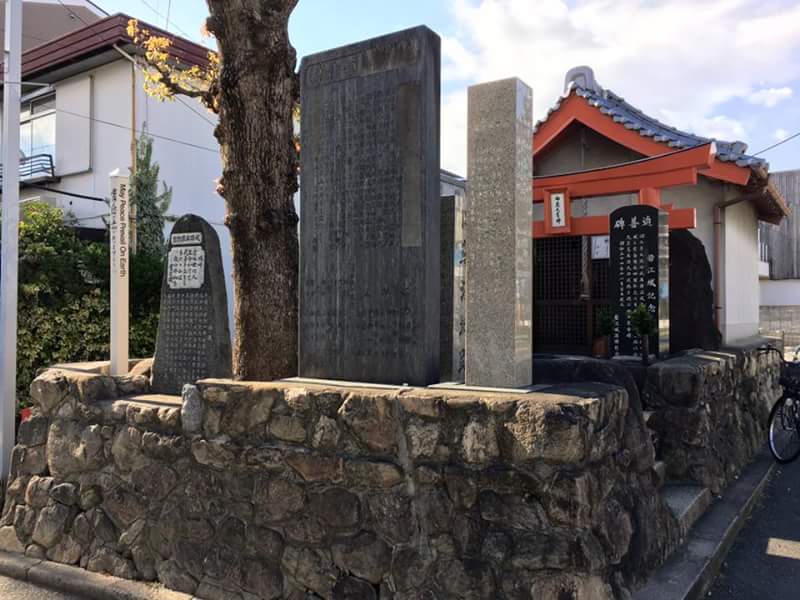
- Stone monument: A monument marking the site of Sanada Yukimura’s death in battle, and a monument marking the site of Tokugawa Ieyasu’s headquarters.
- Information board: An information board explaining the historical background.
- Walking path: A walking path developed as part of the park.
The current Chausuyama, developed as part of Tennoji Park, is a historical spot where you can stroll while imagining the appearance of the past.
Highlights of Otsuka Castle
Monument to the site of Sanada Yukimura’s death in battle
On the south side of Chausuyama, a monument marking the site of Sanada Nobushige (Yukimura)’s death in battle has been erected. While the actual place of his death is believed to be near Yasui Shrine, a monument has been erected here because Chausuyama was the stage of Sanada Yukimura’s final battle.
The area around the monument has been well-maintained and is a popular spot visited by many Sanada Yukimura fans and history enthusiasts. Especially during the Osaka Summer Campaign in May, memorial services and historical events are sometimes held.
Monument to the Site of Tokugawa Ieyasu’s Headquarters
Near the summit of Mt. Chausu, there is a monument marking the site where Tokugawa Ieyasu established his headquarters during the Osaka Winter Campaign. Its historical significance is extremely important as the location where the unifier of Japan, Tokugawa Ieyasu, set up camp in his final great battle.
From the area around this monument, you can see towards Osaka Castle and Tennoji, experiencing Ieyasu’s perspective at the time.
Kawazoko Pond and Surrounding Landscape
At the summit of Mt. Chausu is a pond called Kawazoko Pond. While it was created after the Edo period and is not directly related to the original camp, it contributes to the distinctive landscape of Mt. Chausu today.
The area around the pond is lush with greenery, allowing visitors to enjoy the changing seasons. Especially during the spring cherry blossom season, it is bustling with many visitors enjoying the blossoms.
Integration with Tennoji Park
Otsuka Castle Ruins (Chausuyama) are maintained as part of Tennoji Park, allowing visitors to experience history while strolling through the entire park. Besides Chausuyama, Tennoji Park also includes facilities such as Tennoji Zoo and the Osaka City Museum of Fine Arts, making it a place you can enjoy for a whole day.
Surrounding Historical Spots
Numerous historical sites related to the Siege of Osaka exist around Chausuyama:
- Isshinji Temple: A temple associated with Sanada Yukimura, famous for its bone Buddha statue.
- Yasui Shrine: A shrine believed to be the site where Sanada Yukimura died in battle.
- Shitennoji Temple: An ancient temple built by Prince Shotoku, an important location during the Siege of Osaka.
- Osaka Castle: A famous castle built by Toyotomi Hideyoshi.
Visiting these historical sites will allow you to gain a deeper understanding of the overall picture of the Siege of Osaka.
Access Information
Access by Train
Public transportation is the most convenient way to access Otsuka Castle Ruins (Chausuyama).
Nearest Stations:
- JR Osaka Loop Line/Osaka Metro Midosuji Line “Tennoji Station”: Approximately 10-minute walk
- Osaka Metro Tanimachi Line “Tennoji Station”: Approximately 10-minute walk
- Kintetsu Minami-Osaka Line “Osaka Abenobashi Station”: Approximately 12-minute walk
- Hankai Tramway Uemachi Line “Tennoji-ekimae Station”: Approximately 8-minute walk
Tennoji Station is one of Osaka’s major terminal stations, offering excellent access from various directions. From the station, head towards Tennoji Park and follow the signs within the park to reach Chausuyama.
Access by Car
If visiting by car, there are several paid parking lots around Tennoji Park. However, the Tennoji area experiences heavy traffic, and congestion is expected on weekends and during peak tourist seasons, so using public transportation is recommended.
Access from Major Roads:
- Approximately 5 minutes from the Tennoji Exit of the Hanshin Expressway Route 14 Matsubara Line
- Approximately 10 minutes from the Yuhigaoka Exit of the Hanshin Expressway Route 1 Loop Line
Parking Information
The following parking lots are available around Tennoji Park:
- Tennoji Park Underground Parking
- Nearby Coin Parking
Please check in advance as fees and operating hours vary depending on the facility.
Visitor Guide
Opening Hours and Admission Fees
Chausuyama is part of Tennoji Park, and the park itself is generally open 24 hours a day. Admission is free. However, lighting is limited at night, so daytime visits are recommended.
Other facilities within Tennoji Park (zoo, art museum, etc.) have their own operating hours and admission fees.
Estimated Visiting Time
If you are only visiting Chausuyama, 30 minutes to 1 hour is sufficient. If you plan to explore the surrounding historical sites and the entire Tennoji Park, you should allow about 2-3 hours.
Photo Spots
- View of Osaka city from the top of Mt. Chausu
- Monument marking the site of Sanada Yukimura’s death in battle
- Monument marking the site of Tokugawa Ieyasu’s main camp
- Kawazoko Pond and the surrounding natural scenery
- Panoramic view of Mt. Chausu from Tennoji Park
Recommended Time to Visit
- Spring (late March to early April): Cherry blossoms beautifully adorn the area around Mt. Chausu
- Autumn (October to November): Beautiful autumn foliage and pleasant weather
- Around May 7th: Events commemorating the anniversary of the Osaka Summer Campaign may be held
Precautions
- Mt. Chausu is a natural terrain within a park, so comfortable walking shoes are recommended.
- In summer, the sun is strong, so please bring a hat, parasol, and water.
- Please treat historical sites and monuments with care and observe proper etiquette.
- There are designated non-smoking areas within the park.
Historical Background of Otsuka Castle and its Surroundings
Overview of the Siege of Osaka
The Siege of Osaka was the final battle between the Tokugawa and Toyotomi clans, and one of the largest battles in Japanese history. It was fought in two phases: the Winter Campaign of 1614 (Keicho 19) and the Summer Campaign of 1615 (Genna 1).
In the Winter Campaign, approximately 200,000 Tokugawa troops besieged Osaka Castle, and fierce battles, including the siege of Sanada Maru, unfolded. Ultimately, a peace agreement was reached, but as a condition, the outer moat of Osaka Castle was filled in, significantly reducing the Toyotomi forces.
The following year, the Summer Campaign saw renewed fighting, culminating in the Battle of Tennoji-Okayama. In this battle, Toyotomi Hideyori and Yodo-dono committed suicide, and the Toyotomi clan was destroyed. Chausuyama (Otsuka Castle) played a crucial role in this historical turning point.
The Life and Death of Sanada Nobushige (Yukimura)
Sanada Nobushige (c. 1567–1615) was born the second son of Sanada Masayuki and was a Sengoku period warlord known as “the greatest warrior in Japan.” He sided with the Western Army in the Battle of Sekigahara and, after the defeat, was imprisoned in Kudoyama, Kii Province.
During the Winter Campaign of Osaka, he entered Osaka Castle at the invitation of the Toyotomi forces and built an outpost known as “Sanada Maru,” greatly troubled the Tokugawa forces. In the Summer Campaign, he launched a daring attack on Tokugawa Ieyasu’s main camp from his base at Chausuyama, cornering Ieyasu, but ultimately died in battle near Yasui Shrine.
His courageous and daring fighting style was praised even by his enemy, the Tokugawa, and became a legend passed down through generations.
Tokugawa Ieyasu and the Siege of Osaka
Tokugawa Ieyasu (1543-1616) was the first shogun of the Edo shogunate and the man who unified Japan. Even after his victory at the Battle of Sekigahara and becoming shogun, the Toyotomi clan remained a potential threat to the Tokugawa regime.
The Siege of Osaka was Ieyasu’s final battle to destroy the Toyotomi clan and solidify Tokugawa rule. During the winter campaign, his headquarters were located at Chausuyama, and during the summer campaign, they moved to Okayama, but were put in a critical situation by the attack of Sanada Nobushige.
With his victory at the Siege of Osaka, Ieyasu achieved complete unification of Japan, and he died the following year at the age of 75. Chausuyama is etched in history as the stage of this unifier of Japan’s final battle.
Legends and Anecdotes about Otsuka Castle
Sanada Yukimura’s Red Armor
Sanada Nobushige (Yukimura)’s army was known as the “Red Armor.” The Red Armor refers to a troop formation where armor and banners were unified in red, and it was considered a symbol of elite troops since the time of Takeda Shingen.
During the Battle of Tennoji and Okayama in the Summer Campaign of Osaka, it is said that this Red Armor army charged from Chausuyama towards the Tokugawa headquarters, terrifying Tokugawa Ieyasu. The force of this charge was so tremendous that it is said Ieyasu even considered committing seppuku (ritual suicide).
Origin of the Name Chausuyama
The name Chausuyama is said to have been derived from its shape resembling a tea-grinding mortar (usu). The rounded shape of the burial mound likely evoked the image of a tea-grinding mortar.
Another theory suggests the name comes from a tea ceremony held at this location, but the more common explanation is that it’s based on the shape of the burial mound.
Tokugawa Ieyasu’s Battle Banner
During the Winter Siege of Osaka, Tokugawa Ieyasu, who established his headquarters on Chausuyama, displayed a golden fan battle banner. This banner was an important landmark indicating the position of the commander-in-chief on the battlefield, and was strategically important to both sides.
The golden fan banner standing on the summit of Chausuyama boosted the morale of the Tokugawa forces and became a target for the Toyotomi forces.
Otsuka Castle and the History of Osaka
Strategic Importance of the Uemachi Plateau
The Uemachi Plateau, where Chausuyama is located, has played an important role in Osaka’s history since ancient times. This plateau is the highest in elevation within the Osaka Plain and offers panoramic views of the surrounding area.
In ancient times, Naniwa Palace was located here; in the Middle Ages, Ishiyama Honganji Temple was built here; and in the early modern period, Osaka Castle was constructed here. Chausuyama (Otsuka Castle) was also strategically important in relation to Osaka Castle, as it was located at the southern end of the Uemachi Plateau.
History of Tennoji
The Tennoji area around Chausuyama developed as a temple town for Shitennoji Temple. Shitennoji Temple is one of Japan’s oldest official temples, said to have been founded by Prince Shotoku in 593 AD (the first year of Emperor Suiko’s reign).
During the Edo period, Tennoji flourished as the southern gateway to Osaka, bustling with many pilgrims. Chausuyama also became a popular recreational area for ordinary people as part of the Tennoji area.
Tennoji Park in the Modern Era
In the Meiji era, plans were made to develop the area around Chausuyama into a park. Tennoji Park opened in 1909 (Meiji 42), and Chausuyama was preserved as part of it.
In 1915 (Taisho 4), Tennoji Zoo opened, and in 1936 (Showa 11), the Osaka City Museum of Fine Arts opened. Tennoji Park developed into a center of culture and recreation for the citizens of Osaka.
Today, with the addition of new facilities such as “Tenshiba,” it has become an attractive park where history and modernity blend together.
Nearby Tourist Spots When Visiting Otsuka Castle
Isshinji Temple
Located about a 5-minute walk from Chausuyama, Isshinji Temple is a Jodo sect temple known as the “Temple of Bone Buddhas.” It is famous for its unique belief in creating Buddha statues from the cremated remains of those interred there.
It is also known as a temple associated with Sanada Yukimura, as he is said to have died near this temple during the Summer Siege of Osaka. Within the temple grounds are a bronze statue of Sanada Yukimura and related historical sites.
Yasui Shrine
Located about a 10-minute walk from Chausuyama, Yasui Shrine is considered the site of Sanada Yukimura’s final moments. Within the shrine grounds is the “Monument to the Site of Sanada Yukimura’s Death in Battle,” attracting many Sanada Yukimura fans.
Every May, the “Sanada Yukimura Death Site Commemoration Festival” is held to commemorate Yukimura’s achievements.
Shitennoji Temple
Located about a 15-minute walk from Chausuyama, Shitennoji Temple is one of the seven major temples established by Prince Shotoku and is considered the first official Buddhist temple in Japan. The vast grounds feature impressive temple buildings including a five-story pagoda, main hall, and lecture hall.
A temple fair is held on the 21st and 22nd of each month, attracting many visitors.
Abeno Harukas
Adjacent to Tennoji Station, Abeno Harukas is Japan’s tallest building (as of 2023), standing at 300 meters. From the Harukas 300 observation deck, you can enjoy a panoramic view of Osaka city, and on clear days, you can even see as far as Kyoto and Kobe.
After exploring the historical sites, enjoying the modern Osaka landscape is also highly recommended.
Osaka City Museum of Fine Arts
Located within Tennoji Park, the Osaka City Museum of Fine Arts is a historic museum that opened in 1936. It houses a collection of approximately 8,000 items, including paintings, sculptures, and crafts from Japan and China.
Special exhibitions are held regularly, allowing visitors to enjoy art appreciation.
Summary
Otsuka Castle (Chausuyama) played a decisive role in the Battle of Osaka, a crucial turning point in Japanese history, as a fortified camp utilizing a keyhole-shaped burial mound from the Kofun period. The fact that two heroes, Tokugawa Ieyasu and Sanada Nobushige (Yukimura), used the same location as a fortified camp within just six months, as opposing sides, speaks to the strategic importance of this site.
Currently, it is a beloved part of Tennoji Park, a charming spot that combines historical value with natural beauty. When visiting Osaka, be sure to visit this historical site and reflect on the fierce battle that took place over 400 years ago.
Nearby, there are numerous historical sites related to the Siege of Osaka and Sanada Yukimura, such as Isshinji Temple, Yasui Shrine, and Shitennoji Temple, making it a great place for a historical stroll. The Tennoji area is a fascinating region where history and modernity blend, and it’s well worth spending a full day exploring.
Understanding the history of Otsuka Castle provides important clues to understanding the Siege of Osaka and, by extension, the history of early modern Japan. Be sure to visit and experience the weight of its history firsthand.