Complete Guide to Sagawa Matsuo Castle (Kochi Prefecture) | History, Highlights, and Access Information
Sagawa Matsuo Castle, located in Sagawa Town, Takaoka District, Kochi Prefecture, is a mountain castle built on Mount Matsuo, which is 202 meters above sea level. This castle played a crucial role in the history of Tosa Province from the Nanboku-cho period to the Sengoku period. Even today, its remains, such as earthworks, baileys, and moats, are well-preserved, attracting attention from castle enthusiasts and history buffs. This article provides a detailed explanation of Sagawa Matsuo Castle’s history, structure, highlights, and visiting information.
History of Sagawa Matsuo Castle
Construction during the Nanboku-cho Period and the Sagawa Clan
The exact construction date of Sagawa Matsuo Castle is unclear, but it is believed to have existed since the Nanboku-cho period. During this time, Sagawa Shirozaemon holed up in Matsuo Castle as a base for the Southern Court and waged battles against the Northern Court. The Nanboku-cho conflict in Tosa Province was intense, and Matsuo Castle became one of its important battlegrounds.
History of Sagawa Matsuo Castle
Construction during the Nanboku-cho Period and the Sagawa Clan
The exact construction date of Sagawa Matsuo Castle is unknown, but it is believed to have existed since the Nanboku-cho period. During this time, Sagawa Shirozaemon holed up in Matsuo Castle as a base for the Southern Court and waged battles against the Northern Court. The Nanboku-cho conflict in Tosa Province was fierce, and Matsuo Castle became one of its important stages. During the Nanboku-chō period in Tosa Province, local powerful families were divided between the Southern and Northern Courts, leading to repeated battles centered around mountain castles. Matsuo Castle, utilizing the terrain of Mount Matsuo, possessed ideal defensive conditions and functioned as the base of the Sagawa clan.
The Sengoku Period and Nakamura Echizen-no-kami Nobuyoshi
At the start of the Sengoku period, Matsuo Castle was ruled by Nakamura Echizen-no-kami Nobuyoshi. The Nakamura clan was one of the powerful local lords of Tosa, controlling the Sagawa region from Matsuo Castle. However, the expansion of Chōsokabe Motochika’s power, aiming to unify Tosa, drastically changed the fate of the Nakamura clan.
In 1571 (Genki 2), Nakamura Echizen-no-kami Nobuyoshi surrendered to Chōsokabe Motochika. During this period, the Chōsokabe clan was successively bringing various forces within Tosa under their control, and the capture of Matsuo Castle was part of this strategy. Motochika advanced the unification of Tosa not only through military force but also by employing diplomatic skills, and the Nakamura clan chose to submit to the Chosokabe clan within this context.
The Chosokabe Era and Hisatake Kuranosuke
After the Nakamura clan’s surrender, Chosokabe Motochika appointed his senior retainer, Hisatake Kuranosuke (Hisatake Chikayoshi), as the lord of Matsuo Castle. Hisatake Kuranosuke was a highly trusted retainer of Motochika and was known for his exceptional military talent. Even after unifying Tosa, Motochika continued to consolidate his rule by placing senior retainers in strategic locations throughout the region, and the placement of Hisatake Kuranosuke at Matsuo Castle was one such policy.
However, shortly after Hisatake Kuranosuke entered Matsuo Castle, a serious problem became apparent: the castle’s water supply was extremely scarce. While Matsuo Castle, being a mountain castle, was well-defended, it was unsuitable for prolonged sieges.
To solve this water shortage problem, around 1573, Hisatake Kuranosuke decided to build a new castle on Kojōyama (approximately 200 meters above sea level), opposite Matsuo Castle. This was Sagawa Castle. Sagawa Castle had good water access and was suitable as a residence, so Hisatake Kuranosuke moved his residence from Matsuo Castle to Sagawa Castle.
Thus, Matsuo Castle ceased to function as the main castle and became a subsidiary or auxiliary castle of Sagawa Castle. From then on, Matsuo Castle is thought to have functioned as an emergency refuge and a lookout post.
After the Fall of the Chōsokabe Clan
The Chōsokabe clan, who sided with the Western Army in the Battle of Sekigahara (1600), were dispossessed of their domain, and Yamauchi Kazutoyo was granted Tosa Province in their place. After the Yamauchi clan’s arrival, the Sagawa region came under the rule of their senior retainer, Fukao Izumi-no-kami Shigeyoshi, and the Fukao clan made Sagawa Castle their residence.
It is believed that Matsuo Castle had already been abandoned by this time, but it may have been recognized as part of the defense system of the Sagawa region, along with Sagawa Castle. Throughout the Edo period, Matsuo Castle was never reused, and its remains gradually returned to nature.
Structure and Layout of Sagawa Matsuo Castle
Location and Topography
Sagawa Matsuo Castle is located on Mt. Matsuo, Sagawa-cho, Takaoka-gun, Kochi Prefecture, built on the summit of Mt. Matsuo at an altitude of 202 meters. The relative height from the foot of the mountain is approximately 120 meters, making it a medium-sized mountain castle. Mt. Matsuo is a highly isolated mountain, a strategic location offering panoramic views of the surrounding area.
Matsuo Hachimangu Shrine is located at the southwestern foot of the castle, and the current entrance to the castle also begins at this shrine. The relationship between the shrine and the castle is deep, and it is believed that Hachimangu Shrine was invited to serve as the castle’s guardian deity.
Main Enclosure and Enclosure Layout
Matsuo Castle’s layout is a typical mountain castle design, with multiple enclosures (enclosures) arranged around the main enclosure at the mountaintop. The main enclosure is a relatively large, flat area, presumably where the lord’s residence and important facilities were located.
Around the main enclosure, there are belt-shaped and lower enclosures, further strengthening the defenses. A characteristic of mountain castles is the skillful use of the terrain in the arrangement of enclosures, creating a defensive system that combines natural steep slopes with artificial cliffs.
Earthworks and Moats
Earthworks and moats are evident as defensive structures at Matsuo Castle. The earthworks were built along the edges of the enclosures, preventing enemy intrusion and concealing the interior of the enclosures. Some of the earthworks remain in good condition today, providing valuable clues to the castle construction techniques of the time.
The moats primarily functioned as trenches, designed to halt enemy advances by cutting across the ridge. In mountain castles, defenses primarily consisted of earthworks and moats rather than stone walls, and Matsuo Castle is a typical example.
Ascent Route and Gate
The current ascent route is a mountain path starting from Matsuo Hachimangu Shrine, but this was developed in later times and may differ from the route used during the Sengoku period. While the exact location of the original gate (gate) is unclear, it is believed that access to the main enclosure was limited, and the defenses were strengthened.
Mountain castle gates often featured a “masugata” structure, designed to lure enemies into narrow passages for attack, and Matsuo Castle may have also employed such a design.
Highlights of Sagawa Matsuo Castle
Well-Preserved Remains
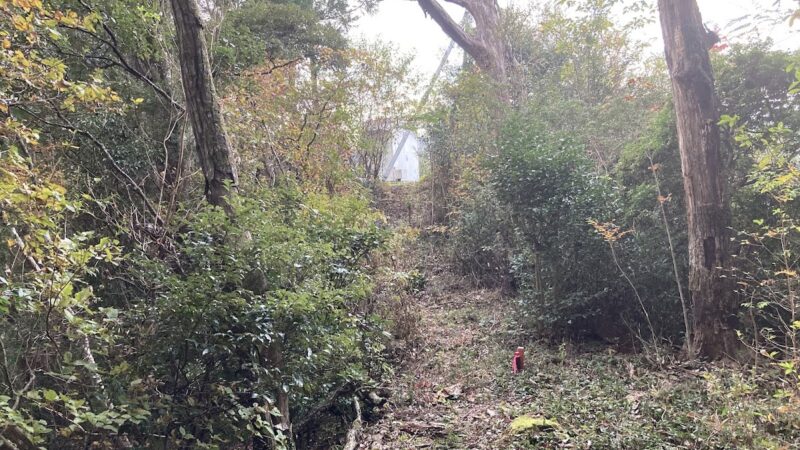
The greatest highlight of Sagawa Matsuo Castle is its well-preserved castle remains. Earthworks, enclosures, and moats remain clearly visible, conveying the appearance of a Sengoku period mountain castle. The earthworks around the main enclosure, in particular, are quite high, demonstrating the advanced castle-building techniques of the time.
Walking through the castle grounds, you can experience the ingenuity of medieval mountain castle layouts, such as the arrangement of baileys and the utilization of the terrain. For castle enthusiasts, this castle site is thoroughly enjoyable just by observing the remains.
Views
The view from the mountaintop is another attraction of Matsuo Castle. From the 202-meter-high summit, you can enjoy a panoramic view of the town of Sagawa and the surrounding mountains. It’s particularly interesting to be able to see the relative position of Sagawa Castle, built on the opposite Kojōyama mountain.
On clear days, you can even see as far as the Pacific Ocean, making it easy to understand why this location served as a lookout and information gathering base.
Matsuo Hachimangu Shrine
Matsuo Hachimangu Shrine, located at the entrance to the castle grounds, is a shrine deeply connected to the castle. It is believed to have been enshrined as the castle’s guardian deity and attracted the faith of the castle lord and samurai. It is still cherished by the local people today and is an important starting point for exploring the castle ruins.
An information board is installed at the shrine, indicating the route to Matsuo Castle. Combining a visit to the shrine with a stroll through the castle ruins will make for a more fulfilling experience.
Relationship with Sagawa Castle
When visiting Matsuo Castle, we highly recommend also visiting Sagawa Castle. Sagawa Castle, to which Hisatake Kuranosuke relocated due to water shortages, is located on the mountain opposite Matsuo Castle, allowing you to see the relative locations of the two castles.
Sagawa Castle retains remnants such as high stone walls and has different characteristics from Matsuo Castle. By comparing the two castles, you can understand the changes in castle construction techniques during the Sengoku period and the criteria for selecting castle locations.
Access Information
Access by Public Transportation
If using JR
- Get off at JR Dosan Line “Sagawa Station,” and walk for approximately 15 minutes to Matsuo Hachimangu Shrine (castle entrance).
- Approximately 1.2 kilometers from Sagawa Station to Matsuo Hachimangu Shrine.
Sagawa Station is a station where express trains also stop, and it is accessible from Kochi City in about 30 minutes. The path from the station to the castle entrance is flat and easy to walk.
Access by Car
From Kochi City
- Approximately 40 minutes via National Route 33
- Approximately 30 minutes from the Ino Interchange on the Kochi Expressway
Parking
- Several parking spaces available around Matsuo Hachimangu Shrine
- Public facility parking in Sakawa Town is also available (within walking distance)
Time Required for Climbing the Castle
- From the castle entrance (Matsuo Hachimangu Shrine) to the summit: Approximately 20-30 minutes on foot
- Sightseeing time at the summit: 30 minutes to 1 hour
- Descent time: Approximately 15-20 minutes
- Total time required: Approximately 1 hour 30 minutes to 2 hours
The hiking trail is well-maintained, but there are steep slopes characteristic of mountain castles, so it is recommended to wear comfortable shoes and clothing.
Points to Note When Visiting
- Clothing and Equipment: Athletic shoes or trekking shoes are recommended. In summer, bring insect repellent spray; in winter, bring warm clothing.
- Drinking Water: There is no water source at the summit, so be sure to bring your own drinking water.
- Weather: Be careful as the ground can be slippery during and after rain.
- Time of Day: Plan your trip with plenty of time to descend before sunset.
- Information Boards: Information boards are installed at the entrance to the castle, but please be careful not to get lost.
Nearby Tourist Spots
Sagawa Castle
As mentioned above, this castle was relocated by Hisatake Kuranosuke from Matsuo Castle. Built on Kojōyama (approximately 200 meters above sea level), magnificent high stone walls remain on the east side of the main enclosure. Visiting it together with Matsuo Castle will help you understand the changes in castles during the Sengoku period.
Townscape of Sagawa
Sagawa Town is attractive for its townscape that retains the atmosphere of the Edo period. With a history of developing as a castle town of the Fukao clan, the streets lined with old merchant houses and sake breweries are perfect for a stroll.
Aoyama Bunko
This facility houses valuable historical documents and books, primarily from the collection of the Fukao clan, the lords of the Sagawa Domain. Recommended for those interested in the history and culture of Tosa (Kochi Prefecture).
Makino Park
This park is located in Sagawa Town, the birthplace of Dr. Tomitaro Makino, the father of Japanese botany. Known as a famous cherry blossom viewing spot in spring, it attracts many tourists.
Sagawa Matsuo Castle Cultural Property Designation
Sagawa Matsuo Castle is designated as a historical site of Sagawa Town and is protected as an important cultural property of the region. Due to its designation as a town historical site, efforts are being made to preserve and utilize the remains, including the installation of information boards and the maintenance of the approach to the castle.
While many mountain castles remain in Kochi Prefecture, Matsuo Castle stands out for its well-preserved remains and is one of the castle ruins of high historical value.
The Significance of Visiting Sagawa Matsuo Castle
Sagawa Matsuo Castle is a valuable historical site where you can experience the history of Tosa from the medieval period to the Sengoku period. As a castle that experienced the turbulent times of the Nanboku-cho period, the warring states of the Sengoku period, and the unification of Tosa by the Chosokabe clan, it holds many historical significances.
In particular, the fact that the castle was relocated for practical reasons such as water shortage is a good example of the importance of practicality in selecting a castle’s location. The relationship between Matsuo Castle and Sagawa Castle reveals the struggles of castle lords in the Sengoku period, who had to consider not only defensive capabilities but also the convenience of daily life.
The charm of hiking in mountain castles lies not only in learning history but also in enjoying hiking and views in nature. Sagawa Matsuo Castle is a recommended spot not only for history enthusiasts but also for those who want to enjoy nature walks.
Summary
Sagawa Matsuo Castle is a mountain castle built on Mount Matsuo in Sagawa Town, Kochi Prefecture, and played an important role from the Nanboku-cho period to the Sengoku period. After the time of Nakamura Echizen-no-kami Nobuyoshi, Hisatake Kuranosuke, a senior retainer of Chosokabe Motochika, became the lord of the castle, but due to a water shortage, he moved to Sagawa Castle—a fascinating history.
Even today, the remains of the castle, such as the earthworks, baileys, and moats, are well-preserved and protected as a historical site by Sagawa Town. It’s easily accessible on foot from JR Sagawa Station, and the view from the mountaintop is magnificent, making it a worthwhile castle site for castle enthusiasts and history buffs.
Visiting Sagawa Matsuo Castle in conjunction with Sagawa Castle will give you a deeper understanding of the changes in castles in Tosa during the Sengoku period. When you visit Kochi Prefecture, be sure to visit Sagawa Matsuo Castle.