Kikkawa Motoharu Yakata (Hiroshima Prefecture) Complete Guide: The Charm of a Sengoku Warlord’s Retirement Residence and a Nationally Designated Historic Site
What is Kikkawa Motoharu Yakata?
Kikkawa Motoharu Yakata is the site of a Sengoku period residence located in Kaioji, Kitahiroshima-cho, Yamagata-gun, Hiroshima Prefecture. Built around 1583 by Kikkawa Motoharu, known as the second son of Mori Motonari, as his retirement residence, it is now protected as a national historic site and a nationally designated scenic spot.
Located on a river terrace facing the Shirohara River at the southwestern foot of Hinoyama Castle, his main castle, this residence is highly regarded by history enthusiasts and castle fans as a valuable historical site that conveys the lifestyle of a Sengoku daimyo to the present day.
About Kikkawa Motoharu
Kikkawa Motoharu (1530-1586) was born as the second son of Mori Motonari, the ruler of the Chugoku region. Known as “Ume” (plum), one of the three Mori brothers, he was a warrior possessing the three virtues of wisdom, benevolence, and courage. He was particularly skilled in martial arts and, along with his elder brother Mori Takamoto and younger brother Kobayakawa Takakage, greatly contributed to the development of the Mori family.
Motoharu was adopted into the Kikkawa family and inherited the Kikkawa clan. He achieved military success in numerous battles, including the capture of Gassan-Toda Castle, and as a senior retainer of the Mori family, he worked diligently to unify the Chugoku region. In his later years, he handed over the family headship to his eldest son, Kikkawa Motonaga, and constructed this residence as his retirement home, but he died of illness at Kokura Castle in 1586 (Tensho 14) before its completion.
History of Kikkawa Motoharu’s Residence
Construction and Background of the Residence
Around 1583 (Tensho 11), Kikkawa Motoharu decided to retire and began construction of a new residence at the foot of Hinoyama Castle. At this time, Motoharu had already handed over the family headship to his eldest son, Kikkawa Motonaga, and it is believed that he wished to retire from the front lines of warfare and live a peaceful life.
The site chosen for the residence was a geographically advantageous location on the river terrace of the Shirohara River. This location, blessed with water resources and suitable for defense, served both as a retirement residence and as a defensive base in case of emergency.
The Residence After Motoharu’s Death
In 1586 (Tensho 14), Motoharu died of illness at Kokura Castle before the residence was completed. He was 57 years old. Afterward, Motonaga, who succeeded him as head of the family, also died prematurely in 1587 (Tensho 15), and Motoharu’s third son, Kikkawa Hiroie, inherited the Kikkawa family.
Kikkawa Hiroie secretly sided with the Eastern Army in the Battle of Sekigahara, and for his service, he was granted 30,000 koku in Iwakuni, Suo Province. During the Edo period, the Kikkawa clan moved their base to Iwakuni, and it is believed that this residence fell into disuse.
Archaeological Excavation and Historic Site Designation
For a long time, the exact location and size of the Kikkawa Motoharu Residence site were unknown. However, archaeological excavations conducted from the Showa to Heisei periods revealed the entire layout of the residence. The excavations uncovered numerous remains, including foundation stone buildings, post-and-beam buildings, wells, stone walls, and gardens, providing extremely important information for understanding the lifestyle of the time.
Following these discoveries, the Kikkawa Motoharu Residence site was designated a national historic site, and the garden area was protected as a nationally designated scenic spot. Currently, it is maintained as the “Kikkawa Motoharu Residence Site Historical Park” and is open to the public.
Structure and Highlights of the Residence
Overall Layout
The Kikkawa Motoharu Residence was built on a long, narrow plot of land approximately 10 meters wide and 80 meters deep. The entire residence was demarcated by earthen ramparts and stone walls, and multiple buildings were systematically arranged. Excavations have confirmed the remains of buildings such as a bathhouse, kitchen, guardhouse, and toilet, indicating that it was a considerably large residence, even though it was a retirement home.
Multiple wells were found on the grounds, suggesting that the facilities were equipped to accommodate many people. This indicates that Motoharu maintained many retainers and servants even after his retirement.
Features of the Stone Wall
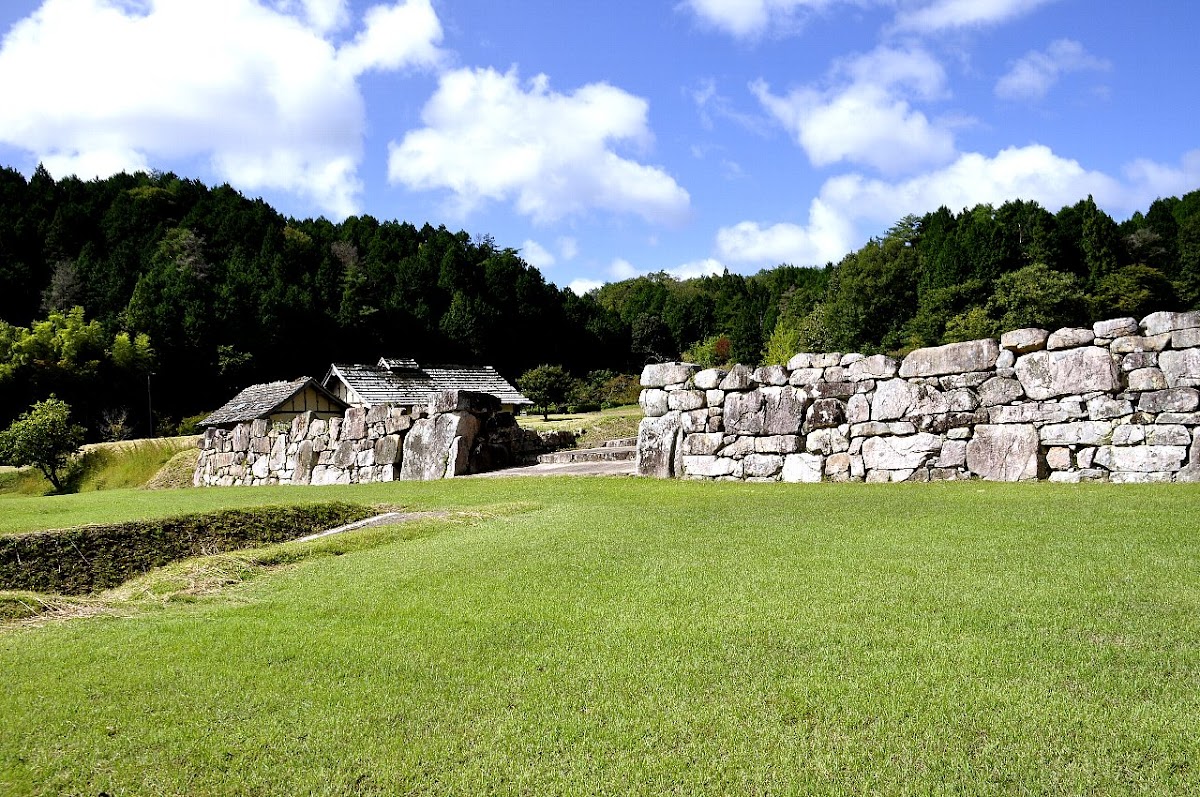
One of the greatest highlights of the Yoshikawa Motoharu Residence is the massive stone wall remaining at the front. This wall, approximately 80 meters long and 3 meters high, is characterized by its unique construction method.
The construction method, which involves placing large upright stones at regular intervals and filling the gaps with flat-stacked stones, is thought to be a technique unique to Aki Province (Hiroshima Prefecture) at the time. Similar stone walls can be seen on Miyajima Island, where Itsukushima Shrine is located, making it a valuable historical site demonstrating the regional tradition of stonework.
The massive stones used in the wall are presumed to have been transported from the surrounding mountains, suggesting that their transportation and stacking required advanced civil engineering skills. It still retains much of its original appearance, making it a valuable historical site for directly observing the castle-building techniques of the Sengoku period.
Structure of the Earthen Embankment
Alongside the stone walls, an earthen embankment surrounded the residence. Excavations have revealed that the embankment was constructed using the rammed earth method. Rammed earth is a technique of constructing a strong embankment by compacting layers of soil.
The height and thickness of the embankment indicate that this residence was not merely a retirement home, but also a facility with defensive functions. Considering the historical context of the late Sengoku period, it was natural that a defensive design would have been considered, given the constant threat of war.
Nationally Designated Scenic Garden
To the northwest of the residence remains a garden designated as a national scenic spot. Although a small garden with an artificially created pond and mound, it is a valuable historical site that conveys the aesthetic sensibilities of Sengoku warlords.
The garden’s style, while influenced by the dry landscape gardens popular at the time, also incorporates elements of a pond garden. The technique of condensing and expressing a natural landscape within a limited space follows the traditions of Japanese gardens.
Excavations have uncovered stonework used in the garden and facilities for drawing water, demonstrating the high level of gardening technology of the time. Currently, restoration work has been carried out, allowing visitors to imagine its former appearance.
Building and Living Remains
Excavations have confirmed numerous remains, including two foundation stone buildings, two post-supported buildings, twelve ditches, two wells, seven pits, nine stone walls/stone masonry structures, one stone staircase, and one pit dwelling.
Of particular note is the remains of a bathhouse. The presence of a bathhouse in the residence of a Sengoku period warlord indicates a high standard of living for Motoharu. Furthermore, traces of a hearth and carbonized food remnants have been discovered at the kitchen site, providing clues to the dietary habits of the time. Multiple wells have been identified, and their depth and structure indicate a stable water source. This was an essential facility for the lives of many people.
Excavated Artifacts
The excavation unearthed numerous artifacts. Many everyday items and building materials of the time were found, including imported ceramics, domestic pottery, earthenware, wooden objects, and stone objects.
Of particular note are the ceramics imported from China and the Korean Peninsula. These were luxury items, demonstrating the high economic power and cultural level of the Yoshikawa family. Domestic Bizen ware and Karatsu ware were also unearthed, revealing the extensive distribution network of the time.
In addition to building materials, wooden objects such as bowls and chopsticks used in daily life were also discovered. These are valuable because they would normally decompose in the soil. The well-preserved artifacts also suggest the high level of woodworking technology of the time.
Relationship with Hinoyama Castle
The Kikkawa Motoharu Residence is located at the southwestern foot of Hinoyama Castle, his main residence. Hinoyama Castle was a mountain castle built on the summit of Mt. Hinoyama, approximately 400 meters above sea level, and served as the Kikkawa clan’s base.
The combination of a mountain castle and a residence at the foot of the mountain is a common form during the Sengoku period (Warring States period). During peacetime, people lived in the convenient residence at the foot of the mountain, and during wartime, they would take refuge in the mountain castle. It is believed that the Motoharu Residence was also planned as part of this traditional castle system.
Currently, the Hinoyama Castle ruins, along with the Kikkawa Motoharu Residence ruins, are designated as a national historic site as the “Kikkawa Clan Castle Ruins.” Visiting both sites together allows for a deeper understanding of the castle system of the Sengoku period.
Kikkawa Motoharu Residence Ruins Historical Park
Currently, the Kikkawa Motoharu Residence ruins have been developed into the “Kikkawa Motoharu Residence Ruins Historical Park” and are open to the public. Within the park, visitors can see the remains revealed by archaeological excavations and experience the lifestyle and culture of the Sengoku period.
Park Development Status
Within the grounds, which have been developed as a historical park, stone walls and earthworks are preserved in their original state. Although the buildings no longer exist, the locations of foundation stones and post holes are marked, allowing visitors to understand the building layout.
The garden area has been restored, and the layout of the pond and artificial hill has been recreated. Plants that change with the seasons are planted, allowing visitors to enjoy different scenery depending on the time of year.
Information boards are installed within the park, where visitors can learn about the remains and the life of Kikkawa Motoharu. Panels showcasing the results of the excavation are also on display, allowing visitors to learn about the history of the residence from an archaeological perspective.
Nearby Related Facilities
Near the Kikkawa Motoharu Residence Site is the “Kitahiroshima Town Historical and Folk Museum,” which exhibits materials and excavated artifacts related to Kikkawa Motoharu. Visiting the museum after visiting the residence site will allow for a deeper understanding of the history.
The history museum features exhibits showcasing the life of Kikkawa Motoharu, as well as displays of Sengoku period (Warring States period) weapons, everyday items, and ancient documents. Since its opening in the Heisei era, it has functioned as a hub for disseminating local history and culture.
Furthermore, a hiking trail to the Hinoyama Castle ruins is maintained, allowing those confident in their physical fitness to extend their hike to the castle. From the summit, you can enjoy panoramic views of the surrounding mountains, gaining a real understanding of why this location was chosen as a base for a Sengoku-era daimyo (feudal lord).
Access and Tourist Information
Location
255-1 Kaioji, Kitahiroshima-cho, Yamagata-gun, Hiroshima Prefecture 731-1703
Transportation Access
By Public Transportation
- Approximately 120 minutes by Hiroshima Bus from Hiroshima Station, get off at “Kaioji” bus stop, approximately 1 minute walk.
- Highway buses are also available from Hiroshima Bus Center (travel time varies depending on the route).
By Car
- Approximately 20 minutes from Chiyoda IC on the Chugoku Expressway
- Approximately 15 minutes from Oasa IC on the Hamada Expressway
- Parking: Free parking available (approximately 20 spaces for regular cars)
Visiting Information
- Opening Hours: Always open (As it is maintained as a historical park, it is generally possible to visit freely)
- Admission Fee: Free
- Estimated Visiting Time: Approximately 45 minutes to 1 hour (1 hour or more for a thorough visit)
- Closed Days: None (However, visits may be difficult due to snow in winter)
Notes for Visitors
- We recommend wearing comfortable shoes (as you will be walking on stone walls and earthworks)
- We recommend bringing insect repellent in summer
- Please be careful as the ground can be slippery in rainy weather
- Toilets are located within the park
- Vending machines are nearby, but their number is limited, so we recommend preparing drinks in advance
Photography
Photography is permitted at the Yoshikawa Motoharu Residence Ruins. The impressive stone walls and the restored garden are particularly popular photo spots. Because it shows different expressions depending on the season, you can discover something new each time you visit.
You can enjoy the beauty of each season: cherry blossoms and fresh greenery in spring, lush green scenery in summer, autumn leaves in fall, and snowscapes in winter. The beauty of the garden is especially striking during the autumn foliage season.
Nearby Tourist Attractions
Hinoyama Castle Ruins
These are the ruins of a mountain castle located on the summit of Mt. Hinoyama, which rises behind the Kikkawa Motoharu Residence. A hiking trail is well-maintained, and the summit can be reached in about an hour. Remains of structures characteristic of mountain castles, such as baileys and moats, are still present, allowing visitors to learn about the structure of medieval mountain castles.
Kitahiroshima Town Historical and Folk Museum
This museum is located about a 10-minute drive from the Kikkawa Motoharu Residence Ruins. In addition to materials related to Kikkawa Motoharu, it features extensive exhibits introducing the history and culture of Kitahiroshima Town. Opening hours are from 9:00 AM to 5:00 PM (last entry at 4:30 PM), closed on Mondays (or the following day if Monday is a public holiday).
Mibu Hanadaue (Rice Planting Festival)
This traditional event, held annually on the first Sunday of June, is designated as a National Important Intangible Folk Cultural Property. It offers a rare opportunity to see rice planting with decorated oxen and a demonstration of traditional rice planting music.
Yawata Marshland
Located at an altitude of 800 to 900 meters, this high-altitude marshland is home to rare flora and fauna. Wooden boardwalks are maintained, making it easy to enjoy a stroll through the marshland.
Evaluation and Appeal of Yoshikawa Motoharu Residence
According to data from Kojodan (a castle-visiting website), Yoshikawa Motoharu Residence has an average rating of ★★★☆☆ (3.42), an average visit time of approximately 55 minutes, and 210 visitors. While it is a moderately sized historical site, it is highly regarded by visitors as a valuable historical site where one can directly experience the lifestyle and culture of the Sengoku period (Warring States period).
Evaluation from Castle Enthusiasts
Castle enthusiasts appreciate the following points:
- Excellent Preservation: The stone walls and earthworks remain in excellent condition, allowing for direct observation of Sengoku period (Warring States period) remains.
- Unique Stonework Techniques: The unique stonework techniques of Aki Province can be observed.
- Results of Archaeological Excavations: Many discoveries of high academic value have been made, making it important as research material.
- Easy Access: Located on flat land, making it easy to visit even for those with limited physical strength.
- Free Admission: Easily accessible.
As a Place for Historical Learning
The Kikkawa Motoharu Residence Site is an excellent resource for learning about the history of the Sengoku period. Visiting the living space of a specific figure, Kikkawa Motoharu, the son of Mori Motonari (who appears in textbooks), allows visitors to feel closer to history.
Many groups visit as part of school history studies or lifelong learning, and it also functions as a hub for local history education.
Summary
The Yoshikawa Motoharu Residence (Kitahiroshima Town, Hiroshima Prefecture) is the site of the retirement home built by the Sengoku period warlord Yoshikawa Motoharu, and is now protected as a national historic site and place of scenic beauty. With its unique stonework, restored garden, and numerous excavated artifacts, it is a valuable historical site that conveys the lifestyle and culture of the Sengoku period.
When visiting Hiroshima Prefecture, why not visit not only famous tourist spots but also historical sites of such high value? It is a place where you can feel the spirit of the Sengoku period and experience the depth of Japanese history and culture.
Admission is free, and there are many related facilities in the surrounding area, making it a tourist spot that can be enjoyed not only by history buffs but also by families. You can spend a precious time reflecting on the era in which the Sengoku warlords lived, along with the beauty of nature in each season.