Nobesawa Castle (Obanazawa City, Yamagata Prefecture) Complete Guide | History, Structure, and Highlights Explained in Detail
What is Nobesawa Castle?
Nobesawa Castle is a mountain castle located in Obanazawa City, Yamagata Prefecture, that existed from the Sengoku period to the early Edo period. Also known as Kiriyama Castle or Nobesawa Castle, it is currently designated as a national historic site. Built on the summit of Mt. Kojōzan (297 meters above sea level), it is a typical multi-bailey mountain castle and holds an important position in castle history research as one of the representative medieval castles of the Mogami region.
The castle ruins are well-preserved, with clearly remaining structures such as the main bailey, second bailey, third bailey, moats, earthworks, and gates. In particular, a large cedar tree, designated as a prefectural natural monument, stands tall on the site of the main bailey, serving as a symbol of the castle ruins.
Nobezawa Castle was an important stronghold, counted among the “Eight Shields of Mogami,” and served as the residence of the Nobezawa clan (also known as the Nobezawa clan), who ruled this region. It played a central role in the politics and military affairs of Dewa Province during the Sengoku period.
Overview
Location: Nobusawa Kojōyama, Obanazawa City, Yamagata Prefecture
Other Names: Kiriyama Castle, Nobesawa Castle
Castle Structure: Concentric mountain castle
Elevation: 297 meters
Year of Construction: Said to be 1547
Builder: Nobusawa Satsuma-no-kami Mitsushige (First)
Main Lords: Nobusawa Mitsushige, Nobusawa Mitsunobu, Nobusawa Mitsumasa (Yasumitsu)
Year of Abandonment: 1622
Designated Cultural Property: National Historic Site
Remains: Enclosures, earthworks, moats, gates, stone walls, etc.
Relocated Existing Structures: Otemon Gate (Relocated as the main gate of Yōsenji Temple)
Enzawa Castle spans approximately 300 meters east-west and 250 meters north-south, with the main citadel located on the mountaintop. Skillfully utilizing the natural terrain, the castle features numerous artificially constructed defensive structures, making it a valuable historical site that conveys the mountain castle construction techniques of the Sengoku period.
History
Construction and the Rise of the Enzawa Clan
Enzawa Castle is said to have been built in 1547 (Tenbun 16) by its first lord, Enzawa Satsuma-no-kami Mitsushige. Mitsushige had previously resided at Honmachi-kan, but it is believed that he built the more robust mountain castle of Enzawa Castle and moved his base there to strengthen his defenses during the turbulent Sengoku period.
The Enzawa clan was originally called “Nobesawa” and had established their power as local lords in this region. During the Sengoku period, Dewa Province was a battleground for power, centered around the Mogami clan. The Nobusawa clan maintained a cooperative relationship with the Mogami while establishing their own independent power base in the region.
The Era of the Second Lord, Nobusawa Noto-no-kami Mitsunobu
The second lord of the castle, Nobusawa Noto-no-kami Mitsunobu, succeeded Mitsushige. During Mitsunobu’s time, the clan continued to maintain relations with the Mogami clan and cooperated in the expansion of Mogami Yoshiaki’s power. At this time, the Nobusawa clan’s territory reached 27,000 koku, positioning them as a powerful group of retainers within the Mogami domain.
Mitsunobu also devoted himself to the development and expansion of the castle, and it is believed that much of the basic structure of Nobusawa Castle seen today was formed during this period.
The Third Lord, Nobusawa Mitsumasa, and the Golden Age
The Nobusawa clan reached its golden age during the time of the third lord, Nobusawa Tōtōmi-no-kami Mitsumasa (also known as Yasumitsu). As a senior retainer of Mogami Yoshiaki, Mitsumasa participated in numerous battles, including the Battle of Hasedo Castle in 1600, and distinguished himself in battle.
The Battle of Hasedo Castle was a fierce battle during the Battle of Sekigahara when Uesugi Kagekatsu’s army invaded Mogami territory. Mitsumasa played a crucial role in supporting Mogami Yoshiaki and repelling the Uesugi forces. He also played a central role in the Mogami clan’s military actions, such as dispatching troops to the Shonai region.
The Mogami Disturbance and the Downfall of the Nobusawa Clan
The Mogami Disturbance, which occurred in 1622, drastically changed the fate of the Nobusawa clan. After the death of Mogami Yoshiaki, an internal conflict arose within the Mogami family over the succession of the family headship, and the shogunate used this as a reason to dispossess the Mogami clan.
Following the dispossession of the Mogami clan, Nobusawa Mitsumasa’s territory was also confiscated, and he was placed under the custody of the Kato clan, the lords of the Kumamoto domain. Enzawa Castle was ordered to be demolished by the shogunate, and it lost its function as a castle. Mitsumasa died of illness in Kumamoto, marking the end of the Enzawa clan’s glory.
Enzawa Castle After its Demolition
After its demolition in 1622 (Genna 8), Enzawa Castle was never used as a military base again. However, the castle’s main gate was relocated during the Kanbun era (1661-1673) to serve as the main gate of Yōsenji Temple, and still exists in Obanazawa City today. This relocated gate is a valuable cultural asset as one of the few remaining structures of Enzawa Castle.
Although the castle ruins themselves were neglected for a long time, the castle was affectionately known as “Kojōyama” (Old Castle Mountain) by locals throughout the Edo period, and the memory of the castle was passed down in the region.
Preservation and Development in the Modern Era
Since the Meiji era, the historical value of the Enzawa Castle ruins has been recognized, and in 1934 (Showa 9), it was designated a national historic site. This led to the site becoming subject to official protection, and efforts were made to preserve the remains.
Currently, hiking trails have been developed, and information boards and pamphlet distribution points have been installed, making it a historical site that history enthusiasts and castle fans can easily visit. The large cedar tree at the site of the main keep has been designated a prefectural natural monument and welcomes many visitors as a symbol of the castle ruins.
Structure and Layout of Enzawa Castle
Overall Structure
Enzawa Castle is a multi-bailey mountain castle built around the summit of Kojōyama Mountain, which is 297 meters above sea level. A multi-bailey style is a form in which the main baileys are arranged in a line, a structure often seen in mountain castles that utilize mountain ridges.
The castle area extends approximately 300 meters east-west and 250 meters north-south, with a tiered defensive line formed from the main bailey to the outer bailey. It is a typical example of a Sengoku period mountain castle, making maximum use of the natural terrain while enhancing its defensive capabilities through artificial civil engineering works.
Honmaru (Main Enclosure)
Located at the mountaintop, the Honmaru is the most important section of the castle, forming its core. Measuring approximately 50 meters east-west and 40 meters north-south, it is surrounded by an earthen rampart. The Honmaru has a main gate (Ote-koguchi) on the north side and a rear gate (Karamete-koguchi) on the south side, allowing entry and exit from both directions.
The north main gate** has a masugata (square-shaped) structure, and traces of stonework remain. Even today, some cut stones are exposed, offering a glimpse into the level of technology at the time. The masugata gate, a defensive technique widely adopted from the late Sengoku period, features a winding passage to prevent enemy intrusion.
On the site of the Honmaru stands a giant cedar, a prefecturally designated natural monument. Estimated to be several hundred years old, this cedar, a living witness to the castle’s history, leaves a profound impression on visitors.
Second and Third Baileys
North of the main bailey lies the second bailey, and further north is the third bailey. These baileys are thought to have served to defend the main bailey, as well as functioning as residences for retainers and garrisons for soldiers.
Each bailey is clearly separated by elevation changes, and moats and earthworks are provided between them. These defensive structures remain remarkably well-preserved today, providing important clues to understanding the castle’s structure in its heyday.
Moats and Earthworks
The core of Nobusawa Castle’s defensive system lies in the moats and earthworks provided throughout the castle. Moats are dry moats excavated to cut across ridges, serving to physically prevent enemy incursions. Nobusawa Castle, in particular, features multiple moats along the ridges, suggesting a multi-layered defensive strategy.
Earthworks are earthen walls built around the baileys, providing protection from arrows and gunfire, as well as obstructing the enemy’s line of sight. The earthworks of Nobusawa Castle are mostly about 1-2 meters high and can still be clearly seen today.
Hiking Trails and Entrance
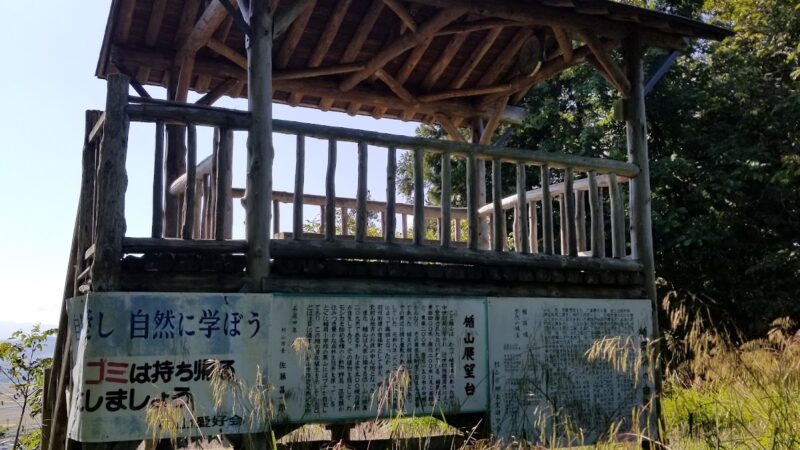
Currently, hiking trails to Nobusawa Castle ruins are maintained from two locations: one west and one east of Tokiwa Elementary School. A pamphlet stand is set up at the eastern entrance, where visitors can obtain information about the castle’s history and structure.
The hiking trails utilize traces of the original main and rear entrances, allowing visitors to experience the castle’s access routes in those days. Along the trails, remnants such as baileys, earthworks, and moats appear in succession, making the climb to the castle a fascinating experience as you appreciate the defensive structure of the mountain castle.
Highlights of Nobusawa Castle
Main Bailey and Giant Cedar
The greatest highlight of Nobusawa Castle is undoubtedly the Giant Cedar, a Prefectural Designated Natural Monument, standing on the site of the main bailey. This giant tree reaches a height of approximately 30 meters and a trunk circumference of approximately 6 meters, and has long been a beloved symbol of the castle ruins.
From the main keep, you can enjoy a panoramic view of Obanazawa town, and on a clear day, you can even see the distant Ou Mountains. The former lords of the castle must have gazed upon their territories from this very spot, contemplating the management of their domains.
Masugata Gate and Stone Masonry Remains
The Ote-koguchi (main gate) on the north side of the main keep is an important remains featuring a masugata (square-shaped) structure. Traces of stone masonry remain around the gate, with some areas where cut stones are exposed. The use of stone masonry in mountain castles of the Sengoku period is relatively limited, making this evidence of the high level of castle-building technology at Nobusawa Castle.
By observing the structure of the gate, you can gain a concrete understanding of the defensive philosophy and castle-building techniques of the time.
Continuous Moats and Earthworks
As you proceed along the mountain path, you will encounter a series of moats and earthworks. These are important elements forming the castle’s defensive line, reflecting the concept of multi-layered defense to progressively prevent enemy incursions.
The trenches along the ridges, in particular, reach depths of 3 to 5 meters, showcasing the impressive scale of the civil engineering work carried out by human labor.
Arrangement of the Enclosures
You can observe how the enclosures are arranged in a stepped pattern, with the main enclosure (Honmaru) at the center, followed by the second and third enclosures (Ninmaru), and then the outer enclosures. By examining the size, shape, and arrangement of each enclosure, you can understand the intentions of the castle’s designer and the level of castle construction technology at the time.
Relocated Main Gate (Yōsenji Temple Gate)
The main gate (Ōtemon) of Nobusawa Castle was relocated to Yōsenji Temple in Obanazawa City during the Kanbun era (1661-1672) and still exists today. This gate is a very valuable cultural asset as one of the few remaining structures from Nobusawa Castle.
Yōsenji Temple is located approximately 3 kilometers from the Nobusawa Castle ruins, and a visit to both is recommended. The structure and style of the relocated gate offer insights into the characteristics of castle architecture at that time.
Seasonal Scenery
The Enzawa Castle ruins are also attractive for their natural scenery that changes with the seasons. In spring, there is fresh greenery; in summer, deep green; in autumn, vibrant autumn leaves; and in winter, a snowy landscape. Each season presents a different face. Especially during the autumn foliage season, the contrast between the colorful trees and the castle ruins is beautiful and captivates many visitors.
The Enzawa Clan and the Mogami Eight Shields
The Enzawa clan was a powerful vassal family, counted as one of the “Mogami Eight Shields“. The Mogami Eight Shields refer to eight major vassal groups that supported the Mogami clan, including the Enzawa clan, as well as the Sagae, Shiratori, Naruse, Tateoka, Nagatoro, and Higashine clans.
These vassal groups built castles in key locations within the Mogami territory and formed the pillars supporting the Mogami clan’s military and political system. Among them, the Enzawa clan played a crucial role as a key point in the northern region, serving as the front line against threats from the north, such as the Uesugi clan.
During the time of Mogami Yoshiaki, Nobusawa Mitsumasa played a significant role in the Battle of Hasedo Castle, greatly contributing to the expansion of the Mogami clan’s power. However, due to the unexpected circumstances of the Mogami Rebellion and the subsequent downfall of the Mogami clan, the Nobusawa clan also disappeared from the historical stage.
Access Information
Access by Public Transportation
Get off at Oishida Station on the JR Yamagata Shinkansen/Ou Main Line and take a taxi for approximately 15 minutes. Alternatively, take a local bus to Obanazawa town center and then walk or take a taxi to the castle ruins.
Public transportation access is somewhat inconvenient, so renting a car is recommended.
Access by Car
Approximately 10 minutes from the Obanazawa Interchange on the Tohoku Chuo Expressway.
Access is possible via National Route 13, passing through Obanazawa town center.
There is some parking space near the castle entrance, but the number of spaces is limited, so caution is advised during busy times. The area around Tokiwa Elementary School is a good guide. ### Points to Note When Visiting the Castle
- The hiking trail is well-maintained, but since it is a mountain castle, comfortable shoes and clothing are essential.
- Allow approximately 20-30 minutes one way from the entrance to the main keep, and about 1 hour round trip.
- Insect repellent is necessary in summer, and caution is needed regarding snow and ice in winter.
- Bringing your own drinking water is recommended.
- Pamphlets are available at the east entrance to the castle.
Nearby Tourist Attractions
Yosenji Temple (Relocated Site of Enzawa Castle’s Main Gate)
A temple where the main gate of Enzawa Castle has been relocated and is now the temple’s main gate. A must-see spot when visiting Enzawa Castle.
Ginzan Onsen
A hot spring town with a Taisho-era romantic atmosphere, located about 30 minutes by car from Enzawa Castle. One of Yamagata Prefecture’s leading tourist destinations, attracting many visitors from both Japan and abroad.
Mogami River
One of Japan’s three major rapid rivers. Enjoy sightseeing such as boat trips.
Natagiri Pass
An ancient road leading from Nobusawa Castle towards the Mogami River. It retains the atmosphere of a historical highway.
Summary
Nobusawa Castle (Obanazawa City, Yamagata Prefecture) is a mountain castle that served as the residence of the Nobusawa clan from the Sengoku period to the early Edo period. It is a valuable cultural asset designated as a national historic site. There are many points of interest, including the multi-bailey castle structure built on the 297-meter-high Kojōyama mountain, the large cedar tree at the site of the main keep, the clearly remaining moats and earthworks, and the main gate that was relocated to Yōsenji Temple.
The history of the Nobusawa clan, who supported the Mogami clan as one of the Mogami Eight Shields, their exploits in the Battle of Hasedō Castle, and their dramatic downfall due to the Mogami Rebellion, symbolizes the rise and fall of local samurai during the Sengoku period and leaves many lessons for the modern age.
The castle ruins are well-preserved, and the hiking trails are well-maintained, making it a recommended spot not only for history enthusiasts but also for hikers. When you visit Yamagata Prefecture, be sure to stop by the ruins of Nobusawa Castle and experience the historical romance of the Sengoku period and the beauty of nature.