Naegi Castle Ruins (Nakatsugawa City, Gifu Prefecture) Complete Guide | Highlights, History, and Access Information for this Mountain Castle in the Sky
Naegi Castle Ruins, towering on the right bank of the Kiso River in Nakatsugawa City, Gifu Prefecture, is a nationally designated historical site known for its unique stone walls skillfully incorporating massive rocks and the 360-degree panoramic view from its keep’s observation deck. Selected as one of the “Continued Top 100 Japanese Castles” in 2017, it has recently attracted attention as the “Castle in the Sky” and “Gifu’s Machu Picchu.” This article provides detailed information you should know before visiting, from the history of Naegi Castle to its highlights and access methods.
What is Naegi Castle Ruins? | A Nationally Designated Historic Mountain Castle that Gifu Prefecture is Proud Of
Naegi Castle Ruins is a mountain castle built on the summit of Mt. Takamori, at an altitude of 432 meters, located in Naegi, Nakatsugawa City, Gifu Prefecture. The elevation difference from the Kiso River to the castle keep ruins is approximately 170 meters, and it is known as a formidable fortress built on a naturally treacherous site surrounded by mountains on three sides.
The castle grounds cover approximately 20,000 square meters for the inner enclosure alone, and approximately 350,000 square meters including the outer enclosure. Of this, 156,774 square meters were designated a national historic site in 1981. On April 6, 2017, “Castle Day,” it was designated one of the “Continued Top 100 Japanese Castles” by the Japan Castle Association, attracting attention from castle enthusiasts nationwide.
Alternative Names and Names of Naegi Castle
Naegi Castle has the beautiful alternative name “Kasumiga-jo” (Mist Castle). It was also called “Akakabe-jo” (Red Wall Castle) because its walls were not covered in white plaster but exposed red clay. This is said to be because the Naegi Domain was a small domain with a 10,000 koku (unit of rice production) yield, and therefore had a limited budget.
The History of Naegi Castle | From the Toyama Clan to the Meiji Restoration
The Castle’s Construction and the Era of the Toyama Clan
Naegi Castle will celebrate its 500th anniversary in 2026. The castle’s origins lie with the Toyama clan, who, alongside the Toki clan, held sway over the eastern Mino region. The Toyama clan used Naegi Castle as their residence throughout the Sengoku period (Warring States period), reigning as the rulers of this region.
During the Sengoku period, Naegi Castle was the stage for numerous battles amidst the power struggles of warring daimyo such as Oda Nobunaga and Takeda Shingen. The castle’s lords changed over time, and the Toyama clan even lost the castle at one point, but ultimately, the Toyama family returned as the lords of Naegi Domain during the Edo period.
Naegi Domain in the Edo Period
During the Edo period, it functioned as the residence of the Toyama family of Naegi Domain. Despite being a small domain with a 10,000 koku (unit of rice production) yield, Naegi Domain is known for its rare castle with a keep. As a small domain, it faced financial difficulties, but this, conversely, became a factor in the creation of a unique architectural style.
Due to its location on a rocky mountain, securing land was difficult, so the building method adopted was “kakezukuri,” a technique where buildings are constructed projecting out from steep slopes such as cliffs. Similar to the stage of Kiyomizu-dera Temple, ingenuity in making the most of the natural terrain can be seen throughout.
From the Meiji Restoration to the Present
After the Meiji Restoration, the Naegi Domain was abolished and the castle was also abandoned. While the buildings were demolished, the remains such as stone walls and baileys were preserved in good condition. Excavation surveys and restoration work were carried out from the Showa to Heisei periods, and it is now open to the public as a historical park.
The Greatest Highlight of Naegi Castle Ruins: Unique Stone Walls Utilizing Giant Rocks
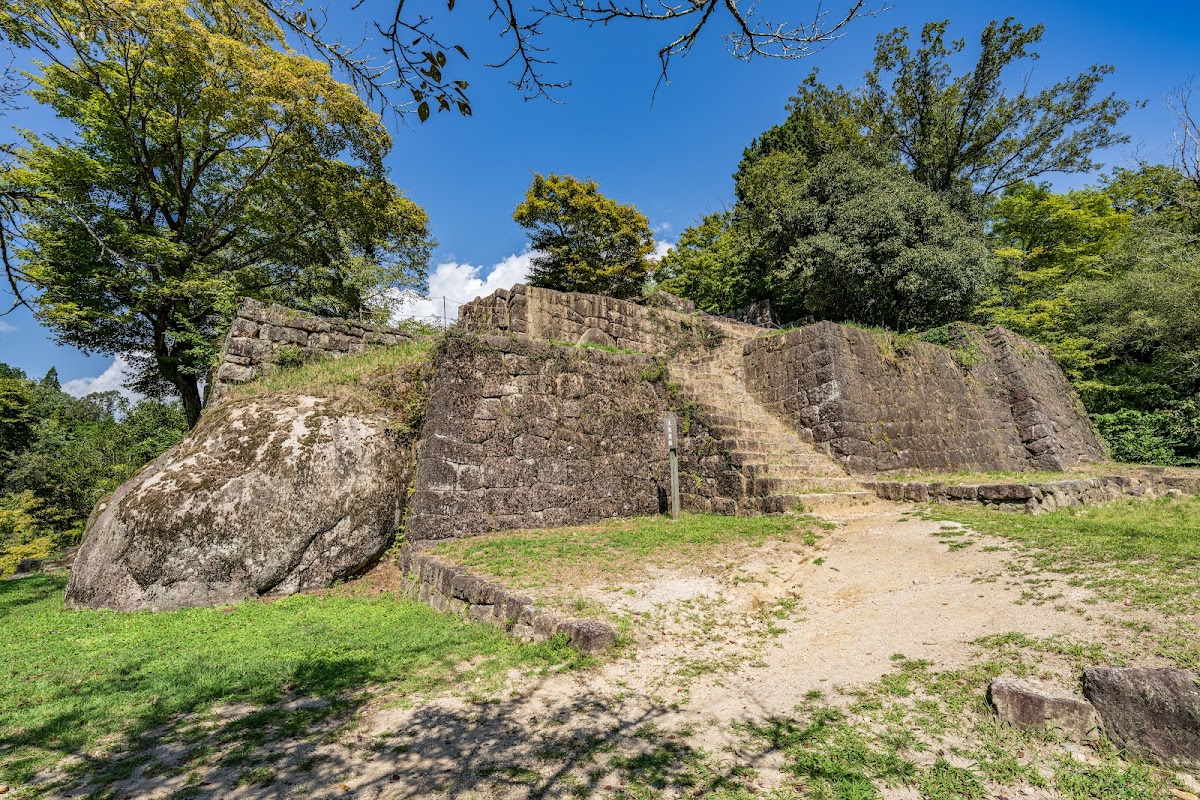
What surprises visitors to Naegi Castle Ruins the most is the unique stone walls that incorporate natural giant rocks. These stone walls, rare in Japan, are the most distinctive feature of Naegi Castle and possess a charm that even castle enthusiasts admire.
Stone Walls Integrated with Natural Rocks
The stone walls of Naegi Castle were built making maximum use of the rocky terrain of Takamori Mountain. An innovative construction method was employed, utilizing massive natural stones as part of the castle wall and reinforcing the gaps with artificially stacked stones. This was not simply a cost-saving measure, but also a rational castle-building technique for the steep terrain.
Especially around the castle tower base, the massive rocks that form the foundation of the building are exposed, creating a unique landscape where the boundary between nature and artificiality is blurred. This combination of massive rocks and stone walls gives the impression that the mountain itself has been fortified.
Differences in Stone Wall Construction Methods by Era
Another highlight of Naegi Castle’s stone walls is the difference in construction methods depending on the era. Different techniques such as rough-hewn stone masonry, fitted stone masonry, and cut stone masonry were used depending on the period of castle expansion and renovation. By observing the stone walls, one can understand the changes the castle has undergone.
For castle experts and history enthusiasts, these stone walls serve as valuable teaching materials for learning about the evolution of castle construction techniques during the Edo period.
Spectacular Views from the Castle Tower Observation Deck | 360-Degree Panoramic View
Another major attraction of the Naegi Castle ruins is the view from the observation deck built on the site of the castle tower. The scenery from the mountaintop at an altitude of 432 meters is simply breathtaking.
Magnificent Landscape of Mount Ena and the Kiso River
From the observation deck, you can see Mount Ena (2,191 meters above sea level), one of Japan’s 100 Famous Mountains, directly in front of you. Mount Ena is a magnificent peak located at the southernmost tip of the Central Alps, and its majestic appearance captivates visitors.
Below, the Kiso River flows majestically, and the city of Nakatsugawa spreads out. The Kiso River serves as a natural moat flowing along the south side of the castle, and its sheer cliffs are clearly visible when viewed from the castle tower base. The location, approximately 170 meters above sea level from the Kiso River, truly demonstrates its strategic defensive advantages.
Scenery Showing Different Faces Through the Seasons
Naegi Castle Ruins displays different faces throughout the seasons. In spring, fresh greenery colors the mountains; in summer, the contrast between the lush trees and the blue sky is beautiful; in autumn, the mountains are painted in vibrant autumn colors; and in winter, you can admire the snow-covered Mount Ena.
The scenery, especially in the early morning and at dusk, is exceptional. On days when a sea of clouds forms, a fantastical scene unfolds, truly befitting the name “Castle in the Sky.” It’s a popular spot for photography enthusiasts.
Naegi Castle Ruins Visiting Route and Estimated Time
From the Parking Lot to the Castle Tower Observation Deck
Naegi Castle Ruins has a free parking lot at the foot of the mountain. From the parking lot to the castle tower observation deck, it’s about a 20-30 minute walk along a well-maintained hiking trail. Signposts are installed along the way, so even first-time visitors won’t get lost.
The hiking trail is relatively gentle, but the final set of stairs leading to the castle keep base is somewhat steep. We recommend wearing comfortable shoes.
Main Points of Interest
Along the climbing route, there are several points of interest:
Otemon Gate Ruins: The site of the castle’s main gate; remnants of the stone walls remain.
Oyagura Ruins: One of the castle’s important defensive structures; the stone walls utilizing massive rocks are magnificent.
Hishiyagura Gate Ruins: The final gate leading to the main keep; the masugata (square-shaped) structure remains.
Honmaru Ruins: The central area of the castle, where buildings such as the palace once stood.
Tenshudai (Castle Keep Base): Located at the highest point, with an observation deck.
The estimated time required for a thorough visit is 1.5 to 2 hours. Including time for photography and enjoying the scenery, it may take longer.
Learning about the History of Naegi Castle and the Naegi Domain at the Naegi Toyama Historical Museum
When visiting the Naegi Castle ruins, we recommend also visiting the Naegi Toyama Historical Museum located at the foot of the mountain. This museum displays valuable materials related to the Naegi Domain and the Toyama family, allowing you to gain a deeper understanding of the history of Naegi Castle.
Exhibits
The museum displays a wide range of materials, including the history of the Naegi Domain, the genealogy of the Toyama family, the culture of the Naegi Domain, a reconstructed model of the castle, excavated artifacts, and ancient documents. The reconstructed model of the castle is particularly valuable for understanding the appearance of Naegi Castle in its heyday.
Furthermore, the “kakezukuri” (suspended structure) architectural feature of Naegi Castle is clearly explained through models and diagrams.
Opening Hours
Basic information about the Naegi Toyama Historical Museum is as follows:
- Opening Hours: 9:30 AM – 5:00 PM (Last entry at 4:30 PM)
- Closed Days: Mondays (or the following day if Monday is a public holiday), New Year holidays
- Admission Fee: 330 yen for adults, 110 yen for elementary and junior high school students (group discounts available)
It is recommended to allow 30 minutes to 1 hour for a visit to the museum.
Access to Naegi Castle Ruins
Access by Car
Via Chuo Expressway
- Approximately 10 minutes from Nakatsugawa IC
- Take National Route 19 towards Naegi
- Free parking available (approximately 30 spaces for regular cars)
Access is very convenient, approximately 5 minutes by car from Nakatsugawa city center. However, the parking lot may be crowded during peak tourist seasons and weekends, so it is recommended to visit with plenty of time to spare.
Access by Public Transportation
Using the JR Chuo Main Line
- Take the Kita Ena Kotsu bus bound for “Tsukechikyo Kuraya Onsen” or “Kashimo General Office” from JR Nakatsugawa Station.
- Get off at the “Naegi” bus stop and walk for approximately 20 minutes.
Since the number of buses is limited, it is recommended to check the timetable in advance. If using a taxi, it takes about 10 minutes from Nakatsugawa Station.
Address and Contact Information
Naegi Castle Ruins
- Address: Naegi, Nakatsugawa City, Gifu Prefecture
- Inquiries: Nakatsugawa City Tourism Division (Tel: 0573-66-1111)
Tourist Attractions Around Naegi Castle Ruins
When visiting Naegi Castle Ruins, you can also enjoy the surrounding tourist attractions.
Nakatsugawa City Center
Nakatsugawa City is a town famous for its Japanese sweets, especially chestnut paste confectionery. The town center is lined with long-established Japanese confectionery shops where you can purchase famous sweets such as kurikinton (sweet chestnut paste). It’s especially lively during the autumn kurikinton season (around September to January).
Magome-juku
Located in the southern part of Nakatsugawa City, Magome-juku is a tourist destination that retains the historic townscape of a post town on the Nakasendo road. It’s also known as the birthplace of the renowned author Shimazaki Toson, and souvenir shops and restaurants line the cobblestone slopes. It’s about a 30-minute drive from the Naegi Castle ruins.
Enakyo Gorge
This artificial lake, created by damming the Kiso River, is a scenic spot with strangely shaped rocks and boulders. You can enjoy a lake cruise on a sightseeing boat, and there are also leisure facilities nearby, such as Enakyo Wonderland.
Tsukechi Gorge
This beautiful gorge, selected as one of “Japan’s 100 Best Forests for Forest Bathing,” is attractive for its crystal-clear stream and abundant nature. There are campsites and hot spring facilities, so you can enjoy the outdoors.
Points to Note and Recommended Time to Visit Naegi Castle Ruins
Clothing and Items to Bring
Since Naegi Castle Ruins is a mountain castle, please note the following:
- Footwear: Wear comfortable, non-slip shoes such as sneakers or hiking boots.
- Clothing: Wear comfortable clothing; take precautions against insects in summer and warm clothing in winter.
- Items to Bring: Drinking water, towel, camera, rain gear (depending on the weather).
Recommended Time to Visit
Naegi Castle Ruins is accessible year-round, but the best times to visit are:
Spring (April-May): Beautiful fresh greenery, mild weather, and easy access to the castle.
Autumn (October-November): At its peak autumn foliage, with beautiful views of Mount Ena.
Winter (December-February): Clear air and excellent views, with a magnificent snow-covered Mount Ena (but be careful of your footing).
Summer offers lush greenery and beautiful scenery, but high temperatures and numerous insects require precautions. ### Precautions for Visitors
- Use of fire is strictly prohibited within the historical site.
- Please take all your trash with you.
- Do not damage the stone walls or ruins.
- Please refrain from visiting in bad weather (rain, strong winds, etc.).
- Beware of wild animals (wild boars, bears, etc.).
Continued Top 100 Japanese Castles Stamp and Castle Card
Naegi Castle Ruins are selected as one of the “Continued Top 100 Japanese Castles,” and you can participate in the stamp rally.
Stamp Location
The stamp is located at the Naegi Toyama Historical Museum. Stamps can be obtained during the museum’s opening hours; please be aware of this if visiting on closed days or outside of opening hours.
Castle Seal (Castle Card)
Naegi Castle’s castle seal is also available for purchase, and its popularity as a souvenir is increasing. The design expresses the characteristics of Naegi Castle and is popular among collectors.
Summary | Visit Gifu Prefecture’s Proud Mountain Castle in the Sky
Naegi Castle Ruins is a nationally designated historical site, boasting unique stone walls utilizing massive rocks, a 360-degree panoramic view from the castle tower’s observation deck, and a rich history dating back to the Toyama clan. Selected as one of the “Continued Top 100 Japanese Castles,” and recently gaining attention as the “Castle in the Sky” and “Gifu’s Machu Picchu,” this mountain castle is a popular spot not only for castle enthusiasts but also for tourists seeking breathtaking scenery.
It’s easily accessible, about a 10-minute drive from Nakatsugawa IC and close to Nakatsugawa city center. Nearby attractions include Magome-juku and Enakyo Gorge, making it an ideal base for sightseeing in eastern Gifu Prefecture.
Naegi Castle will celebrate its 500th anniversary in 2026. Be sure to visit Naegi Castle Ruins in Nakatsugawa City, Gifu Prefecture, to experience its history and stunning views. You’re sure to be captivated by the charm of this mountain castle where nature and man-made structures are beautifully blended.