Kanazawa Castle (Ishikawa Prefecture, Kanazawa City) Complete Guide | A Thorough Explanation of History, Highlights, and the Charm of the Stone Walls
Overview of Kanazawa Castle
Kanazawa Castle is a representative early modern hilltop castle in Japan, located in Marunouchi, Kanazawa City, Ishikawa Prefecture. Built on the site of Oyama in Ishikawa District, Kaga Province, it flourished as the residence of 14 generations of the Maeda family, who boasted a domain of one million koku in Kaga Province, during the Edo period, and is now designated as a national historic site.
Taking advantage of its geographical advantage at the tip of the Kodatsuno Plateau, the castle features structures that represent the pinnacle of castle construction technology of the time, and stone walls built using different construction methods in different eras. Currently, the vast 24.3-hectare site is developed as Kanazawa Castle Park, a historical space with many attractions, including the Ishikawa Gate, Sanjukkan Nagaya (Thirty-Ken Long House), and Tsurumaru Warehouse, all of which are important cultural properties, as well as the Hishiyagura (Diamond Turret), Gojukkan Nagaya (Fifty-Ken Long House), Hashizume-mon Tsuzuki Yagura (Hashizume Gate Connecting Turret), Kahoku-mon (Hachihoku Gate), Hashizume-mon (Hashizume Gate), and Gyokuseninmaru Garden, which were restored in the Heisei era.
The greatest appeal of Kanazawa Castle is the wide variety of stone walls that still exist, earning it the nickname “Museum of Stone Walls.” Over its approximately 400-year history since its construction, stone walls built in various eras remain intact, making it a valuable castle ruin where one can see the evolution of Japanese castle construction techniques all at once. It is highly regarded by castle enthusiasts and history buffs.
History of Kanazawa Castle
From Kanazawa Mido to Castle (Tensho Era)
The history of Kanazawa Castle dates back to Tensho 8 (1580). Originally, this site was home to the Jodo Shinshu Buddhist temple “Kanazawa Mido,” but it was captured by Shibata Katsuie, acting on orders from Oda Nobunaga. His subordinate, Sakuma Morimasa, became the first lord of Kanazawa Castle and began its construction.
In 1583, after Sakuma Morimasa’s defeat at the Battle of Shizugatake, Maeda Toshiie, a retainer of Toyotomi Hideyoshi, entered the castle. This entry by Maeda Toshiie marked the beginning of the history of the Maeda family, who ruled Kaga Province with a million koku of rice production. Toshiie renamed the castle, initially called Oyama Castle, to Kanazawa Castle and began a full-scale renovation into a modern castle.
Castle Construction by the Maeda Family (Keicho Era)
In 1599, Maeda Toshiie died, and his eldest son, Toshinaga, inherited the family headship. In 1602, Toshinaga carried out a large-scale renovation of Kanazawa Castle, constructing a five-story keep. However, this castle tower was destroyed by lightning in 1602 (Keicho 7) after only a few years. Since then, the castle tower at Kanazawa Castle has never been rebuilt, and a three-story turret served as its substitute.
Throughout the Edo period, Kanazawa Castle suffered numerous fires. In particular, the Great Fire of 1759 (Horeki 9) destroyed almost all of the castle’s main buildings, and its subsequent reconstruction took many years. Nevertheless, successive feudal lords persistently continued to maintain the castle grounds, ensuring its function as the administrative center of a domain encompassing the three provinces of Kaga, Noto, and Etchu, with a territory exceeding one million koku (a unit of rice production).
Changes in the Modern Era (Meiji to Showa)
After the Meiji Restoration, Kanazawa Castle was placed under military control, and in 1871 (Meiji 4), it came under the jurisdiction of the Ministry of the Army. Army facilities were constructed one after another within the castle grounds, and many historical buildings were demolished or altered.
In 1949, the site began to be used as the campus of Kanazawa University, and for approximately 50 years thereafter, it was utilized as an educational facility. During this period, important structures such as the Ishikawa Gate and the Sanjukkengaya (Thirty-Ken Long House) were protected as cultural properties, but the castle’s landscape changed significantly.
Development of Kanazawa Castle Park (Since the Heisei Era)
In 1995, with the relocation of Kanazawa University, full-scale restoration and development of the Kanazawa Castle site began. In 2001, the Hishiyagura (diamond-shaped turret), Gojukkengaya (fifty-Ken Long House), and Hashizumemon Tsuzukiyagura (Hashizume Gate connecting turret) were restored, and in 2010, the Kahokumon (Hawaizumi Gate) and Hashizumemon (Hashizume Gate) were restored. Furthermore, in 2015, the Gyokuseninmaru Garden was restored and developed, completing the current appearance of Kanazawa Castle Park.
Currently, Kanazawa Castle is a representative tourist spot in Ishikawa Prefecture, attracting many visitors throughout the year. Along with the adjacent Kenrokuen Garden, one of Japan’s three most famous gardens, it is preserved as an important cultural heritage site that conveys the history and culture of Kanazawa to the present day.
Features and Highlights of Kanazawa Castle
Value as a Museum of Stone Walls
The greatest feature of Kanazawa Castle is the wide variety of stone walls that still exist, earning it the title of “Museum of Stone Walls.” Within the castle grounds, you can see stone walls from various periods spanning approximately 400 years, from the castle’s construction to the end of the Edo period, allowing you to learn about the evolution of Japanese stone wall construction techniques.
Nozurazumi is the oldest type of stone wall construction, using natural stones stacked with minimal processing. It is characterized by many gaps between the stones, resulting in excellent drainage, and some parts of the castle retain its original form.
Uchikomi-tsugi is a construction method where the surface of the stones is processed to make them flat, creating tighter joints between the stones. It is stronger than Nozurazumi and has a more orderly appearance. Many of the stone walls at Kanazawa Castle were constructed using this method.
Kirikomi-tsugi is the most advanced technique, a method of precisely processing stones and stacking them without gaps. It can be seen in stone walls from the late Edo period and is characterized by its beautiful, straight finish.
Comparing these different construction methods within a single castle is a rare experience unique to Kanazawa Castle.
Kanazawa Castle’s Three Main Gates (Ishikawa Gate, Hashizume Gate, and Kahoku Gate)
Kanazawa Castle has three main gates, known as the “Three Main Gates,” each an important structure symbolizing the castle’s defense and prestige.
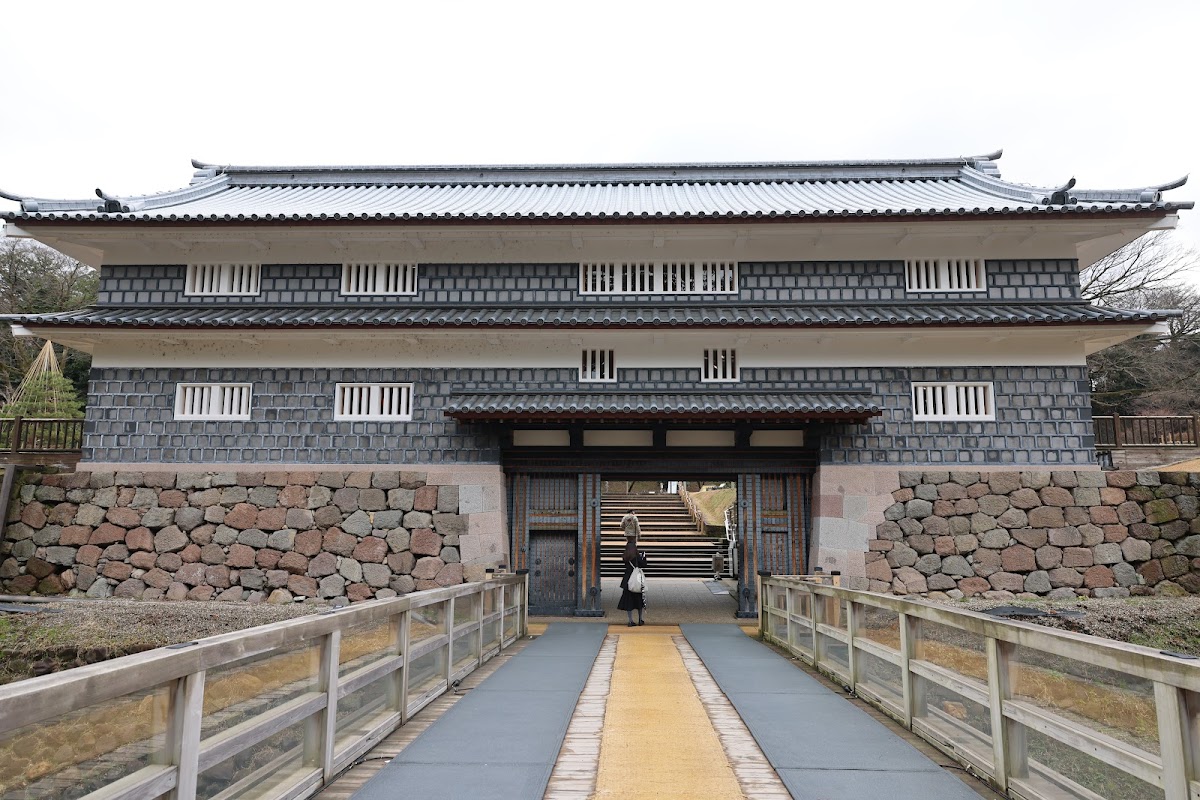
Ishikawa Gate is a representative structure of Kanazawa Castle and is designated as a National Important Cultural Property. Located on the east side of the Ninomaru (second enclosure), it is a turret gate that serves as the entrance from the Kenrokuen Garden side. Rebuilt in 1788, the current Ishikawa Gate, with its beautiful white lead tiles and namako-kabe (sea cucumber-shaped plasterwork), is a symbolic landmark of Kanazawa Castle and is frequently photographed. The Ishikawa Gate features a masugata-koguchi (square-shaped entrance) structure, designed to lure enemies between the first and second gates for attack.
The Hashizume Gate was the most prestigious gate, serving as the main gate of the second bailey. Restored in 2010, it regained its former grandeur. The Hashizume Gate also features a masugata-koguchi structure and consists of a first and second gate. Along with the Hashizume Gate turret, it functioned as an important defensive stronghold for the second bailey.
The Kahoku Gate served as the rear gate (back gate) of Kanazawa Castle, located at the entrance to the third bailey. Restored in 2010, it completed the set of three main gates, along with the Ishikawa Gate and Hashizume Gate. The Kahoku Gate is a two-story turret gate, characterized by its white lead tiles and namako-kabe (sea cucumber-shaped wall).
Visiting these three main gates allows you to appreciate Kanazawa Castle’s defensive system and architectural beauty.
Hishiyagura, Gojukkengaya, and Hashizumemon Tsuzukiyagura
Restored in 2001, the Hishiyagura, Gojukkengaya, and Hashizumemon Tsuzukiyagura are a group of buildings that can be considered the highlights of Kanazawa Castle Park. These three buildings functioned as a single continuous structure, playing a role in the defense of the second bailey and demonstrating the authority of the domain.
The Hishiyagura is a three-story turret with a diamond-shaped floor plan, a rare structure in Japan. The diamond shape was designed to reduce blind spots and allow for wider surveillance. The interior has been restored using traditional construction methods, allowing visitors to see the nailless joinery technique up close.
The Gojukkengaya is a multi-story turret approximately 90 meters long, connecting the Hishiyagura and Hashizumemon Tsuzukiyagura. It is a two-story building; the first floor served as a warehouse for storing weapons and equipment, while the second floor was used as a combat space in times of emergency. The interior of the Nagaya (longhouse) is open to the public, allowing visitors to learn in detail about the structure of the castle architecture of the time.
The Hashizume-mon Tsuzuki Yagura is a two-story turret connected to the Hashizume-mon Gate, and was an important defensive point protecting the gate. From inside, you can see towards the Ishikawa-mon Gate, making it an excellent spot to enjoy the castle’s scenery.
These structures can be viewed for a fee, allowing visitors to learn in detail about the restoration using traditional construction methods, the structure of the castle architecture, and the lifestyle of the time.
Important Cultural Property Buildings
Besides the Ishikawa-mon Gate, Kanazawa Castle has other buildings designated as Important Cultural Properties.
The Sanjukkan Nagaya is a two-story Tamon turret located on the north side of the main keep, rebuilt in 1837. This long, narrow building, approximately 60 meters in length, was used as a storage facility for weapons and furnishings. It still retains much of its original appearance and is designated as a National Important Cultural Property. While only the exterior can be viewed, its imposing presence tells the story of Kanazawa Castle’s history. Tsurumaru Warehouse is a storehouse-style warehouse located in the southwest corner of the main enclosure, built in 1835 (Tenpo 6). It is a sturdy two-story structure, thickly coated with plaster to protect valuables from fire. It is also designated as a National Important Cultural Property and is preserved as a valuable example of late Edo period warehouse architecture.
These Important Cultural Properties are crucial evidence demonstrating the historical value of Kanazawa Castle, which has been preserved from the Edo period to the present day.
Gyokuseninmaru Garden
Gyokuseninmaru Garden is a garden built on the site of the residence of Gyokusenin, the principal wife of Maeda Toshinaga, the second lord of Kanazawa Castle. While successive lords maintained and improved the garden, it was lost after the Meiji era. In 2015 (Heisei 27), it was restored based on the results of archaeological excavations and is now one of the important attractions of Kanazawa Castle Park.
The garden’s most distinctive feature is its pond-centered strolling garden style, set against a backdrop of stone walls. The garden features a 22-meter-high stone wall built in the style of shikishi-tanzaku (colored paper strips) stacked on top of a larger stone wall, with ponds, waterfalls, and artificial hills arranged around it. This unique construction method, using stones of various shapes and sizes arranged like shikishi or tanzaku, is a prime example of Kanazawa Castle’s high level of stonework.
The garden contains three waterfalls, each constructed with different stonework. The “tiered waterfall,” in particular, is a rare sight, cascading directly down from the stone wall and is a highlight of the garden. Carp swim in the pond, and seasonal plantings adorn the garden.
At night, the garden is illuminated, creating a different, more magical atmosphere. The interplay of light on the stone wall and water captivates visitors.
Lead Tiles and Namako Walls
A distinctive feature of Kanazawa Castle’s architecture is the use of lead tiles. While typical castles use ceramic tiles, Kanazawa Castle extensively utilized lead tiles. One theory suggests that lead tiles were used to melt down and produce bullets during wartime, but it’s actually believed they were chosen as a material suited to the unique climate of snowy regions.
Lead tiles shine with a silvery-white luster, and when wet, they emit a distinctive sheen. This beautiful appearance gives Kanazawa Castle a unique dignity, and can be seen particularly at the Ishikawa Gate, Kahoku Gate, and the restored Hishiyagura, Gojukkengaya, and Hashizumemon Tsuzukiyagura.
Namako-kabe (sea cucumber wall) is another characteristic feature of Kanazawa Castle’s architecture. These walls are finished by attaching flat tiles to white plaster, with the joints raised, and are named for their resemblance to a sea cucumber (namako). They offer excellent fire and water resistance, protecting the buildings from the harsh climate of the Hokuriku region.
Kanazawa Castle Photo Spots
Within Kanazawa Castle Park, there are numerous spots where you can photograph historical buildings and beautiful scenery.
Ishikawa Gate is a representative photo spot of Kanazawa Castle. The view of Ishikawa Gate from the Kenrokuen Garden side is particularly striking, with its beautiful lead tiles and namako-kabe (sea cucumber-shaped) walls, attracting many tourists who take photographs. During cherry blossom season, photos of cherry blossoms with Ishikawa Gate in the background are especially popular.
The Hishiyagura, Gojukkengaya, and Hashizumemon Tsuzukiyagura are magnificent when viewed from Shinmaru Plaza. The sight of these three structures lined up makes for an excellent subject showcasing the grandeur of Kanazawa Castle. Daytime shots against a blue sky are beautiful, but the silhouettes at dusk are also impressive.
At Gyokuseninmaru Garden, the view of the pond with the Shikishitanzaku-zumi stone wall in the background is popular. The landscape, a tapestry of stone walls, water, and landscaping, fully expresses the beauty of a Japanese garden. It is especially beautiful during the autumn foliage season and in snow.
The stone walls themselves are also excellent subjects for photography. By taking close-up shots of the various stone walls, such as those of the Imori-bori moat and the Ninomaru bailey, you can document the differences in texture and technique.
The nighttime illuminations offer an excellent opportunity to capture fantastical photographs. Nighttime openings are held until 9 PM every Saturday, and the illuminated Ishikawa Gate and Gyokuseninmaru Garden present a completely different appearance from the daytime.
Sightseeing around Kanazawa Castle
Kenrokuen Garden
Adjacent to Kanazawa Castle, Kenrokuen Garden is a daimyo garden and one of Japan’s three most famous gardens. It is a strolling garden built over approximately 180 years by successive lords of the Kaga domain, offering beautiful scenery throughout the seasons.
The name Kenrokuen comes from the fact that it possesses all six conditions for a famous garden (spaciousness, serenity, human effort, antiquity, water features, and views) as described in the Chinese book “Luoyang Mingyuan Ji” (Records of Famous Gardens of Luoyang). The vast grounds boast numerous attractions, including the Kotoji Lantern, Kasumigaike Pond, and Karasaki Pine Tree.
Kanazawa Castle Park and Kenrokuen Garden are adjacent and accessible through the Ishikawa Gate. Visiting both allows for a deeper understanding of the culture and history of Kaga, the domain of one million koku.
Higashi Chaya District
Located within walking distance of Kanazawa Castle, Higashi Chaya District is a designated Important Preservation District for Groups of Traditional Buildings, preserving the atmosphere of an Edo-period teahouse district. Beautiful townhouses with lattice doors line the streets, creating an atmosphere that feels like stepping back in time.
The teahouse district is lined with traditional Japanese confectionery shops, craft shops, and cafes, offering a chance to experience Kanazawa’s traditional culture. Crafts and sweets using gold leaf are particularly popular souvenirs unique to Kanazawa.
Nagamachi Samurai District
Located west of Kanazawa Castle, the Nagamachi Samurai District was the residence of middle-ranking samurai of the Kaga Domain. The landscape, with its earthen walls and cobblestone alleys, strongly retains the atmosphere of Edo-period samurai society.
The Nomura family samurai residence is open to the public, allowing visitors to tour the gardens and interior. It is a valuable site for learning about the lifestyle of samurai of that time.
Omicho Market
Omicho Market, affectionately known as “Kanazawa’s kitchen,” is a market with a history of approximately 300 years. It offers a wide variety of local ingredients, including fresh seafood from the Sea of Japan and Kaga vegetables.
There are also many restaurants within the market where you can enjoy fresh seafood bowls and sushi. It’s recommended to stop by before or after sightseeing at Kanazawa Castle to enjoy the local food culture.
Access and Sightseeing Information for Kanazawa Castle
Access Methods
Access by Train
- Approximately 25 minutes on foot from JR Kanazawa Station
- Approximately 5 minutes on foot from the “Kenrokuen-shita/Kanazawa Castle” bus stop on the Hokuriku Railway Bus from Kanazawa Station East Exit Bus Terminal
- Approximately 5 minutes on foot from the “Kenrokuen-shita/Kanazawa Castle” bus stop on the Kanazawa Castle Town Loop Bus from Kanazawa Station East Exit Bus Terminal
Access by Car
- Approximately 30 minutes from Kanazawa-Nishi IC on the Hokuriku Expressway
- Approximately 30 minutes from Kanazawa-Higashi IC on the Hokuriku Expressway
- Approximately 20 minutes from Kanazawa-Morimoto IC
Parking Information
There is no dedicated parking lot at Kanazawa Castle Park, so you will need to use nearby paid parking lots.
- Kenroku Parking Lot (Ishikawa Prefecture): Capacity for 554 regular cars, 350 yen for the first hour, 150 yen for every 30 minutes thereafter.
- Ishibiki Parking Lot: Located north of Kanazawa Castle Park.
- In addition, there are several private parking lots in the surrounding area.
During peak tourist seasons and weekends, parking lots can become crowded, so using public transportation is recommended.
Opening Hours and Admission Fees
Kanazawa Castle Park (Free Area)
- Opening Hours: 7:00 AM – 6:00 PM (March 1st – October 15th), 8:00 AM – 5:00 PM (October 16th – end of February)
- Admission Fee: Free
- Nighttime Opening: Open until 9:00 PM every Saturday (year-round)
Hishiyagura, Gojukkengaya, Hashizumemon Tsuzukiyagura (Paid Area)
- Opening Hours: 9:00 AM – 4:30 PM (Last entry 4:00 PM)
- Admission Fee: Adults 320 yen, Children 100 yen
- Closed: New Year’s Holidays (December 29th – January 3rd)
Gyokuseninmaru Garden
- Admission Fee: Free
- Light-up: Held on nighttime opening days
Estimated Time Required for Sightseeing
The time required for sightseeing in Kanazawa Castle Park varies depending on what you want to see, but please use the following as a guideline:
- Visiting the main spots in the park: Approximately 1-2 hours
- Including interior tours of paid facilities: Approximately 2-3 hours
- Detailed tour including stone walls: Approximately 3-4 hours
- Visiting in conjunction with Kenrokuen Garden: Approximately 3-4 hours
Best Season
Kanazawa Castle is beautiful in every season, but the following seasons are especially recommended:
Spring (Late March to Early April): It’s cherry blossom season, and approximately 400 cherry trees bloom within the castle grounds. The combination of Ishikawa Gate and cherry blossoms is a spectacular sight.
Early Summer (May to June): The fresh greenery is beautiful, and the refreshing weather makes it ideal for sightseeing. The greenery of Gyokuseninmaru Garden is vibrant.
Autumn (November): It’s the season of autumn leaves, and the trees within the castle grounds change color. The autumn foliage in Gyokuseninmaru Garden is particularly beautiful, and the combination with the illuminations is fantastic.
Winter (December-February): Kanazawa Castle, covered in snow, is exceptionally beautiful. The contrast between the snow piled on the lead tiles and the white namako-kabe (sea cucumber-shaped) walls creates a landscape not seen in other seasons.
Precautions
Due to the effects of the 2024 Noto Peninsula Earthquake, some areas of Kanazawa Castle Park are off-limits. It is recommended to check the latest information on the official website before visiting.
Because there are many stone walls and cobblestone paths, comfortable walking shoes are recommended. Also, in summer, the sun is strong, so it is recommended to bring a hat, parasol, and drinking water. In winter, there is a possibility of snow and ice, so please wear non-slip shoes.
Summary
Kanazawa Castle is a valuable cultural heritage site that conveys the history and culture of Kaga Hyakumangoku (Kaga’s domain). Kanazawa Castle boasts a wealth of attractions, including its diverse stone walls, known as a “museum of stone walls,” the important cultural properties of Ishikawa Gate and Sanjukkan Nagaya, the restored Hishiyagura, Gojukkan Nagaya, and Hashizumemon Tsuzuki Yagura, and the beautiful Gyokuseninmaru Garden.
With a history of approximately 400 years since its construction during the Tensho era, Kanazawa Castle flourished as the residence of 14 generations of the Maeda family. After the Meiji Restoration, it was used as a military facility and a university campus. Thanks to restoration and development since the Heisei era, it has regained its former glory and is now a representative tourist spot in Ishikawa Prefecture, attracting many visitors throughout the year.
By visiting nearby tourist spots such as Kenrokuen Garden, Higashi Chaya District, and Nagamachi Samurai District, you can experience Kanazawa’s history and culture more deeply. With its beauty in every season and different expressions depending on the time of year, Kanazawa Castle is a fascinating place where you can discover something new with every visit.
When you visit Kanazawa, be sure to stop by Kanazawa Castle Park and experience the history and traditions of the Kaga domain, which boasts a million koku of rice production, as well as the pinnacle of Japanese castle construction technology.