

Inokura Castle: A Complete Guide to its History and Highlights | A Mountain Castle in Shimotsuke Province Hidden with the Tragedy of the Sengoku Period
What is Inokura Castle?
Inokura Castle is a mountain castle from the Sengoku period located in Kanuma City, Tochigi Prefecture. Built on Mt. Kannonji, approximately 420m above sea level, southwest of the current Inokura Elementary School, it functioned as an important base protecting the Mibu clan’s sphere of influence in Shimotsuke Province.
Inokura Castle met a dramatic end, falling during a political upheaval in 1576. It is now preserved as a Kanuma City designated historical site, and a hiking trail has been developed. With a relative height of approximately 200m, it still conveys the high defensive capabilities of a mountain castle.
History of Inokura Castle
Construction Date and Lord
While there are no clear records regarding the construction date of Inokura Castle, it is believed to have existed as early as the mid-Sengoku period. The castle lord is said to have been Kanuma Uemon, and as a member or vassal of the Mibu clan, who were the lords of Kanuma Castle, he was responsible for the defense of this region.
Because it was built on Kannonji Mountain, a site of mountain worship, it has been suggested that the castle may have been a fusion of religious and military elements.
The Mibu Clan’s Internal Conflict and Inokura Castle
An essential part of understanding the history of Inokura Castle is the internal conflict within the Mibu clan that occurred in 1576. This incident marked a significant turning point in the Sengoku period history of Shimotsuke Province.
Mibu Tsunawo, the lord of Kanuma Castle, suffered a tragedy when he was murdered by Mibu Chikanaga, a member of his family. However, Tsunawo’s eldest son, Mibu Yoshio, avenged his father’s death and defeated Chikanaga. During this political upheaval, Kanuma Uemon, the lord of Inokura Castle, sided with Shūchō, and was therefore attacked by Itabashi Shōgen Chikamune, the lord of Itabashi Castle and a general of the Tsunao faction.
The Fall of Inokura Castle
Inokura Castle, attacked by the forces led by Itabashi Shōgen Chikamune, fell after a fierce battle. Despite its advantageous location at an altitude of 420m and a relative height of 200m, it could not withstand political isolation and military pressure.
With this fall, the fate of Kanuma Uemon and his family vanished into the mists of history. There are no records of Inokura Castle being used as a military base again after 1576 (Tenshō 4), and it is believed that this fall marked its de facto abandonment.
The Mibu Clan and the Sengoku Period in Shimotsuke Province
The Mibu clan was a powerful Sengoku daimyo in southern Shimotsuke Province, controlling the surrounding area from their base at Kanuma Castle. Inokura Castle is presumed to have served as part of a network of subsidiary castles, playing a crucial role in preparing for invasions from the north.
During the Tensho era, Shimotsuke Province was surrounded by powerful forces such as the Hojo, Uesugi, and Satake clans, forcing smaller local powers to constantly face survival-oriented choices. The internal conflict within the Mibu clan was an event that arose within this complex political situation.
Structure and Layout of Inokura Castle
Location and Topography
Kannonji Mountain, where Inokura Castle was built, is an isolated peak located northwest of Kanuma city. With an elevation of approximately 420m and a relative height of approximately 200m from the base, it possessed ideal terrain for a mountain castle, making it a strategically important location offering panoramic views of the surrounding area.
From the summit, one could see not only Kanuma Castle but also the roads leading to Nikko and Ashio, suggesting it played an important role as a base for information gathering and vigilance. Even today, on clear days, the Kanto Plain can be seen in the distance, allowing one to experience the excellent visibility of that time.
Layout of the Main Enclosure and Baileys
The main enclosure of Inokura Castle is located on the summit of Kannonji Mountain, providing a relatively flat space. Multiple baileys are arranged around the main enclosure, forming a tiered defensive structure.
It is presumed that the castle’s structure was a linear layout, with the main enclosure at the summit and baileys continuously arranged along the ridge. By combining the natural defensive capabilities of the steep terrain with artificial defensive structures, a strong fortress was achieved.
Earthworks and Moats
Remains still found on Kannonji Mountain today show traces of defensive structures such as earthworks and moats. Moats, in particular, which cut off the ridge, functioned as an important defensive line to prevent enemy intrusion.
Earthworks were built around the baileys, protecting against arrows and stones, and also obscuring the castle’s internal structure from view from the outside. While weathering and vegetation have prevented it from retaining its original form, it is a valuable historical site that conveys the castle-building techniques of the Sengoku period.
Ascent Route and Entrance
The ascent route from the foot of the mountain to the main enclosure at the summit is thought to have been a complex route designed with defense in mind. Instead of a straight climb, the structure gradually increased in altitude, passing through enclosures, dispersing attackers and allowing for a battle advantageous to the defenders.
The entrance (koguchi) is also presumed to have been a reinforced structure with earthworks and stone walls, rather than a simple opening. While the current hiking trail was developed in later periods, some terrain remains that suggests the original ascent route.
Highlights of Inokura Castle
Development as a City-Designated Historic Site
The Inokura Castle ruins are protected as a designated historic site of Kanuma City, and their historical value is recognized. Because the hiking trail is well-maintained, it is easily accessible not only to castle enthusiasts but also to the general public who enjoy hiking.
One of the biggest attractions of Inokura Castle is the opportunity to experience the atmosphere of a Sengoku period mountain castle while walking along well-maintained trails. Signposts are also installed, so even first-time visitors can reach the main enclosure without getting lost.
Remaining Structures
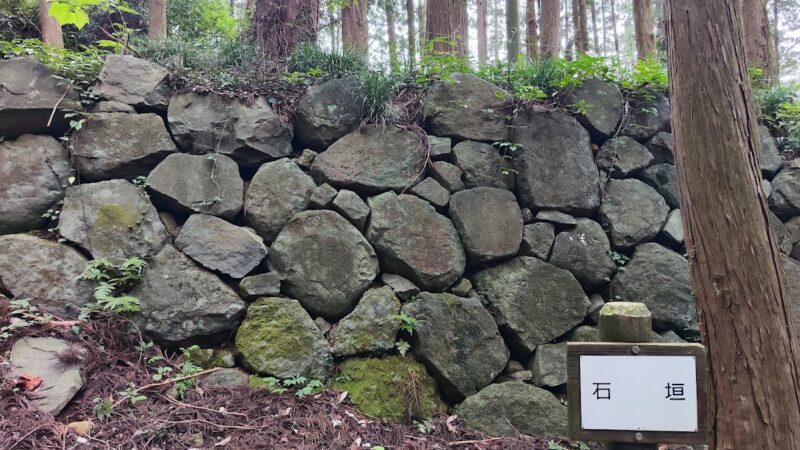
Climbing Mount Kannonji, you can see remnants of the Sengoku period in various places. Especially around the main enclosure, the flat areas of the baileys, the rises of the earthworks, and the depressions of the moats remain in relatively good condition.
The state of preservation of the remains indicates that no major alterations were made after the castle fell, and it is highly likely that they retain their appearance from the time of its fall in 1576 (Tensho 4). Although the view is limited due to the trees, careful observation allows you to decipher the defensive structure of the time.
Views and Strategic Value
The view from the mountaintop is an important element in understanding the strategic value of Inokura Castle. From an altitude of 420m, you can see the city of Kanuma and the surrounding mountains, giving you a real sense of why the castle was built in this location.
The view is particularly unobstructed towards the Nikko mountain range to the north and the Kanto Plain to the east, suggesting its function as a lookout post for early detection of enemy movements. Even today, on clear days, you can see as far as Mount Tsukuba, allowing you to relive the scenery seen by the castle lords of the Sengoku period.
Natural Environment of Kannonji Mountain
Kannonji Mountain, where the Inokura Castle ruins are located, is blessed with a rich natural environment. Hiking while observing the plants of each season offers a valuable experience that combines historical exploration with nature exploration.
The fresh greenery in spring, the vibrant autumn foliage, and the easier observation of the ruins in winter due to fallen leaves all offer different charms depending on the season. Listening to the sounds of wild birds and reflecting on history allows you to forget the hustle and bustle of modern life.
Access and Visiting Information for Inokura Castle
Location and Nearest Station
Location: Shimohinata, Kanuma City, Tochigi Prefecture (Kannonji Mountain)
Nearest Station: Approximately 15 minutes by car from JR Nikko Line “Kanuma Station” or JR Tohoku Main Line/Tobu Nikko Line “Shin-Kanuma Station”
Public transportation access is limited, so using a private car or taxi is recommended.
Parking Information
The trailhead is located near Inokura Elementary School. Please find a parking space that avoids roadside parking. Please park respectfully and avoid disrupting the lives of local residents.
We recommend checking Kanuma City’s tourist information and local guides before your visit.
Hiking Time and Difficulty
The time required from the trailhead to the main enclosure is approximately 40-60 minutes one way. Climbing a 200m elevation gain requires a certain level of physical fitness, but with the use of well-maintained trails, those with general hiking experience should be able to reach the summit without difficulty.
Difficulty: Beginner to Intermediate
Round Trip Time: Approximately 2-3 hours (including time spent viewing the ruins)
Notes for Visitors
- Clothing: Comfortable clothing and hiking boots are recommended.
- Items to Bring: Bring drinking water, a towel, and insect repellent (in summer).
- Season: Be aware that there may be snow or ice in winter.
- Time: Allow ample time to descend before sunset.
- Manners: Please respect the historical site and avoid damaging the ruins.
Related Historical Sites in the Surrounding Area
Kanuma Castle Ruins
Kanuma Castle, the main castle of Inokura Castle, was located in the center of Kanuma City. Although urbanization is progressing, traces of earthworks and moats remain in some areas. Visiting Inokura Castle, the base of the Mibu clan, in conjunction with Inokura Castle, allows for a deeper understanding of the power structure of the time.
Itabashi Castle Ruins
Itabashi Castle, the residence of Itabashi Shōgen Chikamune, who captured Inokura Castle, is also located within Kanuma City. It was one of the important strongholds in the Mibu clan’s internal conflicts and is an essential historical site for understanding the political upheaval of 1576 (Tenshō 4).
Temples and Shrines Associated with the Mibu Clan
Several temples and shrines associated with the Mibu clan exist within Kanuma City. Visiting these allows you to learn about the cultural aspects and beliefs of the Mibu clan as a Sengoku-period daimyo.
Historical Significance of Inokura Castle
Position in the History of Shimotsuke Province during the Sengoku Period
Inokura Castle is a castle that symbolizes the rise and fall of regional powers in Shimotsuke Province during the Sengoku period. It holds significant historical importance as an example of how a small force, caught between larger powers, self-destructs due to internal conflict.
The internal conflict within the Mibu clan was not merely a family dispute, but a political event that occurred under the influence of powerful surrounding forces such as the Hojo and Uesugi clans. The fall of Inokura Castle reflects these complex power dynamics of the Sengoku period.
Value in Mountain Castle Research
In terms of castle construction techniques, Inokura Castle possesses the characteristics of a typical mountain castle in the Kanto region. Its layout, which makes maximum use of the natural terrain, the arrangement of baileys using ridgelines, and the establishment of defensive lines using moats, make it a valuable example for learning about Sengoku period mountain castle construction techniques.
Given the relatively good state of preservation of the remains, further detailed investigations may reveal even more historical facts.
Importance in Local History
Inokura Castle is an indispensable part of the history of Kanuma City. Its designation as a city-designated historical site is part of efforts to protect the region’s historical identity.
Local history enthusiasts and researchers continue their research and preservation activities regarding Inokura Castle, striving to pass it on to future generations as a regional historical heritage.
Summary
Inokura Castle is a Sengoku period mountain castle built on Kannonji Mountain in Kanuma City, Tochigi Prefecture. It has a history of falling in 1576 during an internal conflict within the Mibu clan. Built on a mountaintop at an altitude of 420m and a relative height of 200m, the castle still retains remnants such as earthworks and moats, and is protected as a city-designated historical site.
It can be visited using a well-maintained hiking trail, and the view from the main enclosure allows one to appreciate its strategic value at the time. The dramatic history of Inokura Castle, which was ruled by Kanuma Uemon (who sided with Chikao) and captured by Itabashi Shogen Chikamina during the assassination of Kanuma Castle lord Mibu Tsunawo and his son Yoshio’s revenge, illustrates the harshness of power struggles in the Sengoku period.
It is an important historical site for understanding the Sengoku period history of Shimotsuke Province and a valuable site for learning about the structure of mountain castles. Inokura Castle, where you can enjoy hiking in the lush natural surroundings of Kannonji Mountain while immersing yourself in the history of the Sengoku period, is a place well worth visiting for history buffs.
When visiting, be sure to bring appropriate equipment, allow ample time, and observe proper etiquette for historical site preservation, while imagining the scenery seen by the samurai warriors of 450 years ago.
--765x450.png)
