Marugame Castle Complete Guide | A National Treasure-Class Castle Boasting the Beauty of its Existing Keep and Stone Walls
Marugame Castle, located in Marugame City, Kagawa Prefecture, is a rare and valuable castle in Japan with an existing keep. Known as a “castle of magnificent stone walls,” its stone walls, reaching a total height of 60 meters—the tallest in Japan—and its compact yet elegant three-story wooden keep captivate visitors. This article thoroughly explains the charm of this magnificent castle, from its history and architectural features to its highlights and access methods.
What is Marugame Castle?
Marugame Castle is a flatland castle built on Mt. Kameyama (approximately 66 meters above sea level) in Marugame City, Kagawa Prefecture. Completed in the early Edo period, it is one of the “12 existing keeps” and is designated as a National Important Cultural Property.
The castle’s most distinctive feature is its beautiful four-tiered stone walls. These walls reach a total height of approximately 60 meters, making them the tallest stone walls in Japan. The unique, gently curving “fan-shaped slope” of the stonework is considered a masterpiece of stonework techniques, combining functional beauty and artistry.
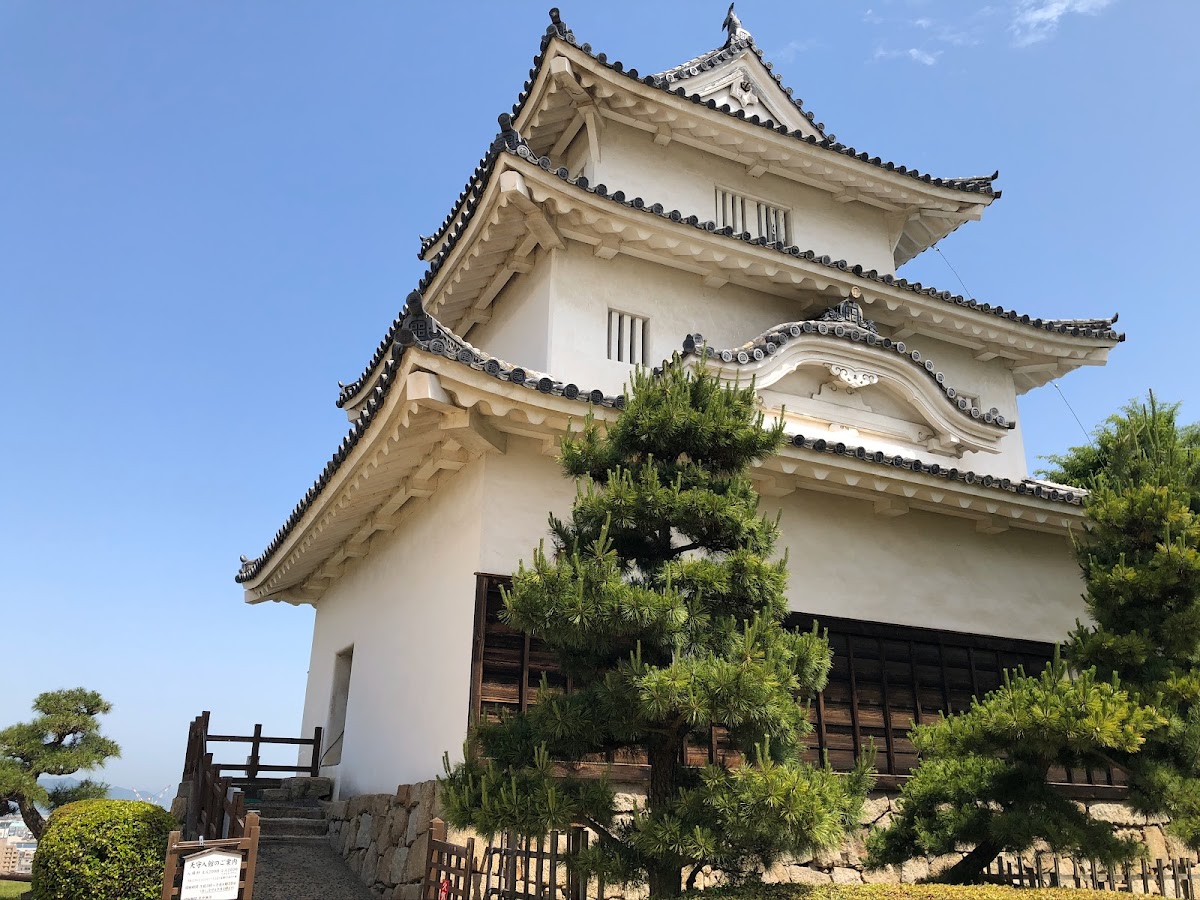
The castle tower is a three-story, three-tiered wooden structure, compact at approximately 15 meters in height, but its well-proportioned and beautiful form possesses an elegance befitting the “Little Kyoto of Sanuki.”
History of Marugame Castle
From Construction to the Edo Period
The history of Marugame Castle begins in 1597 (Keicho 2), at the end of the Muromachi period, when Ikoma Chikamasa built a castle on Kameyama. However, at this point, it was not a full-fledged castle, but rather a subsidiary castle.
The full-fledged Marugame Castle was built in 1602 (Keicho 7). Ikoma Kazumasa, the son of Ikoma Chikamasa, built a castle in Marugame while maintaining Takamatsu Castle as his main castle, as the lord of Sanuki Province with a domain of 170,000 koku.
In 1641 (Kanei 18), the Ikoma clan was dispossessed of their domain due to an internal dispute, and Yamazaki Ieharu was appointed as their successor with a 50,000 koku stipend. However, the Yamazaki clan died out after only 17 years, and in 1658 (Manji 1), Kyogoku Takakazu took over the castle with a 60,000 koku stipend (later reduced to 51,500 koku).
During the Kyogoku era, Marugame Castle underwent extensive renovations, laying the foundation for its current form. In particular, the stone walls were significantly improved, with the highly skilled stonemason group “Anou-shu” constructing the beautifully curved walls.
After the Meiji Restoration
After the Meiji Restoration in 1869 (Meiji 2), the Kyogoku clan became the governors of the Marugame Domain following the return of the domains to the Emperor. However, the Marugame Domain was abolished in 1871 (Meiji 4) with the abolition of the feudal domains and establishment of prefectures.
While many castles were demolished under the Castle Abolition Order, Marugame Castle’s keep miraculously escaped destruction. However, many of the castle’s buildings were demolished or sold off to private individuals.
In 1943 (Showa 18), the keep, the Ote-Ichinomon Gate, and the Ote-Ninomon Gate were designated as National Treasures (formerly National Treasures), and after the war, in 1950 (Showa 25), they were designated as Important Cultural Properties under the Cultural Properties Protection Law.
In 2006 (Heisei 18), it was selected as one of “Japan’s Top 100 Castles,” and in 2017 (Heisei 29), with its selection as one of “Continued Top 100 Castles of Japan,” Marugame Castle’s historical value was once again recognized.
Architectural Features of Marugame Castle
Japan’s Tallest Stone Walls
The greatest highlight of Marugame Castle is undoubtedly its magnificent stone walls. The four-tiered stone walls reach a total height of approximately 60 meters, making them the tallest stone walls in Japan. themselves.
Different stonework techniques can be seen in the stone walls: “nozurazumi” (rough stone masonry), “uchikomi-tsugi” (fitted stone masonry), and “kirikomi-tsugi” (cut stone masonry). The techniques used varied depending on the time and location of construction. By observing these differences, we can decipher the castle’s construction process.
The Charm of Existing Castle Towers
The castle tower of Marugame Castle is believed to have been built around 1660 (Manji 3) during the early Edo period. It is a three-story, three-tiered wooden structure approximately 15 meters tall, characterized by its beautiful proportions that gradually decrease in height from the first to the second and third stories.
The castle tower’s structure is rectangular, with the first story measuring approximately 12.9 meters north-south and 11.6 meters east-west. Its exterior is a white plastered construction. The roof is covered with traditional tiles, and a veranda and railing are provided on the top floor.
The interior has three floors, each housing exhibits where visitors can learn about the castle’s history and the culture of Marugame. From the top floor, one can enjoy a panoramic view of the Seto Inland Sea and the Sanuki Plain. On clear days, the Seto Ohashi Bridge and the islands of the Seto Inland Sea can be seen.
While the castle tower is relatively small among the 12 existing castle towers, this allows visitors to appreciate the warmth of the wooden architecture and the beauty of its details up close.
Main Gate and Castle Gates
Marugame Castle has two important gates that still exist: the Ote-Ichi-no-mon Gate and the Ote-Nino-mon Gate. Both gates are designated as Important Cultural Properties and are valuable examples of Edo period castle architecture.
The Ote-Ichinomon (main gate) is a Korean-style gate, estimated to have been built around 1670 (Kanbun 10). Its simple yet robust structure maintains the dignity of its main entrance to the castle.
The Ote-Ninmon (second main gate) is a yagura-mon (turret gate) with a larger structure. A yagura (turret) is built above the gate, enhancing its defensive capabilities.
Passing through these gates and entering the castle grounds gives you the feeling of having traveled back in time to the Edo period.
Highlights of Marugame Castle
Stone Wall Tour
When visiting Marugame Castle, be sure to carefully observe the stone walls. Walking around the castle and viewing the walls from different angles will allow you to truly appreciate their grandeur and beauty.
The following are some particularly recommended viewpoints:
- Otemon Gate Plaza: An excellent spot to get a panoramic view of the four-tiered stone wall.
- Karamete (Back Gate) Side: The best place to appreciate the height of the stone wall.
- Along the Inner Moat: Enjoy the beauty of the stone wall reflected in the water.
Try observing the intricate techniques of the corner sections of the stone wall, known as “sangi-zumi,” and the marks used to split the stones, known as “ya-ana.”
View from the Castle Tower
The view from the top floor of the castle tower is one of the greatest pleasures of visiting Marugame Castle. Enjoy the following views from the 360-degree panoramic vista:
- North: The magnificent scenery of the Seto Inland Sea and the Seto Ohashi Bridge
- East: The beautiful conical shape of Sanuki Fuji (Mt. Iino)
- South: The Sanuki Plain and the Sanuki Mountains
- West: Marugame city and the islands of the Seto Inland Sea
The sunset over the Seto Inland Sea at dusk is particularly spectacular, attracting many photography enthusiasts.
Cherry Blossoms and Seasonal Scenery within the Castle Grounds
Marugame Castle is one of Japan’s “Top 100 Cherry Blossom Viewing Spots,” and in spring, approximately 650 Somei Yoshino cherry trees adorn the castle. The contrast between the stone walls and the cherry blossoms is magnificent, and the castle is bustling with many visitors every year.
Besides the cherry blossom season, you can enjoy the beauty of each season, including the fresh greenery of early summer, the autumn foliage, and the snowy landscapes of winter. Especially during the autumn foliage season, the autumn leaves against the backdrop of the stone walls present a particularly beautiful sight.
Marugame Castle Museum
Within the castle grounds is a museum exhibiting materials related to Marugame Castle. Exhibits include the castle’s history, construction techniques, materials related to the Kyogoku family, weapons, and ancient documents, allowing visitors to deepen their understanding of Marugame Castle.
In particular, viewing the models explaining the structure of the stone walls and the old maps showing the castle’s history before actually visiting the castle will allow you to enjoy it more deeply.
Cultural Property Designation and Evaluation of Marugame Castle
Marugame Castle has received numerous cultural property designations due to its historical and architectural value:
- Important Cultural Property: Main Tower, Ote-Ichinomon Gate, Ote-Ninomon Gate (National Designation)
- Historic Site: Marugame Castle Ruins (National Designation)
- One of Japan’s Top 100 Castles: No. 78 (Selected by the Japan Castle Association)
- One of Japan’s Top 100 Cherry Blossom Viewing Spots: Selected by the Japan Cherry Blossom Association
The technical value of its stone walls, in particular, is highly regarded, and it is attracting attention from experts in castle architecture and stone wall research as a “textbook of stone walls.”
Access Information
Access by Train
From JR Marugame Station:
- Approximately 10 minutes on foot to Ote-mon Gate
- Approximately 15 minutes further to the main tower (uphill)
Marugame Station is a major station on the Yosan Line, approximately 20 minutes from Takamatsu Station by rapid train and approximately 40 minutes from Okayama Station by limited express train. ### Access by Car
Using the Expressway:
- Approximately 15 minutes from Sakaide IC
- Approximately 15 minutes from Zentsuji IC
Parking:
- Marugame Castle Tourist Parking (Free, approximately 50 spaces)
- Marugame Municipal Baseball Stadium Parking (Available except during events)
- Nearby Paid Parking
During cherry blossom season and long weekends, parking lots become crowded, so we recommend using public transportation.
Opening Hours and Fees
Castle Tower Opening Hours
- Regular Season: 9:00 AM – 4:30 PM (Last entry at 4:00 PM)
- Closed Days: December 25th – December 31st
Admission Fee
- Adults: 200 yen
- Elementary and Junior High School Students: 100 yen
- Group Discount: Discounts available for groups of 20 or more
While the castle ruins themselves are open 24 hours, entry to the castle tower is only permitted during the hours listed above. Exploring the stone walls and castle grounds is free.
Nearby Tourist Attractions
Marugame Genichiro Inokuma Museum of Contemporary Art
Located in front of Marugame Station, this museum primarily exhibits works by Genichiro Inokuma, a painter from Marugame City. The building itself, designed by architect Yoshio Taniguchi, is also considered a work of art.
Nakatsu Banshoen Garden & Marugame Museum
This is a strolling garden built as a villa for the Kyogoku family. The vast garden, covering approximately 15,000 tsubo (about 50,000 square meters), features a beautiful Japanese garden created in 1688, offering beautiful scenery throughout the seasons.
Kotohira Shrine
Located in Kotohira Town, about a 30-minute drive from Marugame City, this shrine is affectionately known as “Konpira-san.” The approach to the shrine, with its 785 stone steps to the main shrine and 1368 steps to the inner shrine, is sure to challenge visitors.
Uchiwa no Minato Museum
Marugame is known as a production center for “Marugame Uchiwa” (Marugame fans). This museum allows visitors to learn about the history and production process of fans, and also offers fan-making experiences.
Tips for Enjoying Marugame Castle
Time Required for Visiting the Castle
- Brisk Visit: Approximately 45 minutes (round trip from the main gate to the keep)
- Standard Visit: Approximately 1 hour 30 minutes (including observation of the stone walls and visit to the keep)
- Thorough Visit: Approximately 2-3 hours (including visit to the museum and photography)
Since the path to the keep involves slopes and stairs, we recommend wearing comfortable shoes.
Best Season
- Cherry Blossom Season (Late March – Early April): The most popular season
- Fresh Green Season (May): The refreshing weather is perfect for a stroll
- Autumn Foliage (Mid-November – Late November): The contrast between the stone walls and the autumn leaves is beautiful
- Winter (December – February): Fewer tourists, allowing for a more relaxed visit
Photography Tips
- Early Morning: The stone walls illuminated by the morning sun are beautiful
- Evening: The silhouette of the castle tower against the setting sun over the Seto Inland Sea
- Otemon Gate Plaza: The best angle to capture the entire stone wall
- Top Floor of the Castle Tower: Enjoy a 360-degree view
Please note that the use of tripods may be restricted during crowded times; please check in advance.
Preservation and Restoration of Marugame Castle
Collapse and Restoration of Stone Walls
In 2018 (Heisei 30), heavy rains caused damage to a portion of the stone walls. This is believed to have been caused by rainwater accumulating inside the walls, and restoration work is currently underway.
The restoration work employs a traditional method called “re-stacking,” where each fallen stone is numbered and recorded, and then returned to its original position as much as possible. This restoration work itself holds significant importance in terms of passing on stone wall construction techniques.
Preservation Activities of the Castle Tower
As a wooden structure, the castle tower requires regular maintenance. Marugame City is continuing its efforts to pass on this valuable cultural asset to future generations by conducting seismic assessments and formulating preservation and repair plans for the castle tower.
Citizen volunteers actively participate in cleaning activities and cultural property protection campaigns awareness, fostering a strong sense of community-wide awareness of protecting Marugame Castle.
Marugame Castle and Udon Culture
Kagawa Prefecture is known as “Udon Prefecture,” and Marugame City is no exception. Around Marugame Castle, there are many Sanuki udon restaurants famous famous by locals.
Enjoying authentic Sanuki udon before or after visiting the castle is one of the pleasures of sightseeing in Marugame. Many restaurants are self-service style, allowing you to enjoy authentic Sanuki udon at reasonable prices.
Marugame City is also famous for its local dish, “Honetsuki-dori” (bone-in chicken). This dish features spicy seasoned chicken thigh meat, served at local izakayas (Japanese pubs).
Marugame Castle Events
Castle Festival
Held every May, this is Marugame City’s largest event. A samurai procession, taiko drumming, and stage events take place, enveloping the entire castle town in a festive atmosphere.
Marugame Castle Candlelight Night
Held on summer nights, this event features candles lit throughout the castle, creating a magical atmosphere. The illuminated castle tower and the candlelight create a scene with a different charm than during the daytime.
Marugame Castle Stone Wall Illumination
During the irregularly held stone wall illumination event, the stone walls, boasting the highest height in Japan, are illuminated, presenting a completely different and fantastical appearance compared to the daytime.
Summary
Marugame Castle is a valuable castle with the tallest and most beautiful stone walls in Japan and an existing wooden castle tower. With a history of over 400 years, this castle, which still retains its original appearance, can be said to be a masterpiece that embodies the essence of Japanese castle architecture.
The elegant curves of the stone walls, known as the “fan-shaped slope,” the compact yet well-proportioned castle tower, and the spectacular view of the Seto Inland Sea from the tower deeply impress visitors.
Marugame Castle displays different expressions throughout the seasons: the splendor of cherry blossom season, the freshness of new greenery, the beauty of autumn leaves, and the tranquility of winter. Along with local delicacies such as Sanuki udon noodles and bone-in chicken, be sure to visit this magnificent castle.
Marugame Castle is not merely a tourist attraction; it is a cultural heritage site that embodies Japan’s history and culture, as well as the skills and wisdom of our ancestors. Understanding its value and passing it on to future generations is our responsibility as modern people.
When you visit Kagawa Prefecture, be sure to visit Marugame Castle and fully appreciate the charm of this beautiful castle. The grandeur of the stone walls, the elegance of the keep, and the breathtaking scenery of the Seto Inland Sea will surely leave a lasting impression on your heart.