Torisaka Castle: A Thorough Explanation of the History and Remains of Two Mountain Castles that Protected the Border of Echigo Province
There are two castles called “Torisaka Castle” in Echigo Province (present-day Niigata Prefecture). One is the Torisaka Castle (Tossaka-jo) in Tainai City, the residence of the Nakajo clan, and the other is the Torisaka Castle (Torisaka-jo) in Myoko These two castles, with their different pronunciations, each played an important role in the history of Echigo. This article provides a thorough explanation of the detailed history of both castles, their existing remains, and a visitor’s guide.
Table of Contents
This article will explain the following in detail:
- Overview of Torisaka Castle and the Differences Between the Two Castles
- History of Torisaka Castle in Tainai City
- History of Torisaka Castle in Myoko City
- Remains and Highlights of Both Castles
- Access Methods and Visitor Guide
- Surrounding Facilities and Reference Materials
Overview of Torisaka Castle: Understanding the Differences Between the Two Castles
Torisaka Castle in Tainai City
Torisaka Castle, located in Okuyamasho Castle Village, Tainai City, Niigata Prefecture, is also known as “Shiratori Castle,” “Okuyamasho Castle,” and “Nakajo Castle.” It is known as the residence of the Nakajo clan, vassals of the Uesugi Province, and is situated on the summit of Mt. Shiratori, at an altitude of 298 meters. The relative height is approximately 230 meters, and it was a base for controlling the area known as Okuyamasho.
Torisaka Castle in Myoko City
Torisaka Castle, located in Himekawahara, Arai Ward, Myoko City, Niigata Prefecture, is also known as “Takajo,” “Tosakajo,” and “Arai Torisaka Castle.” The main keep is situated at an altitude of 347 meters and was Takatokoyama. It functioned as a strategic stronghold controlling the old Iiyama Road (present-day National Route 292), which led from the Shinano border to Kasugayama Castle.
Caution Regarding Differences in Pronunciation and Confusion
The castle in Tainai City is pronounced “Tossakajo,” while the castle in Myoko City is pronounced “Torisakajo.” This difference in pronunciation is an important point for distinguishing between the two castles. Understanding this difference is necessary when search
History of Tossaka Castle in Tainai City
The Rebellion of Shiro Kotaro Sukemori in 1201
The oldest record in the history of Tossaka Castle is a description of a rebellion by Shiro Kotaro Sukemori in 1201, where he fought against Sasaki Moritsuna of the Kamakura Shogunate. The Tossaka Castle where this battle took place is believed to be During this period, Okuyama Manor was an important area as a manor, and Tossaka Castle was its central defensive stronghold.
Development as the Residence of the Nakajo Clan
From the Muromachi period to the Sengoku period, Tossaka Castle developed as the residence of the Nakajo clan. The Nakajo clan were powerful vassals of the Echigo Shugo Uesugi clan and local lords who controlled Okuyama Manor. In peacetime, they used the emang and Tossaka Castle was positioned as a fortified stronghold in times of emergency.
It is believed that Torisaka Castle at this time referred to the old Torisaka Castle on the summit of Mount Torisaka. During the Sengoku period, the Egami Manor was abandoned, and the Haguro Manor and Miyanoiri Manor were built at the foot locations.
The Nakajo Clan during the Uesugi Kenshin Era
During the time of Uesugi Kenshin, Nakajo Fujisuke, the head of the Nakajo clan, played a leading role as a retainer. He played a crucial role in Kenshin’s unification of Echigo and his campaigns in the Kanto region, and Torisaka Castle function’ northern defense. The Nakajo clan, through their control of Okuyama Manor, was an important force supporting the economic base of Echigo Province.
The Otate Rebellion and Nakajo Kagetai
After the death of Uesugi Kenshin, the “Otate Rebellion,” a succession dispute, erupted. In this rebellion, Nakajo Kagetai, the head of the Nakajo clan, sided with Uesugi Kagekatsu and fought against Kagetora’s forces. victory, and the Nakajo clan continued to serve Kagekatsu.
The Abandoned Castle and its Present
In 1598 (Keicho 3), when Uesugi Kagekatsu was transferred to Aizu, the Nakajo clan followed suit, and Torisaka Castle was abandoned. Currently, the Torisaka Castle ruins are designated as part of the national historic site “Okuyama- castle structure.
History of Torisaka Castle, Myoko City
Construction Period and Purpose
The exact construction date of Torisaka Castle in Myoko City is uncertain, but the remaining structures are believed to date from the Sengoku period (Warring States period). It is presumed that the Uesugi clan maintained it as a strategic swhnahold border to Kasugayama Castle, the Uesugi clan’s main castle.
A Fortress for Border Defense
Torisaka Castle was located on the Shinano-Echizen border and played an important role in preventing invasions from the Shinano region. During the Sengoku period (Warring States period), military tensions frequently arose between Echigo and Shinano provinec, and theold 292, was a strategically important transportation route. Torisaka Castle functioned as a frontline fort, monitoring this road and preventing enemy incursions.
Maintenance by the Uesugi Clan
From the time of Uesugi Kenshin to Kagekatsu, Torisaka Castle was maintained as a branch castle of the Uesugi clan. Within the Uesugi clan’s castle network centered around Kasugayama Castle, forisa castle was an important respon and layout indicate that it was a formidable stronghold capable of deploying a considerable number of troops.
Post-Abandonment History
After Uesugi Kagekatsu’s transfer to Aizu, Torisaka Castle is believed to have been abandoned. Currently, it is designated as a historical site by Myoko City and is maintained as the “Takayokoyama Forest Park.” The castle ruins remain ingoo period mountain castle to the present day.
Remains and Restored Structures: Highlights of Both Castles
Remains of Torisaka Castle, Tainai City
Main Enclosure and Group of Enclosures
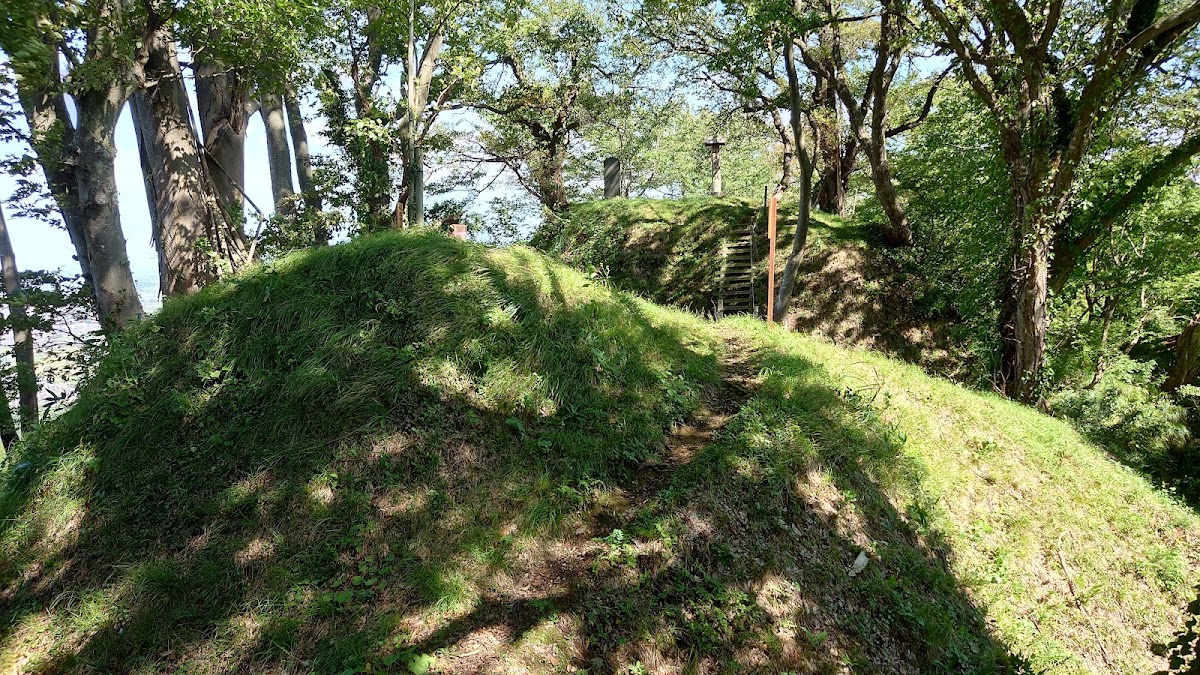
The main enclosure is located on the summit of Mt. Shiratori, at an elevation of 298 meters. Multiple enclosures are arranged in a stepped pattern around the main enclosure, enhancing its defensive capabilities. An observation tower has been built on the “Okuyama-so Castle Ruins (Torisaka Castle Site)” are installed.
Moats and Earthworks
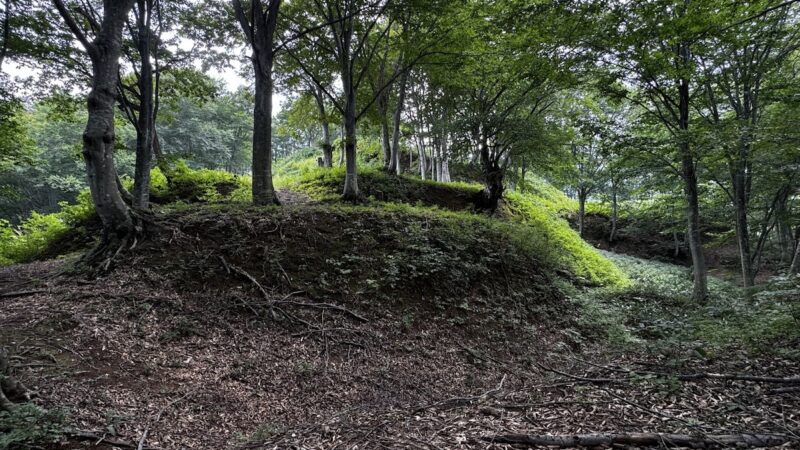
Multiple moats cutting across the ridge can be seen, demonstrating ingenuity in preventing enemy intrusion. Earthworks remain in good condition, providing insight into the castle-building techniques of the Sengoku period.
Access Routes and Entrance
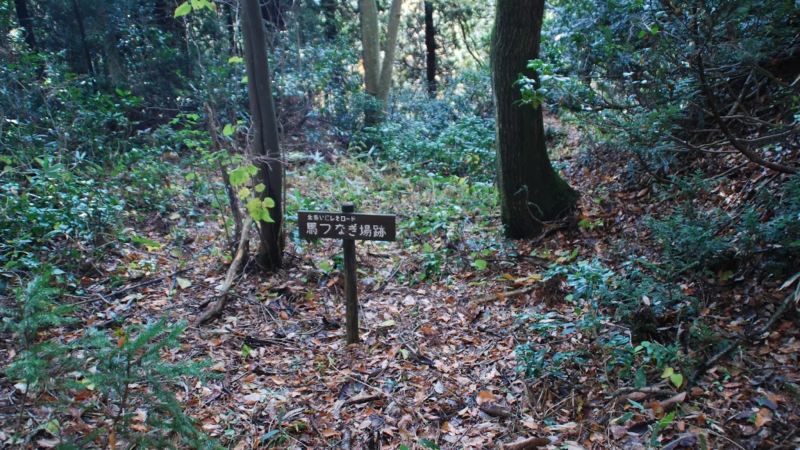
Currently, two access routes to the castle are maintained: the Shiratori Course and the Stream-following Course. Remains of the entrance (gateway) can also be seen, allowing observation of its winding defensive structure.
Remains of Torisaka Castle, Myoko City
Main Enclosure and Enclosure Layout
Numerous enclosures were arranged around the main enclosure, which was located at an altitude of 347 meters. The layout, built on a ridge extending northeast from Takatokoyama, skillfully utilizes the terrain.
Continuous Dry Moats
A series of magnificent dry moats (horikiri) are constructed along the ridge, making them the most impressive feature of Torisaka Castle. These moats cut off the ridge to prevent enemy advances, demonstrating the advanced civil engineering techniques of the Sengoku period.
Enclosure Layout and Defensive Structure
Multiple enclosures are arranged in a stepped fashion, each functioning as an independent defensive base. The defensive design, utilizing the elevation differences between the enclosures, was a clever strategy that imposed significant difficulties on the attacking
Common Features of Both Castles
Both castles, being mountain castles, are characterized by layouts that make maximum use of the natural terrain. With a relative elevation of over 200 meters, attacking these castles would be extremely difficult. Furthermore, typical Sengoku period moats, and earthworks were employed, clearly demonstrating the characteristics of mountain castles in Echigo Province.
While the remaining structures are mainly from the Sengoku period, both castles are well-preserved and provide valuable resources for understanding the castle structure of that time.
Access: Visiting Guide to Both Castles
Access to Torisaka Castle in Tainai City
Access by Car
The nearest location is near 2300 Haguro, Tainai City, Niigata Prefecture. Parking is limited, so it is recommended to check in advance. It is approximately a 20-minute drive from the Nakajo Interchange on the Nihonkai Tohoku Expressway
Ascent Route
From the entrance, climb northeast for about 30 minutes to reach the ridge. There, join the Shiratori course along the stream, and after another 10 minutes of climbing, you will reach the summit of Shiratori Mountain, at an elevation of 293 meter meters. Allow about an hour for the climb to the castle.
Equipment and Precautions
As it is a mountain castle, comfortable walking shoes such as trekking shoes are essential. Insect repellent is necessary in summer, and warm clothing is necessary in winter. Bring drinking water with you.
Access to Torisaka Castle, Myoko City
Access by Car
Located in Torisaka-yama, Himekawahara, Arai-ku, Myoko City, Niigata Prefecture. Approximately 15 minutes from the Arai Smart Interchange on the Joshinetsu Expressway via National Route 292. The area is developed as Takatokoyama Forest Park, and parkingis
Climbing Route
Use the hiking trails in Takatokoyama Forest Park. The elevation difference is approximately 280 meters, and the climb takes about 1 to 1.5 hours. While the hiking trails are well-maintained, there are steep slopes characteristic of mountain physical fitness.
Points of Interest
The continuous dry moats along the ridge are the main highlight. From the main keep ruins, you can overlook the surrounding mountains, clearly understanding its strategic location as a border stronghold. Explore the various baileys in order, examining de
General Precautions for Visiting
Both castles are mountain castles, so please note the following:
- Check the weather: Rainy weather can make the ground slippery and dangerous.
- Time allocation: Plan with ample time to descend before sunset.
- Check your physical fitness: This is a climb with an elevation difference of over 200 meters.
- Equipment: Trekking shoes, drinking water, a map, and a mobile phone are essential.
- Season: Spring to autumn is the best time to visit. Be aware of snow in winter.
Surrounding Facilities and Reference Materials
Facilities around Tainai City and Torisaka Castle
Okuyama-so Historical Museum
At the Okuyama-so Historical Museum in Tainai City, you can learn in detail about the history of the Nakajo clan and Okuyama-so. Materials related to Torisaka Castle are also on display, and a visit before or after your visit is recommended.
Nakajo Town Local History Museum
This museum introduces the history and culture of the region and also houses materials related to Torisaka Castle.
Facilities around Torisaka Castle in Myoko City
Takatokoyama Forest Park
This park is located on the site of Torisaka Castle. It has restrooms and rest facilities and can be used as a base for visiting the castle.
Arai Local History Museum
This facility allows you to learn about the history of Myoko City and obtain information about local castles, including Torisaka Castle.
References
For those who wish to learn more about Torisaka Castle, the following references are recommended:
- *Medieval Castles and Fortifications of Niigata Prefecture* (Yoshikawa Kobunkan): A comprehensive explanation of castles in Niigata Prefecture.
- *Comprehensive Survey of Japanese Castles*, Volume 8 (Shin Jinbutsu Oraisha): Detailed descriptions of castles in Echigo Province.
- *The Uesugi Clan and Castles of Echigo*: Research on castles related to the Uesugi clan.
- Municipal Histories: The histories of Tainai City and Myoko City contain detailed descriptions.
Photo Gallery Information
Numerous photographs of both castles have been published by castle enthusiasts. Websites such as Kojodan and Jōkaku Hōrōki allow you to check visitor photos and evaluations. Checking these sites before visiting will help you understand the highlights
Introduction: The Charm of Torisaka Castle
Torisaka Castle in Echigo Province consists of two castles that have each played different historical roles. Torisaka Castle in Tainai City was the residence of the powerful local lord, the Nakajō clan, and the center of control over Okuyama Manor. Meanwhile, Torisaka Castle Uesugi clan, responsible for guarding against attacks from the Shinano region.
Both castles retain many characteristics of mountain castles from the Sengoku period, with well-preserved remains such as baileys, moats, and earthworks. The continuous dry moats at Torisaka Castle in Myoko City are particularly impressive, showcasing the advanced cast
Currently, hiking trails are maintained at both castles, making them popular not only with castle enthusiasts but also with hikers. The views from the mountaintops are magnificent, allowing visitors to imagine what the former castle lords saw from these
For history buffs, visiting both castles will provide a deeper understanding of the Sengoku period in Echigo. Standing on the ground, one can truly feel the importance of these castles and the roles they played during the turbulent times of Uesugi Kenshin, Kageka
Summary: The Historical Value of Torisaka Castle
The two Torisaka Castles in Echigo Province are important castle ruins, each with its own unique history and role. Torisaka Castle in Tainai City served as the residence of the Nakajo clan and was the center of control for Okuyama Manor, boasting a long history from the rebellion Otate Rebellion. Torisaka Castle in Myoko City served as a border stronghold for the Uesugi clan, on the front lines of defense for Kasugayama Castle.
Both castles currently have well-preserved remains, providing valuable information for understanding mountain castles of the Sengoku period. The remains, such as baileys, moats, and earthworks, convey the castle-building of techniques and defensive philosophies.
We recommend visiting these two Torisaka Castles to castle enthusiasts and anyone interested in history. Standing on-site and examining the remains will provide a sense of presence and understanding that cannot be obtained from documents alone. As a valuable historical site where is expected to continue to be preserved and utilized in the future.