Goryokaku Complete Guide: A Thorough Explanation of its History, Architecture, and Tourism
Goryokaku is Japan’s only Western-style star-shaped fortress, located in Hakodate City, Hokkaido. Built in the late Edo period, this historical structure is now designated a National Special Historic Site and is a representative tourist attraction of Hakodate, attracting approximately 2 million visitors annually. This article provides a thorough explanation from every angle, from Goryokaku’s historical background and architectural features to its role as the stage of the Battle of Hakodate and its appeal as a modern tourist spot.
What is Goryokaku?
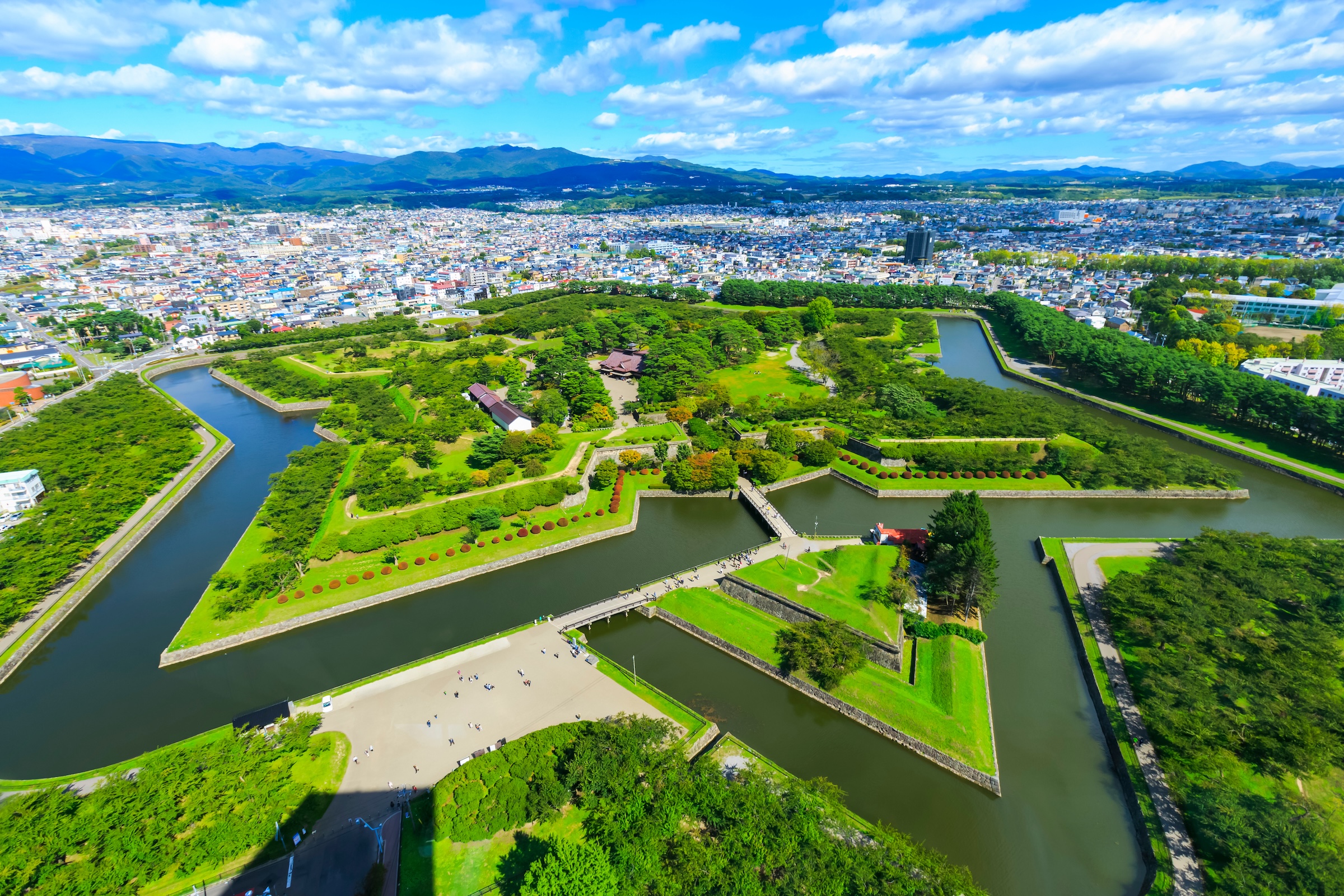
Goryokaku is a star-shaped fortress completed in 1866 (Keio 2). Its official name is “Kameda Onyakusho Dorui” or “Yanaginojo.” However, it became widely known as “Goryokaku” due to its distinctive pentagonal star shape.
This fortress was constructed by the Edo Shogunate as a base for governing Ezo (present-day Hokkaido) and as a defensive facility against the arrival of foreign ships. The vast grounds, covering approximately 250,000 square meters, are now developed as Goryokaku Park, a popular recreational spot for Hakodate residents and a beloved tourist destination.
Origin of the Name Goryokaku
The name “Goryokaku” (五玉角) comes from the fortress’s star shape, characterized by five bastions. This shape is based on Western fortification techniques known as “bastion fortifications,” and is built with a design philosophy entirely different from traditional Japanese castles. While there is another castle in Japan called Goryokaku—Ryūoka Castle in Saku City, Nagano Prefecture, also has a similar star shape—generally, “Goryokaku” refers to the one in Hakodate.
History of Goryokaku
Background and Purpose of Construction
In the mid-19th century, Japan was nearing the end of its more than 200-year-long policy of national isolation. Following Commodore Perry’s arrival in 1853, the Treaty of Peace and Amity between Japan and the United States was signed in 1854, and Hakodate (then known as Hakodate) became an open port along with Shimoda. This change in international affairs made it urgent for the Edo Shogunate to strengthen the defense and governance of Ezo (Hokkaido).
The Hakodate Magistrate’s Office at the time was located in the heart of the city, posing a defensible problem. If attacked by foreign ships, the city could suffer immense damage. Therefore, the Shogunate decided to construct a new magistrate’s office in the suburbs, away from the city center. This new magistrate’s office is Goryokaku.
Design and Construction Process
The design of Goryokaku was handled by Takeda Ayasaburo, a scholar of Dutch studies and a Western military strategist. Takeda studied under Sakuma Shozan and learned Western fortification techniques. While referencing the French Vauban-style fortification methods, he developed his own unique design, taking into account Japan’s topography, climate, and budget constraints.
Construction began in 1857 (Ansei 4) and took approximately nine years to complete in 1866, at a massive cost of approximately 750,000 ryo (equivalent to hundreds of billions of yen in today’s value). Records indicate that hundreds of thousands of laborers were mobilized for the construction.
The Hakodate War and Goryokaku
Goryokaku came to the forefront of history just two years after its completion, during the Hakodate War (the final phase of the Boshin War) which took place from 1868 to 1869.
In October 1868, a fleet led by Enomoto Takeaki of the former shogunate army arrived in Hakodate and occupied Goryokaku. Enomoto and his followers declared the establishment of the “Ezo Republic” and made Goryokaku their seat of government. This is considered the first attempt in Japanese history to establish a government through elections.
The fighting against the new government forces continued until May 1869, but the former shogunate forces were at a disadvantage due to the overwhelming difference in troop numbers and modern equipment. In particular, after the fall of Bentenmisaki Battery, Goryokaku became isolated. Finally, on May 18th, Enomoto Takeaki surrendered, ending the Hakodate War. This battle also completely ended the Boshin War as a whole, and the unification of Japan by the Meiji government was completed.
Changes after the Meiji Restoration
After the Hakodate War, Goryokaku came under the jurisdiction of the Ministry of War and was used as a training ground for a time. However, its importance as a military facility gradually declined.
In 1914 (Taisho 3), Goryokaku was opened to the public as a park. At this time, approximately 1,600 cherry trees were planted, laying the foundation for its current status as a famous cherry blossom viewing spot. In 1952, it was designated a National Special Historic Site, and in 1964, it came under the management of Hakodate City, leading to its development as a full-fledged historical park.
In 2006, restoration work on the Hakodate Magistrate’s Office began, and it opened to the public in 2010. This restoration transformed Goryokaku from a mere historical site into a facility of high educational value where visitors can experience the history of the late Edo period.
Architecture and Structure of Goryokaku
Design Philosophy of the Star-Shaped Fortress
The most distinctive feature of Goryokaku is its unique star-shaped plan. This shape is based on Western fortification techniques known as “bastion-style” or “raft fortification.”
The greatest advantage of the star-shaped design is minimizing blind spots. Traditional square or circular fortress walls create blind spots where the defenders cannot see the enemy approaching the walls. However, the star-shaped projections (bastions) allow for flank fire on adjacent walls, creating a defensive network that covers the entire wall.
Specific Structure and Dimensions
Goryokaku has sides of approximately 125 meters, and its perimeter is approximately 1.8 kilometers. The walls are approximately 5 meters high, and the earthen ramparts are approximately 30 meters wide at the base. A moat approximately 30 meters wide and 3 meters deep surrounds the outside of the walls, covering a total area of approximately 250,000 square meters.
The five bastions correspond to areas called “Ichinohashi,” “Ninohashi,” “Sanohashi,” “Yonohashi,” and “Gonohashi.” The main entrance is on the southwest side, where a small outpost-like defensive structure called a crescent-shaped fort (hangetsuho) is located.
Hakodate Magistrate’s Office Buildings
At the center of Goryokaku stood the buildings of the Hakodate Magistrate’s Office. The main building was the magistrate’s office, equipped with a drum tower (taikoyagura), a large wooden structure with a total floor area of approximately 1,000 tsubo (approximately 3,300 square meters).
The building’s design was a blend of Japanese and Western styles, incorporating elements of Western architecture while maintaining a foundation in traditional Japanese architectural styles. Unfortunately, it was dismantled in 1871 (Meiji 4), but the 2010 reconstruction allows us to learn about the architectural techniques and interior details of the time.
In the reconstruction, thorough analysis of materials such as old photographs, archaeological excavations, and historical documents was conducted to achieve the most faithful reproduction possible. A total of approximately 1,500 cubic meters of timber was used, employing traditional timber-jointing techniques.
Use as a Training Ground
From the Meiji era onward, the interior of Goryokaku was used as a training ground for the army. The vast, flat area was suitable for military training, and barracks and other facilities were constructed there at one time. Even today, the interior of Goryokaku is a large grassy area, retaining the appearance of the training ground from that time.
This area is now open to the public as a place of relaxation, and people can be seen enjoying picnics and sports. It is a good example of how a historical space can be integrated into modern life.
Features of the Defensive System
Goryokaku’s defensive system incorporated various ingenious features beyond just its shape. Water was drawn from the Kameda River into the moat, and the design ensured a constant water level. Furthermore, stone walls were constructed inside the earthen ramparts to prevent collapse.
Cannon emplacements were installed at the tips of the bastions, enabling long-range attacks with artillery. Additionally, parapets were built on top of the castle walls, designed to withstand gun battles. These defensive structures reflected the latest military technology of the time.
View from Goryokaku Tower
Overview of Goryokaku Tower
The adjacent Goryokaku Tower offers the best experience of Goryokaku’s charm. The current tower, the second generation, opened in 2006 and boasts a height of 107 meters (the observation deck is 90 meters).
From the observation deck, you can enjoy a panoramic view of Goryokaku’s beautiful star shape from directly above. This is a breathtaking view that cannot be seen from the ground and is a highlight of Goryokaku sightseeing. On a clear day, you can even see Mount Hakodate, the Tsugaru Strait, and the Shimokita Peninsula.
Highlights of the Observation Deck
The observation deck features an exhibition corner introducing the history of Goryokaku, where you can see dioramas recreating the scene during the Battle of Hakodate and displays of historical materials. Furthermore, a touch-panel explanation system allows you to learn in detail about each part of Goryokaku.
The observation deck also has an exhibition space called the “Goryokaku Historical Corridor,” where you can learn about the history of Hakodate from the end of the Edo period to the Meiji era in chronological order. The exhibits on the Battle of Hakodate are particularly extensive, and detailed information about figures such as Enomoto Takeaki and Hijikata Toshizo is provided.
Goryokaku Through the Seasons
Spring: A Famous Cherry Blossom Spot
Goryokaku is known as one of Hokkaido’s leading cherry blossom viewing spots. Approximately 1,600 Somei Yoshino and Yaezakura cherry trees are planted there, reaching full bloom from late April to early May each year.
During the cherry blossom season, the “Hakodate Goryokaku Festival” is held, attracting many tourists. The area is also illuminated at night, creating a fantastical scene with the cherry blossoms blooming along the star-shaped moat. The full-blooming cherry blossoms viewed from Goryokaku Tower are breathtakingly beautiful, resembling pink stars, captivating many photography enthusiasts.
The best time to see the cherry blossoms varies depending on the weather, but it is usually around Golden Week. This period also coincides with the peak blooming season at other cherry blossom spots in Hakodate, making it a popular time for cherry blossom-viewing tours.
Summer: Fresh Greenery and Historical Exploration
In summer, Goryokaku is enveloped in vibrant greenery. Families enjoy picnics on the grassy plaza, while history enthusiasts explore the historical sites along the walking paths.
During this time of year, a tour of the reconstructed Hakodate Magistrate’s Office is highly recommended. The building is relatively cool inside, allowing visitors to learn in detail about the administrative facilities of the Edo period. Summer-only events and guided tours are also sometimes held.
Autumn: The Beauty of Autumn Leaves
From mid-October to early November, Goryokaku is adorned with autumn leaves. The cherry trees turn red and yellow, creating a unique autumn landscape. It’s less crowded than the spring cherry blossom season, making it ideal for those who want to enjoy a leisurely stroll.
The star-shaped autumn leaves viewed from Goryokaku Tower offer a different charm than in spring. The clear autumn air makes the views of Mount Hakodate and the Tsugaru Strait even more beautiful.
Winter: Snowscapes and Illuminations
In winter, Goryokaku is covered in snow, displaying a serene beauty. From December to February, an illumination event called “Goryosei no Yume” (Dream of the Five-Pointed Star) is held, where the moat is framed in a star shape with approximately 2,000 light bulbs.
The night view from the snow-covered Goryokaku Tower is truly a sight like “the stars shining.” Although the cold is severe, you can enjoy a magical atmosphere unique to winter. Furthermore, the snow-covered Hakodate Magistrate’s Office also has a charming appearance, possessing a beauty only available in winter.
Tourist Information and Access
Basic Information
Goryokaku Park
- Address: 44 Goryokaku-cho, Hakodate City, Hokkaido
- Opening Hours: Always open (park area)
- Admission Fee: Free (park area)
- Estimated Visiting Time: 1-2 hours
Hakodate Magistrate’s Office
- Opening Hours: 9:00-18:00 (April-October), 9:00-17:00 (November-March)
- Closed: December 31st – January 3rd
- Admission Fee: General 500 yen, Students 250 yen, Elementary and Junior High School Students Free
Goryokaku Tower
- Opening Hours: 9:00-18:00 (April 21st – October 20th), 9:00-17:00 (October 21st – April 20th)
- Observation Deck Admission Fee: Adults 900 yen, Junior/Senior High School Students 680 yen, Elementary School Students 450 yen
Access
Public Transportation
- From Hakodate Station, take the tram to “Goryokaku Park-mae” stop, then a 15-minute walk.
- From Hakodate Station, take the Hakodate Bus to “Goryokaku Park Iriguchi” stop, then a 7-minute walk.
- From Hakodate Airport, approximately 20 minutes by car.
By Car
- Approximately 10 minutes from the Hakodate IC on the Hakodate Shindo Expressway.
- Parking: Several paid parking lots are available nearby (approximately 200 yen per hour).
Nearby Tourist Attractions
There are other attractive tourist spots around Goryokaku.
Hakodate City Northern Pacific Fisheries Museum: A facility where you can learn about the history of northern Pacific fisheries, located within walking distance of Goryokaku.
Shiryokaku: The remains of a small fortress built as a subsidiary castle of Goryokaku, a fascinating spot for history buffs.
Hakodate City Tram: A retro streetcar that provides convenient access from Goryokaku to Mount Hakodate and the Motomachi area.
Goryokaku Sightseeing Tips
Recommended Sightseeing Route
- We recommend starting at Goryokaku Tower. Gaining an overview from the observation deck and gaining background knowledge from the historical exhibits will enrich your subsequent visit.
- For a stroll through the park, enter through the main entrance, pass through the crescent-shaped fort, and enter the interior. A full circuit along the moat takes approximately 30 minutes.
- When visiting the interior of the Hakodate Magistrate’s Office, pay attention to the details of the restored building. The tatami rooms, offices, and drum tower are faithfully reproduced to reflect the conditions of the time.
- If you have time, we recommend extending your visit to Shiryokaku. Located about 20 minutes on foot, you can see the remains of a square-shaped fortress, different from Goryokaku.
Best Photo Spots
- Goryokaku Tower Observation Deck: The only place where you can photograph the entire star shape.
- Near the Half-Moon Fort: Beautiful composition from the front.
- Promenade along the moat: Particularly beautiful during cherry blossom and autumn foliage seasons.
- Square in front of the Hakodate Magistrate’s Office: You can take photos where the building and background are in harmony.
Seasonal Clothing and Items
Spring (April-May): It gets chilly in the mornings and evenings, so bring a jacket. It gets crowded during cherry blossom season, so visiting early is recommended.
Summer (June-August): The sun is strong, so a hat and sunscreen are necessary. Don’t forget to stay hydrated.
Autumn (September-November): Due to large temperature fluctuations, layering is convenient.
Winter (December-March): Warm clothing is essential. Prepare snow boots, gloves, and a hat.
Cultural Value of Goryokaku
Significance as a National Special Historic Site
Goryokaku was designated a National Special Historic Site in 1952. Special Historic Sites are cultural properties equivalent to National Treasures, and only about 60 sites nationwide have received this designation. The reasons for Goryokaku’s selection as a Special Historic Site are as follows:
- Architectural Historical Value: A valuable example demonstrating the introduction of Western-style fortification techniques in Japan.
- Historical Value: A place symbolizing the transition period from the end of the Edo period to the Meiji Restoration.
- Preservation Status: The basic star-shaped structure is well-preserved.
- Educational Value: An important teaching material for learning about Japan’s modernization process.
Historical Significance of the Hakodate War
The Hakodate War was a crucial turning point in Japanese history. This battle completely ended the Boshin War and led to the unification of Japan by the Meiji government. Furthermore, the “Ezo Republic” concept by Enomoto Takeaki and others is considered a precursor to democracy in Japan.
Goryokaku, known as the site of Hijikata Toshizo’s final moments, is a sacred place for fans of the Bakumatsu period (late Edo period). Every May, the “Hakodate Goryokaku Festival” is held, featuring events such as a “Restoration Procession” recreating the Battle of Hakodate and a “Music Parade.”
Use as an Educational Facility
Goryokaku is also used as a school educational site. Elementary and junior high schools in Hakodate incorporate visits to Goryokaku as part of their social studies and history classes. It’s also a popular destination for school trips, attracting many students throughout the year.
The Hakodate Magistrate’s Office offers guided tours by volunteers, allowing for a deeper understanding of history. Children’s history classes are also held during the summer holidays.
Goryokaku and Hakodate Tourism
Position in Hakodate Tourism
Goryokaku is considered one of the “three major tourist spots” in Hakodate (the others being the night view from Mount Hakodate and the historical buildings of Motomachi). Data shows that approximately 70% of tourists visiting Hakodate visit Goryokaku, making it an indispensable part of Hakodate sightseeing.
Model Courses
Full-Day Course
- Morning: Goryokaku Tower → Goryokaku Park → Hakodate Magistrate’s Office
- Afternoon: Take the Hakodate City Tram to Motomachi → Red Brick Warehouses → Enjoy the night view from the Hakodateyama Ropeway
Half-Day Course
- Goryokaku Tower (1 hour) → Stroll through Goryokaku Park (1 hour) → Hakodate Magistrate’s Office (30 minutes)
- Lunch nearby → Head towards Hakodate Station
Gourmet Information
There are many restaurants around Goryokaku. In particular, the restaurant “Milchissimo” inside “Goryokaku Tower” offers Hakodate seafood dishes while enjoying the view.
Also, the shopping street in front of Goryokaku Park is lined with ramen shops, seafood bowl restaurants, and sweets shops, allowing you to enjoy Hakodate’s cuisine between sightseeing. There are also restaurants nearby that serve Hakodate’s soul food, such as “Lucky Pierrot” and “Hasegawa Store.”
Preservation and Future of Goryokaku
Preservation Efforts
The preservation of Goryokaku is a collaborative effort between Hakodate City, the Agency for Cultural Affairs, and local residents. Regular surveys and geological investigations are conducted, and the condition of the earthworks and stone walls is monitored. Furthermore, water quality management of the moat and health management of the trees are continuously carried out.
In the 2000s, large-scale restoration work was carried out, including reinforcement of the stone walls and dredging of the moat. Thanks to these efforts, Goryokaku remains in good condition even more than 150 years after its construction.
Utilization of Digital Technology
In recent years, new initiatives utilizing digital technology have begun at Goryokaku. By using an AR (Augmented Reality) app, you can view recreated images of the Hakodate War through your smartphone.
Furthermore, 3D scanning technology has been used to create precise digital data of the entire Goryokaku fort, which will be utilized for future preservation plans and research. These technologies play a crucial role in both the preservation of historical heritage and the enhancement of the tourist experience.
Commitment to Sustainable Tourism
Goryokaku is also committed to promoting sustainable tourism. To avoid excessive concentration of tourists, efforts are being made to promote the attractions of the off-season and to provide information to help distribute visitor times.
In addition, from an environmental protection perspective, campaigns to reduce waste within the park and the implementation of eco-tours are being carried out. The goal is to create a sustainable tourist destination where local residents and tourists can coexist.
Summary: To Fully Enjoy the Charms of Goryokaku
Goryokaku is not merely a historical site, but a living cultural asset. This Western-style fortress, born amidst the international situation at the end of the Edo period, was the stage for the Battle of Hakodate, and today it plays a multifaceted role as a place of relaxation for citizens, a tourist attraction, and an educational center.
Goryokaku encapsulates the beauty of its star shape, the ever-changing natural beauty of the seasons, and the turbulent history from the end of the Edo period to the Meiji era. From the panoramic views from Goryokaku Tower to strolls through the park and visits to the Hakodate Magistrate’s Office, each visitor will experience unique discoveries and emotions.
When visiting Hakodate, be sure to take your time exploring Goryokaku. A unique experience awaits you, where you can feel the weight of history while simultaneously appreciating the charm of modern Hakodate. Whether it’s the cherry blossoms of spring, the lush greenery of summer, the vibrant autumn leaves, or the snowy winter landscape, Goryokaku warmly welcomes visitors.
Goryokaku is a bridge connecting the past, present, and future. This historic star-shaped fortress will continue to be cherished by many and passed down to future generations.