Kitami Jinya Ruins (Tokyo): Traces of History Left by the Only Domain Office in Tokyo’s 23 Wards
Located in Kitami, Setagaya Ward, Tokyo, the Kitami Jinya Ruins are a historically significant site, being the only domain office (jinya) site within Tokyo’s 23 wards during the Edo period. While urbanization has progressed and few visible remains are left, traces of its former glory as the center of the Kitami Domain can still be seen around Keigenji Temple and Suga Shrine.
This article will provide a detailed explanation of the Kitami Jinya, from its historical background and the lineage of the Edo and Kitami clans to the history from its establishment to its dissolution, the current state of the remains, and access methods.
What is the Kitami Jinya?
The Kitami Jinya was the domain office of the Kitami Domain, established in the mid-Edo period. A jinya refers to an administrative and residential facility established by a small daimyo (feudal lord) with a domain of 10,000 to 100,000 koku (a unit of land productivity). Unlike a full-fledged castle, it was characterized by a simple structure lacking defensive features such as stone walls and keeps.
The most distinctive feature of the Kitami Jinya is that it was the only feudal domain jinya located within Tokyo’s 23 wards. The very existence of a daimyo’s territory so close to Edo, the center of the shogunate, is extremely unusual and speaks to the special relationship between the Kitami clan and the Tokugawa family.
From Kitami Castle to Kitami Jinya
The predecessor of the Kitami Jinya was Kitami Castle, built during the Muromachi period. This castle, believed to have been constructed in 1456 by Edo Yasushige, served as the residence of the Edo clan. The Edo clan had close ties to Ota Dokan and wielded considerable power as a powerful local lord in Musashi Province.
After the Sengoku period and into the Edo period, the Kitami clan established their encampment in this area. While Kitami Castle and Kitami Encampment essentially refer to the same location, it’s believed the name changed over time.
From the Edo Clan to the Kitami Clan: The Genealogy of a Prestigious Family
The Origins and Development of the Edo Clan
To understand the Kitami clan, it’s necessary to first understand the history of the Edo clan. The Edo clan was a prominent family from Musashi Province, descended from the Kanmu Taira clan, and their base was in Edo (present-day central Tokyo) from the Kamakura period to the Muromachi period.
The Edo clan is known as the first family to establish a residence on the site of Edo Castle. Even before Ota Dokan built Edo Castle, the Edo clan was active as a powerful lord in this region. During the Muromachi period, they maintained their power in Musashi Province while serving the Ogigayatsu Uesugi clan and the Koga Shogunate.
The Edo Clan in the Sengoku Period
At the start of the Sengoku period (Warring States period), the Edo clan became vassals of the Later Hojo clan (Odawara Hojo clan). During the time of Hojo Ujiyasu and Hojo Ujimasa, the Edo clan was entrusted with important branch castles of the Hojo clan. During this period, a part of the Edo clan made Kitami their base and later adopted the name Kitami.
In 1590, when the Hojo clan was destroyed in Toyotomi Hideyoshi’s siege of Odawara, the Edo clan temporarily lost their territory. However, when Tokugawa Ieyasu entered the Kanto region, members of the Edo clan were employed as vassals of the Tokugawa family.
Renaming to Kitami
There are various theories as to how the Edo clan came to use the name “Kitami,” but it is believed that they adopted the place name as their surname because they made Kitami their base. After becoming a retainer of the Tokugawa family, Edo Katsutada (Kitami Katsutada) served Tokugawa Ieyasu and distinguished himself in battles such as the Battle of Sekigahara and the Siege of Osaka.
Edo Katsutada is known as an extremely capable warrior and is said to have enjoyed the deep trust of Tokugawa Ieyasu. His descendants continued to serve the Tokugawa family for generations, continuing as hatamoto (direct retainers of the Tokugawa shogunate).
Establishment and Prosperity of the Kitami Domain
Tokugawa Tsunayoshi and Kitami Shigemasa
The Kitami clan was elevated to the status of daimyo during the reign of the 5th shogun, Tokugawa Tsunayoshi. In 1686, Kitami Shigemasa was promoted to a daimyo with a 20,000 koku domain through Tsunayoshi’s patronage, and the Kitami Domain was established.
Tokugawa Tsunayoshi is known as the shogun who issued the “Edict on Compassion for Living Things,” but he also had a tendency to favor his close retainers and favorites, and Kitami Shigemasa was one of those who benefited from this. Kitami Shigemasa held important positions in the shogunate and is said to have enjoyed the trust of Tsunayoshi.
The Size and Structure of the Kitami Domain
The Kitami Domain was a small domain with a 20,000 koku (unit of rice production) yield, but it was unique in its proximity to Edo (present-day Tokyo). The domain’s administrative center, the Kitami Jinya (fortified residence), is presumed to have been located near the present-day Keigenji Temple gate.
While historical records are scarce and details about the Jinya’s specific structure are unclear, it is thought to have contained the lord’s residence, government offices, and vassal residences, similar to a typical Jinya. It is presumed to have been relatively simple in construction, lacking full-fledged defensive structures such as stone walls and moats.
Sudden Dispossession: The Truth Behind the Incident
The Incident of Genroku 2 (1689)
The history of the Kitami Domain came to a sudden end just three years after its establishment. In February of Genroku 2 (1689), Kitami Shigeharu, a descendant of Kitami Shigemasa’s branch family, was involved in a sword fight with Asaoka Naokuni, a hatamoto (direct retainer of the shogun).
While historical records are limited regarding the details of this incident, it is believed that some kind of dispute occurred within Edo Castle or in Edo city, leading to the sword fight. During the Edo period, drawing a sword and fighting was considered a serious crime, and sword fights within Edo Castle were particularly severely punished.
Dispossession due to Joint Implicity
Not only was Kitami Shigeharu, who committed the sword fight, implicated, but Kitami Shigemasa, the head of the main family, was also dispossessed of his domain. This was due to the Edo period’s system of joint punishment, a harsh punishment where the crimes of a family extended to the main family.
Genroku 2 is approximately 13 years before the Ako Incident (Genroku 15). During this period, under the rule of Tokugawa Tsunayoshi, the Buke Shohatto (Laws for Military Households) were strictly enforced, and punishments for sword incidents were particularly severe.
Abolition of the Kitami Domain
Due to the confiscation of its domain, the Kitami Domain was abolished after only three years. The Kitami Jinya (fortified residence) was demolished, and the domain became a direct territory of the shogunate. It is believed that the Kitami clan’s retainers either became ronin (masterless samurai) or found employment with other daimyo families.
This sudden confiscation also served as an example of the political risks of having a daimyo territory located close to Edo (Tokyo). Afterward, no daimyo Jinya were ever located within Tokyo’s 23 wards, giving the Kitami Domain its historical significance as “the only domain within the 23 wards.”
Current Status of the Kitami Jinya Site
Current State of Remains
Currently, very few remains of the Kitami Jinya exist. Due to rapid urban development since the Meiji era, the buildings, earthworks, and moats of the Jinya have been completely lost. The area around present-day Kitami has been developed as a residential area, making it difficult to discern any traces of the former encampment from the topography.
Keigenji Temple: The Kitami Clan’s Family Temple
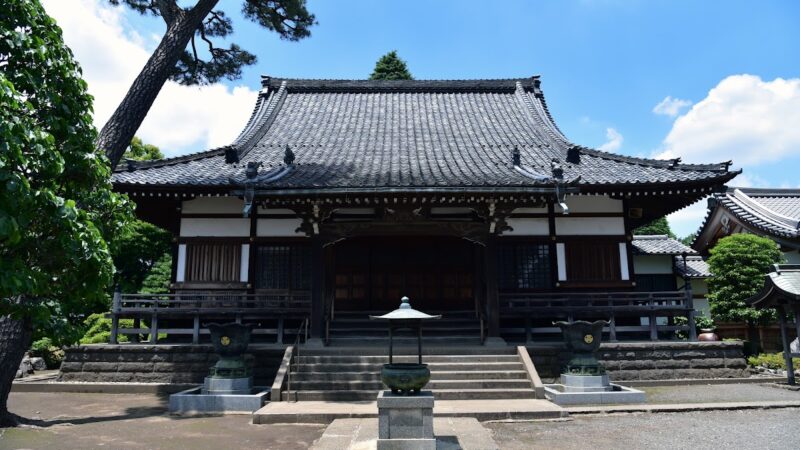
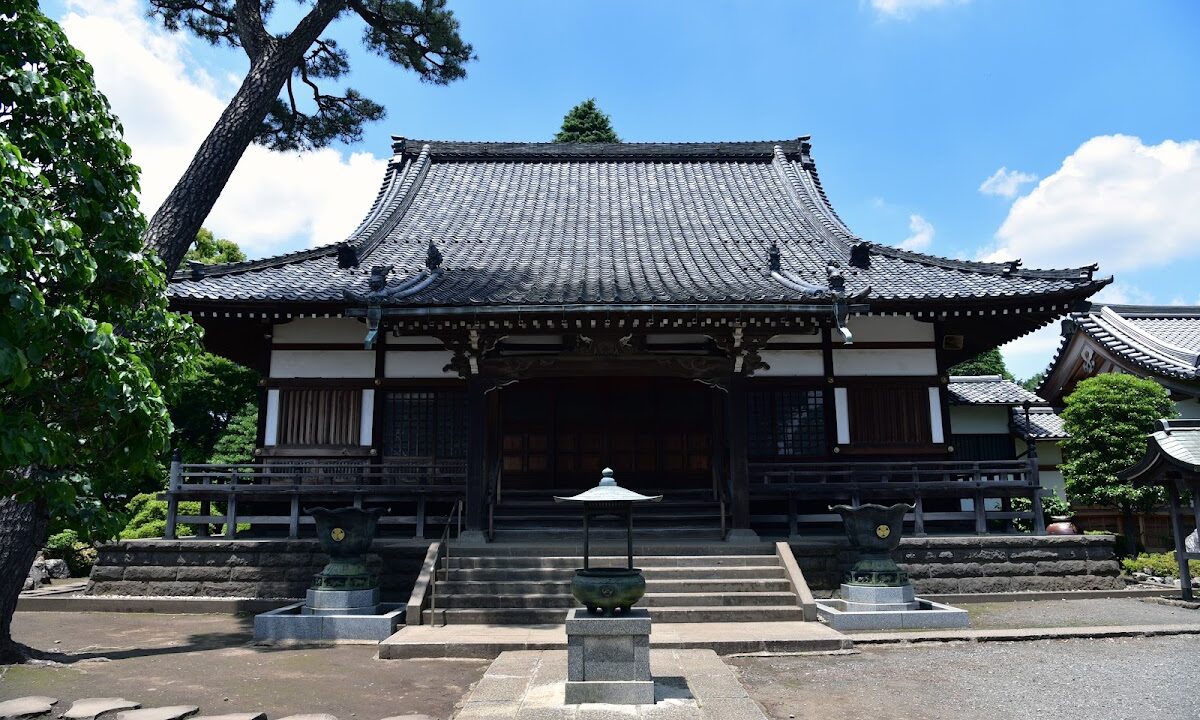
Keigenji Temple, the Kitami clan’s family temple, is central to any visit to the Kitami encampment site. Keigenji is a Soto Zen Buddhist temple, and the Kitami clan’s burial grounds still remain there.
Location: 4-17-1 Kitami, Setagaya-ku, Tokyo
Keigenji Temple contains numerous graves of the Edo and Kitami clans, including the grave of Edo Shigenaga. A bronze statue of Edo Shigenaga is also located on the temple grounds, allowing visitors to reflect on the history of the Edo and Kitami clans.
The area around the gate of Keigenji Temple is believed to have been the center of the encampment, making it a crucial point of interest when visiting the encampment site. The impressive temple gate and main hall evoke the powerful presence of the Kitami clan in their heyday.
Suga Shrine (Kitami Suga Shrine)
Suga Shrine, along with Keigenji Temple, is considered a likely site of the Kitami Jinya (fortified residence). While officially called “Suga Shrine,” it is also known locally as “Kitami Suga Shrine.”
Suga Shrine has long been revered as the guardian shrine of Kitami, and is believed to have existed since the time of Kitami Castle and the Kitami Jinya. It has been suggested that the area surrounding the shrine may have been part of the Jinya’s grounds.
Hikawa Shrine
Kitami also has Hikawa Shrine, which is another likely site of the Jinya. Hikawa Shrines are numerous in Musashi Province, and the Kitami Hikawa Shrine also has a long history.
The area where these three religious facilities—Keigenji Temple, Suga Shrine, and Hikawa Shrine—are concentrated is thought to have been the central part of the former Kitami Jinya. Visiting these sites allows one to imagine the scale of the Jinya.
Rokutenzuka Kofun (Tumulus of the Sixth Heavenly Mound)
Near the Kitami Jinya (fortified residence) site, there remains the Rokutenzuka Kofun, a tumulus period (Kofun period) archaeological site. While this tumulus is not directly related to the Kitami Jinya, it is an important historical site indicating that Kitami was a place where people lived from ancient times.
When visiting the Jinya site, a recommended route is from Keigenji Temple to Suga Shrine and then to the Rokutenzuka Kofun, taking approximately 30 minutes to 1 hour.
Access and Visiting Guide
Access by Train and Bus
The most convenient way to access the Kitami Jinya site is via the Odakyu Odawara Line.
Nearest Station: Odakyu Odawara Line “Seijo Gakuenmae Station”
From the south exit of Seijo Gakuenmae Station, take an Odakyu Bus or Tokyu Bus and get off at the “Jidayu-bori Park-mae” bus stop. Keigenji Temple is approximately an 8-minute walk from the bus stop.
It is also possible to access the site on foot from Kitami Station on the Odakyu Odawara Line, but the distance is somewhat longer (approximately 15 minutes on foot).
Access by Car
If visiting by car, please note that there is no dedicated parking at Keigenji Temple or Suga Shrine, so you will need to use a nearby coin-operated parking lot. The roads on the west side of Tokyo are narrow, and there is a lot of pedestrian and bicycle traffic, so please drive carefully.
While it is possible to access the site from Setagaya-dori and Kanpachi-dori, you will be driving through narrow residential streets, so it is recommended to check the route on a map beforehand.
Points to Note When Visiting
The Kitami Jinya site has been completely developed into residential land, and there are almost no noticeable remains or information signs. Keigenji Temple and Suga Shrine still function as religious facilities, so please observe proper etiquette when visiting.
In particular, Keigenji Temple contains the burial grounds of the Kitami clan, so quiet observation is required. Photography is permitted, but please be careful when taking pictures in the cemetery.
Best Time to Visit
Kitami Jinya Ruins is a flatland castle (castle on flat ground) and does not have particularly rugged terrain, so it can be visited regardless of the season or weather. However, the surrounding scenery is beautiful during cherry blossom season and autumn foliage season, making for a more enjoyable visit.
Nearby Historical Spots
Jidaibori Park
Near Kitami Jinya Ruins is Jidaibori Park. This park is a facility that recreates the rural landscape of the Edo period, exhibiting old houses and watermills. It is a useful spot for imagining life during the time of Kitami Jinya.
Setagaya Castle Ruins Park
There are other medieval castle ruins in Setagaya Ward, and Setagaya Castle Ruins Park is a prime example. Setagaya Castle is known as the residence of the Kira clan and was a larger castle than Kitami Castle. Visiting both Kitami Jinya Ruins and Setagaya Castle allows you to experience the history of Setagaya Ward from the medieval to early modern periods.
Historical Sites in Komae City
Kitami is located near the border with Komae City, and many historical sites remain on the Komae City side as well. There are numerous interesting spots for history enthusiasts, including ancient burial mounds and medieval temples and shrines.
Historical Significance of the Kitami Jinya Ruins
The Uniqueness of the Only Domain in Tokyo’s 23 Wards
The greatest historical significance of the Kitami Jinya Ruins lies in the fact that it was the only domain’s administrative headquarters located within Tokyo’s 23 wards. Edo was strictly controlled as a direct territory of the Tokugawa Shogunate, and the establishment of a daimyo’s domain was extremely unusual.
This unique situation demonstrates the deep relationship between the Kitami clan and the Tokugawa family, particularly their personal connection with Tokugawa Tsunayoshi. At the same time, the fact that they were dispossessed after only three years illustrates the political risks of establishing a daimyo’s domain near Edo.
The Historical Importance of the Edo Clan
The Edo clan, the predecessors of the Kitami clan, is the family from which the name Edo originates and is an indispensable part of Tokyo’s history. The existence of the Edo clan, who had a residence on the site of Edo Castle before Ota Dokan, represents an ancient layer of Tokyo’s history.
Visiting the Kitami Jinya (fortified residence) site allows you to trace the footsteps of a prestigious family that continued from the Edo clan to the Kitami clan, providing an opportunity to deeply understand Tokyo’s regional history.
A Valuable Example in Jinya Research
Many jinya sites remain throughout Japan, but most are located in rural areas. The Kitami Jinya is a valuable example in jinya research because it was located in an urban area, specifically within the 23 wards of Tokyo, Japan’s largest metropolitan area.
Although the remains have been lost, attempts to reconstruct the appearance of the jinya from historical documents, the surrounding topography, and the arrangement of temples and shrines have become an important theme in urban history research.
The Significance of Visiting the Kitami Jinya Ruins
Currently, very few visible remains of the Kitami Jinya are left. However, by visiting the Kitami family’s burial grounds at Keigenji Temple, the tranquil grounds of Suga Shrine, and walking through the surrounding streets, one can feel the weight of history that once characterized this place as the site of a domain’s administrative center.
The story of this small domain, buried within the vast metropolis of Tokyo, reveals the multifaceted and complex nature of Japanese history. The rise and fall of the Kitami family, from the Edo clan to the Tokugawa shogunate, and their dramatic end with sudden confiscation of their domain—these historical facts convey the fascination and depth of history to us today.
The Kitami Jinya Ruins are not a flashy tourist destination. However, for those who love history and contemplate the lives of people from the past, it is undoubtedly a historical site worth visiting. Experiencing the history of Tokyo’s only domain in a quiet residential area will be a unique and invaluable experience.
Summary
The Kitami Jinya Ruins, located in Kitami, Setagaya Ward, Tokyo, are the remains of an Edo-period jinya (fortified residence). It was the administrative center of the Kitami Domain, the only feudal domain located within Tokyo’s 23 wards. Ruled by the Kitami clan, descendants of the Edo clan, the domain was established in 1686 (Jōkyō 3), but was abolished just three years later in 1689 (Genroku 2) due to a stabbing incident.
Currently, no remains of the jinya exist, but the area around Keigenji Temple (the Kitami clan’s family temple) and Suga Shrine is believed to be the site of the jinya. It is accessible by bus and on foot from Seijōgakuenmae Station on the Odakyu Odawara Line, and the visit takes approximately 30 minutes to an hour.
The history of the prestigious Kitami clan, a lineage from the Edo clan, its unique status as the only feudal domain within Tokyo’s 23 wards, and its dramatic end due to sudden abolition are all significant points. The Kitami Jinya Ruins are a valuable historical site that preserves these historical facts, making it a worthwhile place for history enthusiasts to visit.