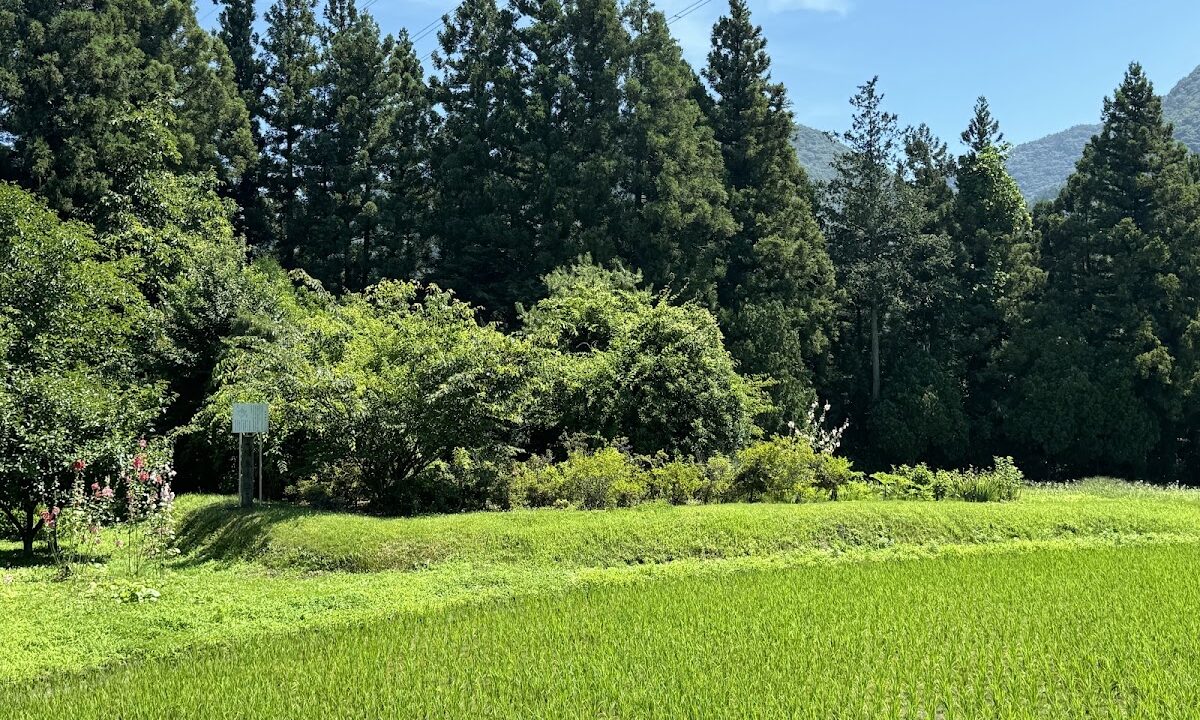
Uekuri Castle (Higashiagatsuma Town, Gunma Prefecture) | A Thorough Explanation of the History and Highlights of this Cliffside Castle Overlooking the Agatsuma River
Uekuri Castle is a medieval mountain castle located in Uekuri, Higashiagatsuma Town, Agatsuma District, Gunma Prefecture. Known as a cliffside castle built on a natural stronghold on the cliff of the south bank of the Agatsuma River, it played an important role in the Agatsuma region during the Sengoku period. This article provides a detailed explanation of Uekuri Castle’s history, structure, highlights, and access methods.
Overview and Location of Uekuri Castle
Uekuri Castle is a flatland castle built on a river terrace on the right bank of the Agatsuma River, with a relative height of approximately 30-40 meters above the river surface. Located at the tip of a gently sloping plateau, it has the typical structure of a cliffside castle, with a sheer cliff of the Agatsuma River to the north and a continuous plateau to the south.
The castle is located at an elevation of approximately 343 meters, overlooking the settlement of the present-day Uekuri district in Higashiagatsuma Town. This location was extremely important for monitoring water transport on the Agatsuma River and controlling a key transportation hub in the Agatsuma region.
Characteristics as a Cliffside Castle
A cliffside castle is a type of castle that utilizes cliffs formed by rivers or valleys as natural defensive walls. Uekuri Castle is a typical example; the cliff facing the Agatsuma River on the north side is a natural stronghold that is extremely difficult for attackers to climb. On the other hand, artificial defensive structures such as dry moats and earthworks were constructed on the south and west sides, which are connected to the plateau, enabling defense from all directions.
History of Uekuri Castle
Construction History and Period
There are various theories regarding the construction period of Uekuri Castle, but according to the “Comprehensive Survey of Japanese Castles,” it was built during the Kansho era (1460-1466). However, the historical evidence supporting this date is unclear, and it has been suggested that the actual construction date may be even earlier.
The castle was built by the Uekuri clan, and records confirm that this family held power as local lords in the Agatsuma region. The Uekuri clan, as influential local lords in the Agatsuma region, were deeply involved in the regional political situation.
The Conflict of the Ōnin Era
One of the most important events in the history of Uekuri Castle is an incident that occurred in Ōnin 2 (1468). According to historical records, Yanagisawa Naoyasu, the aunt-in-law of Uekuri Aki-no-kami, was attacked by Saitō Yukihiro and fled to Uekuri Castle.
During this period, conflicts between local forces intensified in the Agatsuma region, suggesting that Uekuri Castle also served as a refuge.
The Relationship Between the Saitō and Uekuri Clans
With the arrival of the Sengoku period, the relationship between the Uekuri and Saitō clans greatly influenced the fate of Uekuri Castle. When Saito Noritsugu, who had been ordered to suppress Uekuri Motoyoshi, rebelled, defeated Ono Norinao, and became the lord of Iwagutsu Castle, Uekuri Motoyoshi is said to have followed Saito Noritsugu.
This choice allowed the Uekuri clan to be incorporated into the sphere of influence of the Saito clan, who were based at Iwagutsu Castle, and to maintain a certain position within the political structure of the Agatsuma region.
Relationship with the Sanada Clan
In the late Sengoku period, the Agatsuma region came under the influence of the Sanada clan. When Sanada Masayuki captured Iwagutsu Castle, the Uekuri clan also became vassals of the Sanada clan. The Uekuri clan is said to have participated in the Battle of Takeshita and defensive battles against the Hojo clan’s invasions as subordinates of the Sanada clan.
Within the Sanada clan’s rule of the Agatsuma region, Uekuri Castle played a part in the Sanada clan’s network of branch castles and continued to function as a base for monitoring and defending the Agatsuma River basin.
Period of Abandonment
The exact period of abandonment of Uekuri Castle is unclear, but it is believed to have ended its military role with the end of the Sengoku period (Warring States period). In the Edo period, it lost its function as a castle, and much of the remains were converted into farmland.
Structure and Layout of Uekuri Castle
Honmaru (Main Enclosure)
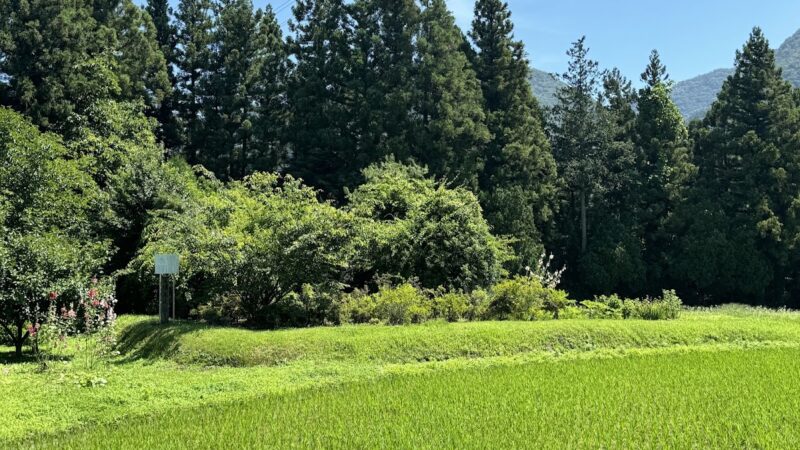
The Honmaru, the central enclosure of Uekuri Castle, is a rectangular enclosure measuring approximately 60 meters east-west and 30 meters north-south. Currently used as farmland, the slightly elevated terrain indicates the former enclosure site.
The Honmaru is the highest point within the castle grounds, offering a panoramic view of the Agatsuma River and the surrounding terrain. It is believed that this enclosure served as the lord’s residence and command post.
Obi-guruwa (Outer Enclosure)
To the south of the Honmaru is the Obi-guruwa (outer enclosure). An Obi-guruwa is a long, narrow enclosure surrounding the main enclosure, enhancing its defensive capabilities and serving as a troop garrison and storage area for supplies.
The outer bailey of Uekuri Castle was built along the southern slope of the main keep, and it is presumed to have functioned as a defensive line against attacks from the plateau.
Dry Moat
The remains of a dry moat are still visible on the west side of the main keep. Dry moats were important defensive structures to prevent enemy intrusion, and their location on the west side, adjacent to the plateau, indicates vigilance against attacks from this direction.
The traces of the dry moat are still relatively clear and are among the best-preserved remains of Uekuri Castle. While the depth and width are shallower than they were in the past, the shape of the moat bottom and slopes allows us to estimate its original size.
Moat Remains and Irrigation Canal
A gravel road and irrigation canal run along the south side of the outer bailey, and these are thought to have utilized the remains of the castle’s moat. Moats of medieval castles were often repurposed as roads or irrigation canals after the castle was abandoned, and this typical pattern can be seen at Uekuri Castle.
Observing the location and shape of the irrigation canals provides clues to estimating the layout of the moats and the extent of the castle grounds in the past.
Earthworks
Traces of earthworks remain in some sections. Earthworks were often constructed in conjunction with moats, and were efficient defensive structures created by piling up excavated soil to form a defensive wall. While most of the earthworks at Uekuri Castle have been lost due to weathering and agricultural development, there are places where the original layout can be inferred from the subtle undulations of the terrain.
Highlights of Uekuri Castle
View from the Cliff
The greatest highlight of Uekuri Castle is the view of the Agatsuma River from the cliff on the north side. The flow of the Agatsuma River, viewed from the cliff 30-40 meters high, is spectacular, and you can truly appreciate why this natural stronghold was chosen as the location for the castle.
On a clear day, you can see the Agatsuma River basin, the terrain on the opposite bank, and even the distant mountain range, allowing you to imagine what the castle lords of the Sengoku period saw from this spot.
Remains of the Dry Moat
The dry moat remaining on the west side of the main enclosure is the most clearly identifiable remains of Uekuri Castle. From the shape and scale of the moat, you can learn about the construction techniques of medieval castles. Walking along the bottom of the moat is a valuable opportunity to experience the defensive structure of the time.
Topography of the Enclosure Sites
In the main enclosure and outer enclosures, which are now farmland, the shape of the flat areas from that time is relatively well preserved. By observing the elevation differences with the surrounding area and the arrangement of the enclosures, you can grasp the overall layout of the castle.
Settlement Below the Castle
To the south of Uekuri Castle lies the Uekuri settlement, which may have had elements of a castle town. Some place names and road layouts within the settlement suggest remnants of the past, providing clues to imagining the medieval landscape integrated with the castle.
Castle Notes (Points to Note When Visiting)
Estimated Visiting Time
The time required to visit Uekuri Castle is approximately 20-30 minutes, considering the size and current state of the remains. Since the main remains are limited to the main keep site and the dry moat, you can complete your visit in a short time even with careful observation.
Difficulty of Visiting
Uekuri Castle is currently farmland and is likely private property, so caution is necessary when visiting. Observation from a distance or from the public road is the basic approach. The cliff side is dangerous, so extreme caution is required when approaching.
Photography Points
The main photography points are the farmland at the main keep site, the dry moat on the west side, and the cliff view overlooking the Agatsuma River. The dry moat, in particular, is well-preserved, allowing for valuable photographs of medieval castle remains.
Best Season for Visiting
Spring to autumn is the best time to visit. In winter, there is a possibility of snow, and the ground may be slippery, so caution is necessary. In summer, vegetation may grow thickly, making the remains difficult to see.
Photography Points
The farmland at the main keep site, the dry moat on the west side, and the cliff view overlooking the Agatsuma River are the main photography points. ## Access Information
Location
Address: Tonomae, Ueguri, Higashiagatsuma-machi, Agatsuma-gun, Gunma Prefecture
Access by Car
Approximately 40 minutes from the Shibukawa-Ikaho Interchange on the Kan-Etsu Expressway via National Route 17 and National Route 353. The Ueguri area along National Route 145 is the target.
There is no designated parking area, so please park in a location that does not inconvenience the surrounding area.
Access by Public Transportation
Approximately 20-30 minutes on foot from JR Agatsuma Line “Iwashima Station” or “Gunma-Haramachi Station”. However, the castle ruins are a bit of a distance from the station, so you may want to consider taking a taxi.
Nearby Facilities
There are no particular tourist facilities around Ueguri Castle, but there are roadside stations and hot spring facilities in Higashiagatsuma-machi, which can be used in conjunction with visiting the castle ruins.
Surrounding Castles
Iwagutsu Castle
Located approximately 5 kilometers northeast of Uekuri Castle, Iwagutsu Castle is a mountain castle known as an important base for the Sanada clan. It served as the main castle of the Uekuri clan when they served the Saito and Sanada clans, and thus has a deep connection to Uekuri Castle. Built on Mt. Iwagutsu (802 meters above sea level), it is a sturdy mountain castle with well-preserved remains.
Nakayama Castle
Nakayama Castle also occupies an important position as part of the castle network in the Agatsuma region. Like Uekuri Castle, it functioned as a castle of a local lord and is a valuable historical site for understanding the region’s history.
Takeyama Castle
Another important castle within Higashiagatsuma Town is Takeyama Castle. Built on the summit of Mt. Takeyama, it is a mountain castle situated in a particularly rugged location among the castles of the Agatsuma region.
Uekuri Castle and the Castle Culture of Gunma Prefecture
Characteristics of Castles in Gunma Prefecture
Gunma Prefecture boasts numerous important castles from the Sengoku period, including Minowa Castle, Kanayama Castle, and Iwagutsu Castle. While Uekuri Castle is smaller in scale compared to these larger castles, it is significant for its role as a local lord’s castle closely integrated with the local community.
Gunma Prefecture’s castles are characterized by their strong defensive structures due to their strategic location at a crucial transportation hub connecting Kanto and Shin’etsu regions, resulting in high military tension.
Castle Network in the Agatsuma Region
The Agatsuma region contains several castles, including Uekuri Castle, Iwagutsu Castle, and Takayama Castle, forming a coordinated defensive network. These castles monitored the transportation routes along the Agatsuma River basin and prepared for invasions from the Shinano region.
Uekuri Castle is thought to have functioned as a monitoring base in the middle reaches of the Agatsuma River within this network, playing a part in the defense system centered around Iwagutsu Castle.
Current Status and Preservation of Uekuri Castle
Preservation Status of Remains
While most of the remains of Uekuri Castle have been altered due to agricultural development, the main structures, such as the topography of the main enclosure, the western dry moat, and the southern moat, remain as topographical features. However, it has not been developed as a historical site, and no information boards or explanatory signs have been installed.
Future Challenges
Uekuri Castle is an important historical site that conveys the history of the region, but its low profile has limited efforts for preservation and utilization. The challenge now is to re-evaluate it as a regional historical resource and consider appropriate methods for preservation and public access.
Related Historical Materials and Research
Major Literature
Descriptions of Uekuri Castle are included in Volume 4 of the “Comprehensive Survey of Japanese Castles” (Shin Jinbutsu Oraisha). Furthermore, fragmentary records remain in local history materials of Gunma Prefecture and Higashiagatsuma Town.
Archaeological Investigation
While no full-scale excavation has been conducted at Uekuri Castle, basic information about the castle’s structure and size has been accumulated through surface observations and layout surveys. Further academic research may yield more detailed information about the castle’s construction period and the changes in its lords.
Tourist Information and Model Courses
Agatsuma Region Castle Tour
When visiting Uekuri Castle, it is recommended to also visit surrounding castles such as Iwagutsu Castle and Takayama Castle. The following is a model course that allows you to visit the major castles of the Agatsuma region in one day.
Morning: Iwagutsu Castle (2 hours of sightseeing)
Lunch: Restaurant in Higashiagatsuma Town
Afternoon: Uekuri Castle (30 minutes of sightseeing) → Takayama Castle (1.5 hours of sightseeing)
Nearby Hot Springs
The Agatsuma region is known as a treasure trove of hot springs. After visiting the castles, you can relax and unwind at Kusatsu Onsen, Shima Onsen, or Kawarayu Onsen. Kawarayu Onsen, in particular, is close to Uekuri Castle and is suitable for day trips.
Local Specialties
Higashiagatsuma Town is known for its agricultural products such as highland vegetables and apples. You can purchase fresh local produce and processed goods at the “Agatsuma Gorge” roadside station.
Summary
Uekuri Castle is a cliffside castle from the Sengoku period that remains in Higashiagatsuma Town, Gunma Prefecture. Although small in scale, Uekuri Castle is a valuable historical site for learning about the characteristics of medieval castles, thanks to its location utilizing the natural fortifications of the Agatsuma River cliffs, its historical changes from the Uekuri clan to the Saito and Sanada clans, and the surviving remains such as dry moats.
While it hasn’t been developed into a large-scale tourist destination, this makes it a place where you can quietly feel the history. It’s a castle site worth visiting as part of a tour of castles in the Agatsuma region, or for anyone interested in the medieval history of Gunma Prefecture.
Visiting it along with other nearby castles such as Iwagutsu Castle and Sugiyama Castle will allow you to gain a deeper understanding of the castle network and regional control in the Agatsuma region during the Sengoku period. When visiting Uekuri Castle, please be sure to prioritize safety while experiencing the historical romance of the Sengoku period.