Takeyama Castle (Gunma Prefecture) Complete Guide | A Fortified Mountain Castle with a Tragic Sengoku Period Story and Remnants of Sacred Mountain Faith
What is Takeyama Castle? – An Overview of the Mountain Castle Towering in Agatsuma District, Gunma Prefecture
Takeyama Castle is a multi-bailey mountain castle located in Takeyama, Gotanda, Nakanojo-machi, Agatsuma District, Gunma Prefecture. Also known as Takeyama Castle, Gakusan Castle, and Gakusan Castle, it functioned as an important base for the Agatsuma Saito clan, a local lord who ruled the Agatsuma region during the Sengoku period.
Mount Takeyama, at an altitude of 789 meters, has long been considered an object of sacred mountain faith and has a history of flourishing as a training ground for Shugendo (mountain asceticism). The mountaintop has three peaks called Kotengu, Nakatengu, and Otengu, and it is a natural fortress built skillfully utilizing the rugged, rocky terrain. Currently, the “Michi-no-Eki Reizan Takeyama” (roadside station) is located at the foot of the mountain, and the hiking trails are well-maintained, making it a popular spot not only for castle enthusiasts but also for hiking lovers. Takeyama Hyakuban Kannon (100 Kannon statues of Takeyama) are scattered throughout the mountain, making it a valuable place where you can enjoy both historical exploration and a path of faith.
History of Takeyama Castle – The Rise and Fall of the Azuma Saito Clan and the Conquest by Sanada Yukitaka
The Azuma Saito Clan and the Construction of Takeyama Castle
While there are no clear records regarding the builder of Takeyama Castle, it was used as the residence of the Azuma Saito clan, who ruled the Azuma region during the Sengoku period. The Azuma Saito clan was a local lord who controlled the Azuma district in the northwestern part of Kozuke Province (present-day Gunma Prefecture), and their main castle was Iwabitsu Castle, located about 5 kilometers to the east.
Takeyama has been revered as a sacred mountain since ancient times and was a training ground for Shugendo practitioners. Due to its rugged terrain and religious significance, it was considered important as a military base and is believed to have been developed as a subsidiary castle of Iwagutsu Castle.
The Fall of the Castle in 1565 – The Tragedy of Shirotoramaru
The most dramatic event in the history of Sugiyama Castle was its fall in November 1565. In that year, Takeda Shingen, a Sengoku daimyo of Kai Province (present-day Yamanashi Prefecture), sought to expand his power into Kozuke Province and ordered his subordinate, Sanada Yukitaka (father of Sanada Masayuki), to conquer the Agatsuma region.
Sanada Yukitaka, through skillful stratagems and military tactics, first captured Iwagutsu Castle. The then-lord of Iwagutsu Castle, Saito Norihiro, lost his home and retreated to Sugiyama Castle. At Sugiyama Castle, Norihiro’s youngest son, Jōtoramaru (then 18 years old), held out, putting up a final resistance against the Sanada forces.
Sanada Yukitaka, instead of a direct assault, employed his masterful strategy to gain insiders within the castle. Sugiyama Castle, weakened from within, fell, and Saitō Norimune (some sources say Norihiro), who was leading reinforcements from Echigo (present-day Niigata Prefecture), committed suicide. It is said that the young lord, Jōtoramaru, threw himself to death from the Great Tengu Rock.
This tragic end led to the downfall of the Azuma Saitō clan, who had ruled the Azuma region, and the area subsequently came under the control of the Takeda clan, and then the Sanada clan.
Mount Takayama After the Castle’s Demise – A Return to a Shugendo Training Ground
After its fall in 1565 (Eiroku 8), Takayama Castle was soon abandoned and returned to its status as a sacred mountain. During the Edo period, it was developed as a Shugendo training ground and used as a place of practice for mountain ascetics.
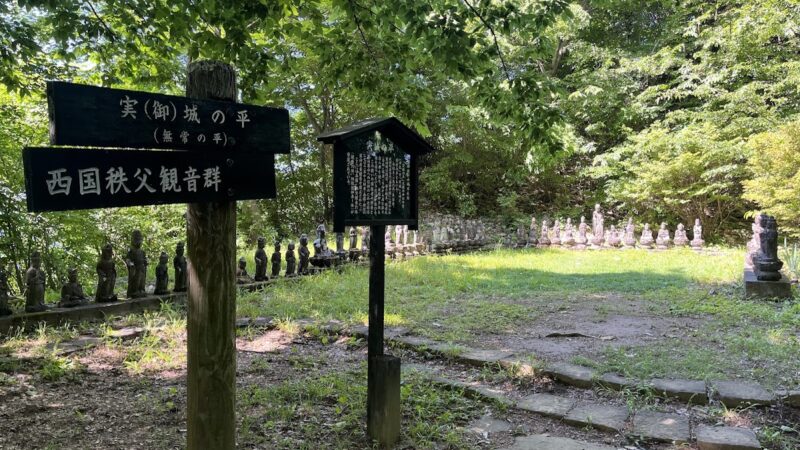
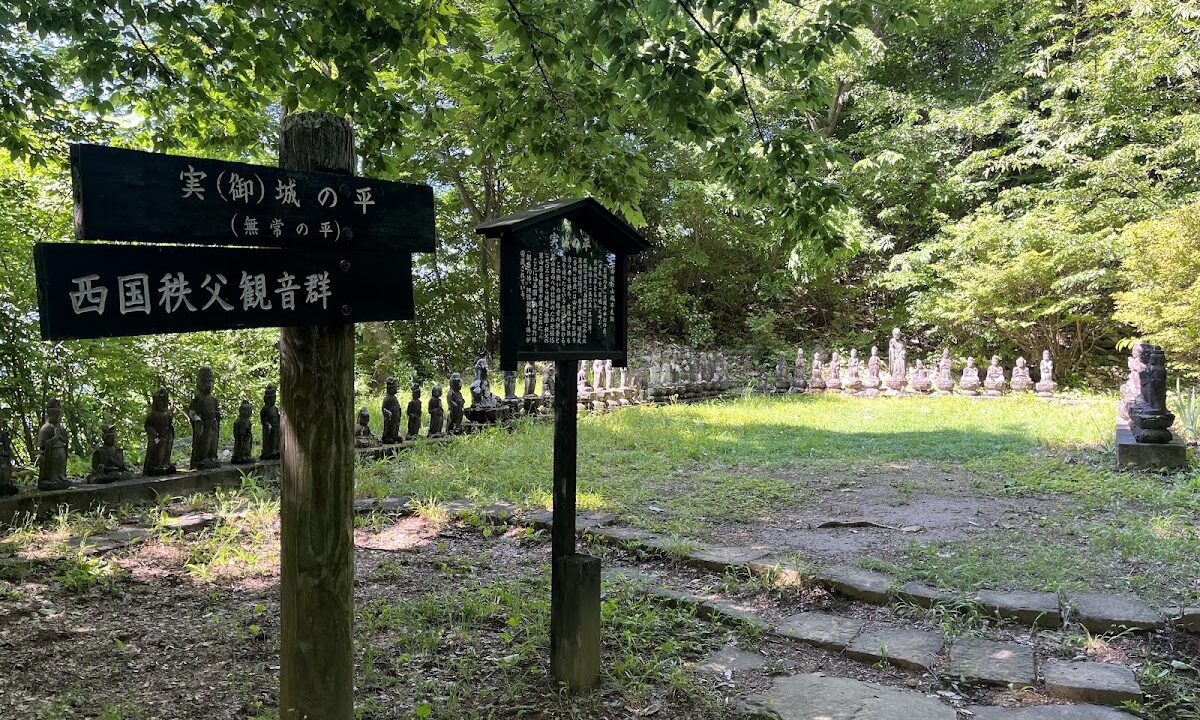
In later generations, the Takayama Hyakuban Kannon (Takayama Hundred Kannon) was erected on the mountain to commemorate those who died in battle, including Shirotoramaru. Even today, 33 Kannon statues (representing the 33 temples of the Saigoku pilgrimage) are scattered along the mountain paths, watching over hikers.
The Layout and Remains of Takayama Castle – Traces of a Mountain Castle Remaining on the Peak of the Three Tengu Mountains
Basic Structure and Layout of the Castle
Takayama Castle is a renkukai-style mountain castle located on the summit of Mount Takayama. The castle’s layout is characterized by its maximum utilization of the natural fortifications of the entire mountain, which is a rocky mountain, with artificial construction kept to a minimum.
The layout utilizes the three peaks of the mountaintop (Kotengu, Nakatengu, and Otengu), and the main enclosure (honkuruwa) is located on a flat area between Nakatengu and Otengu, and is called Minoshiro no Taira. This name signifies the “real castle” that forms the core of Takayama Castle.
Castle Ruins as Seen from the Main Hiking Trail
Currently, access to Takayama Castle is mainly via the main hiking trail. Entering the trailhead from the Michi-no-Eki Reizan Takeyama (roadside station), you will reach the castle area after climbing approximately 200 meters in elevation.
Several information boards are installed along the hiking trail, allowing you to confirm the location of the castle ruins and the Kannon statue. While the hiking trail is well-maintained, there are rocky areas and sections requiring chains, so appropriate equipment is necessary. ### Details of Major Remains
Jitsujo no Taira (Main Enclosure)
Located between Nakatengu and Otengu, the main enclosure was the central facility of Sugiyama Castle. Currently, an information board is installed here, marking “Jitsujo no Taira,” and it indicates that Shirotoramaru met his end here. While the flat area is limited, it is clear that the surrounding rock walls functioned as a natural defensive structure.
Moats and Cut Slopes
As defensive structures unique to mountain castles, traces of moats cutting across the ridges and artificially carved cut slopes remain in various places. However, due to the exposed bedrock terrain, some areas are not as clearly defined as in other mountain castles.
Enclosure Remains and Flat Areas
Several enclosure remains and flat areas can be identified around the main enclosure. These are thought to have been used as soldier garrisons or storage areas for supplies. The arrangement of the enclosures in a linear fashion allows for observation of the tiered placement of each enclosure.
The Great Tengu’s Rock
The Great Tengu, from which Shirotoramaru is said to have thrown himself, is located near the highest point of Mt. Takayama. From the sheer cliff face, one can enjoy a panoramic view of the Azuma Mountains, and many visitors come to this place, which still conveys the tragedy of the Sengoku period.
Remains as a Sacred Mountain – The Hundred Kannon Statues and Traces of Shugendo
Apart from the castle remains, Mt. Takayama also has abundant remains related to Shugendo (mountain asceticism). The Hundred Kannon Statues of Mt. Takayama, scattered throughout the mountain, were erected after the Edo period, and 33 Kannon statues can currently be identified.
These Kannon statues have served as memorials for those who died in battle, including Shirotoramaru, and as guideposts for Shugendo practitioners. Searching for the Kannon statues is one of the pleasures of climbing Mt. Takayama, alongside exploring the castle.
Access and Climbing Information for Takayama Castle
Basic Information
- Location: Takayama, Gotanda, Nakanojo-machi, Agatsuma-gun, Gunma Prefecture
- Castle Type: Multi-bailey mountain castle
- Construction Period: Unknown (Sengoku period)
- Year of Abandonment: Eiroku 8 (1565)
- Designated Cultural Property: Nakanojo Town Historic Site
- Elevation: 789 meters
- Relative Height: Approximately 200 meters (from the trailhead)
Access by Car
The most convenient route is to aim for Michi-no-Eki Reizan Takeyama.
- Approximately 40 minutes from the Kan-Etsu Expressway, Shibukawa-Ikaho IC, via National Route 353 and Prefectural Route 53.
- Approximately 1 hour from the Joshin-Etsu Expressway, Usui-Karuizawa IC, via National Route 18, National Route 145, and Prefectural Route 53.
There is free parking at the roadside station, and it’s just a few minutes’ walk from there to the trailhead of the main hiking trail.
Access by Public Transportation
- Approximately 15 minutes by taxi from JR Agatsuma Line “Nakanojo Station”.
- Since the number of local buses is limited, it is recommended to check with the Nakanojo Town Tourism Association in advance.
Hiking Route and Estimated Time
Main Hiking Trail Course (Recommended)
The most common route is using the main hiking trail from the Michi-no-Eki Reizan Takeyama (roadside station).
- Estimated Time: Approximately 2-3 hours round trip (including time for exploring the castle)
- Difficulty: Beginner to Intermediate (includes rocky areas and sections with chains)
- Distance: Approximately 3 kilometers round trip
The hiking trail is well-maintained, but due to the presence of rocky areas and sections with chains, wearing hiking boots or trekking shoes is required. Gloves are also helpful on the sections with chains.
Loop Hiking Route
Mt. Takayama is also a well-maintained hiking course, and you can enjoy a loop route that visits the three peaks of Kotengu, Nakatengu, and Otengu. Those who are uncomfortable with rocky areas and sections with chains can choose to hike only the safer routes.
Notes for Visitors
- Season: Spring to autumn (April to November) is the best time for hiking. In winter, there is a risk of snow and ice.
- Clothing: Long sleeves, long pants, and hiking boots are recommended.
- Items to bring: Drinking water, snacks, gloves, rain gear, map.
- Safety: Avoid solo hiking; visiting in groups is recommended.
- Manners: Protect the ruins, take your trash with you, and show respect to the Kannon statue.
Highlights and ways to enjoy Takayama Castle
Exploring the castle ruins
The greatest appeal of Takayama Castle is the opportunity to experience the structure of a mountain castle utilizing a natural rocky mountain. At the main enclosure, Jitsujo no Hira, you can feel the tense atmosphere of the Sengoku period while reflecting on the final moments of Shirotoramaru.
By climbing while observing defensive structures such as moats and climbing slopes, you can understand the castle construction techniques and defensive philosophies of the time. There are plenty of information boards, so even first-time visitors can explore without missing any ruins.
Pilgrimage to the 100 Kannon Statues of Mt. Takayama
A major pleasure of climbing Mt. Takayama is searching for the 33 Kannon statues scattered throughout the mountain. The statues are arranged in accordance with the 33 Kannon pilgrimage sites of the Saigoku Kannon Pilgrimage, and each is numbered.
Searching for the Kannon statues offers a different perspective on Mt. Takayama compared to exploring the castle, allowing you to experience a unique atmosphere where history and faith are intertwined.
Enjoying the Views
From various peaks, including Otengu, you can enjoy panoramic views of the Azuma Mountains. On some days, you can even see Mt. Iwagutsu, Mt. Asama, and even as far as Mt. Tanigawa, making it a popular spot for breathtaking views.
During the autumn foliage season, the surrounding mountains change color, creating an even more beautiful landscape.
Photography Tips
Mt. Takayama Castle is also an attractive photo spot.
- Information Board at Jitsujo-no-Taira: An important location that tells the story of Shirotoramaru
- Great Tengu Rock Head: Impressive rock face and view
- Kannon Statue: Moss-covered stone Buddha and forest scenery
- Rocky Area and Chain Climbing: Dynamic atmosphere of a mountain castle
Many castle enthusiasts visit and post on social media, so it’s recommended to refer to photos from other visitors beforehand.
Nearby Historical Spots – Iwagutsu Castle and the Agatsuma Castle Group
Iwagutsu Castle – The Headquarters of the Agatsuma Saito Clan
Located approximately 5 kilometers east of Takayama Castle, Iwagutsu Castle was the main castle of the Agatsuma Saito clan and the first castle captured by Sanada Yukitaka. It is an impregnable mountain castle utilizing the sheer cliffs of Mount Iwagutsu. Visiting it together with Takayama Castle will give you a deeper understanding of the Sengoku period history of the Agatsuma region.
Places Associated with the Sanada Clan
The Agatsuma region, where Sanada Yukitaka and his son Masayuki were active, is home to many other castles and historical sites.
- Sanada Clan Main Castle Ruins (Ueda City, Nagano Prefecture)
- Numata Castle (Numata City, Gunma Prefecture)
- Nagurumi Castle (Minakami Town, Gunma Prefecture)
Historical tours visiting these sites are also popular.
Tourist Attractions in Nakanojo Town
Nakanojo Town, home to Takayama Castle, boasts a variety of tourist resources, including hot springs and natural landscapes.
- Shima Onsen: A famous hot spring designated as a national health resort.
- Sawado Onsen: Known as the finishing touch to a bath at Kusatsu Onsen.
- Nozori Lake: A high-altitude lake at 1,500 meters above sea level.
A trip combining castle exploration with hot springs and nature is highly recommended.
Preliminary Knowledge for Visiting Takayama Castle
Sengoku Period History of the Agatsuma Region
To understand Takayama Castle, it is important to know the Sengoku period history of the Agatsuma region. The Agatsuma region in northwestern Kōzuke Province was situated between the three major powers: the Uesugi clan of Echigo, the Takeda clan of Kai, and the Hojo clan of Odawara, and was constantly a stage for power struggles.
The Agatsuma Saito clan initially belonged to the Kanto Kanrei (governor of the Kanto region), the Uesugi clan, but due to Takeda Shingen’s invasion of western Kōzuke, they came under the control of the Takeda clan through the stratagems of Sanada Yukitaka. This process led to the tragedy of Takayama Castle.
Sanada Yukitaka’s Strategic Techniques
Sanada Yukitaka is known as a general skilled not only in military force but also in strategic (internal manipulation of the enemy). In the capture of Iwagutsu Castle and Takayama Castle, he employed a strategy of acquiring internal collaborators rather than direct force, capturing the castles with minimal casualties.
This art of strategy was passed down to his son, Sanada Masayuki, and his grandson, Sanada Nobushige (Yukimura), becoming a family tradition of the Sanada clan.
Shugendo and Mount Takeyama
Mount Takeyama has been revered as a sacred mountain since ancient times and served as a training ground for mountain ascetics. Shugendo is a uniquely Japanese religion that fuses mountain worship and Buddhism (especially esoteric Buddhism), using rugged mountains as training grounds.
The name “Three Tengu of Mount Takeyama” also originates from the Tengu belief, which is highly valued in Shugendo. Even during the period when it was used as a castle, this religious background was not lost, and after the castle was abandoned, it once again functioned as a training ground for Shugendo.
Frequently Asked Questions about Takeyama Castle
Q: How do you pronounce Takeyama Castle?
A: It is pronounced “Takeyama-jo”. The castle’s alternative names, “Takeyama Castle” and “Takeyama Castle,” are also pronounced “Takeyama-jo.” Locally, it’s affectionately known as “Takeyama.”
Q: Can beginners climb it?
A: Yes, the main climbing route is well-maintained, making it accessible even for beginners. However, due to rocky sections and areas requiring chains, appropriate equipment such as hiking boots is necessary. Please allow approximately 2-3 hours for the round trip.
Q: Is there an entrance fee to visit Takeyama Castle?
A: No, visiting Takeyama Castle is free. Parking at the Michi-no-Eki Reizan Takeyama (roadside station) is also free.
Q: Who was Shirotoramaru?
A: Shirotoramaru was the youngest son of the Azuma Saito clan and a tragic young warrior who committed suicide at the tender age of 18 during the fall of Takeyama Castle in 1565. It is said that he resisted Sanada Yukitaka’s attack to the very end, and then threw himself to his death from the Great Tengu Rock.
Q: Can I find all 100 Kannon statues of Mt. Takayama?
A: Currently, 33 statues have been confirmed. They are scattered along the mountain path, but some are in hard-to-find locations. Please enjoy searching for the Kannon statues using the information boards and maps as a guide.
Q: Is it possible to hike in winter?
A: It is dangerous in winter (December to March) due to snow and ice. We recommend visiting from spring to autumn (April to November).
Q: Which should I visit first, Iwagutsu Castle or Takayama Castle?
A: To understand the flow of history, it is recommended to visit Iwagutsu Castle, the main castle of the Azuma Saito clan, first, and then Takayama Castle, the final stage of their battle. This will enhance the narrative. However, you can enjoy the experience regardless of which castle you visit first.
Summary – The Sengoku Period Memories Told by Takayama Castle
Takayama Castle is a mountain castle that symbolizes the Sengoku period history of the Agatsuma region of Gunma Prefecture. It is a unique historical site, blending the story of the Agatsuma Saito clan, who were destroyed by the stratagems of Sanada Yukitaka, the tragedy of the young castle lord, Shiro Toramaru, and the mountain’s reverence as a sacred place.
The castle’s layout, utilizing the natural fortifications of the rocky mountain, the remains of the San-Tengu Peak, the 100 Kannon statues scattered throughout the mountain, and the panoramic views of the Agatsuma Mountains—all of these elements contribute to the charm of Takayama Castle.
As you ascend from the main trail to the castle plain and stand on the Great Tengu Peak where Shiro Toramaru met his end, visitors will feel the atmosphere of the Sengoku period. Take your time exploring the mountain castle, listening to the historical stories told by the information boards and Kannon statues.
Starting from the Michi-no-Eki Reizan Takeyama rest stop, why not enjoy a safe mountain climb with appropriate equipment and experience the memories of the Sengoku period that Takayama Castle conveys? By visiting nearby castles such as Iwagutsu Castle as well, you will be able to gain a deeper understanding of the Sengoku history of the Agatsuma region.