
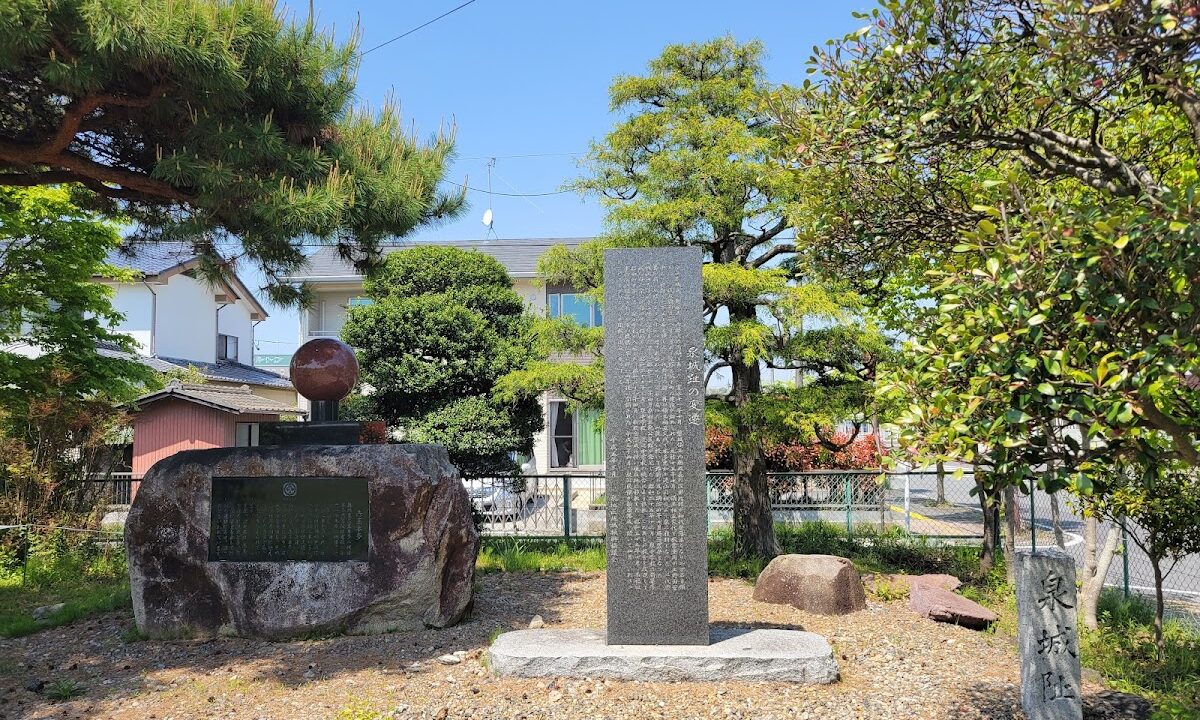
Izumi Jinya Ruins (Iwaki City, Fukushima Prefecture): A Complete Guide to the History and Existing Remains of the Honda Clan, “Akadama Honda”
Located in Izumi-machi, Iwaki City, Fukushima Prefecture, the Izumi Jinya Ruins are an important historical site that functioned as the administrative center of the Izumi Domain, a 20,000-koku domain, during the Edo period. Currently, the site is maintained as a park within the grounds of the Izumi Community Center, with the few remaining earthworks and stone monuments conveying the atmosphere of the past. This article provides a comprehensive explanation of the Izumi Jinya, from its origins to its transformation after the abolition of the feudal system, the existing remains, and the surrounding historical background.
Historical Background of Izumi Jinya
Establishment and Circumstances of the Izumi Domain
The history of the Izumi Domain dates back to 1634 (Kanei 11). When Naito Masanaga, the lord of Iwaki-Taira Castle, died, his eldest son, Naito Tadaoki, inherited the family headship, and granted 20,000 koku to his younger brother, Naito Masaharu. With this division of land, Masaharu became the new lord of Izumi and governed the area.
Initially, the construction of a fortified residence (jinya) did not occur during Masaharu’s reign. However, during the time of his successor, Naito Masachika, in 1668 (Kanbun 8), a jinya was built in Izumi, at the confluence of the Kamado River and the Fujiwara River (present-day Fujiwara River). This location is thought to have been chosen for its convenient water transport and suitability for defense.
Changes in Successive Lords
The Izumi Domain existed for approximately 230 years from its founding until the Meiji Restoration, during which time the ruling family changed three times.
Naito Clan Era (1634-1747)
The Naito clan ruled the domain for four generations, starting with the first lord, Naito Masaharu. The Naito clan served the shogunate as a hereditary daimyo, holding important positions such as Wakadoshiyori (junior councilor) and Jisha Bugyo (commissioner of temples and shrines). However, in 1747 (Enkyo 4), Naito Masaki was transferred to Omi Province, marking the end of the Naito clan’s rule.
Itakura Clan Era (1747-1756)
After the Naito clan’s transfer, Itakura Katsutoshi became the lord of Izumi Domain. The Itakura clan was also a prestigious family of fudai daimyo, having held important positions in the shogunate. However, the Itakura clan’s rule was short-lived, ending in 1756 (Horeki 6) when Itakura Katsukiyo was transferred to Bitchu Matsuyama Domain, after only nine years.
Honda Clan Era (1756-1871)
After the Itakura clan, Honda Tadachika became the lord, and the Honda clan ruled the domain until the Meiji Restoration. The Honda clan was a prestigious fudai family known as the “Tadayoshi-ryu Honda Heihachiro family,” and the Izumi Domain Honda family became particularly known as the “Akadama Honda.”
The Origin and Characteristics of “Akadama Honda”
The Sankin-kōtai Procession with Vermilion Ball Ornaments
The reason the Honda family of the Izumi Domain was called “Akadama Honda” (Red Ball Honda) was due to the distinctive features of their procession during the Sankin-kōtai (alternate attendance) and visits to the castle. The Honda family’s procession featured vermilion (red) ball ornaments on the tips of their spearheads, leading to them being affectionately known as “Akadama Honda” by the people.
These vermilion ball ornaments served as a symbol of the Honda family’s status and dignity, making their procession instantly recognizable in Edo and along the highways. Currently, a monument to “Akadama Honda” stands on the grounds of the Izumi Community Center, preserving this unique culture for future generations.
The Achievements of Honda Tadachika
Honda Tadachika, upon entering the Izumi Domain, dedicated himself to stabilizing the domain’s administration and improving the welfare of its people. While holding important positions in the shogunate, he solidified the foundation of the Izumi Domain, a small domain, and laid the groundwork for the stable domain administration under the Honda family that followed. A monument at the site of Izumi Castle bears an inscription praising Tadachika’s achievements.
Structure and Scale of the Izumi Jinya
Jinya-Style Domain Office
The Izumi Domain’s administrative office was not a “castle” but a “jinya.” A jinya is a domain office without a castle, typically found in small domains of around 10,000 to 50,000 koku. It lacks large defensive structures such as keeps and stone walls, and is characterized by a relatively simple structure demarcated by moats, earthworks, and gates.
Similarly, the Izumi Jinya lacked a keep and stone walls. The lord’s residence, offices, and warehouses were located within a site surrounded by earthworks and a moat. The size of the jinya was appropriate for a small domain of 20,000 koku, and it did not form a large castle city, but it functioned as the political and administrative center of the region.
Location and Topographical Characteristics
The Izumi Jinya (fortified residence) was built at the confluence of the Kamado River and the Fujiwara River. This location offered the following advantages:
- Convenient Water Transport: Being at a river confluence, it was convenient for transporting goods.
- Defensive: The rivers acted as natural moats, providing a defensive advantage.
- Water Resources: Securing water for daily life and agriculture was easy.
It is believed that samurai residences and merchant districts formed around the Jinya, creating a small-scale castle town-like landscape.
The Boshin War and the Izumi Domain
The Turmoil of the Late Edo Period and the Izumi Domain’s Position
During the late Edo period, the Izumi Domain, as a Fudai daimyo (hereditary vassal daimyo), sided with the shogunate. However, being a small domain, it was difficult to take large-scale military action, and it continued to observe the situation.
In 1868 (Keio 4), when the Boshin War spread to the Tohoku region, the Izumi Domain was forced to make a difficult choice. Initially, the Izumi Domain joined the Ouetsu Reppan Alliance, but faced with the overwhelming military power of the new government forces, it ultimately chose to submit to the new government.
The New Government Army’s Advance and the Fate of the Fort
When the new government forces advanced into the Tohoku region, the Izumi Domain surrendered early, thus avoiding a direct attack on the fort. However, fierce battles took place in the surrounding Iwaki-Taira Domain and other areas, and the Izumi region was also affected by the conflict.
With the return of the domains to the emperor in 1868 (Meiji 1) and the abolition of the feudal domains and establishment of prefectures in 1871 (Meiji 4), the Izumi Domain was officially abolished, and the fort ceased to function.
Existing Remains and Historical Sites
Remains on the Grounds of the Izumi Community Center
Currently, the Izumi Fort site is located on the grounds of the “Iwaki City Izumi Community Center” at 4-13-11 Izumi-machi, Iwaki City, Fukushima Prefecture. Although all the buildings of the encampment have been lost, the following remains and historical sites are preserved:
Remaining Earthworks
A small portion of the earthworks that surrounded the encampment remains. While its height is lower than it was at the time, it provides clues to the size and extent of the encampment. The earthworks are preserved in a corner of the park-developed grounds, allowing visitors to imagine its former appearance.
Stone Monuments
Three important stone monuments stand on the site:
- Izumi Castle Site Monument: A major monument indicating the site of the encampment.
- Izumi Castle Site History Monument: A monument recording the history of the castle under the control of the Naito, Itakura, and Honda clans.
- Akadama Honda Monument: A monument recording the achievements of Honda Tadachika and the origin of the name “Akadama Honda.”
These monuments play an important role in conveying the history of the Izumi encampment to visitors.
Relocated and Existing Jinya Rear Gate
Most of the buildings of the Izumi Jinya were demolished after the abolition of the feudal system and sold off to private individuals. However, the Jinya Rear Gate is the only remaining structure, relocated and preserved in a private house within Izumi town.
This rear gate is a valuable historical structure that preserves the architectural style of the late Edo period, and is extremely important for understanding the actual appearance of the Jinya. The gate is a wooden Yakui-mon style structure, demonstrating the high level of carpentry skill of the time. However, because it has been relocated to a private house, it is not open to the public, and only the exterior can be viewed.
Although it has not received formal designation as a cultural property, it is carefully preserved by the local community as a valuable structure that conveys the history of the region.
Access and Visiting Information
Basic Information
- Location: 4-13-11 Izumi-machi, Iwaki City, Fukushima Prefecture 971-8185 (within the grounds of Iwaki City Izumi Community Center)
- Access: Approximately 15 minutes on foot or 5 minutes by car from JR Joban Line “Izumi Station”
- Parking: Parking is available at the Izumi Community Center
- Visiting Hours: The park area is always open (visiting during the community center’s opening hours is recommended)
- Admission Fee: Free
- Estimated Time Required: Approximately 15-30 minutes
Points to Note When visiting the Izumi Jinya Ruins, please pay attention to the following points:
- Explanatory Texts on Stone Monuments: Each of the three monuments contains detailed historical information; carefully reading them will give you an understanding of the overall picture of the Izumi Domain.
- Shape of Earthworks: Try to imagine the scale and extent of the Jinya from the remaining earthworks.
- Surrounding Topography: By examining the relative positions of the Kamado River and Fujiwara River, you can consider why this location was chosen.
- Exhibits in the Community Center: The community center sometimes displays materials related to the Izumi Domain (please check beforehand).
Nearby Historical Spots
Iwaki-Taira Castle Ruins
Located about 20 minutes by car from Izumi Jinya, the Iwaki-Taira Castle Ruins are the site of the main residence of the Iwaki-Taira Domain, the head family of the Izumi Domain. The castle was a fortress with a scale of 50,000 koku, and the remains of the stone walls and moats are remarkably well-preserved. Visiting this site in conjunction with understanding the origins of the Izumi Domain is recommended.
Features of Iwaki-Taira Castle:
- A modern castle with a main keep, second bailey, and third bailey.
- Well-preserved stone walls and moats.
- Developed as Tangosawa Park.
- A castle ruled by Tadaoki, the elder brother of Naito Masaharu, the first lord of the Izumi Domain.
Yunagaya Domain Jinya Site
In addition to the Izumi Jinya, Iwaki City also has the site of the Yunagaya Domain’s jinya (fortified residence). The Yunagaya Domain was a small domain with a 10,000 koku (unit of rice production) yield, ruled by the Naito clan. Like the Izumi Jinya, it was a jinya-style domain office and an important historical site for understanding Iwaki City’s Edo period history.
Iwaki City Archaeological Museum
Located about 15 minutes by car from the Izumi Jinya site, the Iwaki City Archaeological Museum exhibits historical materials from ancient to early modern times in the Iwaki region. It also houses materials related to the Izumi Domain and the Iwaki-Taira Domain, allowing visitors to learn more about the region’s history.
Historical Significance of the Izumi Jinya Site
Value in the Study of Small Domain Administration
The Izumi Jinya site is a valuable historical site for understanding the realities of a small domain with a 20,000 koku (unit of rice production) yield. While there were approximately 260 daimyo families during the Edo period, most were small domains with yields of 50,000 koku or less. However, research and preservation efforts tend to focus on the castles of large domains, often neglecting the jinya (fortified residences) of smaller domains.
The Izumi Jinya site has historical value as a concrete example showing how a small domain managed its administration and interacted with the local community. In particular, the history of three changes in the ruling family—Naito, Itakura, and Honda—is an interesting case study for understanding the shogunate’s personnel policies and the actions of the fudai daimyo (hereditary vassals).
Core of Regional Identity
For the Izumi district of modern Iwaki City, the Izumi Jinya site is the core of the region’s historical identity. The unique culture of “Akadama Honda” is passed down as a source of regional pride and plays a role in strengthening the bonds of the local community.
The preservation of historical sites within the grounds of the Izumi Community Center provides local residents with opportunities to engage with history on a daily basis, and it also functions as a base for local history education.
Challenges and Prospects for Cultural Property Protection
The Izumi Jinya (fortified residence) site is currently protected as a city historical site, but it is not designated as a national or prefectural cultural property. One reason for this is the limited remaining structure, but a comprehensive preservation and utilization plan, including the relocated and existing back gate of the Jinya, is desirable.
In recent years, interest in “Jinya” has been growing nationwide, and comprehensive research and preservation of early modern political and administrative facilities, including Jinya and not just castles, is progressing. The Izumi Jinya site is also expected to be re-evaluated within this trend, and more comprehensive development and information dissemination are anticipated.
Izumi Jinya and Other Jinya in Fukushima Prefecture
Several other Jinya sites remain in Fukushima Prefecture besides the Izumi Jinya.
Shimo-Te-Watari Jinya Ruins (Date City)
In Date City, Fukushima Prefecture (formerly Tsukidate Town), lies the ruins of the Shimo-Te-Watari Domain’s jinya (fortified residence). The Shimo-Te-Watari Domain was a small domain of 10,000 koku (a unit of rice production) established in 1806 (Bunka 3) when the Tachibana family of the Miike Domain, defeated in a political struggle, were demoted and exiled. It lasted for 63 years until 1868 (Meiji 1). Similar to the Izumi Jinya, it is an important historical site for regional history research as a small domain’s jinya.
Jinya Culture of Fukushima Prefecture
Fukushima Prefecture was a region where large domains such as the Aizu Domain and Nihonmatsu Domain coexisted with small domains such as the Izumi Domain, Yunagaya Domain, and Shimo-Te-Watari Domain. The coexistence of the castle culture of large domains and the jinya culture of small domains, and the development of diverse samurai cultures, is one of Fukushima Prefecture’s historical characteristics.
Significance of Visiting Izumi Jinya Ruins
Attraction for History Enthusiasts
Izumi Jinya Ruins, while not flashy, is a valuable place where you can experience firsthand the realities of a small Edo-period domain. By strolling through the site, imagining the simple yet functional layout of the jinya (fortified residence), which differs from large castles, you can understand the practicalities of local governance during the Edo period.
The unique culture of “Akadama Honda” demonstrates the ingenuity and pride of a small domain, offering a glimpse into the diversity of history.
Educational Value
Izumi Jinya Ruins are also used as a site for local history lessons by local elementary and junior high schools. Having historical heritage in a familiar location provides children with an opportunity to feel closer to history and cultivate a love for their hometown.
The explanatory text on the stone monument is clearly written and can be understood even without specialized historical knowledge. It is suitable for family visits and, as it is developed as a park, serves both as a historical walking site and a place of relaxation.
Potential as a Tourism Resource
Currently, the Izumi Jinya Ruins are a historical site not widely known outside of local residents. However, as part of Iwaki City’s historical tourism route, more proactive information dissemination is expected. The development of themed tourism, such as an “Iwaki Domain Tour” combining the Iwaki Jinya Ruins with the Iwaki Taira Castle Ruins and the Yunagaya Domain Jinya Ruins, is also possible.
In particular, the unique culture of “Akadama Honda” is attractive as material for tourism promotion. Exhibits recreating the red ball decorations and events recreating the processions of the Sankin-kōtai (alternate attendance) system are worth considering as initiatives to revitalize the region’s historical culture.
Summary: Izumi Jinya Ruins Convey the History of a Small Domain
The Izumi Jinya Ruins in Iwaki City, Fukushima Prefecture, is a historical site that functioned as the domain office of the Izumi Domain, a small domain of 20,000 koku during the Edo period. The domain’s rulers changed from the Naito, Itakura, and Honda clans, and it is particularly known for the unique culture of “Akadama Honda” during the Honda clan’s rule.
Although most of the original jinya (fortified residence) buildings have been lost, the remaining earthworks, three stone monuments, and the jinya’s back gate (which has been relocated and preserved at a private residence) still convey the history of the past. The site has been developed into a park within the grounds of the Izumi Community Center, serving as both a place of relaxation for local residents and an educational space for learning about local history.
While it may seem less grand compared to large-scale castle ruins, the Izumi Jinya site is a valuable historical site for understanding the realities of the small domains that comprised the majority of daimyo (feudal lords) during the Edo period. When visiting Iwaki City, be sure to stop by the Izumi Jinya site and reflect on the history of the “Akadama Honda” clan. In this quiet park, you can feel the presence of the lords who governed their small domain with pride.


.png)