Complete Guide to Mukaihaguroyama Castle (Fukushima Prefecture) | A Thorough Explanation of the History and Highlights of Tohoku’s Largest Mountain Castle
What is Mukaihaguroyama Castle?
Mukaihaguroyama Castle is a Sengoku period mountain castle located in Aizumisato-machi, Onuma-gun, Fukushima Prefecture. Situated at the southern end of the Aizu Basin, and built spanning the Iwasakiyama and Haguroyama mountains of the Hakuhō Sanzan mountain range, the castle boasts a vast area of approximately 1.4 kilometers east-west and 1.5 kilometers north-south, making it one of the largest mountain castles in the Tohoku region and one of the largest in Japan.
It was built in 1561 (Eiroku 4) or 1568 (Eiroku 11) by Ashina Moriuji, a Sengoku daimyo of Aizu, and functioned as a residence for powerful daimyo such as the Ashina, Uesugi, and Gamō clans. Currently, it is designated as a national historic site and is also selected as one of the Continued Top 100 Japanese Castles. It is also known as Iwasaki Castle or Iwakan, and is maintained locally as Hakuhōzan Park.
Basic Information on Mukaihaguroyama Castle
Location: Iwasaki, Miyabayashi, and Ishikubo, Aizumisato-machi, Onuma-gun, Fukushima Prefecture
Castle Type: Mountain Castle
Construction Date: Eiroku 4 (1561) or Eiroku 11 (1568)
Builder: Ashina Moriuji
Main Lords: Ashina clan, Uesugi clan, Gamo clan
Elevation: 409m (Iwasakiyama, the highest peak)
Relative Height: Approximately 184m
Castle Area: Approximately 1.4km east-west, approximately 1.5km north-south
Common Names/Alternate Names: Iwasaki Castle, Iwakan, Mukaihaguroyama
Cultural Property Designation: National Historic Site (Designated in 2001)
Continued Top 100 Japanese Castles: Selected (Stamp Number: 132)
History of Mukaihaguroyama Castle
Construction by Ashina Moriuji
The history of Mukaihaguroyama Castle begins during the height of the Ashina clan’s power, who ruled Aizu during the Sengoku period. Ashina Moriuji’s base was Aizu Kurokawa Castle (later Tsuruga Castle/Wakamatsu Castle), but in 1561 (Eiroku 4) or 1568 (Eiroku 11), he built Mukaihaguroyama Castle as a more defensible mountain castle.
The construction was driven by tensions with surrounding forces such as Uesugi Kenshin of Echigo and the Hojo clan of Kanto. Ashina Moriuji utilized the topography of the Hakuhō Sanzan mountains, which offered a panoramic view of the Aizu Basin, to construct a large-scale mountain castle that functioned as a natural stronghold. During this period, the Ashina clan expanded their power not only in Aizu but also in southern Oshu, reaching their peak.
The Decline of the Ashina Clan and the Invasion of Date Masamune
After the death of Ashina Moriuji, the Ashina clan gradually declined. In 1589, Ashina Yoshihiro was defeated by Date Masamune at the Battle of Suriagehara and driven out of Aizu, and Mukaihaguroyama Castle also fell into the hands of the Date clan. However, the Date clan’s rule over Aizu was short-lived.
Aizu under the Toyotomi Regime
In 1590, due to Toyotomi Hideyoshi’s pacification of Oshu, Date Masamune was forced to withdraw from Aizu. Gamo Ujisato became the lord of Aizu, and Mukaihaguroyama Castle also came under Gamo’s control. Gamo Ujisato extensively renovated Kurokawa Castle, renamed it Wakamatsu Castle, and developed the castle town, but Mukaihaguroyama Castle continued to function as an important subsidiary castle.
After the death of Gamo Ujisato, Aizu became the territory of Uesugi Kagekatsu. In 1598, when Uesugi Kagekatsu entered Aizu, Mukaihaguroyama Castle was also renovated and improved by the Uesugi clan. Uesugi Kagekatsu became a powerful daimyo with a domain of 1.2 million koku, and Mukaihaguroyama Castle was positioned as an important branch castle of Wakamatsu Castle.
The Battle of Sekigahara and the Abandonment of the Castle
In the Battle of Sekigahara in 1600, Uesugi Kagekatsu sided with the Western Army, and Aizu was confiscated after the war. Gamo Hideyuki then entered Aizu again, but by this time, Wakamatsu Castle had been developed as a modern castle, and the military value of Mukaihaguroyama Castle as a mountain castle had declined.
Mukaihaguroyama Castle suffered significant damage in the Aizu earthquake of 1611, and it is believed to have been abandoned shortly thereafter. Afterward, the castle ruins were neglected for a long time, but in the Heisei era, archaeological excavations and restoration work progressed, and in 2001, it was designated a national historic site.
Layout and Structure of Mukaihaguroyama Castle
Vast Castle Grounds and Bailey Arrangement
The most striking feature of Mukaihaguroyama Castle is its overwhelming scale. The castle grounds extend approximately 1.4 kilometers east-west and 1.5 kilometers north-south, built around Iwasakiyama (elevation 409m), one of the Hakuhō Three Mountains, and spanning Haguroyama and Kannonyama.
The central part of the castle is the first bailey (honmaru), located at the summit of Iwasakiyama. From here, the baileys are arranged in stages, with the second, third, and fourth baileys separated by dry moats and earthworks. In particular, the large dry moats and earthworks from the first to the second bailey are well-preserved, making them valuable remains for understanding the structure of mountain castles from the Sengoku period.
Entrances and Defensive Structures
Mukaihaguroyama Castle had multiple entrances (koguchi). These entrances were not merely entry points, but important defensive structures designed to prevent enemy intrusion. The entrances within the castle were constructed with earthworks and stone masonry, demonstrating ingenuity in allowing attacks on intruders from the flanks.
The entrance to the second enclosure, in particular, has a complex structure, and a form that can be considered a prototype of the masugata koguchi (square-shaped entrance) has been identified. This demonstrates the high level of castle construction technology in the late Sengoku period.
Dry Moats and Earthworks
The most impressive remains of Mukaihaguroyama Castle are the large dry moats and earthworks. The dry moats, which demarcate the enclosures, are over 10 meters deep in some places, and their scale is truly awe-inspiring. The earthworks also reach several meters in height, attributing the high level of defense at the time.
The large dry moat separating the first and second enclosures is still clearly visible today, surprising visitors. These remains have been made easily accessible through archaeological excavations and restoration work, making them a valuable site where visitors can experience the reality of a mountain castle from the Sengoku period.
Stone Walls and Stone Masonry
At Mukaihaguroyama Castle, some remains of stone walls and stone masonry have been confirmed. Stone walls were rare in castles in the Tohoku region during the Sengoku period, and the stone masonry at Mukaihaguroyama Castle demonstrates the advanced castle-building technology of Aizu at the time.
It is believed that stone masonry techniques were introduced during renovations by Uesugi Kagekatsu and the Gamo clan, making it an important remains that shows the transitional aspects of castles towards the early modern period.
Highlights of Mukaihaguroyama Castle
Ichikuruwa (Honmaru)
The Ichikuruwa, the center of the castle, is located on the summit of Iwasakiyama Mountain. From here, you can enjoy a panoramic view of the Aizu Basin, and on a clear day, you can see the surrounding mountains such as Bandaiyama and Iideyama. Imagining Ashina Moriuji and Uesugi Kagekatsu looking down on Aizu from this spot during the Sengoku period evokes a sense of historical romance.
The first enclosure (Ichikuruwa) has been confirmed to contain the remains of building foundations, suggesting the location of the lord’s residence and command post.
Second and Third Enclosures
The second and third enclosures are the next most important enclosures after the first. These are believed to have housed the residences of retainers, barracks, and warehouses. A large dry moat separates the second and third enclosures, its depth and scale overwhelming the viewer.
You can explore these enclosures by walking along the well-maintained promenade, experiencing the structure of a Sengoku period mountain castle firsthand.
Development as Hakuhōzan Park
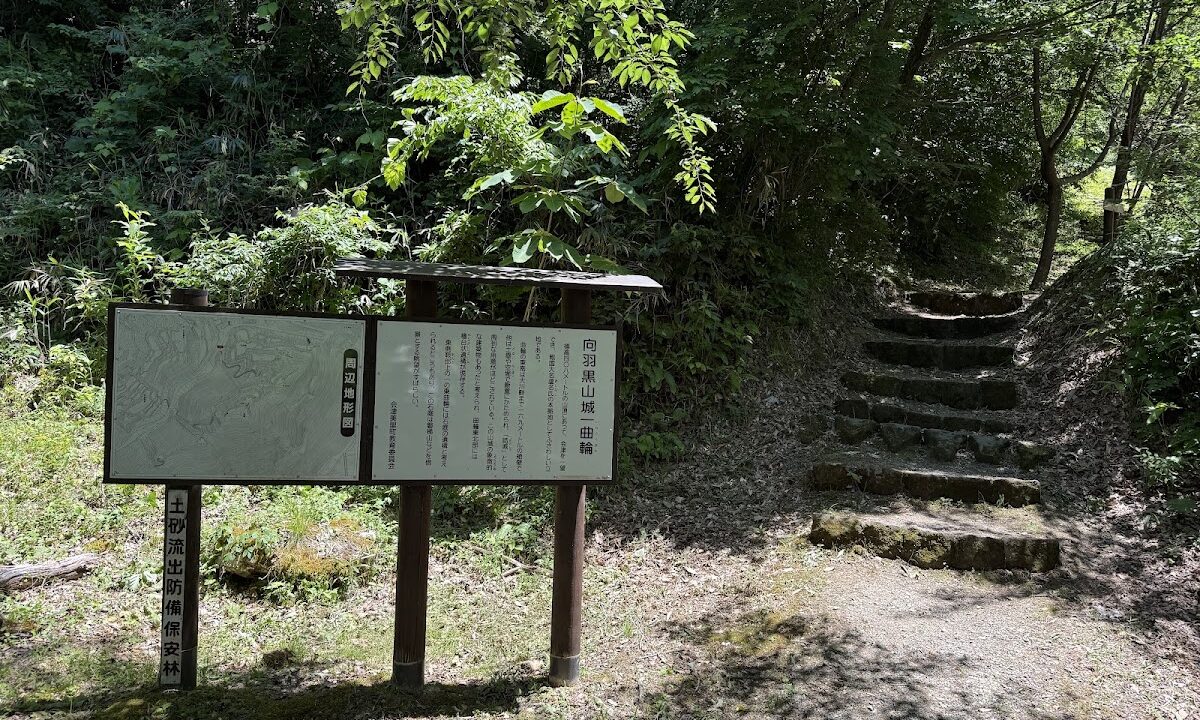
Currently, the site of Mukaihaguroyama Castle has been developed as Hakuhōzan Park. Promenades have been established, and explanatory signs have been placed at the main remains, allowing even first-time visitors to understand the castle’s structure while exploring.
In spring, the cherry blossoms are beautiful, and in autumn, the autumn leaves are stunning. It’s a popular spot not only for historical walks but also for enjoying nature.
Continued Top 100 Japanese Castles Stamp
Mukaihaguroyama Castle is selected as one of the Continued Top 100 Japanese Castles, and its stamp number is 132. The stamp is located at the Mukaihaguroyama Castle Ruins Maintenance Materials Room (Information Center) in Aizu-Misato Town.
For castle enthusiasts, collecting stamps while visiting famous castles throughout Japan is a fun experience. The Mukaihaguroyama Castle stamp, representing a mountain castle in the Tohoku region, is worth adding to your collection.
Access to Mukaihaguroyama Castle
Access by Car
Ban-etsu Expressway: Approximately 20 minutes from Aizu-Wakamatsu IC
National Route 121: Head south from Aizu-Wakamatsu city center towards Aizu-Misato Town
Parking is available at the foot of Hakuhozan Park and is free of charge. However, spaces are limited, so early arrival is recommended on holidays. ### Access by Public Transportation
JR Tadami Line: Get off at Aizu-Hongo Station, approximately 40 minutes on foot or 10 minutes by taxi.
Local Bus: From Aizu-Wakamatsu Station, take the Aizu Bus bound for “Hongo/Takada,” get off at the “Iwasaki” bus stop, and walk for approximately 20 minutes.
Access by public transportation is somewhat inconvenient; therefore, using a rental car or taxi is recommended.
Points to Note When Visiting
- As it is a mountain castle, we recommend wearing comfortable shoes and clothing.
- Insect repellent is necessary in summer, and warm clothing is necessary in winter.
- Bring your own drinking water (vending machines are only available at the foot of the mountain).
- Allow approximately 1.5 to 2 hours for the visit.
- Be careful as the ground can be slippery after rain or snow.
Tourist Spots Around Mukaihaguroyama Castle
Tsuruga Castle (Aizuwakamatsu Castle)
Tsuruga Castle, located about 20 minutes by car from Mukaihaguroyama Castle, is a famous castle known as a symbol of Aizu. It was renovated by Gamo Ujisato from Kurokawa Castle, the base of the Ashina clan. Visiting both Mukaihaguroyama Castle and Tsuruga Castle will give you a deeper understanding of Aizu’s castle history.
Aizu Hongo Pottery Village
Aizu Hongo town, located at the foot of Mukaihaguroyama Castle, is known as the production area of Aizu Hongo pottery. In this pottery village with a history of over 400 years, you can enjoy kiln tours and pottery making experiences.
Isasumi Shrine
Located in Aizu-Misato Town, Isasumi Shrine has long been revered as the guardian shrine of Aizu. It was also deeply revered by the Ashina clan and has strong historical ties to Mukaihaguroyama Castle.
Niitsuru Winery, Aizu-Misato Town
Niitsuru Winery, which produces wine using local grapes, is another tourist spot close to Mukaihaguroyama Castle. You can enjoy wine tastings and winery tours.
Excavation and Preservation Activities of Mukaihaguroyama Castle
Investigations and Development Since the Heisei Era
The full-scale investigation of Mukaihaguroyama Castle began in the Heisei era. The Aizu-Misato Town Board of Education has led continuous excavation surveys, revealing the castle’s structure and history.
The investigation revealed that the castle was renovated during the Ashina, Uesugi, and Gamo periods, and the differences in construction techniques between each era became clear.
Since its designation as a National Historic Site in 2001, preservation and utilization of the site have been promoted, including the development of walking paths, the installation of explanatory signs, and maintenance such as grass cutting.
Preservation Activities by Local Residents
The cooperation of local residents is essential for the preservation of Mukaihaguroyama Castle. Organizations such as the “Mukaihaguroyama Castle Ruins Preservation Association” play a central role, conducting regular cleaning activities, organizing tours, and providing guided tours.
Furthermore, local elementary and junior high schools provide opportunities for students to visit Mukaihaguroyama Castle as part of their local history studies, demonstrating a commitment to passing on history to future generations.
Mukaihaguroyama Castle and the Sengoku History of Aizu
The Rise and Fall of the Ashina Clan
The history of Mukaihaguroyama Castle is deeply intertwined with the rise and fall of the Ashina clan, a powerful daimyo family of Aizu during the Sengoku period. The Ashina clan was a family that had established roots in Aizu since the Kamakura period, and during the Sengoku period, they unified Aizu and reigned as a powerful daimyo of southern Oshu.
The era of Ashina Moriuji, in particular, was the Ashina clan’s golden age, boasting a power said to be equivalent to 1.2 million koku in Aizu. Mukaihaguroyama Castle was built as a symbol of that power.
However, after Moriuji’s death, the Ashina clan rapidly declined due to internal conflicts and external pressure. They were defeated by Date Masamune at the Battle of Suriagehara in 1589, and the Ashina clan was driven out of Aizu. Mukaihaguroyama Castle also fell into the hands of the Date clan, marking the end of the Ashina clan’s era.
Date Masamune and Aizu
After defeating the Ashina clan at the Battle of Suriagehara, Date Masamune finally gained control of Aizu, his long-desired territory. However, his rule lasted only a little over a year. Due to Toyotomi Hideyoshi’s pacification of Oshu, Masamune withdrew from Aizu and was transferred to Yonezawa.
While there are few historical records detailing how Date Masamune utilized Mukaihaguroyama Castle, it has been suggested that he may have made renovations to the castle during his short tenure.
Gamo Ujisato’s Management of Aizu
Gamo Ujisato, who succeeded Date Masamune in Aizu, was a samurai from Omi Province and a renowned general who served both Oda Nobunaga and Toyotomi Hideyoshi. Ujisato was granted Aizu as a large domain of 420,000 koku, renamed Kurokawa Castle to Wakamatsu Castle, and developed the castle town.
It is believed that Ujisato also valued Mukaihaguroyama Castle and made renovations to it. In particular, the introduction of stonework techniques is seen as an influence from Ujisato, who had experience building castles in Omi Province. However, Ujisato died of illness in 1595 at the young age of 40, and his management of Aizu ended prematurely.
Uesugi Kagekatsu’s Entry into Aizu
After the Gamo clan, Aizu became the territory of Uesugi Kagekatsu. Kagekatsu moved from Echigo to Aizu and reigned as a powerful daimyo with a domain of 1.2 million koku in the Tohoku region. Kagekatsu played an important role under the Toyotomi regime, using Aizu as his base.
The Uesugi clan also renovated Mukaihaguroyama Castle and considered it an important subsidiary castle of Wakamatsu Castle. However, because they sided with the Western Army in the Battle of Sekigahara, Aizu was confiscated after the war, and their domain was reduced to 300,000 koku in Yonezawa. As a result, the strategic value of Mukaihaguroyama Castle was lost, and it was eventually abandoned.
Cultural Value of Mukaihaguroyama Castle
One of the Largest Mountain Castles in Tohoku
The greatest value of Mukaihaguroyama Castle lies in its sheer size. Measuring 1.4 kilometers east-west and 1.5 kilometers north-south, it is one of the largest mountain castles in the Tohoku region and one of the largest in Japan.
Examples of such a large-scale mountain castle remaining in such good condition are rare, making it an extremely important historical site for the study of Sengoku period mountain castles.
Remains Showing the Evolution of Castle Construction Techniques
Mukaihaguroyama Castle retains layers of castle construction techniques from the Ashina, Uesugi, and Gamo periods. The remains, showing the transitional period from Sengoku period mountain castles primarily composed of earthworks and dry moats to early modern castles incorporating stone masonry, are valuable resources for understanding the history of Japanese castles.
A Historical Site Conveying Regional History
Mukaihaguroyama Castle is also a historical site symbolizing the Sengoku period history of Aizu. This castle, associated with prominent Sengoku-era daimyo such as the Ashina, Date, Gamo, and Uesugi clans, is an indispensable part of Aizu’s history.
It is cherished by the local people as a source of local pride and plays an important role in historical education and as a tourist resource.
Summary
Mukaihaguroyama Castle, located in Aizumisato Town, Fukushima Prefecture, is one of the largest mountain castles in Tohoku. Built by Ashina Moriuji, who ruled Aizu during the Sengoku period, it was later renovated by renowned generals such as Uesugi Kagekatsu and Gamo Ujisato.
Within its vast castle grounds, measuring 1.4 kilometers east-west and 1.5 kilometers north-south, the remains of large dry moats, earthworks, and stone walls are well-preserved, making it a valuable historical site for understanding the realities of Sengoku-era mountain castles. Designated a national historic site and selected as one of the Continued Top 100 Japanese Castles, Mukaihaguroyama Castle is a place that should be visited not only by castle enthusiasts but also by many people who love history and nature.
Located close to Aizu-Wakamatsu city center, this area, when visited in conjunction with Tsuruga Castle and Aizu-Hongo Pottery Village, allows you to experience Aizu’s history and culture more deeply. Why not take a stroll along the mountain paths of the Hakuhō Sanzan while reflecting on the Sengoku period?