Complete Guide to Shinchiyama Castle Ruins (Fukushima Prefecture): The Mountain Castle Remains and Historical Background of the Shirakawa Yuki Clan
What are Shinchiyama Castle Ruins?
Shinchiyama Castle Ruins are the remains of a medieval mountain castle located in Oyaji, Karijuku, Shirakawa City, Fukushima Prefecture. The entire mountain, approximately 80 meters high, where the Haguro Shrine is located, was transformed into a castle fortification. Its scale and sophistication make it a remarkable example among medieval castles in southern Fukushima Prefecture.
It is a large-scale castle utilizing the entire mountain, characterized not only by its size but also by its highly sophisticated layout. Multiple baileys are arranged from the mountaintop to the middle slopes, with defensive structures such as earthworks and moats skillfully placed.
Location and Geographical Characteristics
Shinchiyama Castle Ruins are located in the hilly area of the Karijuku district of Shirakawa City, in a strategic location overlooking the surrounding area. This location was extremely important from a military perspective, making it an ideal location for monitoring and defending the southern part of the Shirakawa region.
The castle makes maximum use of the mountainous terrain, utilizing natural undulations while incorporating artificial modifications to create an impregnable fortress for attackers. The excellent view overlooking the plains below further enhances the castle’s strategic value.
Historical Background of Shinchi-yama Castle Ruins
Construction History and Historical Context
The exact construction date and original builder of Shinchi-yama Castle remain largely unknown due to limited historical records. However, the prevailing theory is that the castle was expanded and improved by the Shirakawa Yuki clan during the Tensho era (1573-1592) in preparation for an invasion by the Satake clan.
The Tensho era was the end of the Sengoku period, a time of fierce territorial disputes in the Tohoku region, including the rise of Date Masamune and the expansion of the Satake clan. The Shirakawa Yuki clan was a powerful daimyo ruling the Shirakawa region, but they were constantly under pressure from the Satake clan advancing northward from the south.
The Relationship Between the Shirakawa Yuki and Satake Clans
The Shirakawa Yuki clan was a branch of the Yuki clan of Shimosa Province, a prestigious family that ruled the Shirakawa region from the Muromachi period. On the other hand, the Satake clan was a powerful Sengoku daimyo based in Hitachi Province (present-day Ibaraki Prefecture), and expanded its influence northward during the Tensho era.
There was tension between the two clans, and the Shirakawa Yuki clan needed to develop castles throughout their territory to defend it. Shinchiyama Castle is thought to have been a major expansion and reinforcement of an existing castle, serving as an important base in this defense network.
The Situation in Tohoku During the Tensho Era
During the Tensho era, the Tohoku region was in a chaotic state with multiple forces vying for supremacy. Date Masamune rose to power as the ruler of Oshu, the Satake clan exerted pressure from the south, and the Soma and Ashina clans also sought to maintain their own spheres of influence.
In this situation, the Shirakawa Yuki clan needed to strengthen their defenses in order to survive, and the construction of a sturdy mountain castle like Shinchiyama Castle became an urgent necessity. The castle’s intricate layout can be considered a culmination of the best castle-building techniques of this period.
Details of the Castle Structure
Overall Layout
Shinchiyama Castle is a large-scale mountain castle that utilizes the entire mountain as its fortifications, with multiple baileys arranged in a stepped pattern around the main bailey. The main bailey, equivalent to the honmaru (main enclosure), is located at the summit, and from there, the second and third baileys extend along the ridges and slopes.
The total area of the castle is considerable, and it is not merely a fortified outpost, but designed to withstand a siege for a considerable period. Each bailey is surrounded by earthen ramparts, and the baileys are separated by trenches and vertical moats.
Structure of the Main Bailey
The main bailey is built at the highest point of the mountaintop and is surrounded by high earthen ramparts. The height of the ramparts varies depending on the location, but reaches several meters at their highest points. The interior of the main enclosure is relatively flat and level, providing ample space for building structures.
The main enclosure’s entrance (koguchi) is a masugata structure, a clever design to prevent enemy intrusion. A masugata is a defensive structure that uses a double entrance and a winding passageway to prevent direct enemy advances and allow for attacks from the flanks.
Arrangement of Earthworks and Moats
A distinctive defensive feature of Shinchiyama Castle is the earthworks and moats placed throughout. The earthworks not only surround the enclosures but are also strategically placed to limit enemy intrusion routes, giving the defenders an advantage.
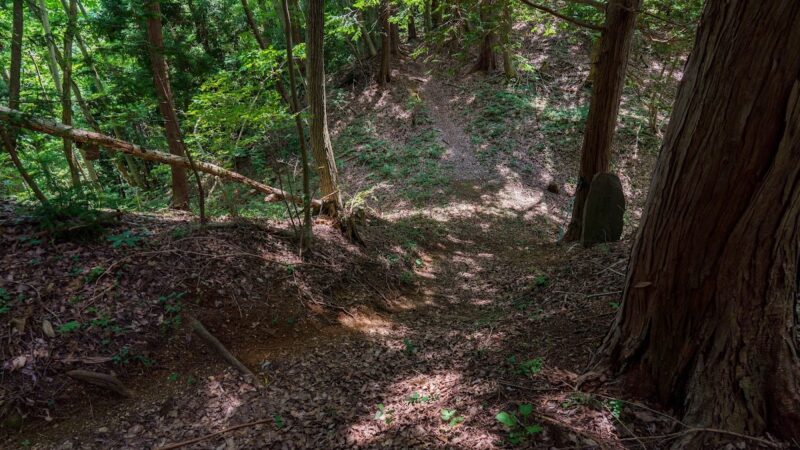
The moats are constructed to cut off the ridgelines, playing a crucial role in hindering enemy advances. In particular, multiple moats are continuously constructed along the ridge leading to the main enclosure, creating a multi-layered defensive structure. The depth and width of the moats are considerable, demonstrating the high level of castle-building technology of the time.
Techniques of Vertical and Horizontal Moats
Numerous vertical moats (tatebori) are dug into the slopes. Vertical moats are dug vertically along the slope, effectively preventing enemies from climbing. Furthermore, the parallel digging of multiple vertical moats demarcates the slope, making lateral movement difficult for the enemy.
Horizontal moats can also be found in some areas, digging around the perimeter of the enclosures. These horizontal moats likely served to prevent enemy approaches and also functioned as movement routes for the defenders. The arrangement of these moats is highly planned, suggesting the entire castle was designed to function as an organic defensive system.
Arrangement and Function of Enclosures
In addition to the main enclosure, several other enclosures are located throughout the mountain. These enclosures were not merely defensive strongholds, but each likely had a specific role.
The second enclosure (Ninokuruwa) was the second most important enclosure after the main enclosure, likely functioning as a forward position protecting the main enclosure. The baileys below the third bailey may have been used as garrisons for soldiers or storage areas for supplies. Furthermore, the baileys closer to the foot of the mountain may have served as residences or functioned as a castle town during peacetime.
Relationship between Haguro Shrine and the Castle Ruins
History of Haguro Shrine
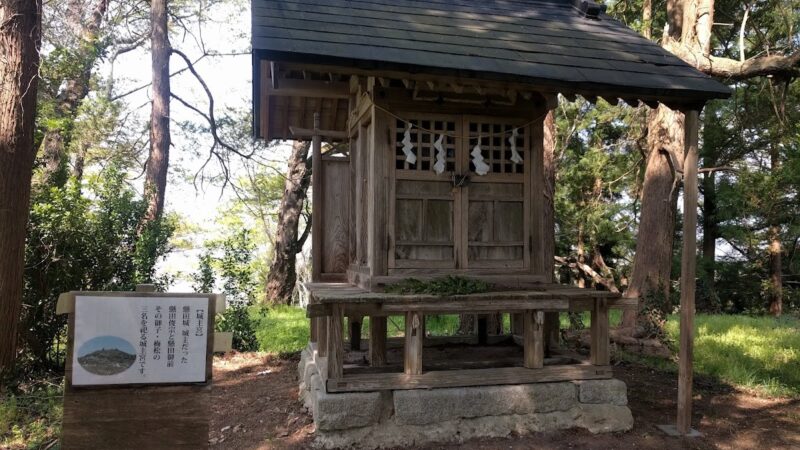
Currently, Haguro Shrine is located on the mountaintop of the Shinchiyama Castle ruins. Haguro Shrine is a shrine based on mountain worship, and it is believed to have enshrined the deity of Mount Haguro, one of the three sacred mountains of Dewa.
While the exact founding date of the shrine is unclear, medieval mountain castles often had shrines or temples as guardian deities, and it is possible that Shinchiyama Castle had some kind of religious facility from the time of its construction. The current Haguro Shrine likely continued to exist as a center of local faith even after the castle was abandoned.
Role of the Shrine in Castle Ruins Preservation
The existence of Haguro Shrine has protected the Shinchiyama Castle ruins as a sacred area, preventing development. While many castle ruins have been lost due to residential and agricultural development, the fact that this site has been preserved as a shrine is extremely fortunate from the perspective of preserving historical remains.
Although some remains may have been altered due to the development of the shrine’s approach and grounds, the overall state of preservation is excellent. Even today, major remains such as earthworks and moats can be clearly observed.
Highlights of Shinchiyama Castle Ruins
Preservation of the Remains
Shinchiyama Castle Ruins is one of the best-preserved medieval mountain castle ruins in southern Fukushima Prefecture. The earthworks around the main enclosure retain their height, and the moats remain clearly visible without being buried.
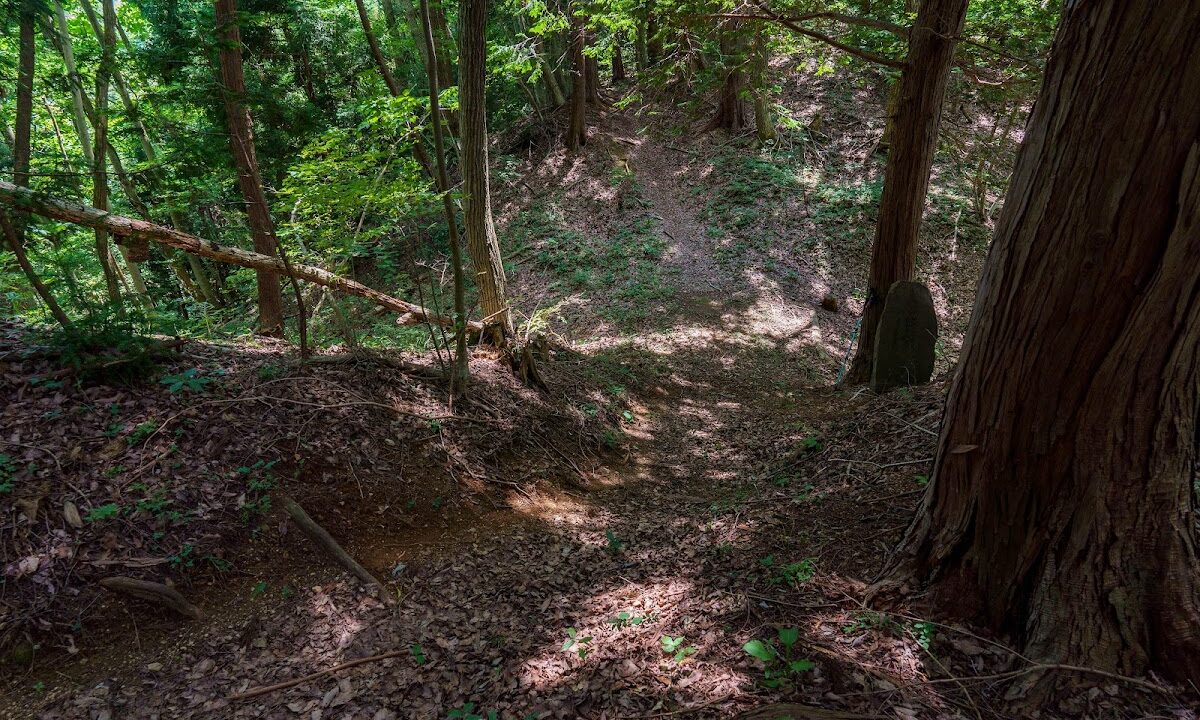
Many vertical and horizontal moats can be identified, allowing visitors to experience the original layout almost exactly as it was. While some areas are overgrown, the basic structure is still understandable.
Features of the Skillful Layout
The greatest highlight of Shinchiyama Castle is its skillful layout. This is not a simple mountain castle; its remarkable feature is the ingenious use of the terrain to construct a complex defensive system.
The castle exhibits late Sengoku period castle construction techniques, such as a square-shaped gate, continuous moats, and parallel vertical moats, making it a highly valuable historical site from the perspective of castle research. The remains clearly indicate that the Shirakawa Yuki clan seriously fortified this castle in preparation for an invasion by the Satake clan.
Magnificent Views
From the main enclosure at the summit, you can enjoy a panoramic view of the Shirakawa Basin and the surrounding mountains. On a clear day, you can even see the Nasu mountain range in the distance, highlighting the strategic importance of this castle’s location.
The castle lord and soldiers of the time likely monitored the surrounding area while gazing at this view. For modern visitors, it is a magnificent landscape that stimulates historical imagination.
Related Historical Sites in the Surrounding Area
Medieval Castles in the Shirakawa Region
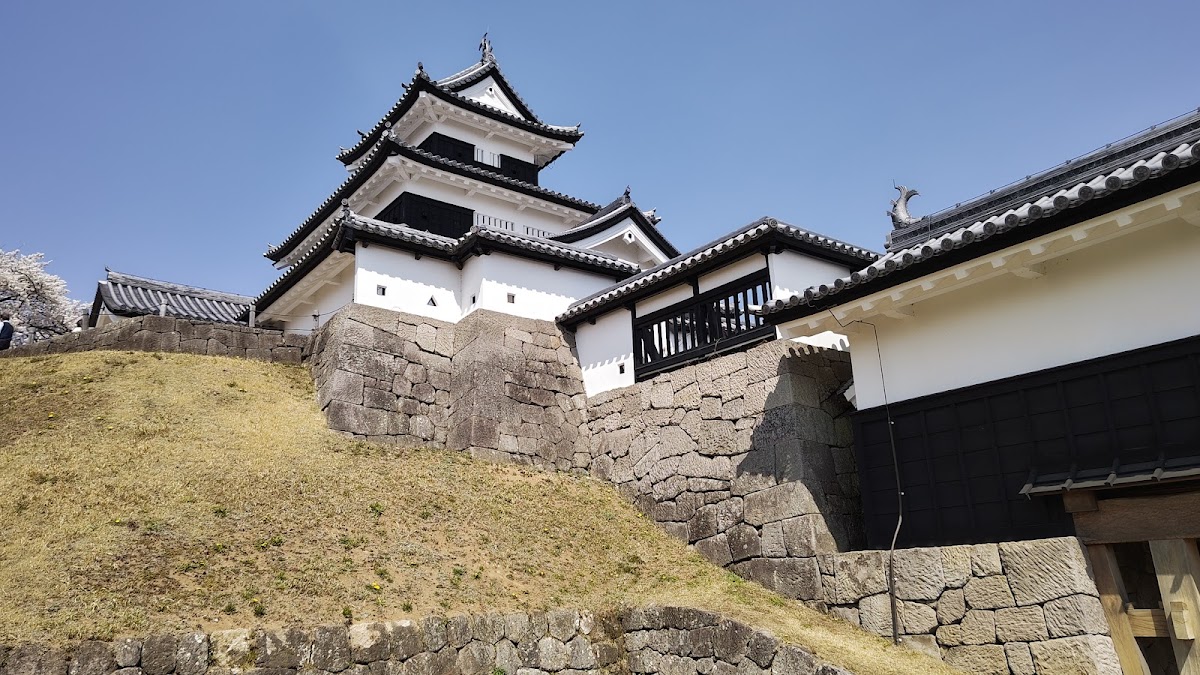
Several castles related to the Shirakawa Yuki clan exist around the Shinchiyama Castle ruins. Shirakawa Komine Castle was the base of the Shirakawa Yuki clan and is now maintained as a symbol of Shirakawa City.
Furthermore, there are scattered castle ruins that are thought to have functioned at the same time as Shinchiyama Castle, such as Mimori-kan, Horinouchi-kan, Tenno-kan, and Kawatoda-kan. Visiting these together will allow you to gain a deeper understanding of the Shirakawa Yuki clan’s rule over their territory.
Local Historical and Cultural Facilities
Shirakawa City has facilities such as the Shirakawa Shukoen and the Shirakawa Historical and Folk Museum where you can learn about the local history and culture. These facilities also have exhibits related to the Shirakawa Yuki clan, and it is recommended to visit them before or after visiting the Shinchiyama Castle ruins.
Access and Visiting Information
Location and Transportation
The Shinchiyama Castle ruins are located in Oyaji, Karijuku, Shirakawa City, Fukushima Prefecture. Access by public transport is not easy, so visiting by private car is recommended.
It is about a 20-minute drive from Shirakawa Station; you will arrive by heading towards Haguro Shrine. Parking space is limited, so please be considerate of other visitors.
Points to Note When Visiting
Since Shinchiyama Castle Ruins is a mountain castle, appropriate equipment is necessary for visiting. Prepare appropriate hiking boots and clothing, and be especially careful after rain, as the ground can be slippery.
In summer, the area is overgrown with bushes and has many insects, so wearing long sleeves and long pants, and using insect repellent are recommended. Also, since there is a possibility of encountering wild animals such as bears, carrying a bell or similar device is advisable.
The castle ruins are a valuable cultural asset, so please observe proper etiquette and refrain from damaging the remains or littering.
About “Shinchi Castle Ruins,” which are often confused with Shinchiyama Castle Ruins
Differences from Shinchi Castle Ruins (Shinchi-cho, Soma-gun)
When searching for “Shinchiyama Castle Ruins,” information about “Shinchi Castle Ruins” (Shinchi-cho, Soma-gun) is often mixed in. These are completely different castle ruins, and care should be taken not to confuse them.
Shinchi Castle Ruins are located in Yachigoya, Shinchi-machi, Soma-gun, Fukushima Prefecture. It was built by the Soma clan during the Eiroku era (1558-1570). Also known as Minokubi Castle, it was the site of a battle between the Soma and Date clans.
The current Shinchi Castle Ruins are a park, known for its annual “Tulip Festival” held in late April, where approximately 30,000 tulips of about 40 varieties bloom. It has a strong tourist character and is a completely different place from Shinchiyama-kan Ruins, where visitors can see the remains of a mountain castle.
Confusion due to Similar Names
Both sites contain the name “Shinchi,” leading to confusion in internet searches. However, they are completely different castle ruins with different locations and histories.
Shinchiyama-kan Ruins are a mountain castle associated with the Shirakawa Yuki clan, located in Shirakawa City, while Shinchi Castle Ruins are a flatland castle of the Soma clan, located in Shinchi-machi. The castle’s structure, historical context, and current situation differ in every aspect.
Current Status and Challenges of Research on the Shinchiyama Castle Ruins
Limitations of Historical Sources
Regarding the Shinchiyama Castle Ruins, there is a scarcity of historical sources detailing the construction date, lord, and specific historical events, leaving many points unresolved. The theory that the Shirakawa Yuki clan expanded and improved the castle during the Tensho era is not definitive, and further research is needed.
By carefully examining local traditions and the limited historical documents available, it is hoped that the full picture of history will gradually become clear.
The Need for Archaeological Investigation
No full-scale excavation has been conducted at the Shinchiyama Castle Ruins, leaving many unknowns regarding the detailed structure and age of the remains. Analyzing excavated artifacts could potentially provide more accurate information about the castle’s usage period and function.
Creating detailed layout maps through surveying is also important. Using the latest surveying techniques will capture subtle topographical changes that are difficult to discern with the naked eye, leading to a more accurate understanding of the castle’s structure. ### Balancing Preservation and Utilization
The Shinchiyama Castle Ruins are currently maintained as part of the grounds of Haguro Shrine, but no proactive preservation and utilization measures have been taken. As a valuable medieval castle site, it is necessary to consider appropriate preservation measures while simultaneously exploring ways to utilize it as a regional historical resource.
Creating an environment where visitors can safely observe the ruins, such as installing information boards and developing viewing paths, is also a challenge. However, excessive development could lead to the destruction of the ruins, so careful planning is required.
Summary
The Shinchiyama Castle Ruins (Shirakawa City, Fukushima Prefecture) are the remains of a large-scale and technically sophisticated mountain castle said to have been constructed by the Shirakawa Yuki clan during the Tensho era in preparation for an invasion by the Satake clan. The entire mountain, with a relative height of 80 meters where Haguro Shrine is located, was processed as a castle. The complex layout centered around the main enclosure, the skillfully placed earthworks and moats, and the continuous vertical trenches showcase the pinnacle of late Sengoku period castle construction technology.
Although much of its detailed history remains unclear due to a lack of historical records, the remains are well-preserved, making it a highly valuable historical site from the perspective of castle and medieval history research. It’s important to note that this is a completely different castle site from the Shinchi Castle ruins (Shinchi-cho, Soma-gun) of the same name.
For those interested in the medieval history of the Shirakawa region, mountain castle enthusiasts, and castle researchers, the Shinchi Yamakan ruins are a must-see historical site. Be sure to bring appropriate equipment when you visit, and enjoy the ingenious layout while reflecting on the Sengoku period.