
Kamegasaki Castle (Sakata City, Yamagata Prefecture) Complete Guide | History, Remains, and Access Information
Basic Information about Kamegasaki Castle
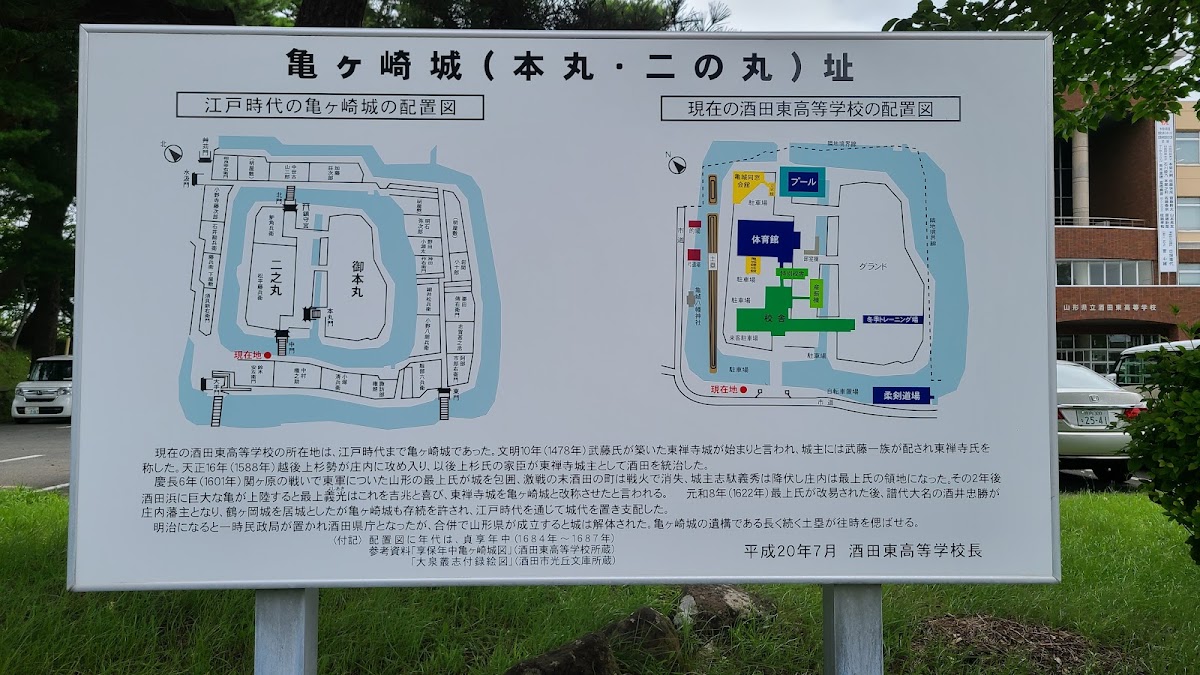
Kamegasaki Castle is a flatland castle located in Kamegasaki, Sakata City, Yamagata Prefecture. Also known as Sakata Castle or Tozenji Castle, it is an important historical fortress. Currently, most of the castle site is occupied by Yamagata Prefectural Sakata Higashi High School, although some of the earthworks, which convey the appearance of the castle in its heyday, still remain.
Basic Data
Location: 1-3-60 Kamegasaki, Sakata City, Yamagata Prefecture (near Sakata Higashi High School)
Former Province: Ugo Province
Classification/Structure: Flatland Castle
Builder: Daiboji Muto Clan
Year of Construction: Bunmei 10 (1478)
Main Lords: Tozenji Clan, Shida Yoshihide, Shimura Mitsuyasu, Sakai Clan
Year of Abandonment: Genna 8 (1622)
Common Name/Alternate Name: Sakata Castle, Tozenji Castle
Main Remains: Earthworks, relocated rear gate (Entsuji Temple Gate)
Cultural Property Designation: None (Not a city-designated historical site)
History of Kamegasaki Castle
Construction of Tozenji Castle (Muromachi Period)
The origins of Kamegasaki Castle date back to Bunmei 10 (1478). At that time, the Daiboji Muto clan, who ruled the Shonai region, built Tozenji Castle to strengthen their control over the area after repeatedly suppressing the rebellious Sunagoshi clan.
A member of the Muto clan was appointed as the castle lord, and they adopted the name Tozenji. Tozenji Castle functioned as an important base controlling the strategic location of Sakata near the mouth of the Mogami River, playing a role in protecting trade and military strongholds along the Sea of Japan coast.
Turmoil of the Sengoku Period
With the arrival of the Sengoku period, Tozenji Castle became a battleground for conflicts over the Shonai region. During the time of Daiboji Yoshiuji, the castle lord, Tozenji Yoshinaga (Maemori Kurōdo), staged a rebellion, and power struggles within the Muto clan intensified.
During the Tensho era (1573-1592), the area became embroiled in a power struggle between the Uesugi and Mogami clans. The Shonai region fell under the control of Uesugi Kagekatsu and then under the influence of Mogami Yoshiaki, resulting in a complex political situation that led to changes in lordship for Tozenji Castle.
The Battle of Sekigahara and the Mogami Clan’s Rule
The Battle of Sekigahara in 1600 dramatically altered the fate of Tozenji Castle. Mogami Yoshiaki of Yamagata, who sided with the Eastern Army, attacked the Shonai region, which was aligned with the Uesugi clan and supported the Western Army.
In 1601, the Mogami army besieged Tozenji Castle, forcing its lord, Shida Yoshihide, to surrender. Thus, the Shonai region became Mogami territory, and Tozenji Castle also came under Mogami control.
Renaming to Kamegasaki Castle
Mogami Yoshiaki positioned Tozenji Castle as an important subsidiary castle and appointed Shimura Izunokami Mitsuyasu as its lord. According to legend, around this time, a large turtle was found washed ashore on Sakata Beach near Tozenji Castle, a very auspicious sign. Mogami Yoshiaki, pleased with this, renamed the castle “Kamegasaki Castle.”
Shimura Mitsuyasu dedicated himself to the renovation and improvement of the castle, transforming Kamegasaki Castle into a modern castle with a main keep, second bailey, and third bailey. The castle town was also developed, laying the foundation for Sakata’s prosperity as a port of call for Kitamae ships.
Dispossession of the Mogami Clan and Entry of the Sakai Clan
In 1622 (Genna 8), the Mogami clan was dispossessed of their domain due to internal strife. Subsequently, Sakai Tadakatsu was appointed to the Shonai region from Shinano Matsushiro with a stipend of 138,000 koku, establishing the Shonai Domain.
The Sakai clan initially resided at Kamegasaki Castle, but in 1631 (Kanei 8), they moved their base to Tsurugaoka Castle (present-day Tsuruoka City). From then on, Kamegasaki Castle served as a branch castle of the Shonai Domain, becoming an important base for managing the port town of Sakata.
Kamegasaki Castle in the Edo Period
Throughout the Edo period, senior retainers and high-ranking officials of the Shonai Domain were stationed at Kamegasaki Castle as castle lords, responsible for managing Sakata Port, supervising Kitamae-bune trade, and maintaining public order.
Sakata flourished to such an extent that it was called “Sakai in the west, Sakata in the east,” and Kamegasaki Castle continued to function as the administrative and military center supporting this economic prosperity. Taking advantage of its geographical advantage as a junction of the Mogami River shipping route and the Sea of Japan shipping route, it developed into a major commercial city where goods such as rice and safflower were gathered.
After the Meiji Restoration
After the Meiji Restoration, Kamegasaki Castle was abolished due to the castle demolition order, and its castle facilities were gradually dismantled. The castle site was sold off to private individuals, and in 1909 (Meiji 42), Yamagata Prefectural Sakata Junior High School (now Sakata Higashi High School) was established on the site of the main keep and second bailey.
Residential areas and schools were built on the site of the third bailey, and the castle’s appearance was almost completely lost, but the remaining earthworks convey its former appearance to the present day.
Layout and Structure of Kamegasaki Castle
Overall Structure of the Castle
Kamegasaki Castle was a typical flatland castle, with the main keep at the center and the second and third baileys arranged concentrically. The castle grounds extended approximately 400 meters east-west and 350 meters north-south, and it was a strong defensive structure surrounded by moats and earthworks.
Located near the Niida River, a tributary of the Mogami River, the castle’s layout utilized natural water resources. Furthermore, its location, just a few kilometers from the Sea of Japan, provided convenient access for transporting goods by sea.
Honmaru (Main Enclosure)
The Honmaru was the core of the castle, located where the current Sakata Higashi High School buildings and grounds stand. Its dimensions are estimated to be approximately 120 meters east-west and 100 meters north-south.
The Honmaru housed the lord’s residence and administrative offices, and also contained defensive structures such as turrets and gates. However, it is believed that a keep was never built, and the structure of a keep is listed as “none.”
Ninomaru (Second Enclosure)
The Ninomaru surrounded the Honmaru, and contained the residences of chief retainers and senior officials, as well as an armory. Currently, the earthworks of the Ninomaru remain in good condition on the west and north sides of the Sakata Higashi High School grounds.
The western earthworks extend approximately 160 meters, and the northern earthworks approximately 100 meters, both with a height of approximately 3-4 meters and a base width of approximately 8-10 meters. This earthen rampart is the most important remaining structure of Kamegasaki Castle and a valuable historical site that allows us to appreciate the scale of the castle in its heyday.
Third Bailey
The Third Bailey was positioned to surround the Main Bailey and Second Bailey, forming the boundary with the castle town. The area around the current Kamegasaki Elementary School is part of it, and a monument marking the “Site of the Third Bailey” and a signpost for the “Site of the Udogawara Village Office” are located just inside the school gate.
The Third Bailey was home to the residences of lower-ranking samurai and merchants, serving as a buffer zone connecting the castle and the castle town.
Moat and Water Supply
An outer moat surrounded the castle, enhancing its defensive capabilities. It is believed that the water in the moat was drawn from the Niida River, maintaining a constant water level.
Currently, most of the moat has been filled in and replaced by roads and residential areas, but some topographical features and waterways indicating the moat remain.
Castle Gates
Kamegasaki Castle had several castle gates. Particularly important is the Karamete-mon (rear gate), which was located on the north side, the rear of the castle.
This Karamete-mon was relocated to Entsuji Temple in Yoshida Isezuka, Sakata City, during the Meiji era, and is now used as the temple’s main gate. It is the only surviving structure from Kamegasaki Castle and a valuable cultural asset that conveys the architecture of Edo-period castles.
Existing Remains and Points of Interest
Earthworks within the Sakata Higashi High School Grounds
The most important remains at the Kamegasaki Castle site are the earthworks of the second bailey, located on the west and north sides of the Sakata Higashi High School grounds. Because it is on school grounds, consideration is needed when visiting, but the earthworks can be seen from the surrounding road.
The western earthwork is particularly well-preserved, extending for approximately 160 meters. Trees grow on top of the earthworks, preserving its original appearance. The height and width of the earthworks suggest that Kamegasaki Castle was a considerably large fortress.
Approximately 100 meters of the northern earthwork remains, and it is also in good condition. Walking along and observing these earthworks allows you to truly appreciate the Edo period castle defense system.
Relocated Rear Gate of Entsuji Temple
Entsuji Temple, located in Yoshida Isezuka, Sakata City, houses the relocated rear gate of Kamegasaki Castle, which now serves as the temple’s main gate. This gate is the only surviving structure from Kamegasaki Castle and a valuable example of castle architecture.
The gate’s structure is in the Yakui-mon style, a dignified design with main pillars and supporting pillars. The roof is a gable roof, reflecting the architectural style of the mid-Edo period. The gate’s wood has a dignified appearance, reflecting its centuries-old history.
Entsuji Temple is located approximately 3 kilometers northeast of Kamegasaki Castle, about a 10-minute drive away. When visiting the Kamegasaki Castle ruins, we highly recommend also visiting Entsuji Temple and seeing the relocated gate.
Monument at the Site of the Third Bailey (Kamegasaki Elementary School)
Just inside the gate of Kamegasaki Elementary School, there is a monument marking the “Site of the Third Bailey” and an information board for the “Site of the Udogawara Village Office.” This area was part of the Third Bailey, and during the Edo period, it was home to samurai residences and merchant districts.
The monument is relatively small, but it is an important landmark for understanding the castle’s boundaries. Since it is located on the school grounds, visitors should be considerate of school activities.
Seigenji Temple (Family Temple of Lord Shimura Mitsuyasu)
Segenji Temple, the family temple of Shimura Mitsuyasu, who served as the lord of Kamegasaki Castle, is also an important historical site in the vicinity of the castle ruins. Seigenji Temple houses Shimura Mitsuyasu’s grave, allowing visitors to reflect on the history of Kamegasaki Castle.
Shimura Mitsuyasu was a senior retainer of Mogami Yoshiaki and dedicated himself to the development of Kamegasaki Castle, leaving a significant mark on the history of the Shonai region. Visiting Seigenji Temple will allow you to reflect on the life and faith of the castle lord himself.
Access and Visiting Information
Access by Public Transportation
Walking from JR Sakata Station: Approximately 20 minutes (approximately 1.5 kilometers)
Leaving Sakata Station, head southeast, passing through the city center towards Sakata Higashi High School. You can also choose a route that passes through the Sankyo Warehouses, a popular tourist spot in Sakata.
By Bus: Take the Shonai Kotsu Bus “Kamegasaki Loop Line” from Sakata Station and get off at the “Sakata Higashi High School” bus stop. The temple is a short walk from there.
Access by Car
Nihonkai Tohoku Expressway: Approximately 15 minutes (approximately 7 kilometers) from Sakata IC
After exiting Sakata IC, proceed along National Route 7 towards Sakata city center, and follow the signs towards Sakata Higashi High School.
Parking: There is no parking available for general visitors at Sakata Higashi High School. When visiting, we recommend using nearby public parking lots or accessing the site on foot.
Notes on Visiting
- School Grounds: The Honmaru and Ninomaru sites are located within the grounds of Sakata Higashi High School. Please be considerate and avoid disrupting school activities. Avoid entering during class hours and primarily view from the perimeter.
- Viewing the Earthworks: The earthworks can be observed from the perimeter road. If you wish to enter school grounds, it is advisable to obtain permission from the school beforehand.
- Photography: When taking photographs on school grounds, please respect student privacy and obtain permission from the school beforehand.
- Entsuji Temple: As this is a temple, please observe proper etiquette when visiting. Visiting hours are usually from 9:00 AM to 5:00 PM, but it is recommended to confirm in advance.
Estimated Visiting Time
Please allow approximately 30 minutes to 1 hour for a visit to the Kamegasaki Castle ruins, including observation of the earthworks. If you plan to visit the relocated gate of Entsuji Temple as well, please allow approximately two hours, including travel time.
Nearby Tourist Attractions
Sankyo Warehouses
Located about a 15-minute walk from the Kamegasaki Castle ruins, the Sankyo Warehouses are a representative tourist attraction of Sakata. Built in 1893 (Meiji 26), these rice storage warehouses are still partially in use today.
The beautiful zelkova tree-lined avenue allows visitors to experience Sakata’s history as a rice-producing region dating back to the Edo period. Parts of the warehouses are open to the public as the “Sakata City Tourism and Product Center” and the “Shonai Rice History Museum,” where visitors can learn about the history and culture of Shonai.
Former Honma Family Residence
The former residence of the Honma family, known as Japan’s largest landowners, is also located near the Kamegasaki Castle ruins. It is a valuable building that conveys the lifestyle of a wealthy merchant during the Edo period, and its garden is magnificent.
The Honma family prospered as official merchants of the Shonai Domain, and their wealth was even celebrated in a folk song: “Though we cannot compare to the Honma family, we aspire to at least become lords.”
Sakata City Museum of Art
The Sakata City Museum of Art exhibits local art and historical materials. It also holds special exhibitions on the history of Kamegasaki Castle and Sakata, making a visit in conjunction with a tour of the castle ruins a valuable experience.
Hiyoriyama Park
Hiyoriyama Park, offering a panoramic view of the Sea of Japan, was once a place where Kitamae-bune (northern route) sailors assessed the weather. The park contains historical sites that tell the story of maritime transport, such as directional stones and permanent lanterns.
Considering that Kamegasaki Castle was the administrative center of Sakata Port, the view of the Sea of Japan from this park allows us to imagine the scenery that the castle lords of the time also gazed upon.
Shirowa-saku Ruins
For those interested in ancient ruins, the Shirowa-saku Ruins are also recommended. Located approximately 5 kilometers northeast of Kamegasaki Castle, this is the site of an ancient castle and fortification dating from the Nara to Heian periods.
Designated as a national historic site, it offers a glimpse into the continuity of Shonai region’s history from ancient times through the medieval and early modern periods.
Nittame Castle Ruins
For those interested in medieval castles, the Nittame Castle Ruins are a must-see. A contemporary of Tozenji Castle, the predecessor of Kamegasaki Castle, it is an important historical site for understanding the medieval history of the Shonai region.
Historical Significance of Kamegasaki Castle
A Key Point for Governing the Shonai Region
Kamegasaki Castle was a crucial political and military center of the Shonai region from the Muromachi period to the Edo period. Its proximity to the Mogami River estuary and control of Sakata, a key point for maritime trade on the Sea of Japan, led to control of the entire Shonai region.
Even as rulers changed from the Mutō, Uesugi, Mogami, and Sakai clans, the strategic importance of Kamegasaki Castle remained unchanged, and high-ranking officials were always stationed there. ### Kitamae-bune Trade and Economic Prosperity
During the Edo period, Sakata flourished greatly as a hub for Kitamae-bune (northern route ship) trade. Kamegasaki Castle played a vital role in managing and protecting this economic activity, supporting Sakata’s development to the point where it was known as “Sakai of the West, Sakata of the East.”
Specialty products such as rice and safflower, transported inland via the Mogami River, were transferred to Kitamae-bune ships in Sakata and then shipped to Osaka and Edo. Kamegasaki Castle played a crucial role as a management hub for this logistics.
Position in the History of Castle Architecture
Kamegasaki Castle is a prime example of the development process from the medieval Tozenji Castle to the early modern Kamegasaki Castle. It embodies the transformation of Japanese castle architecture from mountain castles and hill castles of the Sengoku period to flatland castles of the Edo period.
As a practical castle without a main keep, it represents a typical example of a subsidiary castle and is an important historical site for understanding the local governance system of the Edo period.
Points to Remember When Visiting Kamegasaki Castle
Learn About the History Before Visiting
Because the remains of Kamegasaki Castle are limited, learning about its history beforehand will lead to a deeper understanding and appreciation of the site. We recommend obtaining materials from the Sakata City Library or tourist information center, or reading information like this article, before your visit.
Combine Visits to Multiple Historical Sites
Since visiting Kamegasaki Castle alone takes relatively little time, we recommend combining it with other nearby historical sites and tourist spots, such as the relocated gate of Entsuji Temple, the Sankyo Warehouse, and the former Honma family residence.
By experiencing Sakata’s history and culture comprehensively, you will gain a clearer understanding of the role Kamegasaki Castle played.
Seasonal Landscape Differences
The trees growing on the earthworks display different appearances depending on the season. The fresh green of spring, the lush green of summer, the vibrant autumn foliage, and the snow-covered winter each have their own unique charm.
Especially during the autumn foliage season, the trees on the earthworks change color, creating a beautiful landscape. The winter snowscape also possesses a unique charm characteristic of the Sea of Japan coast, allowing one to imagine the harsh environment of the castle in its heyday.
Interacting with Locals
Sakata has many people who are knowledgeable about the castle ruins and local history. Inquiring at the tourist information center or local history enthusiasts’ groups can provide detailed information and advice for your visit.
The history and anecdotes told from the perspective of locals will be invaluable information that cannot be obtained from documents alone.
Summary
Kamegasaki Castle is an important historical site indispensable to understanding the history of Sakata City, Yamagata Prefecture. Beginning with the construction of Tozenji Castle in 1478, it boasts a history spanning approximately 400 years, including the turmoil of the Sengoku period, renovations by the Mogami clan after the Battle of Sekigahara, and its role as a branch castle of the Shonai Domain.
Currently, most of the castle site is occupied by Sakata Higashi High School, and the main and second baileys have been lost. However, the well-preserved earthworks and the rear gate, relocated to Entsuji Temple, convey the castle’s former appearance.
Visiting the Kamegasaki Castle ruins is not simply about viewing a historical site; it’s an entry point to understanding the history of Sakata, which prospered as a hub for Mogami River and Sea of Japan shipping, the economic prosperity brought about by the Kitamae-bune trade, and the complex political history of the Shonai region.
Although the remains are limited, the scale and arrangement of the earthworks allow one to imagine the castle’s appearance in its heyday, and the style of the relocated gate gives a glimpse into the architectural techniques of the Edo period. Visiting the castle ruins in conjunction with other nearby historical sites such as the Sankyo Warehouse and the former Honma family residence will further highlight the historical role that Kamegasaki Castle played.
When visiting Sakata, be sure to visit the Kamegasaki Castle ruins and experience the historical romance of Shonai. You’ll be able to enjoy a dialogue between the past and present at this castle site, which has become a modern school.


