
Oura Castle (Yamagata Prefecture) Complete Guide: The Residence of the Daiboji Muto Clan and the Full Picture of a Sengoku Period Historic Site
What is Oura Castle?
Oura Castle (Ōra-jō) is a Sengoku period mountain castle located in Ōyama, Tsuruoka City, Yamagata Prefecture. Also known as Ōyama Castle or Ōura Castle, it played an important role as the base of the Daiboji Muto clan, a Sengoku daimyo of Dewa Province. Built on Ōhirayama, at the tip of a hill extending from Takadateyama (273.8m above sea level), this castle functioned as the political and military center of the Shōnai region and is an indispensable historical site when discussing Shōnai during the Sengoku period.
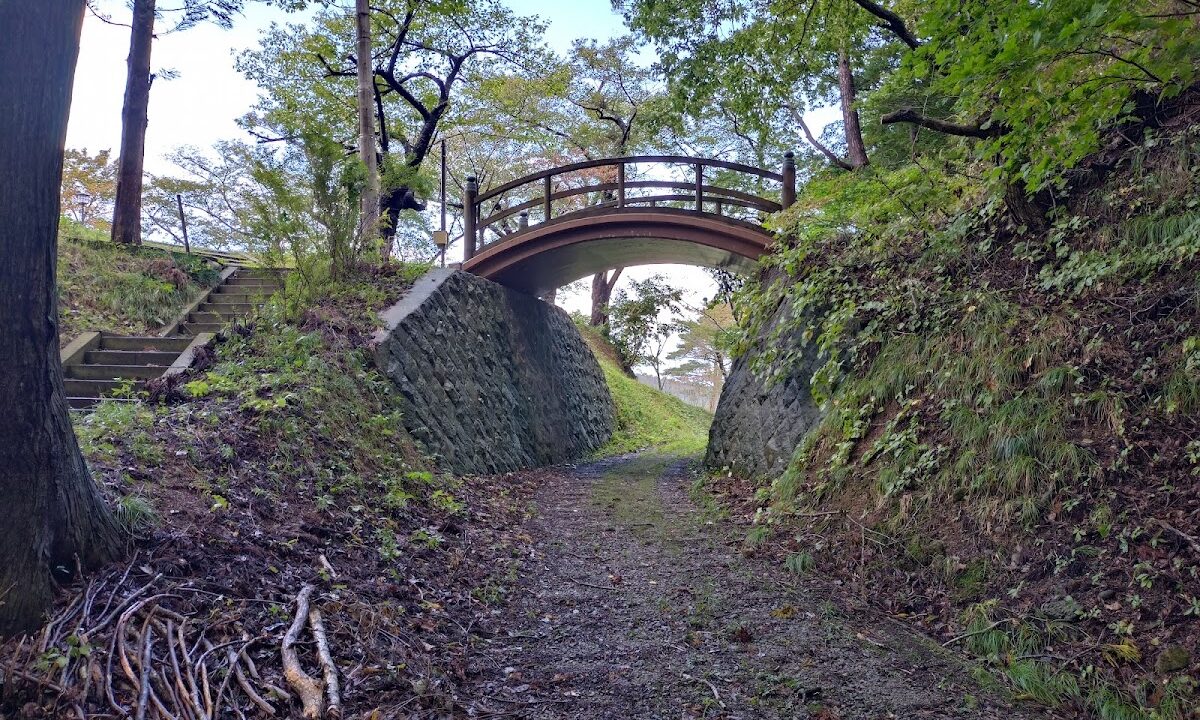
Currently, it is maintained as Ōyama Park, and the castle ruins are preserved within a vast area of approximately 72,000 square meters. Designated as a Tsuruoka City Historic Site, the remains such as baileys, earthworks, and dry moats are well-preserved, making it a valuable cultural asset that conveys the appearance of a Sengoku period mountain castle to the present day.
Basic Information about Oura Castle
Common Names and Alternate Names
Oura Castle has been known by several names. The most common alternative name is Oyama Castle, named after the Oyama mountain where it is located. The spelling Oura Castle is also found in historical documents. These names are used interchangeably depending on the era and document, but refer to the same castle.
Location and Former Province
Location: Oyama, Shiroyama, Oyama 3-chome, Tsuruoka City, Yamagata Prefecture
Former Province: Dewa Province (Uzen Province)
Access: Approximately 19-25 minutes on foot from JR Uetsu Main Line “Uzen-Oyama Station”
The castle ruins are located within the current Oyama Park, approximately 5.5 km northwest of Tsuruoka city center. Situated on the eastern side of the Takadateyama mountain range, it was chosen as a strategic location overlooking the Shonai Plain.
Classification and Structure
Classification: Mountain Castle
Builder: Daiboji Mutō Clan (Mutō Harutoki)
Year of Construction: Tenbun Era (1532-1555)
Year of Abandonment: Genna 8 (1622) or Genna 1 (1615)
Keep Structure: No keep (Mountain Castle Style)
Oura Castle is a typical Sengoku period mountain castle, characterized by defensive structures that utilize the natural terrain. It has a complex layout consisting of a main enclosure, secondary enclosure, second enclosure, third enclosure, and other enclosures, with the groups of enclosures arranged in a continuous sequence.
Major Remains
The existing remains include the following:
- Kuruwa (Enclosure): Multiple flat areas arranged in stages
- Earthwork: Remains in good condition behind the Miyoshi Shrine in the main enclosure
- Dry Moat: A dry moat that functioned as a defensive line can be seen
- Stone Monument: A monument commemorating the remains of the Mutō family, lords of Oura Castle
- Miyoshi Shrine: Located on the site of the main enclosure
In particular, the earthwork behind the Miyoshi Shrine in the main enclosure and the dry moat behind it are considered the most impressive parts of the Oura Castle remains.
History of Oura Castle
Establishment and Development of the Daibōji Mutō Clan
The Daibōji Mutō clan was a branch of the Mutō clan that served Minamoto no Yoritomo and achieved meritorious service. Their origins date back to the Kamakura period when they were granted the position of jitō (land steward) of Ōizumi-shō (present-day Tsuruoka City area). Initially, the Daiboji clan was based at Daiboji Castle (the predecessor of Tsurugaoka Castle), located near the city center of Tsuruoka. However, with the advent of the turbulent Sengoku period, it became necessary to relocate to a mountain castle more suitable for defense.
Background of Oura Castle’s Construction
Around 1532, the Daiboji clan faced intensified conflicts with surrounding forces, including attacks from the Sunagoshi clan, a branch family. In response to this situation, the clan head, Muto Harutoki (Daiboji Harutoki), constructed Oura Castle on Mount Ohira, a strategically important location in the Takadateyama mountain range, as a more robust defensive base, and relocated their headquarters there.
Constructed during the Tenbun era (1532-1555), Oura Castle was strategically located overlooking the Shonai Plain and became a base for strengthening the power base of the Daiboji Muto clan.
The Daiboji Mutō Clan at its Peak
The Daiboji Mutō clan, based at Oura Castle, expanded its power as a powerful Sengoku daimyo in the Shōnai region. Through repeated alliances and conflicts with surrounding forces such as the Mogami, Onodera, and Honjō clans, they significantly influenced the political situation in Dewa Province.
It is believed that the castle town developed with the residences of their retainers. Oura Castle was not merely a military base, but also functioned as a political center for governing the territory.
The Fall of Oura Castle in 1587
The most dramatic event in the history of Oura Castle was its fall in 1587. In that year, the Mogami forces, led by the powerful northern lord Mogami Yoshiaki, invaded the Shōnai region. The Mogami clan had been in conflict with the Daiboji clan for many years, engaging in fierce battles over control of Shōnai.
At Oura Castle, which was under fierce attack from the Mogami forces, Lord Mutō Yoshioki (Daihōji Yoshioki) fought bravely, but ultimately the castle fell, and Yoshioki committed suicide. This fall marked the end of the Daihōji Mutō clan’s rule over Shōnai.
From the Fall to the Abandonment
After the fall of Oura Castle in 1587 (Tenshō 15), it came under the control of the Mogami clan. However, the Shōnai region subsequently experienced a period of rapid rule changes, with the Uesugi clan, the Mogami clan, and then the Tokugawa Shogunate.
Around 1622 (Genna 8) or 1615 (Genna 1), Oura Castle was officially abandoned. Due to the Edo Shogunate’s “One Castle Per Province” decree, Oura Castle, having fulfilled its role as a mountain castle, withdrew from the stage of history.
The Layout and Structure of Oura Castle
Location as a Mountain Castle
Oura Castle was built on Ohirayama, at an elevation of approximately 100m, at the tip of a hill range extending from Takadateyama. This location offered two advantages: excellent views overlooking the Shonai Plain and natural fortifications surrounded on three sides by steep slopes.
The relative height from the foot of the mountain was approximately 80-90m, providing sufficient height to defend against enemy attacks. Furthermore, the Takadateyama mountain range behind it acted as a natural barrier, limiting attackers to approaches from only a few directions.
Layout of Major Enclosures
Oura Castle consisted of the following major enclosures:
Main Enclosure (Honmaru): The central part of the castle, where the Miyoshi Shrine now stands. It is presumed to have contained the lord’s residence and administrative facilities. Earthen ramparts surrounded it, with particularly high ramparts and a dry moat at the rear.
Second Enclosure: An important enclosure adjacent to the main enclosure, serving to defend it.
Second and Third Enclosures: Groups of enclosures located outside the main enclosure, forming a tiered defensive line.
Other Enclosures: Several other smaller enclosures were located here, likely used as barracks for soldiers and storage facilities for supplies.
Characteristics of Defensive Structures
The defensive structures of Oura Castle exhibit typical characteristics of Sengoku period mountain castles:
Earthworks: Earthworks surrounding the enclosures prevented enemy intrusion and provided protection from arrows and firearms. The earthworks behind the main enclosure, in particular, are tall and wide, indicating their importance as a defensive line.
Dry Moats (Horizontal Moats): Dry moats dug between or around enclosures functioned as obstacles to hinder enemy advances. Multiple dry moats have been identified at Oura Castle, suggesting a multi-layered defensive strategy.
Cut-off cliffs: These cliffs, created by cutting the edges of the enclosures at a near-vertical angle, served as a defensive measure to make climbing difficult.
Characteristics of the Castle Layout
Despite being built relatively early, during the Tenbun era, Oura Castle exhibits a sophisticated design philosophy that foreshadows later Sengoku period mountain castles. The layout of the enclosures cleverly utilizes the terrain, allowing for effective defense even with a small force.
Furthermore, the centripetal structure centered around the main enclosure is thought to have demonstrated the authority of the castle lord and contributed to the efficiency of the command and control system.
Highlights of Oura Castle
Main Enclosure Site and Miyoshi Shrine
The main attraction of a visit to Oura Castle is Miyoshi Shrine, located on the site of the main enclosure. The shrine grounds correspond to the flat area of the main enclosure and are presumed to be the location of the castle lord’s residence. Walking around the shrine, you can imagine the former building layout from the slight elevation changes and undulations of the terrain.
Miyoshi Shrine itself is thought to have been built as a guardian deity of the castle, or to commemorate the castle lord and those who died in battle, and it enhances the historical atmosphere of the castle ruins.
Earthworks and Dry Moat (The Main Highlight)
The most impressive feature of Oura Castle is the earthworks remaining behind the Miyoshi Shrine in the main enclosure, and the dry moat behind it. This section is well-preserved and is a valuable historical site that allows for a concrete understanding of the defensive facilities of a mountain castle from the Sengoku period.
The earthworks reach a height of several meters, and the dry moat behind them is deeply excavated. Seeing it in person allows you to truly appreciate the scale of these civil engineering works and how effective they were as defensive structures.
For castle enthusiasts and history buffs, these earthworks and dry moat are must-see points.
Stone Monuments and Historical Site Towers
Within the castle ruins, several stone monuments have been erected, including a monument commemorating the history of the Muto family, the lords of Oura Castle. These stone monuments were erected to pass on the history of Oura Castle to future generations and to commemorate the achievements of the Mutō clan of Daibōji.
By reading the inscriptions and explanations on the monuments, you can deepen your understanding of the castle’s history and the achievements of the Mutō clan.
Exploring the Enclosures
Within the castle ruins, now developed as Ōyama Park, several enclosures remain. A walking path is provided, allowing you to explore these enclosures and grasp the overall layout of the castle.
By observing the elevation differences and arrangement of each enclosure, you can understand the ingenuity of the castle’s layout and the ingenuity of its defensive features. During the lush green seasons from spring to autumn, you can enjoy a historical walk amidst nature.
Views
From Oura Castle, a mountain castle, you can enjoy a wide view of the Shōnai Plain. On a clear day, you can experience the landscape of the territory that the castle lords once saw, providing a valuable opportunity to observe the terrain from the perspective of a Sengoku period warlord.
This view is important for understanding why this location was chosen for the castle.
Access and Visiting Information
Access by Public Transportation
Approximately 19-25 minutes on foot from JR Uetsu Main Line “Uzen-Oyama Station”. The route from the station to the castle ruins goes through a residential area towards Oyama Park. There are signs along the way, so even first-time visitors should be able to arrive without getting lost.
Access by Car
Approximately 15 minutes from Tsuruoka city center via National Route 7. Oyama Park has a parking lot, making it convenient to visit by car. Entering “Oyama Park” or “Oura Castle Ruins” into your car navigation system is recommended.
Notes for Visitors
- Clothing: As it is a mountain castle, comfortable walking shoes and clothing are recommended.
- Season: Spring to autumn is suitable for visiting, but caution is advised during winter due to snow.
- Estimated Time Required: Allow approximately 1-2 hours for a thorough visit.
- Facilities: While the site is maintained as a park, it is a mountain castle, so there are steep slopes and uneven terrain.
- Admission Fee: Admission is free.
Related Historical Sites in the Surrounding Area
When visiting Oura Castle, visiting the following related historical sites will deepen your understanding of the Sengoku period history of Shonai:
Tsurugaoka Castle (Tsuruoka Castle): This was the first castle established by the Daiboji clan, and later became the residence of the Sakai clan. It is currently maintained as Tsuruoka Park.
Kamegasaki Castle: Another important castle in the Shonai region, it served as a base of operations for the Mogami and Uesugi clans.
Visiting these castle ruins will provide a more comprehensive understanding of the Sengoku period history of the Shonai region.
Historical Significance of Oura Castle and the Daiboji Muto Clan
As a Base for Controlling Shonai
Oura Castle functioned as a political and military center in the Shonai region during the Sengoku period. The Daiboji Muto clan used this castle as their base to control a vast area of the Shonai Plain and acted as a powerful daimyo in southern Dewa Province.
The Shonai region had a rich economic base as a rice-producing area and was also a key trading hub facing the Sea of Japan. Oura Castle occupies an important position in regional history as a base for controlling this important region.
An Example of Mountain Castle Construction Technology
Oura Castle, built during the Tenbun era, is a valuable example of Sengoku period mountain castle construction technology. It incorporates the latest construction techniques of the time, such as earthworks, dry moats, and bailey layouts, making it an important resource for the study of Sengoku period castles.
In particular, Oura Castle is highly regarded as one of the representative examples of well-preserved remains in the study of mountain castles in the Tohoku region.
A Witness to the Turmoil of the Sengoku Period
The history of Oura Castle directly reflects the turbulent times of the Sengoku period. The castle’s life cycle—construction, development, and eventual fall—symbolizes the very nature of the Sengoku era.
The conflict with the Mogami clan and the tragic end of Mutō Yoshioki’s suicide serve as a historical lesson illustrating the rise and fall of Sengoku daimyo, a lesson passed down to the present day.
As a Regional Cultural Heritage Site
Currently, the Oura Castle ruins are protected as a Tsuruoka City designated historical site and are enjoyed by citizens as Ōyama Park. Its value as a regional historical heritage site and educational site continues to thrive.
Regular maintenance and preservation activities keep the remains in good condition, ensuring their transmission to future generations.
Current Status and Challenges of Oura Castle Research
Status of Archaeological Excavations
While partial surveys and field explorations have been conducted regarding Oura Castle, large-scale archaeological excavations have been limited. Further detailed archaeological investigations may yield new insights into the castle’s structure and the realities of daily life.
Comparison with Historical Documents
Many historical documents concerning the Daiboji Muto clan are scattered, leaving many aspects of Oura Castle’s detailed history unclear. It is hoped that the discovery of new documents and a re-examination of existing ones will shed more light on the castle’s history.
Balancing Preservation and Utilization
Preserving the castle ruins as a historical heritage site while utilizing it as a park is a challenge that always requires a balance. Efforts are ongoing to prioritize the protection of the remains while developing the site as an attractive historical site for visitors.
Summary
Oura Castle is a valuable mountain castle ruin from the Sengoku period located in Tsuruoka City, Yamagata Prefecture. Built by the Daiboji Muto clan during the Tenbun era, it functioned as the political and military center of the Shonai region. It met a tragic end when it fell to an attack by the Mogami forces in 1587 (Tensho 15).
Currently developed as Oyama Park, the remains of the castle, including the baileys, earthworks, and dry moats, are well-preserved. The earthworks and dry moat behind the main keep and the Miyoshi Shrine are particularly noteworthy, offering a tangible glimpse into the defensive structures of a Sengoku period mountain castle.
This historical site, easily accessible on foot from JR Uzen-Oyama Station and free to visit, is a valuable place for anyone interested in history, not just castle enthusiasts. The panoramic views of the Shonai Plain and the numerous remains that evoke the spirit of the Sengoku warlords will undoubtedly leave visitors with a profound sense of historical significance.
By learning about the history of Oura Castle and visiting the site in person, you can gain a deeper understanding of the Shonai region during the Sengoku period and the glory and tragedy of the Daiboji Muto clan. When visiting Yamagata Prefecture, be sure to stop by this historic castle site.


