
Complete Guide to Sakenobe Castle (Yamagata Prefecture): History and Highlights of the Castle of Sakenobe Hidetuna, a Famous Sengoku Period General
What is Sakenobe Castle?
Sakenobe Castle (Sakenobe-jo) is a Japanese castle (mountain castle) located in Uchimachi, Mamurogawa-cho, Mogami-gun, Yamagata Prefecture, dating from the Sengoku period to the early Edo period. Also known as Mamuro Castle or Manazuru Castle, it is currently protected as a designated historical site by Mamurogawa-cho.
Built on a cliff overlooking the Sakegawa River, a tributary of the Mogami River, it was a formidable stronghold that functioned as an important base in the Mogami region during the Sengoku period. The castle’s lord is particularly known as Sakenobe Hidetuna, a renowned strategist. Despite fierce conflict with Mogami Yoshiaki, Hidetuna’s abilities were recognized, and he became a senior retainer of the Mogami clan, leaving his mark on Sengoku history.
Basic Information on Sakenobe Castle
- Location: Uchimachi, Mamurogawa-machi, Mogami-gun, Yamagata Prefecture
- Builder: Sasaki Noriyoshi Sadatsuna (Sakenobe Sadatsuna)
- Year of Construction: Tenbun 4 (1535) *There are also theories that it was built during the Tenbun era (1532-1555) or the Eiroku era (1558-1569)
- Main Lords: Sakenobe clan (Sakenobe Hidetsuna), Tozawa Masamori
- Year of Abandonment: Kan’ei 2 (1625)
- Castle Style: Mountain Castle
- Remains: Main enclosure (Honmaru), Second enclosure, Third enclosure, Enclosures, Earthworks, Horizontal moats (dry moats), Vertical moats, Main road, Rear road
- Designation: Mamurogawa Town Designated Historic Site
- Nearest Station: JR Ou Main Line, “Mamurogawa Station” or “Uzen-Toyosato Station”
History and Background of Sakenobe Castle
Background of Construction and the Establishment of the Sakenobe Clan
Sakenobe Castle is believed to have been built in 1535 (Tenbun 4), by Sasaki Sadatsuna. The Sasaki clan was originally a family that served the Onodera clan, a powerful daimyo family in Dewa Province. Sadatsuna acquired the land of Sakenobe and eventually adopted the name Sakenobe, taking it from the place name.
At that time, the Mogami region was a region where the powers of the Onodera clan of Akita and the Muto clan (later the Mogami clan) of Yamagata were in balance. Sakenobe Castle was strategically important as a key point in the Mogami River system and a crucial transportation hub. There are theories regarding the construction date, with some dating it to the Tenbun era and others to the Eiroku era, but in any case, it is certain that the castle was built in the mid-16th century, during the turbulent Sengoku period.
Relationship with the Onodera Clan
Initially, the Sakenobe clan was under the influence of the Onodera clan, a powerful daimyo family in Akita during the Sengoku period. During the time of Onodera Kagemichi, the northern part of the Mogami region was strongly influenced by the Onodera clan, and the Sakenobe clan, as their subordinates, served as a base for the Onodera clan’s expansion into the Mogami region.
Sakenobe Castle served as a bridgehead for the Onodera clan into the Mogami region and played a crucial role in protecting the border with the southern Mogami clan (Muto clan). During this period, it is believed that the Sakenobe clan, as vassals of the Onodera clan, were involved in the struggles over the ownership of the Mogami region.
The Fierce Battle Between Sakenobe Hidetuna and Mogami Yoshiaki
The most important figure in the history of Sakenobe Castle is Sakenobe Hidetuna. Hidetuna, as the head of the Sakenobe clan, is known as a brilliant strategist who was active in the late Sengoku period.
During the Tensho era (1573-1592), Mogami Yoshiaki expanded his power in the Mogami region, successively bringing surrounding local lords under his control. Yoshiaki aimed to unify Dewa Province and pressured the Sakenobe clan, who were under the influence of the Onodera clan.
Initially, Hidetuna remained loyal to the Onodera clan and fiercely opposed Mogami Yoshiaki. He repeatedly engaged Yoshiaki’s forces from his base at Sakenobe Castle, and it is said that his military strategy and bravery troubled Yoshiaki. However, as the Mogami clan’s power continued to expand and the Onodera clan’s support became limited, Hidetuna ultimately decided to submit to Yoshiaki.
Sakenobe Hidetuna as a Senior Retainer of the Mogami Clan
Yoshiaki highly valued Hidetuna’s abilities and talents, and not only did he guarantee Hidetuna’s Sakenobe territory after his surrender, but he also treated him well as a senior retainer of the Mogami clan. Hidetuna was counted among the Four Heavenly Kings of the Mogami clan and gained the trust of Yoshiaki, participating in important battles.
Particularly famous is the Battle of Hasedo Castle in 1600, which was linked to the Battle of Sekigahara. In this battle, Hidetuna played a leading role in the Mogami army, fighting valiantly against a large army led by Naoe Kanetsugu, a renowned general of the Uesugi army. Due to Hidetuna’s achievements, Mogami Yoshiaki’s territory was secured and even increased.
As a senior retainer of the Mogami clan, Hidetuna was also involved in the administration of the domain, and was responsible for governing the northern part of the Mogami region from his base at Sakenobe Castle.
The Arrival of the Tozawa Clan and the Abandonment of the Castle
In 1622, the Mogami clan was dispossessed of their domain due to an internal dispute, and the Mogami region was divided, with several daimyo taking control. Tozawa Masamori from Hitachi Province was appointed to the Shinjo territory, including Mamurogawa, with a stipend of 60,000 koku.
Initially, the Tozawa clan used Sakenobe Castle, but it was inconvenient as a base for governing their territory, and also too small to be a proper castle. Therefore, they planned to build Shinjo Castle as their new residence.
In 1625, upon the completion of Shinjo Castle, the Tozawa clan moved their residence, and Sakenobe Castle was abandoned. While Numata Castle was temporarily used as a subsidiary castle, Sakenobe Castle itself had completed its historical role at this point.
Layout and Structure of Sakenobe Castle
Location and Topography
Sakenobe Castle is a typical mountain castle built on a cliff approximately 70 meters high overlooking the Sakegawa River. Surrounded on three sides by steep cliffs, it was a natural stronghold, making it extremely difficult for attackers to conquer.
The Sakegawa River flows to the north and east of the castle, a deep valley to the west, and only the south side is connected to a ridge. The main road was located on the south side, and defensive structures were concentrated there.
Layout of Enclosures
Sakenobe Castle has a linear layout, with the main enclosure (honmaru) at the center, surrounded by a series of other enclosures such as the second and third enclosures.
The main enclosure is located at the highest point of the castle, measuring approximately 40 meters east-west and 30 meters north-south. Earthen ramparts surrounded it, and the entrance was heavily fortified. The topography of the main enclosure is still relatively well-preserved, allowing us to imagine its appearance in the past.
The second enclosure is located south of the main enclosure and served to protect the access route to the main enclosure. A moat was constructed between the second and main enclosures to prevent enemy intrusion.
The third enclosure is located further south and was the frontline defensive base to repel intruders from the main road.
Defensive Structures
Sakenobe Castle had numerous defensive structures typical of a mountain castle.
Earthen ramparts surrounded the baileys, preventing enemy intrusion and providing a base for attacks with bows, arrows, and firearms. Remains of these ramparts still exist around the main and second baileys.
Dry moats were located between baileys, particularly along the southern ridge, and served to hinder enemy advances. They were several meters deep, and it is believed that obstacles were placed at the bottom.
Vertical moats were dug vertically along slopes, designed to prevent enemies from climbing the slopes and approaching the castle. Multiple vertical moats have been identified at Sakenobe Castle, indicating a strong defense against attacks from the flanks.
Main and Rear Access Roads
The castle had two access routes: the main road (Ote-michi) on the south side and the rear access road (Karamete-michi) on the north side.
The main road was the frontal approach, a complex route passing through baileys before reaching the main bailey. Along the way, fortified entrances and earthworks were constructed, giving the defenders an advantage in battle.
The rear entrance was a route from the back, utilizing the steeper terrain to serve as a secret passage. It is thought to have also been used as an escape route in emergencies.
Current State of Sakenobe Castle Ruins
Preservation Status of the Remains
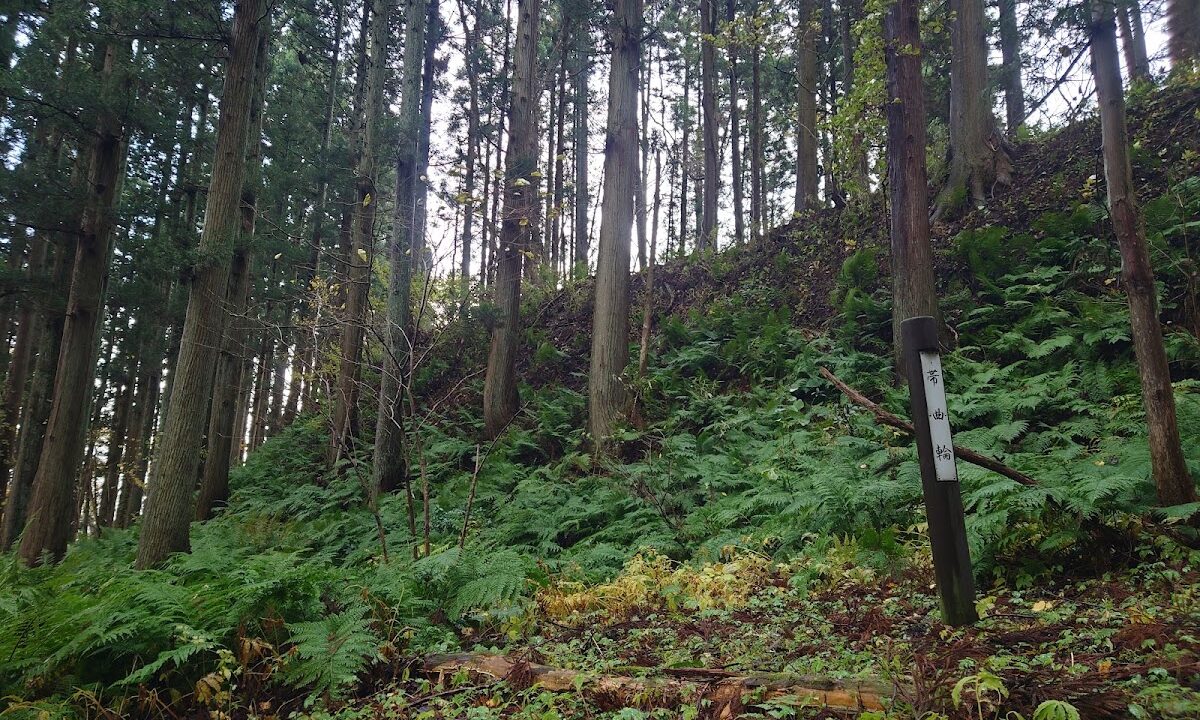
The current Sakenobe Castle ruins are protected as a designated historical site of Mamurogawa Town. The topography of the baileys, including the main bailey, second bailey, and third bailey, is relatively well preserved, and remnants of earthworks and moats can be partially confirmed.
A castle site monument has been erected at the castle site, telling the history of Sakenobe Castle. Information boards are also installed, allowing visitors to learn about the castle’s structure and history.
While it is difficult to fully grasp its original appearance due to the overgrown trees, it is a valuable historical site where you can experience the atmosphere of a Sengoku period mountain castle while enjoying a leisurely hike.
Views and Scenery
From the ruins of Sakenobe Castle, you can enjoy a panoramic view of the Sakegawa River and the town of Mamurogawa. Its location on a cliff provides a magnificent view that makes you appreciate why this castle functioned as a fortress during the Sengoku period.
The view from the main enclosure is particularly exceptional, offering a panoramic view of the mountains and rural landscapes of the Mogami region. In autumn, the autumn foliage is beautiful, and in spring, the fresh greenery is vibrant, allowing you to enjoy nature throughout the seasons.
Access
Access by Public Transportation
- Approximately 10 minutes by car from JR Ou Main Line “Mamurogawa Station”
- Approximately 12-15 minutes on foot to the trailhead from JR Ou Main Line “Uzen-Toyosato Station”
Taking a taxi from Mamurogawa Station is convenient. While it’s possible to access the castle ruins on foot from Uzen-Toyosato Station, you will need to climb further from the trailhead to the castle ruins.
Access by Car
- Approximately 1 hour from Higashine IC on the Tohoku Chuo Expressway via National Route 13.
- Parking is limited, so it is recommended to check in advance.
Precautions for Visiting the Castle
Since Sakenobe Castle is a mountain castle, the following points should be noted when visiting:
- Wear comfortable walking shoes (hiking boots or trekking shoes are ideal).
- Bring drinks.
- Insect repellent is necessary during the summer months.
- Be careful as the ground can be slippery during and after rain.
- In winter, snowfall may make visiting the castle difficult.
The climbing time from the trailhead to the main enclosure is approximately 20-30 minutes one way. Including time spent sightseeing at the castle ruins, allow approximately 1.5 to 2 hours in total.
Highlights of Sakenobe Castle
1. Earthworks of the Main Enclosure (Honmaru)
The earthworks surrounding the main enclosure are important relics that attest to the high defensive capabilities of Sakenobe Castle. Earthworks several meters high surround the enclosure, conveying the castle-building techniques of the Sengoku period.
2. Moats and Vertical Ditches
The moats between the enclosures and the vertical ditches on the slopes are valuable relics as defensive structures unique to mountain castles. The moat on the south side, in particular, is large in scale, demonstrating the strictness of the defenses at the time.
3. Cliffside Topography
The north and east sides of the castle face cliffs along the Sakegawa River, giving a real sense of its natural fortress location. This topography is likely one of the reasons why Sakenobe Hidetuna was able to confront Mogami Yoshiaki.
4. Castle Site Monument and Information Board
The castle site monument is inscribed with the history of Sakenobe Castle, and the information board provides detailed information about the castle’s structure and the achievements of Sakenobe Hidetuna.
5. View
The view from the main enclosure is exceptional, offering a panoramic view of the rich natural beauty of the Mogami River system and the townscape of Mamurogawa. Imagining Sakenobe Hidetuna surveying his territory from this spot during the Sengoku period evokes a sense of historical romance.
Sakenobe Hidetuna and the Later Sakenobe Clan
Profile of Sakenobe Hidetuna
Sakenobe Hidetuna is known as a Sengoku period warlord with exceptional strategic brilliance. His career, where he faced a formidable enemy like Mogami Yoshiaki and was recognized for his talent, leading to his appointment as a senior retainer, speaks volumes about Hidetuna’s great character.
His exploits in the Battle of Hasedo Castle are particularly famous; he fought valiantly against the large Uesugi army led by Naoe Kanetsugu, saving the Mogami clan from crisis. This achievement solidified Hidetuna’s place in the history of the Sengoku period.
The Sakenobe Clan After the Mogami Clan’s Dispossession
Following the Mogami clan’s dispossession in 1622, the Sakenobe clan also lost their territory. However, Hidetuna Sakenobe’s achievements were highly regarded, and his descendants served the Edo shogunate as hatamoto (direct retainers of the shogun).
The Sakenobe lineage continued throughout the Edo period and persisted until the Meiji Restoration. Even today, descendants bearing the Sakenobe surname exist, proud of Hidetuna’s accomplishments.
Related Historical Sites in the Surrounding Area
Historical Buildings in Mamurogawa Town
Besides Sakenobe Castle, Mamurogawa Town has numerous historical buildings and sites. The town’s historical museum exhibits materials related to the Sakenobe clan and Sakenobe Castle, allowing visitors to learn more about the history.
Castles in the Mogami Region
Besides Sakenobe Castle, many castle ruins remain in the Mogami region. Visiting the ruins of Shinjo Castle and Numata Castle will provide a more comprehensive understanding of the Sengoku period history of this region.
Historical Sites Related to Mogami Yoshiaki
As historical sites related to Mogami Yoshiaki, who had a deep connection with Sakenobe Hidetuna, there are Yamagata Castle ruins (Kajo Park) and Hasedo Castle ruins. Visiting these together will allow for a deeper understanding of the Sengoku period history of the Mogami region.
Summary
Sakenobe Castle is a mountain castle of valuable historical significance, serving as an important base in the Mogami region during the Sengoku period and as the residence of the renowned general Sakenobe Hidetuna.
From its construction in 1535 to its abandonment in 1625, this castle was a crucial stage in the history of the Mogami region for approximately 90 years. Sakenobe Castle witnessed the power struggle between the Onodera and Mogami clans, the fierce battles and reconciliation between Sakenobe Hidetuna and Mogami Yoshiaki, and the arrival of the Tozawa clan and their relocation to Shinjo Castle.
The remaining structures, such as baileys, earthworks, and moats, are invaluable cultural assets that convey the castle-building techniques and defensive philosophies of the Sengoku period. Its location atop a sheer cliff gives a tangible sense of its natural fortifications, demonstrating that this castle was an impregnable fortress.
Located in Mamurogawa Town, the northernmost point of Yamagata Prefecture, the Sakenobe Castle ruins are a historical site well worth visiting for history buffs and castle enthusiasts. Why not stroll through the castle ruins, surrounded by beautiful nature, and feel the spirit of the Sengoku period warriors? Sakenobe Castle is a fascinating historical site where you can experience the era in which the brilliant strategist Sakenobe Hidetuna lived, the fierce battles against Mogami Yoshiaki, and the history of the Mogami region.


