Shimonote Castle Ruins (Yamagata Prefecture): A Thorough Explanation of the Sengoku Period Mountain Castle Remains and Their Historical Value
The Shimonote Castle Ruins are a valuable mountain castle site in Yamagata Prefecture dating from the medieval to the Sengoku period. As an important historical site that tells the story of the region’s history, it attracts attention from castle researchers and history enthusiasts. This article will provide a detailed explanation of the Shimonote Castle Ruins, including its historical background, structural features, current site conditions, and access methods.
What are the Shimonote Castle Ruins?
The Shimonote Castle Ruins are the remains of a medieval mountain castle located in Yamagata Prefecture. The name “Tekan” refers to a residence built by a feudal lord or samurai during the medieval period, indicating that it functioned as a regional power base.
Basic Information
- Period: Medieval to Sengoku period (estimated)
- Type: Mountain castle, residence ruins
- Location: Hilly area in a mountainous region
- Current Status: Partial remains remain
The Shimonote Castle ruins, as a mountain castle, are a defensive structure that skillfully utilizes the natural terrain, and are a valuable cultural heritage site that conveys the castle-building techniques and strategic thinking of the time.
Historical Background
Political Situation in Medieval Yamagata
The Yamagata Prefecture region was in a complex political situation from the medieval period to the Sengoku period. Powerful daimyo such as the Mogami, Date, and Uesugi clans competed for power, and local minor lords repeatedly formed alliances and conflicts in order to survive.
The Shimonote Castle ruins were built during this turbulent period, and it is believed to have played an important role as a base for regional control and as a defensive structure against hostile forces.
Purpose and Function of Castle Construction
Medieval mountain castles were primarily built for the following purposes:
- Military Defense: A defensive base to prepare for enemy invasions
- Territorial Control: A base for monitoring and governing the surrounding area
- Storage of Supplies: A place to store food and weapons
- Refuge: A place for the villagers to evacuate in times of emergency
The Shimonote Castle ruins are presumed to have been a complex facility possessing these functions.
Related Warlords and Clans
Many medieval castles in Yamagata Prefecture were built by local minor lords and kokujin (local samurai), and the Shimonote Castle ruins are highly likely to have been a base for a samurai group that controlled the region. Regarding the specific builders and lords, historical documents are limited, so further research is needed.
Structure and Characteristics of the Castle
Location and Utilization of Topography
The Shimonote Castle ruins are located in a hilly area in a mountainous region, and are characterized by a layout that makes maximum use of the natural terrain. The location selection combines the fundamental elements of a mountain castle: “securing a clear view from high ground” and “difficulty of attack.”
Types of Remains
Based on on-site surveys and research, the existence of the following remains has been confirmed or estimated:
Kuruwa (Enclosure)
A flat area forming the core of the castle, where buildings and facilities were located. It is possible that multiple kuruwa were arranged in stages at the Shimonote Castle ruins.
Horikiri (Dry Moat)
A moat dug to cut across a ridge, an important defensive structure to prevent enemy intrusion. It is one of the most basic and effective defensive measures in a mountain castle.
Dorui (Earthwork)
A defensive wall made by piling up earth, built to surround the kuruwa. It served to protect against attacks from arrows and stones.
Vertical Moat (Tatebori)
A moat dug vertically along a slope, it functions to prevent lateral movement of the enemy. It is a defensive structure unique to mountain castles.
Characteristics of Castle Construction Techniques
The castle construction techniques at the Shimonote Castle ruins exhibit the characteristics of typical mountain castles in the medieval Yamagata region:
- Utilization of Natural Terrain: Minimizing artificial construction and utilizing the elevation differences of the terrain.
- Centered on Civil Engineering: Defense using earthworks and moats rather than stone walls.
- Simple Structure: A practical design without large stone walls or keeps.
These are common characteristics of regional mountain castles during the Sengoku period, showing ingenuity in efficiently enhancing defensive capabilities with limited resources and labor.
Current Situation
Preservation Status of Remains
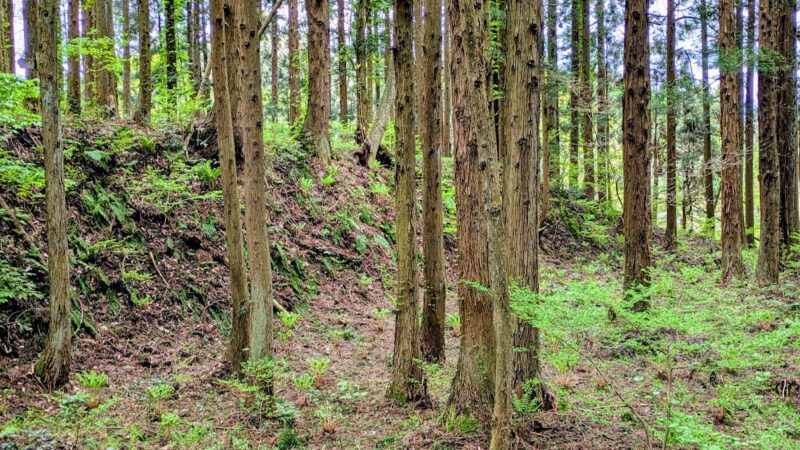
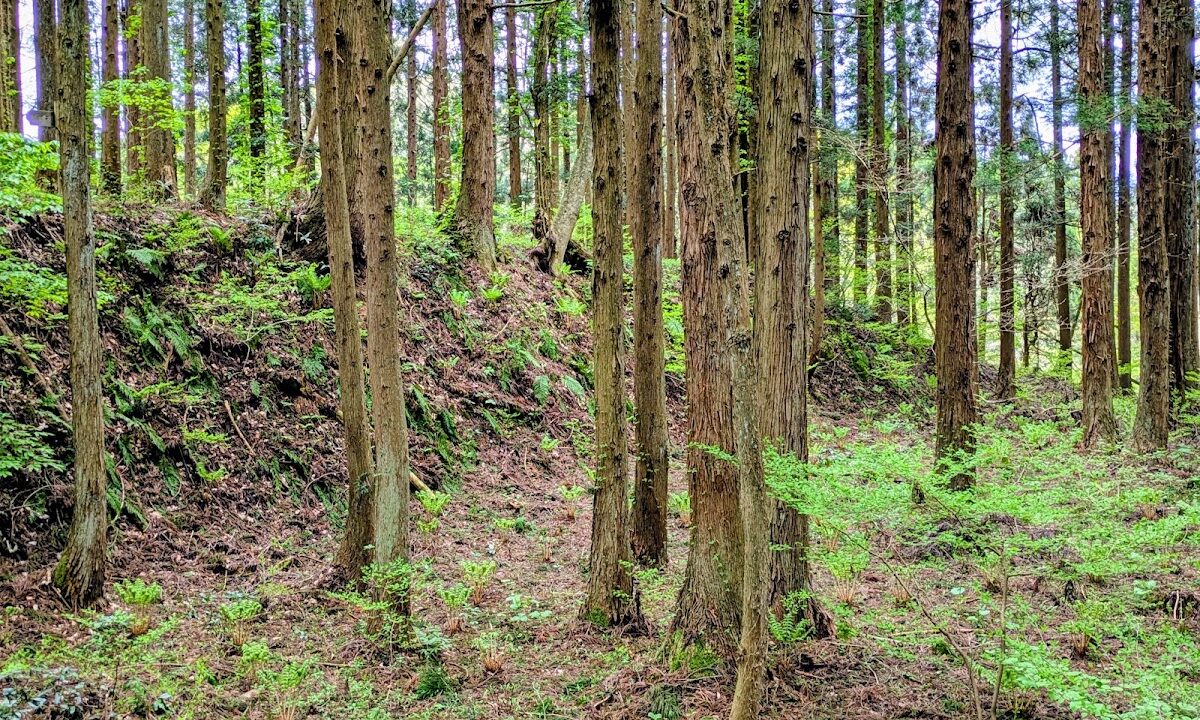
The current state of the Shimonote Castle ruins shows that, despite the effects of the natural environment and development, some remains are preserved as part of the topography. Much of the site is covered in forest, and the dense vegetation makes it difficult to confirm the remains in some areas.
Status of Maintenance
The status of maintenance of castle ruins varies by region, but many mountain castles remain in an unmaintained state. Regarding the Shimonote Castle ruins, it is necessary to check the latest information to determine whether a full-scale investigation and maintenance are being carried out.
Points to Note When Visiting
When visiting mountain castle ruins, please note the following:
- Safety of Footwear: There are many mountain paths and slopes, so wear appropriate shoes.
- Check the Weather: It can be slippery and dangerous in rainy weather.
- Possibility of Private Property: Entry may require permission.
- Protection of Remains: Take care not to damage the remains.
- Cell Phone Signal: Signal may be unavailable in mountainous areas.
Historical Value of the Shimonote Castle Ruins
Importance in Regional History Research
The Shimonote Castle ruins provide important clues for understanding the medieval history of Yamagata Prefecture. In the history of regions with limited written records, physical evidence such as castle ruins is a valuable source of information.
Significance in Castle Research
In the study of Japanese castles, small, rural mountain castles are indispensable for understanding the realities of the Sengoku period (Warring States period). Their practical and simple structures, unlike large, modern castles, reflect the technological level and tactics of the time.
Status as a Cultural Property
Whether the Shimonote Castle Ruins are designated as a cultural property depends on the local government’s judgment, but it is desirable that they be protected and utilized as a regional historical heritage.
Related Historical Sites in the Surrounding Area
Major Mountain Castles in Yamagata Prefecture
Besides the Shimonote Castle Ruins, many other medieval mountain castles remain in Yamagata Prefecture:
- Hasedo Castle Ruins: Yamagata City, site of fierce battles during the Keicho Dewa Campaign
- Hataya Castle Ruins: Kaminoyama City, stage of conflict between the Mogami and Date clans
- Ayugai Castle Ruins: Shirataka Town, a medieval stronghold
Visiting these castle ruins together will allow you to gain a deeper understanding of Yamagata Prefecture’s medieval history.
Local Historical and Cultural Facilities
Facilities to visit before or after visiting the castle ruins:
- Local Historical Museum: Exhibits of excavated artifacts and historical documents
- Local History Museum: Introduction to local history and culture
- Tourist Information Center: Check the latest information and access methods
Access Methods
Using Public Transportation
Many mountain castle ruins are located in places that are difficult to access by public transportation. In most cases, you will need to travel on foot or by taxi from the nearest train station or bus stop.
By Car
Access by car is the most convenient, but please note the following:
- Road Conditions: Possible mountain roads or narrow roads
- Parking: Dedicated parking may not be available
- Car Navigation: The exact location may not be registered
Preparations for Visiting
When visiting the mountain castle ruins, we recommend the following preparations:
- Map and Compass: GPS apps are also useful
- Drinking Water and Snacks: There are often no shops nearby
- Appropriate Clothing: Long-sleeved shirt and long pants, hat, work gloves, etc.
- Insect Repellent: Essential, especially in summer
- Camera: For documentation
Investigation and Research of the Shimonote Castle Ruins
Archaeological Investigation
The following methods are used for academic investigations of mountain castle ruins:
- Survey Investigation: Creation of a layout map based on topographic surveying
- Excavation Investigation: Excavation of remains and artifacts
- Literature Research: Analysis of ancient documents and maps
- Place Name Research: Interpreting historical information from place names
Future Research Topics
Regarding the Shimonote Castle Ruins, the following research topics can be considered:
- Identification of the castle’s construction date
- Identification of the castle lord and related warlords
- Clarification of the time and reason for its abandonment
- Clarification of its relationship with surrounding castles
- Clarification of its role in the regional governance system
Protection and Utilization of Mountain Castle Ruins
Preservation Challenges
Preserving mountain castle ruins presents the following challenges:
- Natural Disasters: Damage to remains due to landslides and fallen trees
- Development Pressure: Destruction due to housing development and road construction
- Lack of Management: Neglect due to unknown ownership or insufficient budget
- Low Awareness: Decline in interest among local residents
Possibilities for Utilization
On the other hand, mountain castle ruins can be utilized as a regional resource in the following ways:
- Historical Tourism: Holding castle ruin tours
- Educational Activities: Local history learning in school education
- Health Promotion: Development as a trekking course
- Regional Identity: As a historical symbol of the region
Characteristics of Medieval Castles in Yamagata Prefecture
Geographical Conditions and Castle Arrangement
Yamagata Prefecture is located in the southern part of Dewa Province and is divided into the Mogami, Okitama, and Shonai regions. Different powers vied for power in each region, forming their own unique castle networks.
Changes in Castle Construction Techniques
Castles in Yamagata Prefecture underwent the following changes:
- Late Ancient Period to Early Medieval Period: Simple fences and residences
- Sengoku Period: Construction of full-fledged mountain castles
- Early Modern Period: Transition to flatland castles
The Shimonote Castle ruins are thought to be classified as a mountain castle from the Sengoku period.
Manners and Rules for Visiting Castle Ruins
Basic Manners
When visiting castle ruins, please observe the following manners:
- Respect for Private Property: Unauthorized entry is strictly prohibited
- Take Your Trash With You: Protection of the Natural Environment
- Protection of Remains: Do not damage earthworks or moats
- Consideration for Noise: Maintaining a Quiet Environment
- No Open Fires: Prevention of Forest Fires
Safety Management
Exploring mountain castles involves the following risks:
- Risk of Falls or Slips
- Possibility of Getting Lost
- Encounter with Wild Animals
- Insect Bites or Skin Rash
It is recommended to avoid traveling alone and visit in groups whenever possible.
Summary
The Shimonote Castle Ruins are a valuable heritage site that tells the story of Yamagata Prefecture’s medieval history. As a mountain castle ruin that conveys the realities of regional control during the Sengoku period, it possesses historical and academic value.
In modern times, many small, rural mountain castle ruins are largely unknown, and their preservation and utilization are often insufficient. However, learning about local history and reflecting on the lives of our ancestors holds great significance for us living today.
When visiting the Shimonote Castle ruins, we hope you will explore with appropriate preparation and consideration, feeling a sense of responsibility to pass on this valuable historical heritage to future generations.
The research and protection of mountain castle ruins can only be achieved through the cooperation of local residents, researchers, government officials, and history enthusiasts. We hope that the Shimonote Castle ruins will be further investigated and researched in the future, revealing their historical value.
Besides the Shimonote Castle ruins, many other medieval castles remain in Yamagata Prefecture. Visiting these will allow you to gain a more comprehensive understanding of Yamagata’s history during the Sengoku period. By taking an interest in local history and actually visiting the sites, you can experience living history that cannot be learned from textbooks.
Exploring castle ruins is not only a form of historical learning, but also a meaningful activity that connects you to nature and promotes health. We hope you will visit the mountain castle ruins safely and enjoyably with proper preparation and consideration.