
Complete Guide to Oguni Castle (Yamagata Prefecture): Detailed Explanation and Highlights of Three Castles with the Same Name
There are three castles named “Oguni Castle” in Yamagata Prefecture. Each was built in a different region and possesses its own unique history and characteristics. This guide provides a comprehensive explanation of these castles, including detailed information and highlights.
Three Oguni Castles in Yamagata Prefecture: Overview and Location
There are three castles named “Oguni Castle” in Yamagata Prefecture, as listed below.
Oguni Castle (Tagawa District, Tsuruoka City)
Location: Shiri, Oguni-machi, Tsuruoka City, Yamagata Prefecture (formerly Atsumi-machi, Tagawa District)
Former Province: Tagawa District, Dewa Province
Classification/Structure: Mountain Castle
Year of Construction: Sengoku period
National Historic Site: Designated December 19, 2002 (Heisei 14)
Oguni Castle (Okitama District, Oguni Town)
Location: Oguni-Kosaka-machi, Oguni-machi, Nishioitama District, Yamagata Prefecture
Former Province: Okitama District, Dewa Province
Classification/Structure: Flatland Castle
Year of Construction: Sengoku period
Common Name/Alternate Name: Goyakuya (after Genroku 5)
Oguni Castle (Mogami District, Mogami Town)
Location: Honjo, Mogami-machi, Mogami District, Yamagata Prefecture
Former Province: Mogami District, Dewa Province Classification/Structure: Mountain Castle
Common Name/Alternate Name: Iwabe-no-Yate, Honjo-no-Yate
Year of Construction: Tensho 12 (1584)
Builder: Oguni Mitsumoto
Detailed Explanation of Oguni Castle (Tagawa District, Tsuruoka City)
Basic Information and Historical Background
Located in Shiri, Oguni-machi, Tsuruoka City, Oguni Castle is the most famous Oguni Castle in Yamagata Prefecture and an important mountain castle designated as a National Historic Site. Built on the summit of “Tateyama” mountain, which rises to an elevation of 348.5 meters on the left bank of the Oguni River (Shonai Oguni River), the elevation difference between the mountain and the Oguni settlement at the foot of the mountain reaches approximately 235.5 meters. This elevation difference is the largest among mountain castles in Yamagata Prefecture, demonstrating its high level of defense.
History of Construction and Strategic Importance
This castle, as a “border castle” protecting the border between Echigo Province (present-day Niigata Prefecture) and major roads, played an extremely important role in the history of conflicts in the Shonai region during the Sengoku period. Located at a crucial transportation hub connecting Echigo Province (present-day Niigata Prefecture) and the Shonai region, it was a strategically and economically important base.
During the Sengoku period, this region became the front line of the power struggle between the Uesugi and Mogami clans, and Oguni Castle was the stage for these battles. The castle’s location was ideal for early detection of enemy invasions and fortifying its defenses.
Details of the Remains
The remains of Oguni Castle are well-preserved and typical of a mountain castle from the Sengoku period.
Major Remains:
- Kuruwa (Enclosures): Multiple flat areas are arranged in a stepped pattern, confirming the layout centered around the main enclosure.
- Earthworks: Defensive earthworks surround each enclosure, some maintaining a height of over 2 meters.
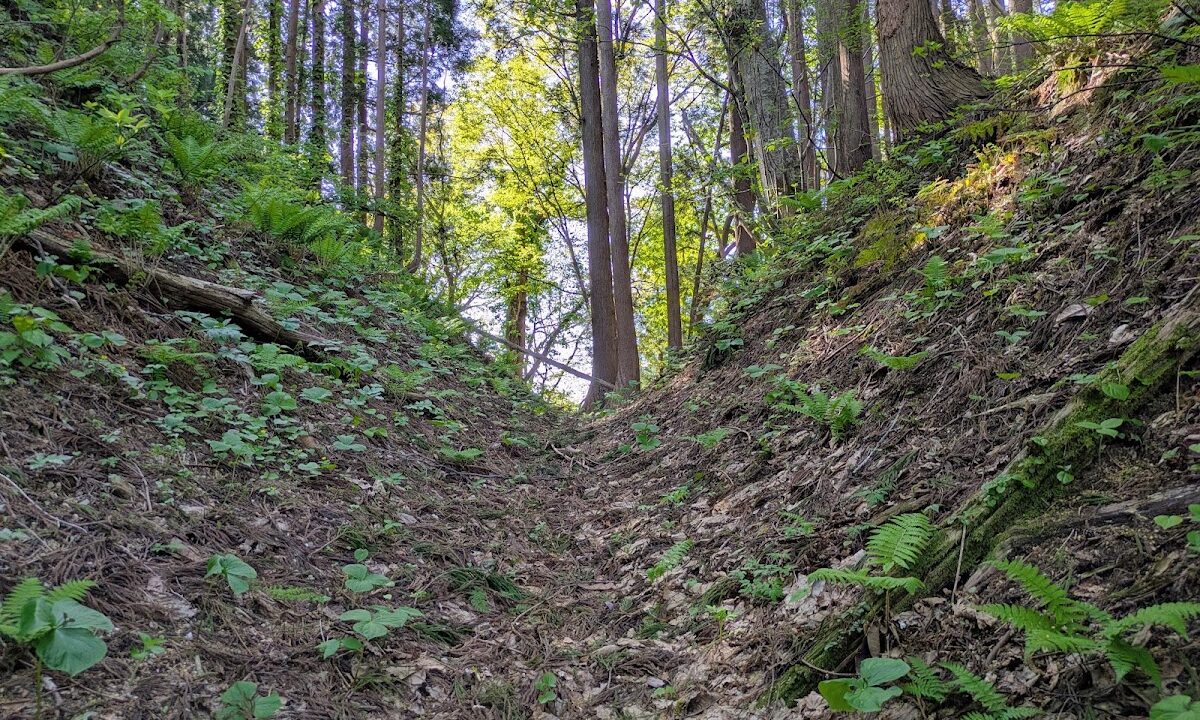
- Moat: Multiple moats, cut across the ridge, remain, demonstrating a strategy to prevent enemy intrusion.
- Vertical Moats: Vertical moats dug into the slopes have been identified, providing a structure to prevent attacks from the flanks.
From the main enclosure at the mountaintop, there are panoramic views of the Oguni River basin and the Echigo region, highlighting the site’s high level of surveillance.
Access and Visiting Guide
Transportation:
- Approximately 20 minutes by car from JR Uetsu Main Line “Koiwagawa Station”
- Approximately 30 minutes via National Route 7 from Nihonkai Tohoku Expressway “Atsumi Onsen IC”
Climbing Route:
A hiking trail is maintained from the Oguni settlement at the foot of the mountain. This is a full-fledged mountain castle climb with an elevation difference of 235.5 meters, so the round trip takes approximately 2-3 hours. Appropriate equipment such as hiking boots is necessary.
Points to Note During Your Visit:
- The path to the castle has some steep sections, so it is recommended to visit on a day with good weather.
- The view from the main enclosure is spectacular, allowing you to experience the castle’s strategic importance.
- The well-preserved remains make it ideal for learning about the structure of a medieval mountain castle.
Detailed Explanation of Oguni Castle (Okitama District, Oguni Town)
Basic Information and History
Located in Oguni Town, Nishiokitama District, Oguni Castle is a flatland castle that functioned as the political and military center of Oguni from the Sengoku period to the Edo period. It is characterized by its convenient location, approximately a 10-minute walk from Oguni Station on the JR Yonesaka Line, and was situated in the heart of the castle town.
Transition to an Official Residence
After 1692 (Genroku 5), this castle was renamed “Oyakuya” (official residence). This indicates that, during the peaceful Edo period, administrative functions became more important than the military functions of the castle. The magistrate’s office served as an outpost of the Yonezawa Domain and became the administrative center of Oguni-go.
Lords and Changes in Rule
During the Sengoku period, it came under the control of the Date and Uesugi clans. During the Edo period, it was part of the territory of the Uesugi clan of the Yonezawa Domain, and a magistrate’s office was established there. Oguni-go was located along an important road connecting Yonezawa and Echigo, making it an economically important region.
Remains and Current State
Because it was a flatland castle, there are few clear remains today, but the topography and town layout around the castle site retain traces of its former glory. Some areas show traces of earthworks and what are believed to be the remains of moats.
Nearby Facilities:
- Oguni Town Local History Museum: Exhibits materials related to the history of Oguni Castle and Oguni village.
- Around Oguni Station: A townscape that retains the atmosphere of a castle town.
Access Information
Transportation:
- Approximately 10 minutes on foot from JR Yonesaka Line “Oguni Station”
- Access from the Tohoku Chuo Expressway (planned route) is expected to improve in the future.
Points to Note When Visiting:
- As it is a flatland castle, it is easy to visit.
- Visiting in conjunction with the Oguni Town Local History Museum will provide a deeper understanding.
- Strolling through the surrounding townscape allows you to experience the atmosphere of a castle town.
Detailed Explanation of Oguni Castle (Mogami District, Mogami Town)
Basic Information and Background of Construction
Oguni Castle, located in Honjo, Mogami Town, Mogami District, is a mountain castle built in 1584 by Oguni Mitsumoto. Also known as Iwabe-Tate (or Honjo-kan), it is believed to have been built on the site of the former residence of the Mogami-Hosokawa clan.
Builder: Oguni Mitsumoto and the Kuramasu Clan
Oguni Mitsumoto is believed to have been a member of the Kuramasu clan, a powerful vassal family of the Mogami clan. The Mogami clan expanded its power within Yamagata Prefecture during the Sengoku period, reaching its peak during the time of Mogami Yoshiaki. Oguni Castle played an important role as a base for the Mogami clan’s northern defenses.
Location and Strategic Significance
Mogami Town is located in the northeastern part of Yamagata Prefecture, near the current border with Miyagi Prefecture. This castle was located at the northeastern edge of the Mogami clan’s sphere of influence and served as a defensive base against eastern forces such as the Date clan.
Status of Remains
Remains of the mountain castle are preserved, and traces of baileys and earthworks can be confirmed. However, compared to the other two Oguni castles, it is less well-known and less well-maintained.
Access and Visit Information
Transportation:
- Approximately 50 minutes from Higashine IC on the Tohoku Chuo Expressway via National Route 347
- Approximately 15 minutes by car from Mogami Station on the JR Rikuu East Line
Notes on Visiting:
Located in the northeastern corner of Yamagata Prefecture, access is primarily by car. Due to heavy snowfall in winter, choosing the right time to visit is necessary.
Comparison and Characteristics of the Three Oguni Castles
Scale and Preservation Status
Oguni Castle in Tsuruoka City, Tagawa District is designated a National Historic Site and is the largest of the three, with the best-preserved remains. As the largest mountain castle in Yamagata Prefecture with a relative elevation difference of 235.5 meters, its value is highly regarded.
Oguni Castle in Oguni Town, Okitama District is a flatland castle, notable for continuing to function as an administrative center until the Edo period. Its easy accessibility makes it a castle site that can be visited casually.
Oguni Castle in Mogami Town, Mogami District holds significant importance in local history as a castle that tells the story of the Mogami clan’s expansion of power.
Difficulty of Visiting
- Beginner-friendly: Oguni Castle in Oguni Town, Okitama District (flatland castle, close to the station)
- Intermediate-friendly: Oguni Castle in Mogami Town, Mogami District (somewhat difficult access)
- Advanced-friendly: Oguni Castle in Tsuruoka City, Tagawa District (serious mountain castle climb)
Nearby Spots and Tourist Guide
Around Tsuruoka City, Tagawa District
Atsumi Onsen: A historic hot spring resort along the Sea of Japan, perfect for relaxing after climbing the castle.
Oura Castle: Like Oguni Castle, a mountain castle in the Shonai region; visiting both will give you a deeper understanding of the region’s castle history.
Tsuruoka City Local History Museum: A facility where you can learn about the history and culture of the Shonai region.
Around Okitama District and Oguni Town
Oguni Town Local History Museum: Exhibits the history and culture of Oguni, and houses detailed materials on Oguni Castle.
Mt. Iide: One of Japan’s 100 Famous Mountains, a popular spot for mountain climbing enthusiasts.
Oguni Onsenkyo: Multiple hot spring resorts, offering a relaxing environment surrounded by nature.
Around Mogami District and Mogami Town
Mogami Town Historical and Folk Museum: A facility where you can learn about the history and culture of Mogami Town.
Akakura Onsen: A representative hot spring resort in Mogami Town, also featuring a ski resort.
Practical Advice for Visiting Oguni Castle
Efficient Visiting Plan
Since the three Oguni Castles are geographically separated, visiting them all at once is difficult. We recommend the following plan:
1-Night, 2-Day Plan (Tagawa District + Okitama District):
- Day 1: Visit Oguni Castle in Tsuruoka City, stay overnight at Atsumi Onsen.
- Day 2: Visit Oguni Castle in Oguni Town, visit Oguni Town Local History Museum.
Day Trip Plan (Okitama District Only):
- Take the Yonesaka Line from Yonezawa to Oguni Station, visit Oguni Castle and the Local History Museum.
Seasonal Highlights
Spring (April-May): Beautiful fresh greenery, ideal season for climbing mountain castles. However, be careful of remaining snow.
Summer (June-August): Lush greenery, making it easy to see the ruins, but insect repellent is necessary.
Autumn (September-November): Beautiful autumn foliage, best time to visit. Mid-October to early November is especially recommended.
Winter (December-March): Snowfall makes climbing mountain castles difficult. While the Oguni Castle ruins in Oguni Town (a flatland castle) are accessible even in winter, warm clothing is essential.
Equipment and Preparation
Oguni Castle in Tagawa District, Tsuruoka City:
- Hiking boots, trekking poles
- Drinking water, snacks
- Rain gear, warm clothing
- Map, compass (GPS)
- Insect repellent (summer)
Oguni Castle in Okitama District, Oguni Town; Mogami District, Mogami Town:
- Comfortable walking shoes
- Camera, binoculars
- Allow time for visiting the museum
Historical Value and Future Preservation of Oguni Castle
Importance as a Cultural Property
In particular, Oguni Castle in Tsuruoka City, designated as a National Historic Site, is a valuable cultural property that well preserves the structure of a Sengoku period mountain castle. Excavation surveys and preservation work are underway, and it is recognized as an academically important historical site. ### Significance in Local History
The three Oguni Castles each tell the history of a different region. The castle in Tagawa District represents the relationship between the Shonai region and Echigo, the castle in Okitama District represents the rule of the Yonezawa Domain, and the castle in Mogami District represents the expansion of the Mogami clan’s power. Each is an essential historical site for understanding the history of its respective region.
Efforts for Preservation and Utilization
Each local government is working on the preservation and utilization of the castle ruins. Tsuruoka City is proceeding with a development plan for the castle as a national historical site, and Oguni Town is disseminating information through its local history museum. Mogami Town is also continuing preservation activities as a regional historical heritage site.
Summary: The Significance of Visiting Oguni Castle
The three Oguni Castles in Yamagata Prefecture each have different characteristics and histories, offering visitors diverse discoveries. Tsuruoka City’s Oguni Castle, a national historical site, offers an authentic mountain castle experience; Oguni Town’s Oguni Castle evokes the atmosphere of a castle town; and Mogami Town’s Oguni Castle allows visitors to experience the history of the Mogami clan.
Visiting these castle ruins will be fascinating not only for castle enthusiasts but also for history buffs and mountain climbing aficionados, allowing you to gain a deeper understanding of Yamagata Prefecture’s rich history and culture. Embark on a journey to discover the unique value of each castle.


