Complete Guide to Onikiribe Castle (Miyagi Prefecture) | The Starting Point of the Former Nine Years’ War and the History of the Abe Clan
Onikiribe Castle, located in Onikobe, Naruko Onsen, Osaki City, Miyagi Prefecture, is a historically significant castle site that marked the beginning of the Former Nine Years’ War, which occurred in the mid-Heian period. Built by Abe Yoriyoshi (later Yoriyoshi), the leader of the Emishi people of Oshu, this castle is an indispensable part of understanding the medieval history of the Tohoku region.
Basic Information on Onikiribe Castle
Onikiribe Castle, also known as “Onikiribe-kan,” is located in Gunzawa, Onikobe, Naruko Onsen, Osaki City, Miyagi Prefecture. Situated on a plateau approximately 500 meters above sea level, it functioned as a natural stronghold overlooking the Gunzawa River to the north and the Arao River to the east.
Location and Geographical Characteristics
- Location: Gunzawa, Onikobe, Naruko Onsen, Osaki City, Miyagi Prefecture
- Alternate Name: Onikiribe-kan
- Elevation: Approximately 500 meters
- Location: Hilly area, vast plateau
- Topographical Characteristics: Gunzawa River to the north, Arao River to the east, and the Ou Mountains to the west and south, creating a natural jungle.
At the entrance to Onikobe Takahata, where the castle ruins are located, there is a castle ruins monument and a signpost. There is also a guide sign along the national highway leading from Onikobe towards Yuzawa. Turning left from the guide sign and proceeding for 3-4 minutes, you will reach a flat, plateau-like area where a sign for the Onikiribe Castle ruins is located.
History of Onikiribe Castle
Construction by Abe Yoriyoshi
Onikiribe Castle was built in 1050 (Eisho 5) by Abe Yoriyoshi (later renamed Yoriyoshi), the leader of the Emishi people of Mutsu Province. At that time, the Abe clan boasted a powerful force controlling the six northern counties (present-day inland Iwate Prefecture), and their influence extended throughout the Tohoku region.
While based in the six northern counties, Abe Yoriyoshi expanded his influence south of the Koromogawa River, strengthening his resistance to the imperial court’s rule. Onikiribe Castle was built as a strategic stronghold during this process of Abe clan expansion.
The Beginning of the Former Nine Years’ War
Onikiribe Castle made its mark in history as the site of the first battle of the Former Nine Years’ War (1051-1062), which broke out in 1051 (Eisho 6).
According to the *Mutsu Waki*, Abe no Yoriyoshi advanced beyond the six northern districts of his territory south of Koromogawa and refused to pay taxes to the provincial governor. As a result, Fujiwara no Noritō, the governor of Mutsu Province, led several thousand soldiers to battle Yoriyoshi’s forces at Onikiribe. This is considered the beginning of the Former Nine Years’ War.
Battle of Onikiribe
In 1051 (Eishō 6), Fujiwara no Noritō, the governor of Mutsu Province, led his forces northward to subjugate the Abe clan. Meanwhile, Abe no Yoriyoshi, along with his sons Sadatō and Munetō, and other family members and retainers, holed up in Onikiribe Castle, preparing to meet the provincial army.
According to novels and research, around 1051, during the mid-Heian period, the Abe army, which controlled the Emishi people, defeated the provincial army waiting at Onikiribe after traversing the difficult winter route of Kurikoma Pass. It is said that the Abe army then returned towards Ichinoseki via Iji Castle. This battle marked the beginning of the Former Nine Years’ War, a crucial battle that continued for 12 years.
The Former Nine Years’ War and the Role of Onikiribe Castle
Overview of the Former Nine Years’ War
The Former Nine Years’ War was a large-scale conflict between the Imperial Court and the Abe clan of Oshu, lasting from 1051 (Eisho 6) to 1062 (Kohei 5). This war was a struggle for control of the Tohoku region, ultimately ending when Minamoto no Yoriyoshi and his son Yoshiie, with reinforcements from the Kiyohara clan, defeated the Abe clan.
Strategic Importance of Onikiribe Castle
Onikiribe Castle held the following strategic importance during the Former Nine Years’ War:
- Key Transportation Point: Located on the route connecting the six northern districts and the Mutsu Provincial Capital (Taga Castle)
- Natural Fortress: A defensible terrain surrounded by rivers and mountain ranges
- Vast Garrison: The 500-meter-high plateau could accommodate a large army
- Excellent Visibility: Allows for reconnaissance from a high vantage point overlooking the surrounding area
These features made Onikiribe Castle a crucial military base for the Abe clan.
Current Status of Onikiribe Castle Ruins
Current State of Remains
Unfortunately, very few clear remains of Onikiribe Castle remain today. According to reviews on the “Castle Enthusiasts” website, “There are only information boards, no remains.” The current site is a forest, making it difficult to identify any traces of castle structures, earthworks, or moats.
Castle Site Monument and Information Board
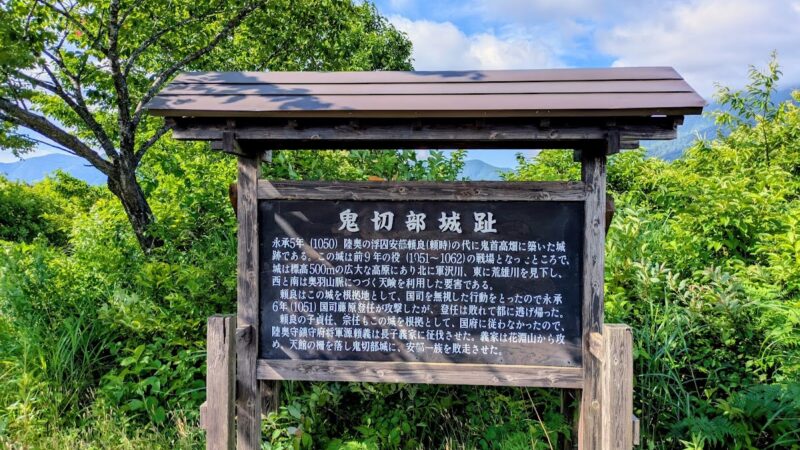
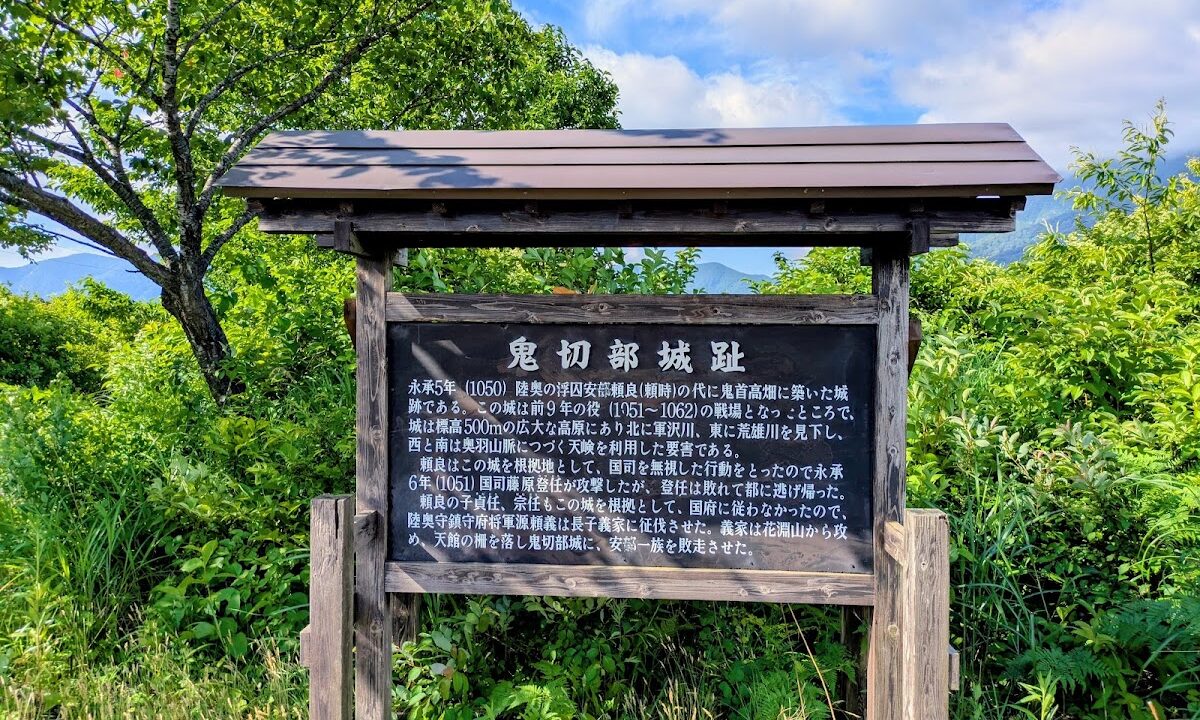
Although no remains of the castle exist, a castle site monument and signpost are located at the entrance to Onikobe Takahata, and an information board stands at the site of the castle ruins. The information board contains the following information:
“This is the site of a castle built in Onikobe Takahata in 1050 (Eisho 5) during the time of Abe Yoriyoshi (Yorito), a prisoner of Mutsu Province. This castle was the site of a battle during the Former Nine Years’ War (1051-1062). The castle was situated on a vast plateau at an altitude of 500m, overlooking the Gunzawa River to the north and the Arao River to the east, and utilizing the natural defenses of the Ou Mountains to the west and south.”
This information board is the only remaining local document that conveys the history of Onikiribe Castle.
Access to Onikiribe Castle
Access by Car
Access to Onikiribe Castle ruins is primarily by car:
- Use National Route 108 (from Onikobe towards Yuzawa)
- Turn left at the castle ruins sign
- After driving for about 3-4 minutes, you will arrive at a flat, plateau-like area
- There is an Onikiribe Castle ruins sign at the site.
Parking Information
Detailed parking information is limited, but since the site is a mountainous and plateau area, there is likely to be roadside space near the sign. Please park safely when visiting.
Estimated Visiting Time
According to Kojodan data, the average visiting time is approximately 23 minutes. Since no remains are left, the visit will mainly consist of reading the information board and observing the surrounding terrain.
Onikiribe Castle Evaluation and Visitor Feedback
Evaluation as a Castle
The average evaluation of Onikiribe Castle on Kojodan is 3.00 (based on evaluations by 8 people). While the castle’s historical significance is limited due to the lack of remaining structures, it is highly regarded as a worthwhile visit due to its historical importance.
Visitor Reviews
Visitors who have actually visited the Onikiribe Castle ruins have shared the following comments:
- “A historically important place that marked the beginning of the Former Nine Years’ War”
- “Although no structures remain, you can learn about its history from the information boards”
- “The surrounding terrain helps explain why this was a strategic location”
- “An ancient battlefield featured in historical dramas”
Nearby Historical Spots
Naruko Onsenkyo
Naruko Onsen in Osaki City, where the Onikiribe Castle ruins are located, is known as one of Tohoku’s leading hot spring resorts. You can enjoy the hot springs in conjunction with visiting the castle ruins.
Historical Sites Related to the Former Nine Years’ War
Historical sites related to the Former Nine Years’ War are scattered throughout the Tohoku region:
- Tagajo Castle Ruins (Tagajo City, Miyagi Prefecture): Site of the Mutsu Provincial Government
- Kurikawa Fort Ruins (Morioka City, Iwate Prefecture): The last stronghold of the Abe clan
- Koromogawa Battlefield (Oshu City, Iwate Prefecture): A major battlefield of the Former Nine Years’ War
Visiting these historical sites will allow you to gain a deeper understanding of the overall picture of the Former Nine Years’ War.
Onikiribe Castle and the NHK Taiga Drama
The Former Nine Years’ War has recently attracted renewed attention, being featured as background information in the 2024 NHK Taiga drama “Hikaru Kimi e” (To You, Shining). The Former Nine Years’ War is an important episode in depicting the rise of samurai clans such as the Abe, Minamoto, and Kiyohara clans, and Onikiribe Castle, the site where it began, is also attracting the interest of history buffs.
Points to Remember When Visiting Onikiribe Castle
Preparation Before Your Visit
- Learning the Historical Background: Learning about the Former Nine Years’ War and the Abe Clan beforehand will deepen the significance of your visit.
- Checking the Map: Check the location of the information boards in advance.
- Considering the Season: As it is a plateau area at an altitude of 500 meters, be aware of snow in winter.
- Clothing: As it is a mountainous area, comfortable clothing and shoes are recommended.
Points to Remember When Taking Photos
- Castle Ruins Monument and Signpost
- Full View and Contents of the Information Board
- Surrounding Topography (View towards Gunzawa River and Arao River)
- Appearance of the Plateau-like Flat Area
There are currently 10 photos posted on Kojodan (Castle Enthusiasts’ Group), which can be helpful when planning your visit.
Cultural Property Designation Status of Onikiribe Castle
Onikiribe Castle Ruins (Onikiribe Manor Ruins) are registered as a historical site in Miyagi Prefecture. According to the Cultural Properties WebGIS, it is recorded as a medieval (details unknown) castle site and is managed under site number 89877.
Although the period classification is medieval, the actual construction of the castle was in the late Heian period (1050), and it is closely related to the Heian period event known as the Former Nine Years’ War.
Summary: Historical Significance of Onikiribe Castle
Although no remains of Onikiribe Castle exist, it is a castle site of extremely high historical value as the starting point of the Former Nine Years’ War, a crucial turning point in Japanese history.
The battle that began at this castle, built by Abe no Yoriyoshi, developed into a large-scale conflict lasting 12 years, ultimately creating a historical flow that led to the rise of the Oshu Fujiwara clan. It also served as a catalyst for strengthening the ties between the Minamoto clan and the eastern warrior groups, and can be considered one of the contributing factors to the establishment of the Kamakura Shogunate by Minamoto no Yoritomo.
Standing on a plateau 500 meters above sea level, and experiencing the topography firsthand—overlooking the Gunzawa River to the north and the Arao River to the east—you can understand why this location was chosen as a strategic stronghold and how the Abe clan utilized the terrain to their advantage in battle.
When visiting Miyagi Prefecture, why not combine a visit to this historic battlefield with a soak in the Naruko Onsen hot springs? Reflecting on the history inscribed on the information boards and contemplating the Tohoku region during the Heian period will surely be a valuable experience.