Complete Guide to Kosai Castle (Miyagi Prefecture) | The Site of Date Masamune’s First Battle and the History of the Three Castles of Igu
What is Kosai Castle?
Kosai Castle (Kosai-jo) is a medieval mountain castle located in Kitamachi-ba, Kosai, Marumori-cho, Igu-gun, Miyagi Prefecture. Also known as Shibagoya Castle or Shibagoya Manor, it was an important strategic point during the Sengoku period, where fierce battles took place between the Date and Soma clans.
Built on a long, narrow hill stretching east to west at an altitude of 75.5 meters, this castle is strategically located on the right bank of the Abukuma River and is counted as one of the three castles of Igu (Kosai Castle, Kanayama Castle, and Maruyama Castle). Of particular note is its reputation as the site of Date Masamune’s first battle, making it a castle ruin of special significance for fans of Sengoku history.
Even today, the remains of the castle, including the baileys arranged east and west of the main keep and three deep moats, are well-preserved, conveying the appearance of a mountain castle from the Sengoku period. Yaegaki Shrine stands on the site of the main keep, and the watchtower offers a beautiful view of the Zao mountain range.
History of Kosai Castle
Construction and Lord
Records indicate that Kosai Castle was the residence of Kosai Heitahyō during the Sengoku period. The Kosai clan were local lords belonging to the Date family and were entrusted with governing this region.
While there are no clear records regarding the exact construction date of the castle, it is believed to have been built during the early to mid-Sengoku period, as part of the Date family’s consolidation of control over the southern Oshu region. The Kosai area was a strategically important location along the Abukuma River and, being close to the border with the Soma territory to the south, was considered a militarily significant base.
The Conflict Between the Date and Soma Clans
The most important event in the history of Kosai Castle is the attack and fall of the castle by the Soma clan in 1566. At that time, the Date and Soma clans were fiercely opposed to each other for supremacy in southern Oshu, and Kosai Castle was located on the front lines.
Kosai Castle fell to the Soma clan’s attack, and Kosai Heitahei is said to have been killed in action. This battle was a major blow to the Date clan, and from then on, this region became the site of fierce battles between the Date and Soma clans.
Date Masamune’s First Battle
The reason Kosai Castle is particularly noteworthy in history is that it is said to be the site of the first battle of Date Masamune, the “One-Eyed Dragon.” In 1584, at the age of 18, Masamune is said to have experienced his first real battle in the vicinity of Kosai Castle during a battle against the Soma clan.
This first battle marked the beginning of Masamune’s career as a military commander and became a turning point in his later rise to become a powerful daimyo who unified the Tohoku region. An information board commemorating Masamune’s first battle is installed at the site of Kosai Castle, and it is known as a pilgrimage site for Masamune fans.
The Later History of Kosai Castle
After the time of Date Masamune, Kosai Castle came under the control of the Date family. However, due to Toyotomi Hideyoshi’s pacification of Oshu and the changing circumstances after the Battle of Sekigahara, its role as a castle gradually declined. In the Edo period, with the stabilization of the Sendai domain’s rule and the easing of military tensions, it is believed that Kosai Castle was abandoned.
Structure and Remains of Kosai Castle
Characteristics of the Castle Layout
Kosai Castle is a multi-bailey mountain castle built on a long, narrow hill stretching approximately 400 meters from east to west. The main baileys are arranged east and west, with deep moats between each bailey. This structure was designed to prevent enemy intrusion and to allow each bailey to function as an independent defensive base.
The main keep (Honmaru) is located at the highest point of the hill, with the second and third baileys (Ninokuruwa) positioned to its east and west. The Honmaru measures approximately 60 meters east-west and 40 meters north-south, a standard size for a medieval mountain castle.
Honmaru and Yaegaki Shrine
The Yaegaki Shrine currently stands on the site of the Honmaru. This shrine is a center of local faith and plays an important role in the preservation of the castle ruins. From the Honmaru, one can see the surrounding terrain, suggesting it functioned as a lookout and command post during the Sengoku period.
Remnants of earthworks remain around the Honmaru, suggesting that wooden fences or walls once stood there.
Moats
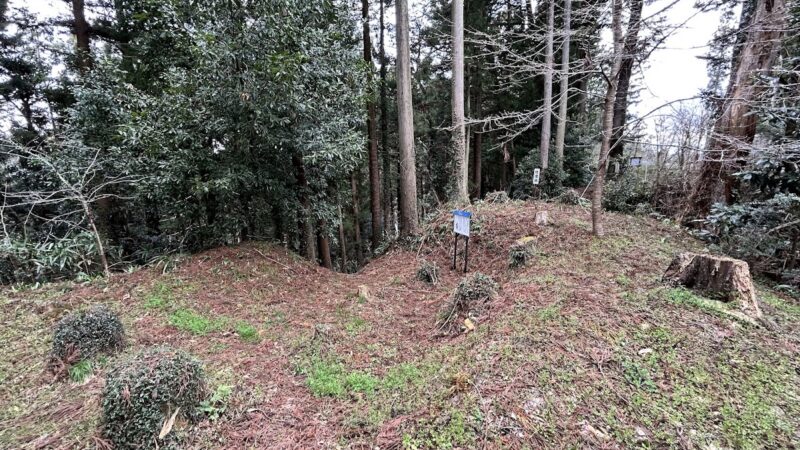
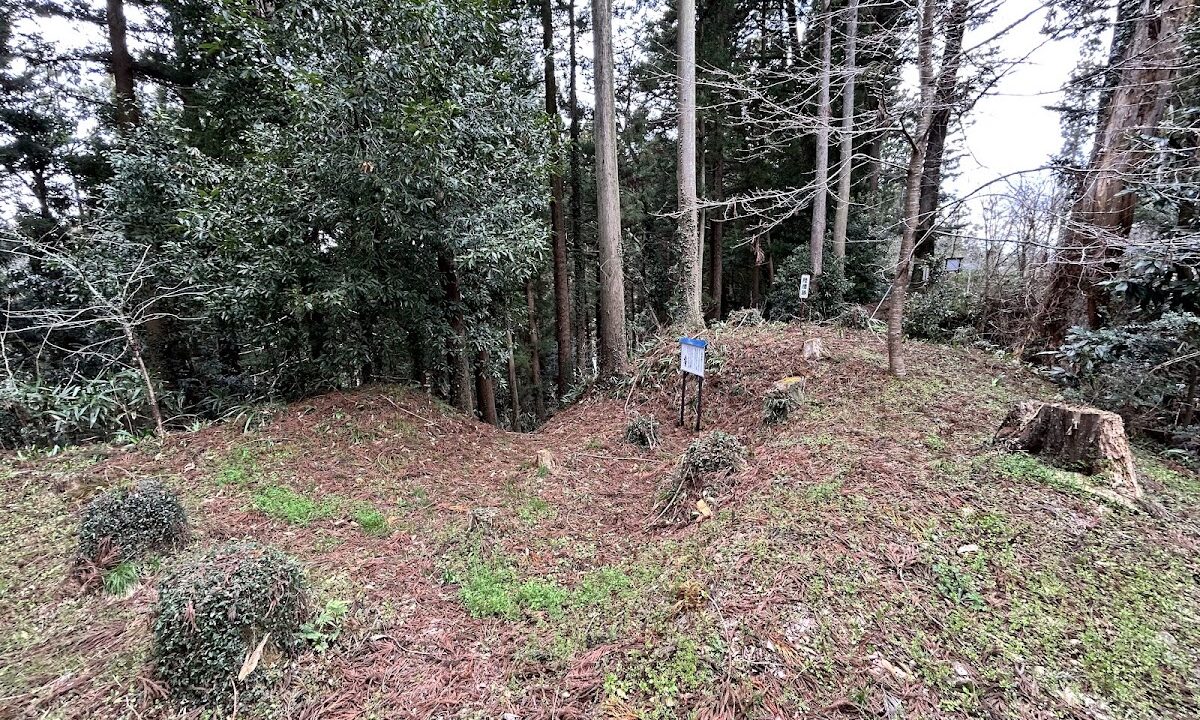
The most prominent remains of Kosai Castle are the three deep moats. These moats separated each bailey and functioned as important defensive structures to hinder enemy advances.
The moats reach a depth of 7-8 meters at their deepest point and are over 10 meters wide. Even today, this moat remains clearly visible, allowing visitors to appreciate the advanced civil engineering techniques of the Sengoku period. Walking along the bottom of the moat, one is struck by its sheer scale.
Enclosures and Earthworks
The enclosures located to the east and west of the main enclosure each maintain clearly defined flat surfaces, suggesting they were used as building sites or troop encampments. Earthworks surrounded the enclosures, enhancing their defensive capabilities.
The earthworks on the western enclosure, in particular, remain in relatively good condition, with earthworks measuring 1-2 meters in height clearly visible.
Watchtower Site
In a corner of the main enclosure, there is a site believed to have been the location of a watchtower, which is still maintained as an observation space. From here, one can enjoy a beautiful view of the Zao mountain range, and on clear days, one can even see the mountains on the Fukushima Prefecture side.
During the Sengoku period, it is believed that enemy movements were monitored from this watchtower, and signal fires were used to transmit information.
Igu Three Castles and Surrounding Fortresses
What are the Igu Three Castles?
Kosai Castle, as one of the Igu Three Castles, played a crucial role in the defense system of this region. The Igu Three Castles refer to Kosai Castle, Kanayama Castle, and Maruyama Castle, which worked together to form the southern defense line of the Date clan.
Kanayama Castle was located approximately 5 kilometers southwest of Kosai Castle and was also known as Kanayama Fortress. It was close to the border with the Soma clan and functioned as a frontline fortress. Remains such as earthworks and moats still exist today.
Maruyama Castle (Maruyama Manor) was located northeast of Kosai Castle and played a role in monitoring the transportation route along the Abukuma River. It is believed that the three castles communicated with each other, and a system was in place to send reinforcements from the other castles if one was attacked.
Major Surrounding Fortresses
In addition to the Igu Three Castles, many other fortresses existed around Kosai Castle.
Marumori Castle is located in the center of Marumori Town and was an important base where a senior retainer of the Date family served as lord. It was larger in scale than Kosai Castle and possessed characteristics of a modern castle.
Himematsu-kan is the site of a manor house remaining in Marumori Town, which was used as the residence of a local influential figure. Nakanouchi Castle, Maekawa Honjo Castle, and Nishikiga-kan are also scattered around the area, and these smaller castles formed a regional defense network.
Relationship with Major Castles in Miyagi Prefecture
Kosai Castle is one of the medieval castles in southern Miyagi Prefecture, but many other important castles exist within the prefecture.
Sendai Castle (Aoba Castle) was the residence built by Date Masamune and was the largest castle in the Tohoku region, serving as the base of the 620,000-koku Sendai Domain. The contrast between Masamune, who fought his first battle at Kosai Castle, and the magnificent castle he later built is fascinating.
Shiraishi Castle (also known as Masuoka Castle or Masuoka Castle) was an important branch castle protecting a strategic southern point of the Sendai Domain, and the Katakura clan served as its lords for generations. The keep (three-story turret) and main gate have been restored, making it a popular tourist destination.
Taga Castle (Taga Fort) is an ancient fortified settlement, the site of the Mutsu Province’s provincial capital during the Nara and Heian periods. While it differs in era from the medieval Kosai Castle, it is an indispensable part of Miyagi Prefecture’s castle history.
Wakutani Castle (Wakutani Fort) was the residence of the Wakutani Date clan and has been developed into Shiroyama Park. Iwadeyama Castle (also known as Gagyū Castle, Iwatesawa Castle, or Iwadeyama Fort) was the residence of Date Masamune before the construction of Sendai Castle, and is known as a place associated with Masamune.
Compared to these other castles, Kosai Castle, though not large in scale, played a crucial role in the Date clan’s territorial management.
Highlights of Kosai Castle
The Impressive Moats
The most striking feature of Kosai Castle is its three deep moats. The moat separating the main keep from the second enclosure is particularly impressive in both depth and width, offering a tangible experience of Sengoku period defensive structures. Looking up from the bottom of the moat is truly awe-inspiring.
Views from the Main Keep
From the area around the Yaegaki Shrine on the site of the main keep, you can see the townscape of Marumori, the flow of the Abukuma River, and the distant Zao mountain range. The autumn foliage and winter snowscapes are especially beautiful, allowing you to enjoy the scenery of each season.
The view from the watchtower ruins is particularly magnificent; imagining the castle soldiers of the Sengoku period monitoring enemy movements while gazing at this view evokes a sense of historical romance.
Value as the Site of Date Masamune’s First Battle
Kosai Castle holds significant historical importance as the site of Date Masamune’s first battle. An information board explaining Masamune’s first battle is installed at the site, allowing visitors to learn that he took his first steps as a warrior here.
For Masamune fans, it is an important historical site to visit, alongside Sendai Castle and Iwadeyama Castle.
Well-Preserved Remains
Kosai Castle is relatively well-preserved for a medieval mountain castle, with major remains such as moats, baileys, and earthworks clearly visible. In recent years, local preservation societies and the government have been working to improve the site, creating an environment that is easy to visit.
With well-maintained walking paths, even castle novices can enjoy a safe and enjoyable stroll.
Access and Visiting Information
Location
- Address: Kitamachiba, Kosai, Marumori-cho, Igu-gun, Miyagi Prefecture
- Elevation: 75.5 meters
- Relative Height: Approximately 50 meters
Transportation Access
Access by Train
- Get off at Marumori Station on the JR Tohoku Main Line or Abukuma Express Line, then take a taxi for approximately 10 minutes.
- Approximately 40-50 minutes on foot from Marumori Station.
Access by Car
- Approximately 30 minutes from Shiroishi IC on the Tohoku Expressway via National Route 113.
- Parking: Several parking spaces available near Yaegaki Shrine.
Visiting Hours and Fees
- Free admission
- Estimated Visiting Time: Approximately 30 minutes to 1 hour
- Recommended Season: Spring to Autumn (Snowfall may make walking difficult in winter)
Precautions During Visits
- Clothing and Equipment: As this is a mountain castle, comfortable walking shoes and clothing are essential. Particular caution is needed after rain, as the ground can become slippery.
- Insect Protection: During the summer, mosquitoes and gnats are abundant, so insect repellent spray and long-sleeved clothing are recommended.
- Heatstroke Prevention: Shade is scarce during the summer, so please bring a hat and drinking water.
- Manners: The main keep houses the Yaegaki Shrine. Remember that this is a sacred place and view it with respect.
- Photography: Photography of the ruins is permitted, but please be considerate of the privacy of local residents.
History and Culture of the Kosai District
Kosai is a district located in the northeastern part of Marumori Town. According to 2015 data, it is a settlement with 298 households and a population of 958. Its postal code is 981-2401, and it generally stretches along the right bank of the Abukuma River.
The name Kosai has existed since ancient times, and during the Sengoku period, the Kosai clan ruled the area. It developed as a castle town of Kosai Castle and also functioned as a trading hub utilizing the Abukuma River’s water transport.
Even today, the Kosai district retains traces of its old highways, allowing visitors to stroll through its historic streets. Traditional events, such as the festival of Yaegaki Shrine, are also preserved.
Other Attractions in Marumori Town
When visiting Kosai Castle, we recommend also visiting other tourist spots in Marumori Town.
Sairi Residence is a facility that preserves and opens to the public the residence of a wealthy merchant from the Edo period, offering insights into the life of a merchant family at that time. The beautiful Japanese garden is also a highlight.
The Abukuma River Boat Cruise is a popular activity that allows you to enjoy the beauty of the Abukuma River gorge from a boat. The scenery is particularly spectacular during the autumn foliage season.
Visiting other castle ruins in the Igu Three Castles region, such as Kanayama Castle Ruins and Marumori Castle Ruins, will allow you to gain a deeper understanding of the Sengoku period history of this area.
Significance of Visiting Kosai Castle
Although Kosai Castle is not widely known throughout Japan, it is a castle ruin worth visiting for the following reasons:
- The site of Date Masamune’s first battle: A historical site where Date Masamune, a leading Sengoku period warlord of Tohoku, took his first steps as a military commander.
- Well-preserved remains: Remains such as moats and baileys are well-preserved, allowing visitors to learn about the structure of a medieval mountain castle.
- The stage of the battle between the Date and Soma clans: A site that was the stage of an important battle in southern Oshu during the Sengoku period.
- Superb views: Enjoy the scenery of the Zao mountain range and the Abukuma River.
- Quiet environment: Because it is not a tourist spot, you can reflect on history at your leisure.
By visiting Kosai Castle, you can learn about the reality of a medieval mountain castle built by a local lord, which differs from large-scale castles such as Sendai Castle and Shiroishi Castle. It is also a valuable place where you can touch upon the origins of the great warlord Date Masamune.
Summary
Kosai Castle (Marumori Town, Miyagi Prefecture) is a historically important castle site where Date Masamune fought his first battle. Built on a hill 75.5 meters above sea level, this mountain castle, one of the three castles of Igu, played a vital role in the southern defense of the Date clan and was the site of fierce battles against the Soma clan.
Although it fell to an attack by the Soma clan in 1566, the Date clan recaptured it, and in 1584, the young Date Masamune experienced his first battle here.
Even today, the remains of the castle, including three deep moats, baileys, and earthworks, are well-preserved, and the Yaegaki Shrine stands on the site of the main keep. From the remains of the watchtower, one can enjoy the beautiful scenery of the Zao mountain range and appreciate the changing seasons.
While Miyagi Prefecture boasts many famous castles such as Sendai Castle, Shiroishi Castle, Taga Castle, Wakuya Castle, and Iwadeyama Castle, Kosai Castle, though not large in scale, is a historical site worth visiting as a place associated with Date Masamune and as a typical example of a medieval mountain castle. When you visit Marumori Town, be sure to stop by the ruins of Kosai Castle and experience the history of the Sengoku period and the origins of Date Masamune. Spending time at this tranquil mountain castle will be a special experience filled with historical romance.