Shizukuishi Castle (Iwate Prefecture) Complete Guide | History, Remains, and Access Information
What is Shizukuishi Castle?
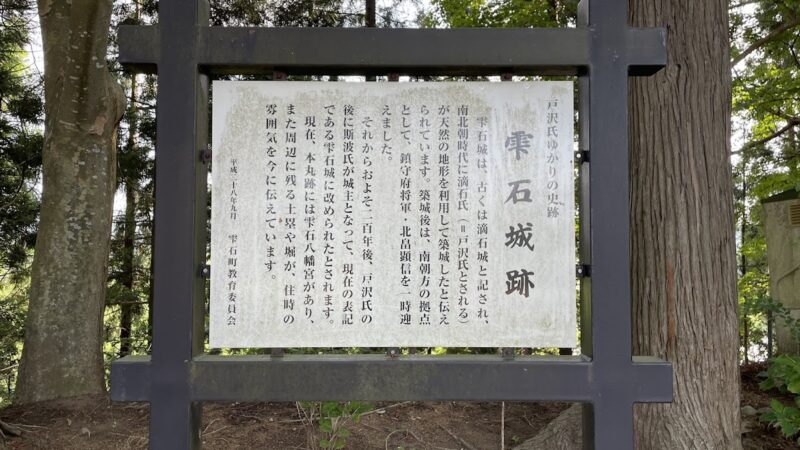
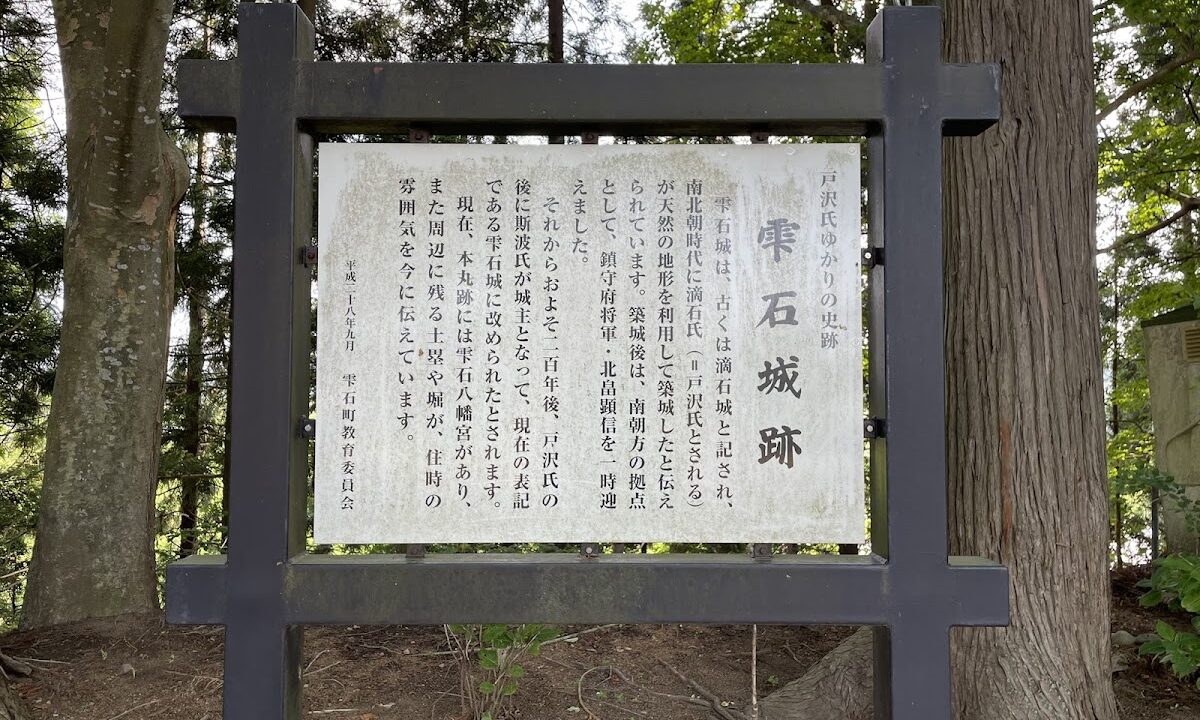
Shizukuishi Castle is a medieval mountain castle located in Furudate, Shizukuishi-cho, Iwate-gun, Iwate Prefecture. Also known as “Shizukuishi Gosho,” “Shizukuishi Castle,” and “Shizukuishi Gosho,” it played a crucial role as a political and military stronghold in the region from the Nanboku-cho period to the Sengoku period.
Shizukuishi Castle is built on the tip of a plateau, almost in the center of the Shizukuishi Basin, a key transportation hub to Dewa Province (present-day Akita Prefecture). The Shizukuishi River flows eastward to the south, and the Kanizawa River flows eastward to the north, resulting in a highly defensible castle structure that skillfully utilizes the natural terrain. Its location, at an elevation of approximately 200 meters and a relative height of about 10 meters above the low-lying wetlands, provided a strategic position that allowed for overlooking the surrounding area while preventing enemy incursions.
Shizukuishi Castle is built on the tip of a plateau, almost in the center of the Shizukuishi Basin, a strategic point for transportation to Dewa Province (present-day Akita Prefecture). Currently, the castle is protected as a designated cultural property of Iwate Prefecture, and the remains of the castle from that time are well preserved.
History
Construction of the Castle and Kitabatake Akinobu during the Nanboku-cho Period
The history of Shizukuishi Castle dates back to the Nanboku-cho period. It is believed to have been built around 1340 (Ryakuō 3rd year/Kōkoku 1st year) by the Tozawa clan. During this period, Japan was divided into the Southern Court, centered on Emperor Go-Daigo, and the Northern Court, supported by Ashikaga Takauji, and was in a state of fierce civil war.
The Tozawa clan belonged to the Southern Court, and Shizukuishi Castle functioned as an important base for the Southern Court. Of particular note is the fact that Kitabatake Akinobu, a senior retainer of the Southern Court, resided at Shizukuishi Castle and commanded the Southern Court’s military activities in the Tohoku region. Kitabatake Akinobu was the son of Kitabatake Chikafusa and a central figure in the Southern Court’s forces in Mutsu Province.
It is believed that Shizukuishi Castle was called “Shizukuishi Gosho” (Shizukuishi Palace) because of the residence of Kitabatake Akinobu. The name “Gosho” (palace) signifies the residence of a member of the imperial family or a high-ranking noble, indicating that a person of the court noble class, such as the Kitabatake clan, resided there.
The Era of the Tozawa Clan
The Tozawa clan, the lords of the castle, were a powerful family that ruled the Shizukuishi region from the Nanboku-cho period to the Muromachi period. Originally a powerful family from Dewa Province, their sphere of influence was vast, spanning from present-day Akita Prefecture to Iwate Prefecture.
The Tozawa clan’s construction of Shizukuishi Castle was driven by a strategic intention: securing a transportation route connecting Dewa Province and Mutsu Province. Shizukuishi was a key point on the route connecting Morioka and Akita, and controlling this location held significant military and economic importance.
Even after the end of the Nanboku-cho period (Northern and Southern Courts period), the Tozawa clan maintained their power based at Shizukuishi Castle, but eventually they were incorporated into the sphere of influence of the Shiba clan, a powerful daimyo family in Mutsu Province.
The Rule of the Shiba and Shizukuishi Clans
From the mid-Muromachi period onward, Shizukuishi Castle came under the control of the Shiba clan. The Shiba clan was a prestigious family, a branch of the Ashikaga shogunate, and a powerful daimyo family that served as the governor of Mutsu Province. The Shiba clan controlled a vast territory stretching from central to northern Iwate Prefecture, establishing a strong system of control in the region centered around Morioka.
Under the Shiba clan’s rule, the Shizukuishi clan was appointed as the castle lords. As part of the Shiba clan’s vassal group, the Shizukuishi clan was entrusted with governing the region. This family, whose surname was derived from the place name Shizukuishi, is believed to have been deeply rooted in the region and contributed to the development of the castle town.
As the Sengoku period began, the power of the Shiba clan gradually declined, eventually allowing the rise of the Nanbu clan. During the Tensho era (1573-1592), the Nanbu clan unified the region from central to northern Iwate Prefecture, and the powers of the Shiba and Shizukuishi clans were absorbed into the Nanbu.
Abandonment and Aftermath
From the Tensho era onward, Shizukuishi Castle gradually lost its military importance and was eventually abandoned. After the unification by the Nanbu clan, the political and military center of the region shifted to Morioka Castle, and Shizukuishi Castle disappeared from the historical stage.
However, even after its abandonment, the castle ruins were carefully preserved by the local people and continue to be passed down as a valuable historical heritage to this day.
Structure and Remains
Basic Structure of the Castle
Shizukuishi Castle is a flatland castle utilizing the tip of a plateau. The castle had a long, narrow layout running east to west, with multiple baileys (kuruwa) arranged around the central Honmaru (main enclosure).
The castle’s location made maximum use of the natural terrain, with the Shizukuishi River to the south and the Kanizawa River to the north acting as natural moats. The western side of the plateau was a steep cliff, while only the eastern side had relatively gentle terrain. Therefore, it is thought that artificial defensive structures were concentrated on the eastern side.
Honmaru and Baileys
The Honmaru was located in the center of the castle and is presumed to have housed the lord’s residence and important facilities. The Honmaru measured approximately 80 meters east-west and 60 meters north-south, a standard size for a medieval castle.
Surrounding the Honmaru were the second and third baileys, forming a tiered defensive line. These baileys were designed to gradually halt enemy advances, demonstrating a defensive philosophy common to medieval castles.
Even today, the remains of these enclosures can be clearly seen as elevation changes in the terrain. The enclosures around the main keep, in particular, are well-preserved and retain much of their original layout.
Moats and Earthworks
The moats and earthworks are crucial defensive features of Shizukuishi Castle. A deep dry moat was dug on the east side of the castle, the direction most vulnerable to attack. This moat remains clearly visible today, reaching depths of up to 5 meters in some places.
Earthworks were built inside the moat (on the castle side), and the combination of the moat and earthworks provided a high level of defense. The height of the earthworks varies depending on the location, but existing sections are approximately 2-3 meters high. It is estimated that they were even higher when the castle was built.
The arrangement of the moats is complex; in addition to the main moat protecting the main keep, several moats separating the enclosures can be seen. These moats were strategically placed to restrict enemy movement and give the defenders an advantage.
Koguchi (Entrance/Exit)
The koguchi (entrance/exit) to the castle was also a crucial defensive point. At Shizukuishi Castle, it is believed that the koguchi to the main keep was located on the east side. The koguchi was likely not a simple straight passage, but rather had a winding shape to make enemy intrusion difficult.
In medieval castles, complex structures such as “staggered” or “square” entrances were used at the koguchi to prevent enemy charges and give the defenders an advantage. It is presumed that Shizukuishi Castle also had similar features, but further research through archaeological excavations is needed to determine the details.
Preservation of the Remains
Even now, more than 400 years after its abandonment, the remains of Shizukuishi Castle are preserved in relatively good condition. In particular, the arrangement of the moats, earthworks, and baileys is clearly visible, making them valuable resources for understanding the structure of medieval castles.
The castle site is currently protected as a designated cultural property of Iwate Prefecture and is safeguarded from development. However, due to natural erosion and changes in vegetation, some parts of the remains are gradually changing. Continuous preservation, management, and research are future challenges.
Historical Significance of Shizukuishi Castle
Importance in Tohoku during the Nanboku-cho Period
Shizukuishi Castle was an important military base for the Southern Court in the Tohoku region during the Nanboku-cho period. The fact that Kitabatake Akinobu, a powerful central nobleman, resided there indicates that this castle was not merely the residence of a local lord, but was closely linked to the nationwide political and military situation.
The Tohoku region was an area where the Southern Court maintained relatively strong power during the Nanboku-cho conflict. Shizukuishi Castle is thought to have played an important role as one of its bases in the battles against the Northern Court.
Role as a Transportation Hub
Shizukuishi was a strategic point on the transportation route connecting Mutsu Province and Dewa Province. This route, corresponding to the current National Route 46, was an important main road in the Tohoku region since ancient times, with a bustling flow of people and goods.
Shizukuishi Castle gained significant military and economic advantages by controlling this transportation route. It is believed that it controlled military movement during wartime and provided a source of revenue through tolls during peacetime.
Center for Regional Control
Shizukuishi Castle also served as a center for controlling the entire Shizukuishi Basin. The castle lord controlled the surrounding farming villages, collected taxes, and also played an administrative role in maintaining local order and resolving disputes.
A town formed below the castle, inhabited by retainers, merchants, and artisans, and it is presumed to have functioned as the economic and cultural center of the region. The existence of Shizukuishi Castle may have influenced the formation of the current Shizukuishi town.
Visitor Guide
Access Methods
By Public Transportation:
- Approximately 20 minutes on foot from Shizukuishi Station on the JR Tazawako Line
- Approximately 5 minutes by taxi from Shizukuishi Station
By Car:
- Approximately 30 minutes via National Route 46 from Morioka IC on the Tohoku Expressway
- Parking is available for several cars near the castle ruins (free of charge)
Points to Note During Your Visit
Shizukuishi Castle Ruins are open to the public (free admission). Please pay attention to the following points during your visit:
- Main Enclosure Site: This is the central area of the castle, now a flat open space. Looking around from here, you can appreciate the castle’s excellent location.
- Moat and Earthworks: The moat and earthworks remaining on the east side are the best-preserved remains of Shizukuishi Castle. The combination of a deep moat and high earthworks is valuable for understanding the defensive system of a medieval castle.
- Layout of Enclosures: You can see the remains of enclosures arranged in stages around the main keep. Walking while paying attention to the changes in terrain will help you understand the castle’s layout.
- View: From the castle ruins, you can enjoy a panoramic view of the Shizukuishi Basin. You will appreciate the strategic importance of its location, overlooking the Shizukuishi River to the south and the Kanizawa River to the north.
Notes for Visitors
- Some parts of the castle ruins are wooded, and the ground can be uneven. Please wear comfortable shoes.
- In summer, vegetation can be overgrown, making it difficult to see the remains. Visiting in spring or autumn is recommended.
- Don’t forget to bring insect repellent.
- While there are information boards at the castle ruins, those who want more detailed information should obtain materials beforehand.
Nearby Attractions
In addition to visiting Shizukuishi Castle Ruins, please also consider visiting the following facilities:
Shizukuishi Town Historical and Folk Museum: A facility where you can learn about the history and culture of Shizukuishi. It also exhibits materials related to Shizukuishi Castle.
Koiwai Farm: A leading tourist farm in Japan and a representative tourist spot in Shizukuishi Town.
Oushuku Onsen: A hot spring resort located within Shizukuishi Town, perfect for relaxing after visiting the castle ruins.
Estimated Visiting Time
A general tour of the castle ruins takes approximately 30 minutes to 1 hour. If you want to carefully observe the remains and enjoy taking photographs, it’s best to allow 1.5 to 2 hours.
Reference Materials for Learning About Shizukuishi Castle
For those who wish to learn more about Shizukuishi Castle, the following resources may be helpful:
Books and Papers
- “Medieval Castles and Residences of Iwate Prefecture” (Iwate Prefectural Board of Education): A fundamental document comprehensively introducing medieval castles in Iwate Prefecture.
- “Comprehensive Survey of Japanese Castles, Volume 2: Aomori, Iwate, and Akita”: A detailed explanation of castles in the Tohoku region.
- Research reports by local history research societies: Available for viewing at libraries in Shizukuishi Town, etc.
Online Resources
- Iwate Prefecture Cultural Properties Database: Information on Shizukuishi Castle as a prefecturally designated cultural property.
- Castle information websites such as Kojodan: Abundant visitor reviews and photos.
Summary
Shizukuishi Castle is a medieval castle that played an important role as a strategic point in central Iwate Prefecture from the Nanboku-cho period to the Sengoku period. The history of Shizukuishi Castle as a base for the Southern Court under Kitabatake Akinobu, the successive changes in its lords—the Tozawa, Shiba, and Shizukuishi clans—and the well-preserved remains such as moats and earthworks, make it a valuable resource for understanding Japanese medieval history.
Currently, the castle ruins are protected as a designated cultural property of Iwate Prefecture and can be freely visited. When visiting Shizukuishi Town, be sure to visit these historic castle ruins and feel the spirit of the Middle Ages.
Standing on the plateau overlooking the Shizukuishi Basin and reflecting on the historical drama that once unfolded here will surely be a valuable experience for us living in the present day. Shizukuishi Castle is a cultural property that should be carefully preserved and passed down to future generations as one of Iwate Prefecture’s rich historical heritage sites.