Takinogawa Castle (Kita Ward, Tokyo): History and Remains | A Thorough Explanation of the Phantom Castle Site that Was the Stage of the Toshima Clan’s Downfall
Takinogawa Castle, located in Takinogawa, Kita Ward, Tokyo, was an important base for the Toshima clan in Musashi Province during the medieval period. Although it is now the grounds of Kongoji Temple and almost no remains of the castle exist, it is a historically significant castle site as the residence of the Takinogawa clan, who disappeared from the historical stage after their battle with Ota Dokan. This article provides a detailed explanation of Takinogawa Castle’s history, the lineage of the Takinogawa clan who built it, their battle with Ota Dokan, and the current state of the castle site.
Basic Information on Takinogawa Castle
Takinogawa Castle was a flatland castle located in Takinogawa, Kita Ward, Tokyo, and dates from the early Sengoku period. Let’s start by summarizing the basic information.
Location: 3-88 Takinogawa, Kita-ku, Tokyo (within the grounds of Kongoji Temple)
Former Province: Toshima District, Musashi Province
Classification/Structure: Hilltop Castle
Builder: Takinogawa Clan (a branch of the Toshima Clan)
Year of Construction: Mid-Muromachi period (estimated mid-15th century)
Main Lord: Takinogawa Clan
Year of Abandonment: Bunmei 9 (1477)
Remains: None (Information board available within the grounds of Kongoji Temple)
Keep Structure: None (due to being a medieval castle)
Common Name/Alternate Name: None in particular
Access: Approximately 15 minutes on foot from JR Keihin-Tohoku Line “Oji Station”, approximately 12 minutes on foot from Toei Mita Line “Nishi-Sugamo Station”
History and Background of Takinogawa Castle’s Construction
The Genealogy of the Toshima and Takinogawa Clans
The Takinogawa clan, who are said to have built Takinogawa Castle, were a branch family of the Toshima clan, a powerful local clan in Musashi Province. The Toshima clan was a branch of the Taira clan, descended from the Chichibu clan, and controlled the Toshima district of Musashi Province.
According to the Toshima clan’s genealogy, during the time of Toshima Kiyomitsu (the 4th head of the clan), the family dispersed to various locations, and the branch that established its base in Takinogawa adopted the name Takinogawa. The Toshima clan expanded its power from the late Heian period to the Kamakura period, and by the Muromachi period, it was known as an important samurai group in northern Musashi Province.
The Toshima clan had several branch castles around their main bases, Shakujii Castle and Nerima Castle. Takinogawa Castle is thought to have functioned as part of this branch castle network.
The Situation in Musashi Province during the Muromachi Period
In the 15th century, Musashi Province was a complex battleground for various samurai clans, fueled by the conflict between the Kanto Kanrei (governor of the Kanto region) Uesugi clan and the Koga Kubo (governor of Koga) Ashikaga clan. The Toshima clan initially followed the Ogigayatsu Uesugi clan, but gradually began to expand their own power.
During this period, Takinogawa Castle was located at the eastern edge of the Toshima clan’s sphere of influence and is presumed to have played a crucial role as a defense against attacks from the Edo area. The castle’s location on a plateau along the Shakujii River allowed for defenses that utilized the natural terrain.
Legends Related to Minamoto no Yoritomo
At Kongoji Temple, located on the site of Takinogawa Castle, there is a legend that this was the location of “Matsubashi,” where Minamoto no Yoritomo is said to have deployed his troops in 1180. Records in texts such as the *Azuma Kagami* indicate that Yoritomo set up camp here when passing through Musashi Province shortly after raising an army to overthrow the Taira clan.
If this legend is true, it would mean that this area was recognized as a strategically important military location approximately 300 years before Takinogawa Castle was built. However, the direct relationship between Yoritomo’s encampment and Takinogawa Castle is unclear, and it has been pointed out that this may be a later fabrication.
The Battle of Bunmei 9 and the Downfall of the Takinogawa Clan
Conflict with Ota Dokan
The most important event in the history of Takinogawa Castle was the attack by Ota Dokan in Bunmei 9 (1477). This battle was part of a series of battles between the Toshima clan and Ota Dokan, a vassal of the Ogigayatsu Uesugi clan.
The conflict began in Bunmei 8 (1476) when Toshima Yasutsune attacked Edo Castle. At that time, Edo Castle was an important stronghold of the Ogigayatsu Uesugi clan, built by Ota Dokan. In response to this action by the Toshima clan, Dokan decided to attack Ishigami Castle and Hiratsuka Castle, the Toshima clan’s strongholds.
The Battle of Egota-Numabukuro Plains
In April of Bunmei 9 (1477), the forces of Ota Dokan and the Toshima clan clashed at Egota-Numabukuro Plains (present-day Nakano Ward). The Toshima clan suffered a crushing defeat in this battle, and Toshima Yasumasa, the younger brother of the clan head Toshima Yasutsune, was killed.
This defeat led to a rapid decline in the Toshima clan’s power. Dokan, seizing this opportunity, successively captured the Toshima clan’s branch castles. It is believed that Takinogawa Castle was also attacked and fell during this period.
The Fall of Takinogawa Castle and the End of the Takinogawa Clan
While there are no specific records of the battle for Takinogawa Castle, it is presumed that, along with the successive fall of the Toshima clan’s strongholds, Shakujii Castle and Hiratsuka Castle, Takinogawa Castle also surrendered or fell without resistance.
The Takinogawa clan shared the same fate as the Toshima clan and is believed to have perished in this battle. While the detailed fate of the castle lord and his family is unknown, given that many members of the Toshima clan were killed in battle or dispersed, it is believed that the Takinogawa clan suffered a similar fate.
The series of battles in Bunmei 9 (1477) completely collapsed the Toshima clan’s power in Musashi Province, establishing the rule of Ota Dokan and the Ogigayatsu Uesugi clan. Takinogawa Castle was abandoned after only a few decades and was never reused as a castle.
Structure and Remains of Takinogawa Castle
Estimated Castle Structure
Although detailed layouts (castle blueprints) of Takinogawa Castle do not remain, its structure can be inferred to some extent from its location and historical context.
The castle was built on a plateau along the Shakujii River, and it is thought that the river was used as a natural moat. It is a typical location for a medieval flatland castle, and it is presumed to have been a defensive structure utilizing a plateau several meters higher than the surrounding area.
Based on the characteristics of medieval castles of that time, it is possible that it had the following structure:
- Main Enclosure (Honmaru): The central area where the lord’s residence was located
- Earthwork: A defensive wall made of piled-up earth
- Dry Moat: A moat that is not filled with water
- Enclosure: A defensive section surrounding the main enclosure
- Tiger’s Mouth: An entrance (castle gate)
However, there are no structures typical of early modern castles, such as stone walls or keeps; it is thought to have been a simple defensive facility constructed solely through civil engineering.
Current State of the Castle Site
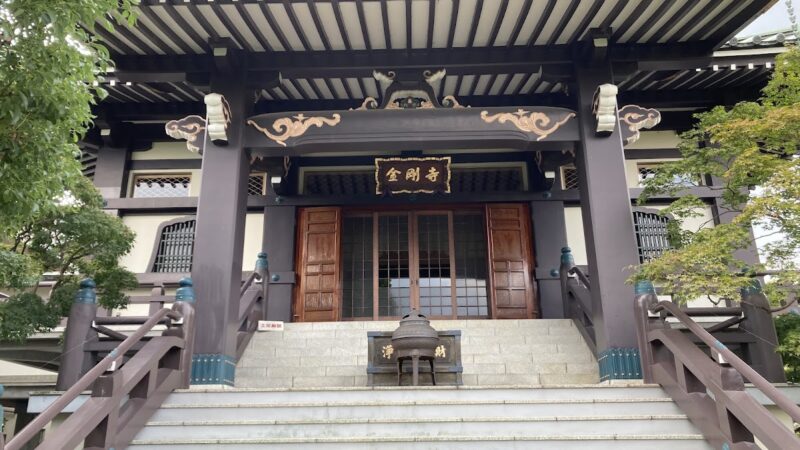
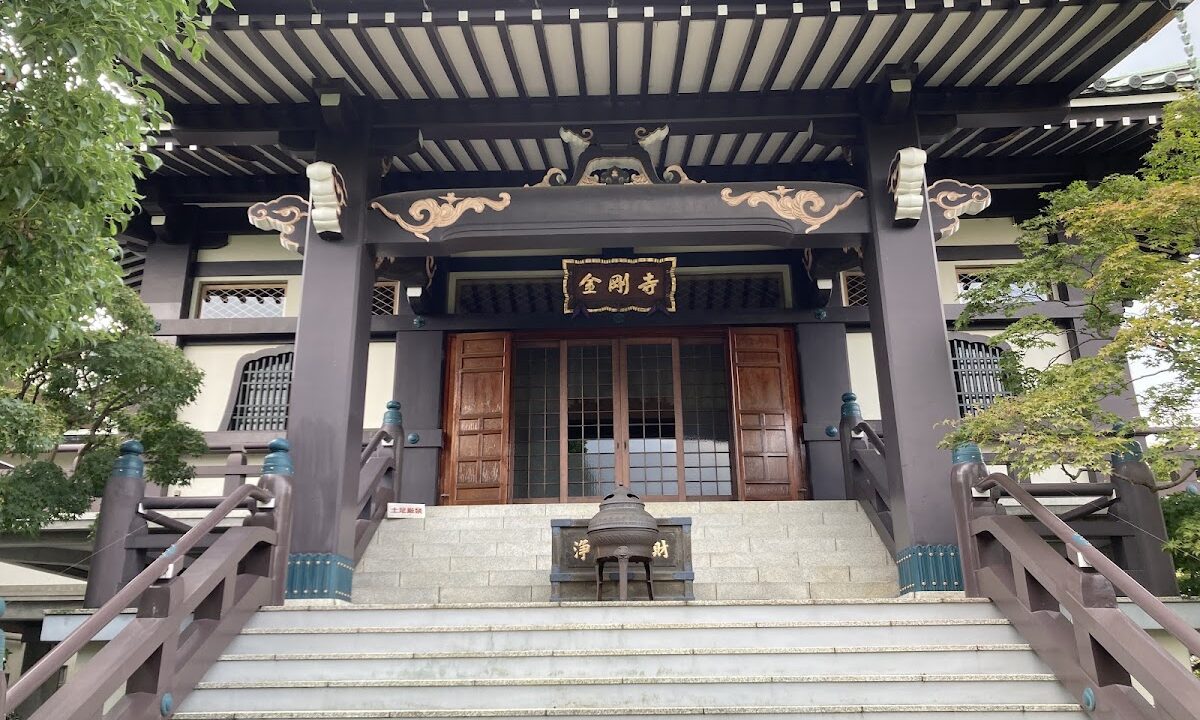
Currently, the Takinogawa Castle site is the grounds of Kongoji Temple, a Shingon Buddhist temple. Kongoji Temple was founded during the Edo period and built on the castle site, so most of the castle’s remains have been lost.
There is an information board about Takinogawa Castle on the temple grounds, explaining the castle’s history and the legend of Minamoto no Yoritomo’s encampment. However, it is not possible to confirm any specific remains such as earthworks or moats.
Observing the topography around the temple, a slight difference in elevation on the plateau can be observed, allowing us to imagine the location of the former castle. The Shakujii River, although now improved with riverbank construction, was once a rapid current, which is the origin of the place name.
Status of Archaeological Excavations
No full-scale archaeological excavations have been conducted at the Takinogawa Castle site. The fact that it is a religious facility within the grounds of Kongoji Temple, and that the topography has been significantly altered due to urbanization, are thought to be reasons why the investigation has not progressed.
If an excavation is conducted at some point in the future, it may be possible to shed more light on the actual state of Takinogawa Castle, including its specific structure, age, and excavated artifacts.
Relationship with Other Castles Related to the Toshima Clan
To understand Takinogawa Castle, it is important to know its relationship with other castles built by the Toshima clan.
Shakujii Castle (Nerima Ward)
This was the base of the Toshima clan, a flatland castle built on a plateau along the Shakujii River. The site is now Shakujii Park, with some remnants of the earthworks and dry moats remaining. It fell to Ota Dokan in 1477 (Bunmei 9). It is located approximately 8 km west of Takinogawa Castle.
Hiratsuka Castle (Kita Ward)
Another major stronghold of the Toshima clan, located near present-day Kaminakazato in Kita Ward. It was captured by Ota Dokan around the same time as Shakujii Castle. Located approximately 2 km northeast of Takinogawa Castle, it is believed that the two castles were closely connected.
Inazuke Castle (Kita Ward)
A castle located in Akabane, Kita Ward, considered one of the Toshima clan’s branch castles. The area around Seishoji Temple is presumed to be the castle site, but no remains exist. It is located approximately 3 km north of Takinogawa Castle.
Shimura Castle (Itabashi Ward)
A castle located in Shimura, Itabashi Ward, believed to be a castle related to the Toshima clan, but details are unknown. The area around Kumano Shrine is said to be the castle site. It is approximately 4 km west of Takinogawa Castle.
Asukayama Castle (Kita Ward)
Asukayama, located approximately 1 km northeast of Takinogawa Castle, is also believed to have been used as a castle during the medieval period. Currently, it is a famous cherry blossom viewing spot as Asukayama Park, and was known as a recreational area developed by Tokugawa Yoshimune during the Edo period.
These castle ruins are part of a network of castles built by the Toshima clan in northern Musashi Province, and Takinogawa Castle was an important component of this network. Following an attack by Ota Dokan in Bunmei 9 (1477), these castles fell one after another, and the Toshima clan’s sphere of influence disappeared.
Origin of the Place Name Takinogawa
This section explains the origin of the place name “Takinogawa,” which is the origin of the name of Takinogawa Castle.
The place name Takinogawa originates from another name for the Shakujii River that flows through this area. The Shakujii River’s riverbed deepens near Kaga in Itabashi Ward, forming a valley-like terrain. The river’s rapid current, flowing like a waterfall, is said to have given it the name “Takinogawa” (Waterfall River).
While the current Shakujii River has been improved through embankment construction and no longer resembles its former rapids, the name remains as a trace of its past. The name Takinogawa is still used today as a town name in Kita Ward, Tokyo, encompassing Takinogawa 1-chome through Takinogawa 7-chome.
During the Edo period, this area was known as Takinogawa Village and was famous for its radish production. Vegetables such as “Takinogawa radish” and “Takinogawa burdock” were highly valued in the Edo market.
Access and Visiting Information for Takinogawa Castle
Access Methods
Access by Train:
- Approximately 15 minutes on foot from the North Exit of Oji Station on the JR Keihin-Tohoku Line
- Approximately 12 minutes on foot from Nishi-Sugamo Station on the Toei Mita Line
- Approximately 13 minutes on foot from Itabashi Station on the JR Saikyo Line
- Approximately 8 minutes on foot from Takinogawa-Itchome Station on the Toden Arakawa Line
Access by Bus:
- Approximately 3 minutes on foot from the Takinogawa-Sanchome bus stop (Kokusai Kogyo Bus)
Access by Car:
- Approximately 10 minutes from the Itabashi-Honcho Exit of the Metropolitan Expressway Central Circular Route
- There is no dedicated parking lot; please use nearby coin-operated parking lots.
Visiting Information
Takinogawa Castle ruins are located within the grounds of Kongoji Temple, so visits are possible during the temple’s visiting hours.
Location: 3-88 Takinogawa, Kita-ku, Tokyo
Visiting Hours: Daytime (according to temple opening hours)
Admission Fee: Free
Duration: Approximately 15-20 minutes
Highlights: Castle ruins information board, explanatory board about the legend of Minamoto no Yoritomo’s encampment
Since no castle remains exist, the highlights as a castle ruin are limited. However, for those interested in history or castle tours, it is a valuable place to learn about the history of the Toshima clan.
Nearby Attractions
When visiting Takinogawa Castle Ruins, we recommend also visiting nearby historical spots.
Asukayama Park: Approximately 15 minutes on foot. A famous cherry blossom viewing spot developed by Tokugawa Yoshimune, it houses cultural facilities such as the Kita Ward Asukayama Museum, the Paper Museum, and the Shibusawa Memorial Museum.
Oji Shrine: Approximately 20 minutes on foot. Nearby is the Oji Inari Shrine, a shrine that has long attracted worshippers and is known for its “Fox Procession” held every New Year’s Eve.
Former Furukawa Garden: Approximately 20 minutes on foot. A beautiful garden where a Western-style building built during the Taisho era harmonizes with a Japanese garden.
Hiratsuka Shrine: Approximately 25 minutes on foot. A shrine built on the site of Hiratsuka Castle, and a place associated with the Toshima clan.
Historical Significance of Takinogawa Castle
Takinogawa Castle is a small castle site with no remaining structures, but it holds significant historical importance.
Value in Toshima Clan Research
Takinogawa Castle is important for understanding the network of branch castles of the Toshima clan, a powerful local family in Musashi Province during the medieval period. It provides clues to how the Toshima clan formed their sphere of influence and deployed family members in various locations.
Historical Site for Understanding Ota Dokan’s Strategy
Ota Dokan’s conquest of the Toshima clan in 1477 (Bunmei 9) was an important military action in the Kanto region during the early Sengoku period. The capture of the Toshima clan’s castles, including Takinogawa Castle, is a valuable example for understanding Ota Dokan’s military strategy.
A Place that Tells the Story of Tokyo’s Medieval History
While many medieval castle ruins exist within Tokyo’s current 23 wards, most have been lost due to urbanization. Takinogawa Castle ruins are one of the valuable historical sites that demonstrate the existence of Sengoku period castles in Tokyo.
Summary
Takinogawa Castle was a castle belonging to the Toshima clan, located in Takinogawa, Kita Ward, Tokyo. It was destroyed in a battle against Ota Dokan in 1477. Currently, the site is part of the Kongoji Temple grounds, and no castle remains exist, but its history can be learned through information boards.
Although the castle was small in scale and its period of existence was short, it is an important historical site for understanding the formation of the Toshima clan’s sphere of influence and Ota Dokan’s military actions. The surrounding area is dotted with historical sites related to the Toshima clan, such as Hiratsuka Castle, Shakujii Castle, and Asukayama Park. Visiting these sites together will give you a deeper understanding of the history of Musashi Province in the Middle Ages.
When you visit Kita Ward in Tokyo, why not stop by this legendary castle site and reflect on the history of the Sengoku period that once unfolded here? It’s also recommended as part of a walking course that includes the Toden Arakawa Line and Asukayama Park.