Kasai Castle, Katsushika Ward, Tokyo: Complete Guide | History, Remains, and Access Explained
Kasai Castle, located in Aoto, Katsushika Ward, Tokyo, was a historical castle that served as an important base during the Sengoku period in the Kanto region, where the Uesugi and Hojo clans fiercely fought. Although now divided by the Loop Route 7, the site has been developed into Kasai Castle Ruins Park and Gotenyama Park, and is designated as a Tokyo Metropolitan Historic Site. This article provides a thorough explanation of Kasai Castle’s detailed history, existing remains, and access methods.
What is Kasai Castle? | Basic Information and Overview
Basic Data of Kasai Castle
Kasai Castle was a medieval Japanese castle located in Aoto, Katsushika Ward, Tokyo, and is classified as a hilltop castle. It was designated as a Tokyo Metropolitan Historic Site on March 13, 1998 (Heisei 10) as “Kasai Castle Ruins.”
Basic Information
- Location: Aoto 7-chome and 8-chome, Katsushika-ku, Tokyo
- Former Province: Musashi Province
- Classification/Structure: Hilltop Castle
- Common Name/Alternate Name: Aoto Palace
- Construction Period: Estimated mid-15th century
- Designated Cultural Property: Tokyo Metropolitan Government Designated Historic Site (Designated March 13, 1998)
Location and Topographical Characteristics of Kasai Castle
Kasai Castle is a hilltop castle that utilized the meandering section of the Nakagawa River as a natural moat. Located almost in the center of Katsushika Ward, in the Aoto area, its structure makes maximum use of the topographical characteristics of Katsushika Ward, which is surrounded by rivers. Although the difference in elevation is small, it was built on slightly elevated ground and possessed defensive functions as a medieval castle.
Currently, the central part of the castle ruins is near the “Aoto Overpass,” where the Loop 7 (Kan-nana) and Nikko Kaido intersect. While development has divided the castle grounds, archaeological excavations have revealed that it was once a considerably large castle.
History of Kasai Castle | From Construction to Abandonment
The Kasai Clan and the Establishment of Kasai Castle
While there are no clear records of the construction of Kasai Castle, it is believed to have been built in the mid-15th century. The Kasai clan, who ruled this region, were a powerful family descended from the Kanmu Taira clan, and in the medieval period, they built their power centered around Aoto (Aoto).
The Kasai clan was originally a powerful family based in Kasai Mikuriya in Shimosa Province, and it is believed that their residence later developed into Kasai Castle. The Kasai clan, medieval military commanders, established their residence near Aoto and governed the surrounding area.
Sengoku Period | The Struggle Between the Uesugi and Hojo Clans
Kasai Castle first appears on the historical stage during the Sengoku period (Warring States period). Between the Later Hojo clan, who were expanding their power in the Kanto region, and the Uesugi clan, the Kanto Kanrei (governor of the Kanto region), Kasai Castle became a crucial strategic base and the subject of fierce battles.
The Battles of the Tenbun Era (1532-1555)
Particularly during the Tenbun era, Kasai Castle functioned as the front line between the two forces. As Hojo Ujiyasu and Uesugi Norimasa and Uesugi Tomosada confronted each other, the ownership of Kasai Castle changed hands numerous times. During this period, Kasai Castle was an extremely important strategic point for both sides, connecting Edo Castle and Kōnodai (Ichikawa).
Connection to the Battle of Kōnodai
In the two Battles of Kōnodai, held in 1538 (Tenbun 7) and 1564 (Eiroku 7), Kasai Castle is believed to have functioned as an important rear base for the Hojo forces. In particular, during the Second Battle of Kōnodai, when Hōjō Ujiyasu and his son Ujimasa defeated Satomi Yoshitaka and his son Yoshihiro, the area around Kasai Castle is believed to have been strategically utilized.
Hōjō Rule and Castle Lords
In the late Sengoku period, Kasai Castle came under the control of the Hōjō clan. A Hōjō vassal was appointed as the castle lord, and it functioned as a defensive base stretching from the northern shore of Edo Bay to Shimōsa Province. During this period, Kasai Castle is sometimes called Nakasone Castle and played a key role in the Hōjō clan’s control of the Kanto region.
While there are various theories regarding the specific castle lords, it is believed that hereditary vassals of the Hōjō clan defended the castle for generations. The castle’s size was also expanded, and it was developed into a full-fledged medieval castle with multiple baileys.
Toyotomi Hideyoshi’s Siege of Odawara and the End of Kasai Castle
In 1590 (Tensho 18), Toyotomi Hideyoshi’s Siege of Odawara led to the downfall of the Hojo clan, and Kasai Castle ceased to function as a fortress during the Sengoku period. When Tokugawa Ieyasu entered the Kanto region, Kasai Castle lost its function as a military base and is believed to have been abandoned.
Edo Period | Tokugawa Ieyasu’s Falconry Palace, “Aoto Palace”
After its abandonment, the site of Kasai Castle was used as a resting and lodging place for Tokugawa Ieyasu during his falconry expeditions during the Edo period. This facility is known as “Aoto Palace.”
Tokugawa Ieyasu enjoyed falconry and conducted it in various locations around Edo. The Kasai Castle site was developed as one of his bases, and a palace was built there. Because Aoto Palace functioned not as a military facility but as a resting place for the shogun, the name Aoto Palace came to be used as an “alternative name” for Kasai Castle. Records show that even after Ieyasu’s death, successive shoguns occasionally hunted with falcons in this area. However, its use decreased from the mid-Edo period onward, and eventually the palace was demolished.
Structure and Layout of Kasai Castle
Scale and Arrangement of the Castle
Kasai Castle was a medieval castle with multiple enclosures (kuruwa). Based on archaeological excavations and research on old maps, the following structure is estimated:
Main Enclosure Layout
- Main Enclosure: The area around the current Gotenyama Park is presumed to be the main enclosure (prime enclosure).
- Second Enclosure: It is thought to have been located north of the main enclosure.
- Third Enclosure: It extended further outwards.
- Outer Enclosure: An outer enclosure is believed to have surrounded the entire castle area.
The exact total area of the castle is unknown, but it is estimated to have been far larger than the combined area of the current Kasai Castle Ruins Park and Gotenyama Park, measuring approximately 500 meters east-west and 400 meters north-south.
Defensive Structures and Moats
Kasai Castle’s defenses skillfully utilized the natural terrain.
Use of Water Moats
The meandering section of the Nakagawa River was used as an outer moat, and artificial moats were also dug inside. Excavations have confirmed moat remains more than 10 meters wide.
Earthworks
Earthworks were built around the enclosures, and some are thought to have reached a height of more than 3 meters. However, most of it has been lost due to development.
Tiger’s Mouth (Entrance)
Multiple gates (koguchi), which were entrances to the castle, were established to strengthen its defenses. The main entrance (Ote-guchi) in particular is said to have had a very robust defensive structure.
Current Kasai Castle Ruins | Remains and Highlights
Kasai Castle Ruins Park
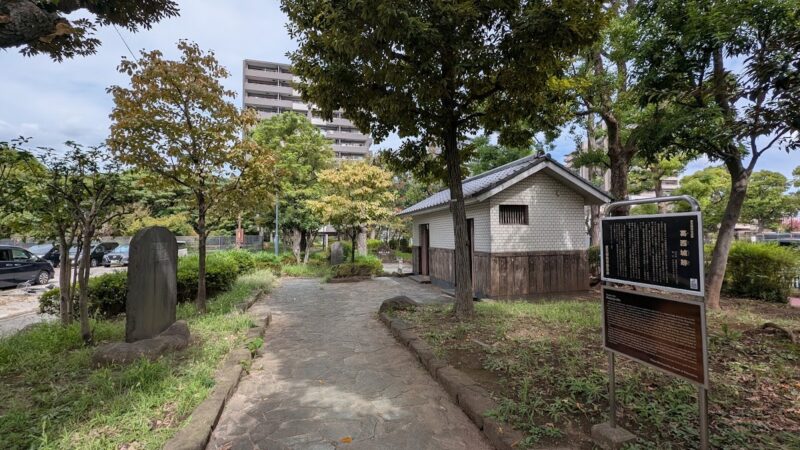
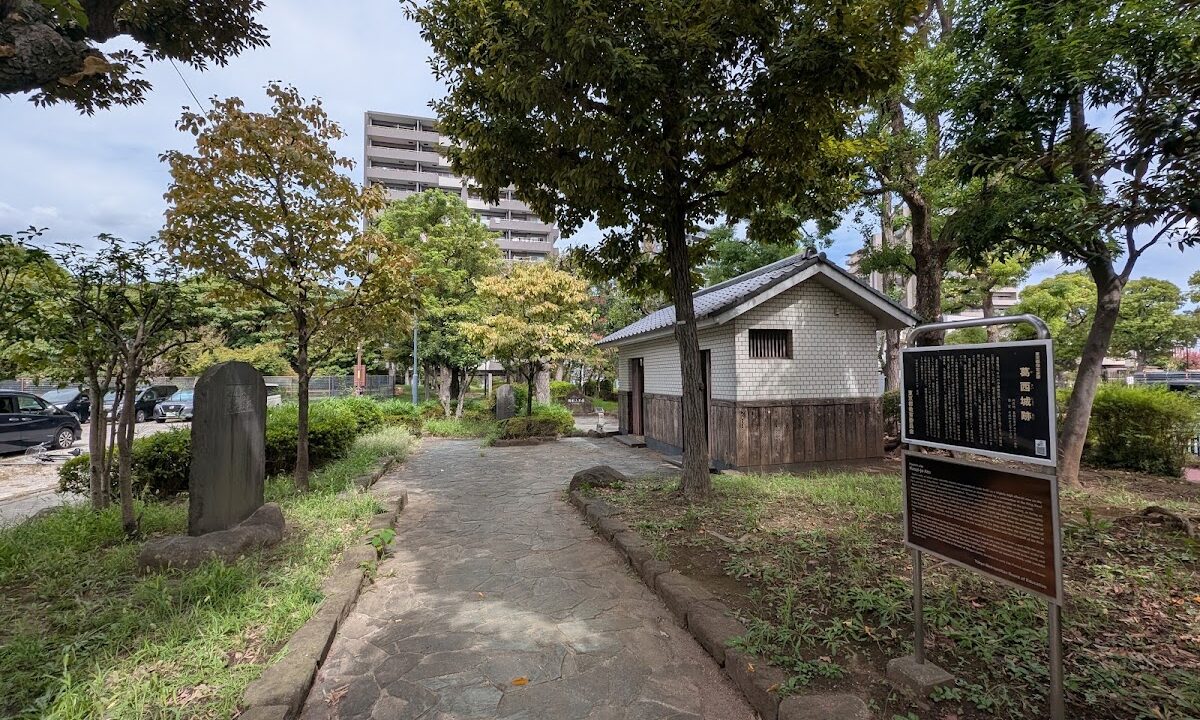
Kasai Castle Ruins Park is a park developed on part of the castle ruins located north of Loop Route 7. Its address is 7-33 Aoto, Katsushika-ku, Tokyo, and it is used as a place of relaxation for local residents.
Park Features
- Area: Approximately 4,000 square meters
- Playground equipment and open spaces are provided
- An explanatory sign indicating that it is a castle ruin is installed
- Cherry trees are planted, making it a popular spot for cherry blossom viewing in spring
While no clear remains exist within the park, the slight undulations of the terrain allow for the imagination of the former layout of the castle’s enclosures.
Gotenyama Park
Gotenyama Park is located south of Loop Route 7 and is believed to be the site of the main enclosure of Kasai Castle. Its address is 8-18 Aoto, Katsushika-ku, Tokyo, and its name originates from the Edo period “Aoto Goten” (Aoto Palace).
Park Features
- Located on higher ground than Kasai Castle Ruins Park
- An important site believed to be the main enclosure
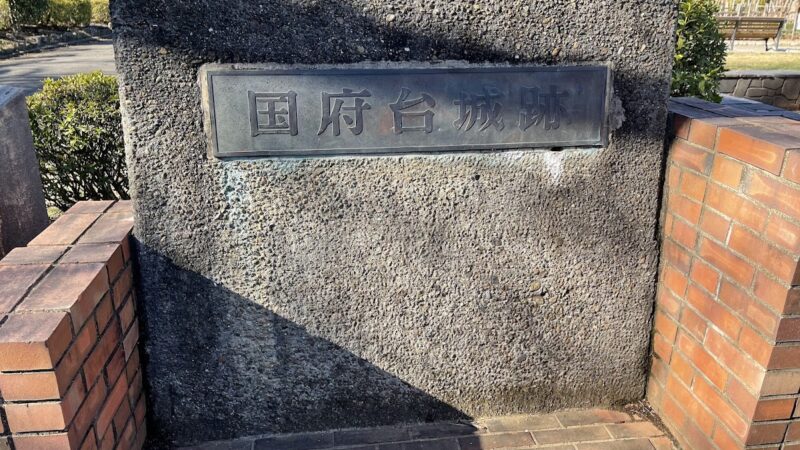
- A monument designating it as a Tokyo Metropolitan Government Historic Site is installed
- The slightly higher terrain compared to the surrounding area indicates characteristics of a flatland castle
The name Gotenyama Park itself tells the history of Tokugawa Ieyasu’s falconry palace being located there.
Monuments and Information Boards
Several monuments and information boards are installed at the Kasai Castle ruins.
Tokyo Metropolitan Government Historic Site Monument
A monument inscribed “Tokyo Metropolitan Government Historic Site: Kasai Castle Ruins” is erected within Gotenyama Park, indicating to visitors that it is a castle site.
Contents of the Information Board
Both parks have information boards explaining the history and structure of Kasai Castle, containing the following information:
- Overview of Kasai Castle’s History
- Structure and Scale of the Castle
- Results of Archaeological Excavations
- About the Aoto Palace during the Edo Period
These information boards are installed and managed by the Katsushika Ward Board of Education.
Identifiable Remains
Unfortunately, there are very few clearly identifiable remains of a medieval castle at the current Kasai Castle site. Major remains such as moats, earthworks, and baileys have been lost due to the construction of the Loop Route 7 and residential development.
Few Remaining Traces
- Slightly elevated terrain around Gotenyama Park: Suggests the former elevation of the main enclosure.
- Surrounding road layout: May partially reflect the road layout from the castle era.
- Place names: Place names such as “Aoto” and “Gotenyama” convey history.
Results of Archaeological Excavations
Past excavations have unearthed moat remains, earthwork remains, building remains, and pottery fragments, archaeologically confirming the existence of a castle from the 15th to 16th centuries. These excavated artifacts are stored and displayed at the Katsushika City Museum of Local History and Astronomy, among other places.
How to Access Kasai Castle
Access by Train
Public transportation is the most convenient way to access the Kasai Castle ruins.
Nearest Station and Travel Time
- From Aoto Station on the Keisei Main Line
- Distance: Approximately 1.2 km
- Walking Time: Approximately 15 minutes
- This is the closest station.
- Aoto Station is a convenient transfer station between the Keisei Main Line and the Keisei Oshiage Line.
- From Kameari Station on the JR Joban Line and Tokyo Metro Chiyoda Line
- Distance: Approximately 2.0 km
- Walking Time: Approximately 25 minutes
- Bus access is also available.
Recommended Route
Access from Aoto Station is the most convenient. Exit the north exit of Aoto Station and head towards Loop Route 7. Walking along Loop Route 7 will allow you to visit both Kasai Castle Ruins Park and Gotenyama Park.
Access by Bus
Keisei Bus
- Take the bus bound for Shin-Koiwa Station from Kameari Station
- Get off at the “Aoto 7-chome” bus stop
- Kasai Castle Ruins Park is approximately a 3-minute walk from the bus stop.
Access by Car
Parking Information
Neither Kasai Castle Ruins Park nor Gotenyama Park has its own dedicated parking lot. You will need to use nearby coin-operated parking lots. There are several paid parking lots along Loop Route 7 and around Aoto Station.
Important Note
Loop Route 7 is a major road with very heavy traffic. Traffic congestion is especially common during weekday commuting hours and on weekends, so we recommend using public transportation.
Attractions and Spots Around Kasai Castle
Katsushika City Museum of Local History and Astronomy
Located approximately 2km from the Kasai Castle Ruins, the Katsushika City Museum of Local History and Astronomy offers a chance to learn about the history and culture of Katsushika City.
Exhibition Contents
- History of Katsushika Ward from ancient times to the present day
- Materials and excavated artifacts related to Kasai Castle
- Exhibits on the Kasai clan, a powerful family in medieval Katsushika
- Planetarium also available
Access
- Approximately 8 minutes on foot from Ohanajaya Station on the Keisei Line
- Opening Hours: 9:00-17:00 (until 21:00 on Fridays and Saturdays)
- Closed: Mondays (or the following day if Monday is a public holiday), 2nd and 4th Tuesdays
Shibamata Taishakuten (Daikyoji Temple)
Located approximately 3km from the Kasai Castle ruins, Shibamata Taishakuten is a representative tourist spot in Katsushika Ward, famous for its appearance in the movie “Tora-san.”
Features
- Nichiren Buddhist temple
- Taishakudo hall with beautiful carvings
- A shopping street with a Showa-era retro atmosphere along the approach
- Approximately 3 minutes on foot from Shibamata Station on the Keisei Kanamachi Line
Mizumoto Park
The largest waterside park in Tokyo’s 23 wards, located approximately 4 km from the Kasai Castle ruins.
Features
- Area: Approximately 96 hectares
- A metropolitan park where you can enjoy the nature of the waterside
- Ideal for birdwatching, strolling, and picnics
- Famous for its irises (best viewing in June)
Historical Sites around Nakagawa River
Along the Nakagawa River, which Kasai Castle used for defense, there are many other medieval historical sites. Walking along the Nakagawa River embankment, you can reflect on the former water transport and castle defenses.
Points to Note When Visiting Kasai Castle
Best Season for Visiting
Spring (Late March – Early April)
Kasai Castle Ruins Park is planted with cherry trees, offering beautiful scenery during cherry blossom season. This is a recommended time to enjoy both historical sightseeing and cherry blossom viewing.
Autumn (October – November)
The weather is mild and ideal for strolling. While there are fewer autumn leaves, it’s a comfortable season for historical exploration.
Estimated Visiting Time
Even if you leisurely visit both Kasai Castle Ruins Park and Gotenyama Park, the required time is about 30 minutes to 1 hour. We recommend carefully reading the information boards and observing the surrounding terrain while strolling.
If you plan a Katsushika Ward historical tour including nearby museums and other historical sites, it can be enjoyed as a half-day to full-day course.
Photo Spots
- Stone monument designated as a Tokyo Metropolitan Historic Site (Gotenyama Park)
- Information board at Kasai Castle Ruins Park
- View of both parks across Loop Route 7
- Kasai Castle Ruins Park during the spring cherry blossom season
Precautions
Protection of Historical Remains
As this is a Tokyo Metropolitan Historic Site, please be careful not to dig the ground or damage the stone monument.
Park Usage Manners
Both parks are also living spaces for local residents. Please avoid making noise or causing disturbances, and observe proper etiquette while visiting.
Crossing Loop Route 7
Kasai Castle Ruins Park and Gotenyama Park are located on opposite sides of Loop Route 7. When crossing, always use pedestrian overpasses or crosswalks and pay close attention to traffic safety.
Historical Significance of Kasai Castle
Importance in Kanto Sengoku Period History
Kasai Castle was an important strategic base during the Sengoku period, when the Uesugi and Hojo clans vied for supremacy in the Kanto region. Located on the line connecting Edo Castle and Kōnodai, Kasai Castle functioned as a base for expansion into Shimōsa Province and as a frontline base for the defense of Edo Castle.
In major battles in the Kanto region, including the Battle of Kōnodai, the area around Kasai Castle played a crucial role, and the affiliation of this region sometimes influenced the course of the battle.
Value as a Medieval Castle in Tokyo
In present-day Tokyo’s 23 wards, very few remains of medieval castles remain. Edo Castle itself was significantly altered by modernization, losing its medieval appearance. In this context, the Kasai Castle ruins are a valuable historical site where the existence of a medieval castle has been confirmed through archaeological excavations.
Its value as a Tokyo Metropolitan Government-designated historical site lies not only in the historical importance of Kasai Castle itself, but also in its significance as one of the few remaining sites that tell the story of Tokyo’s medieval history.
Significance in Local History
Kasai Castle was the center of Katsushika Ward and the surrounding area during the medieval period. As the base of the powerful Kasai clan and a strategic point during the Sengoku period, it is an important element in shaping the identity of this region.
The place names “Aoto” and “Kasai” are deeply connected to this castle and serve as historical symbols for the modern local community.
The Future of Kasai Castle | Preservation and Utilization
Challenges in Historic Site Preservation
While the Kasai Castle ruins are legally protected as a Tokyo Metropolitan Government designated historic site, a large portion has already been developed, and its state of preservation is not necessarily good.
Current Challenges
- Very few clear remains remain
- The majority of the castle area has been developed into residential land and roads
- Low public awareness
- Constraints on development budget
Efforts for Utilization
Katsushika Ward is promoting initiatives to utilize the Kasai Castle ruins as a local historical resource.
Educational Activities
- Use in local history education at elementary and junior high schools in the ward
- Exhibition at the Katsushika City Museum of Local History and Astronomy
- Holding history lectures and walking events
Information Dissemination
- Installation and updating of explanatory signs
- Inclusion in tourist brochures
- Providing information on websites
Future Prospects
While complete restoration is difficult, there are expectations for visualization of the former castle using AR (augmented reality) technology and enhancement of academic value through further archaeological excavations.
Summary | The Significance of Visiting Kasai Castle
Kasai Castle ruins in Aoto, Katsushika Ward, Tokyo, are not a castle site with a flashy keep or stone walls. However, it is a valuable historical site that conveys the turbulent history of the Kanto Sengoku period and is an indispensable place for understanding medieval Tokyo.
The front line where the Uesugi and Hojo clans fought, the Aoto Palace where Tokugawa Ieyasu enjoyed falconry, and now a quiet residential park. While its appearance has changed with the times, history is certainly etched into this land.
When visiting Kasai Castle Ruins Park and Gotenyama Park, even if there are few visible remains, take the time to read the explanatory signs, observe the surrounding terrain, and reflect on the magnificent castle that once stood here and the dramas of the people who lived and worked there. As a hidden historical spot in Tokyo, Kasai Castle is well worth a visit.
Its convenient location, just a 15-minute walk from Aoto Station, is another attractive feature. Why not visit the Kasai Castle ruins as part of a historical walk through Katsushika Ward, or combine it with sightseeing in Shibamata or Mizumoto Park?